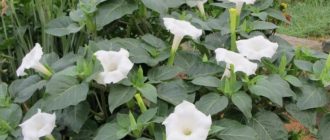
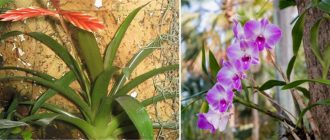
Brunfelsia is a perennial plant in the nightshade family. When grown indoors, it grows up to 50 cm tall. It has a branched root system and thick, leathery leaves.
It blooms from February to May with tubular flowers, the color and size of which depend on the variety. Many species have no odor. The sap and fruit are poisonous.
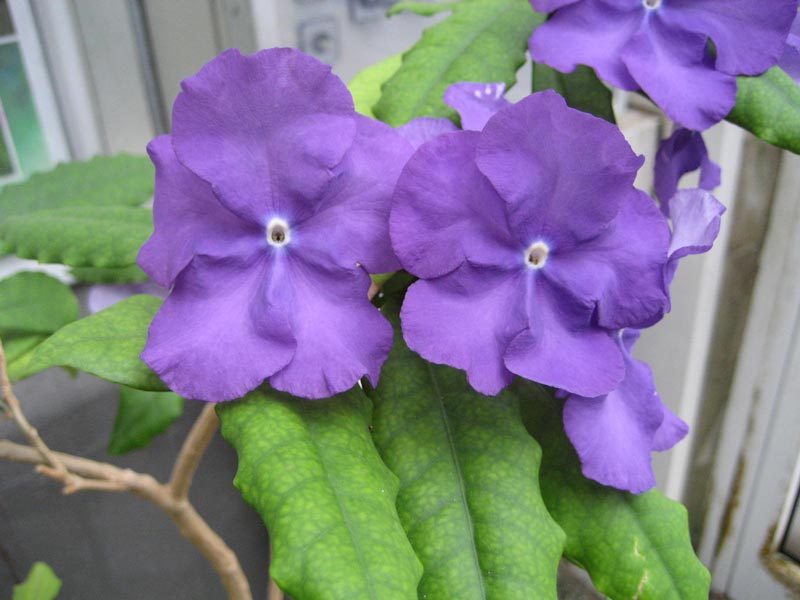
Brunfelsia americana, lactea and other species for indoor growing
| View | Leaf shape and size | Flowers |
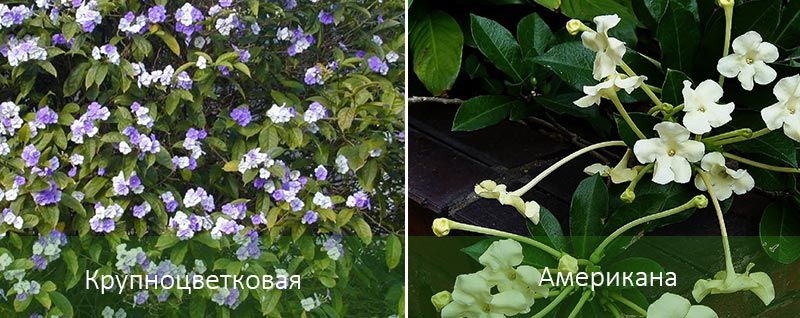
| Americana | Ellipse up to 10 cm in length. | Creamy, aromatic, tube length up to 10 cm. |
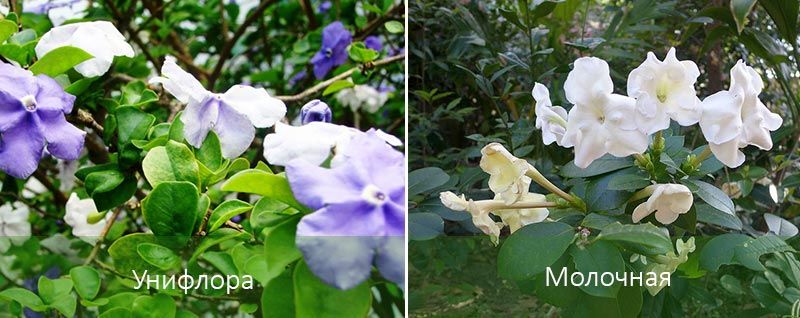
| Few-flowered | Oval, up to 10 cm in length. | White, purple, no aroma. |
| Large-flowered | Oval, pointed. | White, purple, up to 12 cm in diameter. |
| Uniflora | Oval up to 10 cm. | White, purple, up to 2.5 cm in diameter. |
| Lactose (lactea) | Oval, 5 cm long. | White, light yellow, fragrant, 5-7 cm long. |
Caring for Brunfelsia at Home
The flower is sensitive to environmental changes and prefers bright light without direct sunlight. For long-lasting flowering, maintain temperatures from -16 to -18°C from March to September, and lower them to -9 to -14°C in winter, thereby stimulating bud formation.
Brunfelsia requires high humidity and regular watering without stagnant water. In spring and summer, water up to three times a week using room-temperature water; during cool winters, reduce the frequency.
In autumn and winter, fertilize once a month with reduced doses of complex mineral fertilizers; during the growing season, top dressing is applied twice a month.
Transplantation, pruning
During the growing season, annual repotting into a larger container is necessary, with soil and drainage changed. Mature plants are repotted every four years, replacing the top 3 cm of soil.
Ready-made rose soil is suitable for growing roses, but a mixture of leaf mold, turf, peat, and sand, in a ratio of 2:2:1:1, can also be used. Stimulate the growth of young branches and the formation of flower buds by pruning the bush after flowering, removing up to 50% of the branches.
Reproduction
Propagation is by cuttings or stem shoots. In early spring, cut off 10 cm of the top of the shoot with three buds and soak it in root-stimulating solutions.
The cuttings are planted in a common container and covered with plastic wrap or a glass jar. Roots form after a few months, after which the plants are transplanted into pots.
At home, the specifics of caring for cuttings include maintaining a constant temperature of +25°C and regular ventilation.
Diseases, pests
The plant is resistant to diseases and pests, but can be affected by aphids and spider mites. Infestations can be identified by the following signs:
- the appearance of yellow, deformed leaves;
- sticky coating, lumps similar to cotton wool, on the leaves;
- black or green bugs on the stems.
To combat pests, use a soap or alcohol solution, applying the mixture to a cotton pad. The pests are collected by hand, after which they are treated with insecticides.
The most common diseases are chlorosis, which is a consequence of improper soil selection, and various rots that form due to overwatering.