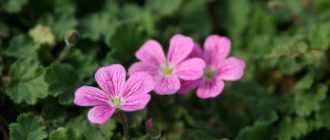
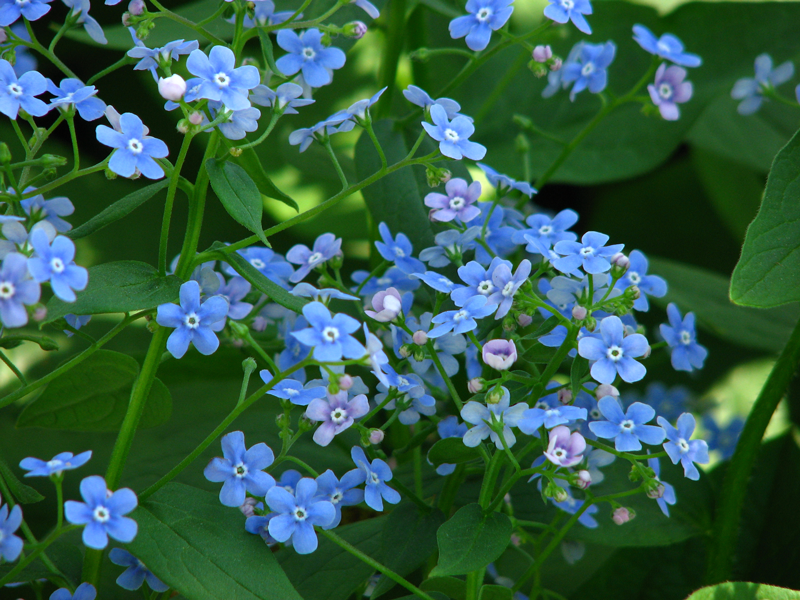
Brunnera is a perennial plant in the Borage family. The herbaceous plant was named by the Swiss botanist S. Brunner. While traveling in Crimea, he was drawn to the flowers, which had a distinctive sky-blue hue. This gives brunneras a resemblance to forget-me-nots.
Content
Description
Brunneras are characterized by a thick rhizome, large, broadly cordate leaf blades, and pubescent, branched stems. Small corollas are gathered into loose paniculate or corymbose inflorescences.
- The pistil and stamens do not protrude.
- The forget-me-not's fruits are small, dry nuts. They appear towards the end of August.
- The height of the perennial plant ranges from 45 to 55 cm. Its distribution area includes Asia Minor and Siberia.
- Brunnera's blooming corollas adorn the garden for a month. The flowering period is April-May. A distinctive feature is the white spot inside the flower.
- The mature plant forms low thickets that do not require complex care.
Additional advantages of Brunners include their winter hardiness and visual attractiveness.
Brunnera macrophylla, Siberian and other species
The site is selected based on the variety's characteristics. Brunnera is undemanding in terms of humidity. This plant is used to enhance shady corners of the garden.
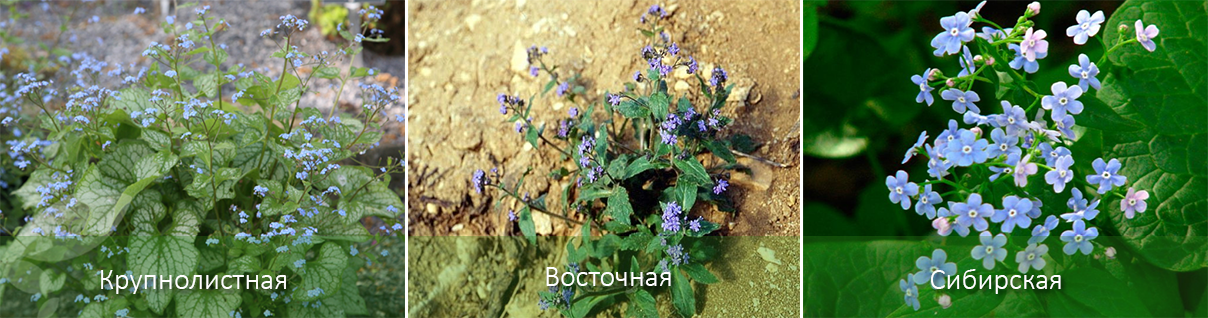
| Variety | Description | Leaves | Flowers |
| Large-leaved (brunnera macrophylla) | The stems are pubescent. The plant grows to 50 cm in height. This plant is native to the Caucasus. | Heart-shaped, rough underside. | Diameter – about 7 mm. Terminal inflorescences. Under proper conditions, they can bloom again. |
| Siberian (brunnera sibírica) | Large size, the height of the thickets is 60 cm. | Located at the root, they are characterized by a dense structure and a wrinkled surface. | The dark blue corollas are 5 mm in diameter. The paniculate inflorescences bloom for several weeks. |
| Eastern (brunnera orientalis) | Low-growing, weather-resistant. | Elliptical, length – 10 cm. | Inconspicuous corollas resembling forget-me-nots. |
Varieties of large-leaved brunnera
This perennial plant grows quickly in shade. The shrubs retain their decorative appearance even after flowering. The silvery leaves are adorned with a vibrant border, green veins, and splashes of lighter shade.
The horizontal rhizome consists of thickened, thread-like appendages. The length of the petioles depends on the size of the leaf blades. The erect stem reaches 60 cm in height.
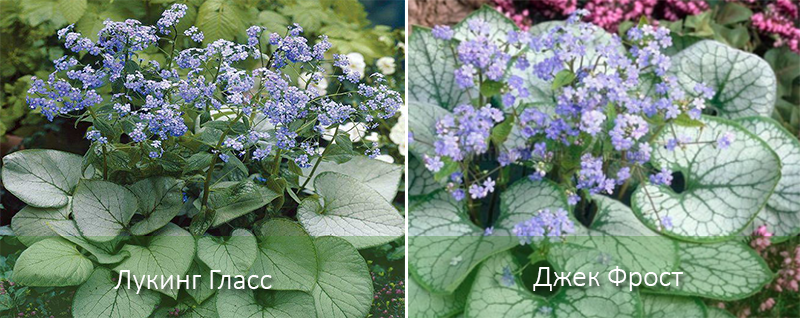
The shoots are pubescent over their entire surface. Flower stalks emerge from axils located near the apical leaf blades.
The general list includes:
| Variety | Leaves |
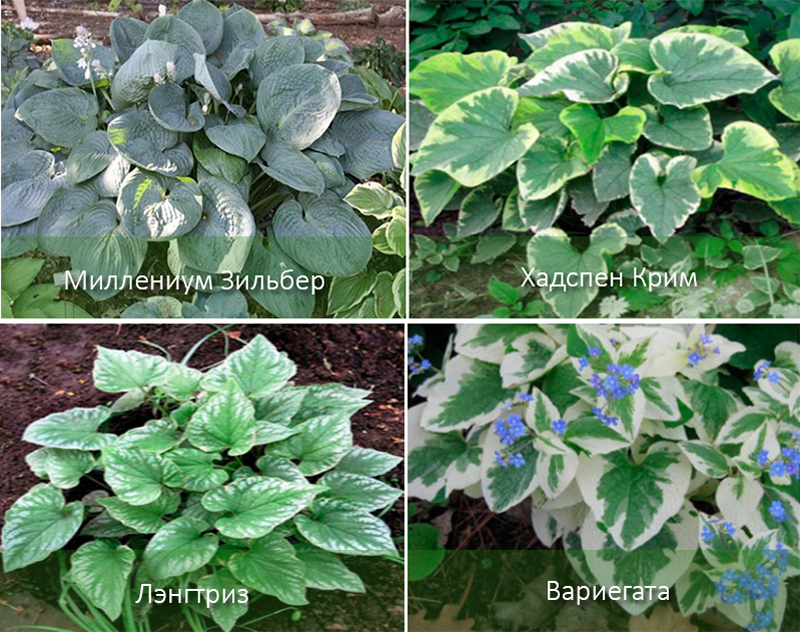
| Millennium Silber | Decorated with silver spots. |
| Jack Frost | White, with a narrow border around the edge. |
| Langtrees | Dark green, speckled. Bluish inflorescences. |
| Silver Wings | Carved, covered with silver web. |
| Looking Glass | Olive-silver, decorated with filiform veins. Pale blue corollas. |
| King's Ransom | Silvery, characterized by a dense structure. Distinguishing features include a wide, milky border and an elegant, intricate pattern. |
| Variegata | The center is bright green, the flowers are pale pink, and there is no fragrance. |
| Hadspen Cream | Wide, heart-shaped, no more than 15 cm long, with a pale pinkish border. |
Landing a Brunner
Wild varieties can be found in forests. This is because Brunnera prefers shady and moist areas. In regions with hot climates, gardeners have a much more difficult time creating suitable growing conditions.
The plant doesn't require much sunlight. Planting outdoors is possible if there's a body of water nearby. Clayey soil is preferable. This procedure should be carried out in the evening.
Brunnera is usually planted simultaneously with dividing the root system. The bush is first dug up, the above-ground portion is removed, and the cleaned rhizome is placed in a container filled with water.
Each prepared hole should contain a mature bud in addition to the separated plant part. After the brunnera is planted, it needs to be watered.
Planting dates
Planting time depends on the variety. Siberian brunnera is planted in the second half of summer. Large-leaved varieties can be replanted in the spring. If done correctly, the brunnera will open its corollas in mid-spring.
Landing rules
To ensure that the effort spent on seed material is worth it, several important nuances need to be taken into account.
Among them are:
- Amount of sunlight – for this plant, an area that is exposed to ultraviolet rays only in the morning hours will be sufficient.
- Siberian brunnera prefers heavy clay soil, while large-leaved brunnera prefers loose soil.
- Fertilizing with organic and mineral fertilizers before planting is essential if the soil is not very fertile.
- To prevent the bushes from growing together, the area must be weeded before propagating and replanting Brunnera.
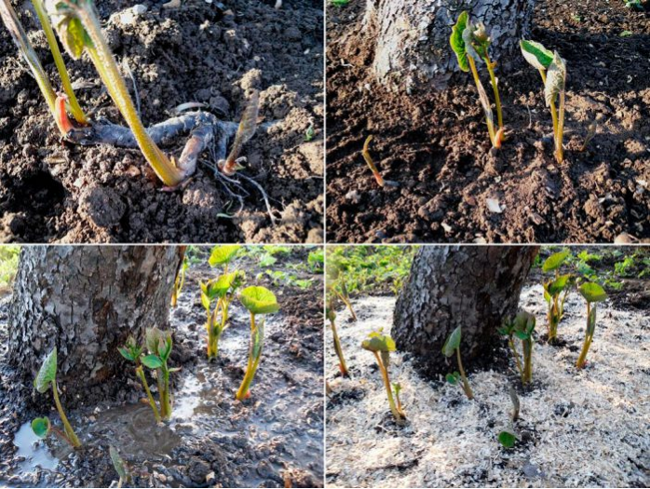
- The root system is located in the upper soil layers, so loosening the soil should be avoided. Otherwise, damage to the shoots responsible for nutrition cannot be avoided. To prevent the soil from drying out, mulch the plantings.
Gardening
Gardeners differentiate between the different species. The large-leaved brunnera retains its decorative appearance even after flowering. The Siberian variety requires more complex care.
Natural precipitation is usually sufficient for this species of forget-me-not.
If pruning is done on time, new foliage will appear this season. This basic set of measures is supplemented by timely watering, fertilizing, and weeding. The health of the perennial in the current season depends on the measures taken in the previous period.
Preparing for winter
Brunneras are highly winter-hardy, so there's no urgent need for additional shelter. Preparatory measures include pruning and mulching. For the latter, you'll need a mixture of organic compounds.
Forcing brunners
The brunnera rhizome is transferred to a container filled with a nutrient mixture. By leaving the future bushes outdoors, they are hardened off. After the onset of cold weather, the plant should be moved to a cooler room.
To ensure the plant blooms on time, the gardener must create certain conditions. To do this, place it in a warm, bright room.
The flowers appearing by the end of the first winter month indicate that the brunneras are developing normally. If the temperature experiments are successful, the flowers will appear by the New Year holidays.
Reproduction
To grow a new forget-me-not, you can use two methods. The first requires seed, the second requires rhizomes. The latter is divided according to a specific algorithm.
The result is several fragments, each at least 6 cm long. The presence of a bud is a prerequisite. With this method, inflorescences appear the following spring.
It's recommended to purchase Brunnera seeds from a specialist store. The number of seedlings depends on the quality of the seed. This method is less preferable.
Its disadvantages include the waste of time and money and the lack of maternal properties. Propagation is carried out after the brunneras have finished flowering. In the spring, they are planted only after stratification.
Pests and diseases
Plants often suffer from powdery mildew and brown spot. To eliminate the danger, remove affected foliage. Brunnera rhizomes can attract mice. Fungicides such as Fitosporin-M, Bordeaux mixture, Topaz, and Fundazol can be used against fungal diseases.
To combat pests, use Actellic, Karbofos, Aktara, and tar water. To prepare the latter, you'll need 5 drops of the main ingredient and 10 liters of the solution. Water the flowers using a watering can. If there are too many pests, use insecticides.
Top.tomathouse.com recommends: Brunnera in the landscape
Forget-me-nots are flowers that have earned the appreciation of both summer residents and city dwellers. Brunneras are used to create a meadow of blue, bluish, and white corollas. The key is to time the blooming period.
Plants grow quickly. Placing them in the background enhances the impact of ferns, junipers, wild garlic, and epimedium. A perennial arrangement is created based on the intended landscape design, agricultural characteristics, and size. A diagram is always required.
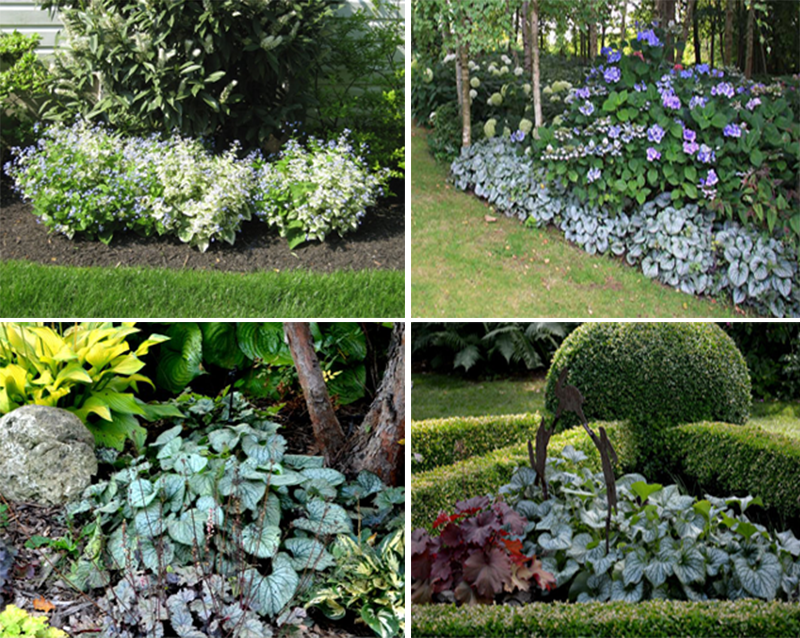
These flowers are among the first to awaken after the cold weather. Due to their shade-loving nature, they are planted in rockeries, mixed borders, and alpine gardens. Brunneras can be found in Chinese- and Japanese-style gardens. The bushes are used to decorate riverbanks.
The large-leaved variety is used more often in landscape design than the Siberian variety. This is due to its decorative appearance and low maintenance. These thickets are suitable for shady areas of the garden.
Suitable neighbors include Colchis epimedium, hellebore, primrose, multicolored spurge, bear's onion, hyacinths, muscari, tulips, and daffodils.
The list can be supplemented with garden plants such as lungwort, hosta, rogers, astilbe, irises, ornamental onions, and globeflowers. Their delicate blooms, coupled with their carved, multicolored leaves, can decorate any flowerbed or path.