Bougainvillea is a genus of tropical evergreen shrubs belonging to the Nyctaginaceae family. Native to Brazil, it is named after the French explorer L. A. de Bougainville, who led the first French circumnavigation expedition. These plants grow as shrubs, trees, or vines, distinguished by their elongated, flexible, and spiky branches.
Bougainvillea has earned the acclaim of gardeners for its luxurious, long-lasting blooms, which continue year-round in the tropics. In our region, it can brighten up any space, although growing it is considered quite challenging.
Content
General information
The bougainvillea genus comprises evergreen creeping shrubs or small trees, reaching up to five meters in height in the wild. Indoors, these shrubs can also grow up to three meters tall, but their growth can be controlled with pruning.
The plants reproduce easily and grow rapidly. Their flexible, vine-like shoots are equipped with spines, allowing them to grasp any support and use them to pull themselves upward. Breeders have attempted to remove the spines from the plants, but so far without success.
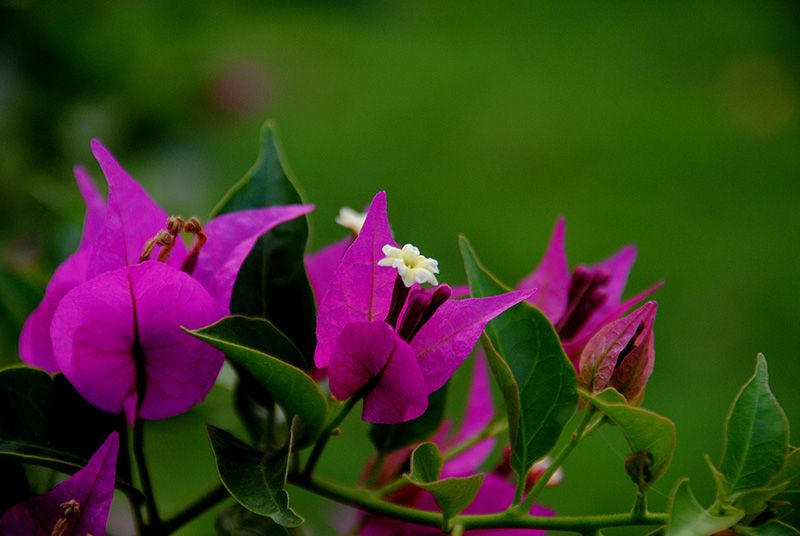
The small foliage, with uniform, smooth or pubescent edges (depending on the plant species) and pointed tips, can be quite varied: green above and light green below, with specimens of mixed colors also found. The shrub's main beauty lies in its tiny, inconspicuous, light-colored flowers, which quickly fade and fall off, but are surrounded by spectacular, colorful bracts, naturally lilac-hued.
Breeders have succeeded in producing flowers of all possible colors. Among them are:
- purple;
- purple-crimson;
- beige-cream;
- orange;
- pinkish;
- snow-white.
Bougainvilleas can combine shades of two colors. The shape of the long-lasting inflorescences is surprisingly whimsical. They come in:
- triangular;
- heart-shaped;
- rounded;
- oblong.
They range from 3 to 5 cm in length. The bracts feel like ultra-fine embossed paper. In tropical regions, bougainvillea blooms year-round.
Popular types
Of the 14 species of tropical creeping plants found in the wild, several are commonly cultivated. The most commonly grown houseplant is the naked and striking bougainvillea. Hybrid forms, characterized by masses of double lilac bracts that cover the entire foliage, are especially popular.
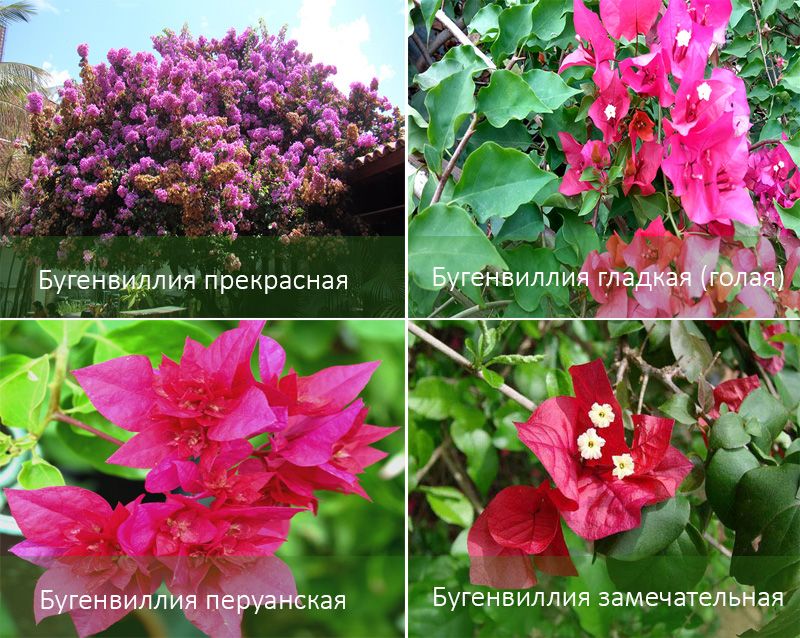
Bougainvillea is beautiful
It is a climbing vine with pubescent shoots bearing foliage with short petioles and pointed tips. The flowers, either solitary or gathered in elongated racemes (3 to 5), are edged with purple terminal leaves. At home, the vine is grown as a hanging plant.
Bougainvillea smooth (naked)
Bougainvillea glabra has a smooth, spreading, branched stem. As a houseplant, it is grown as an upright shrub, blooming profusely and continuously, and can be pruned to any desired shape. It is the basis for the creation of most hybrids. The shrub has elongated, glossy, dark green leaves with pointed tips. It is characterized by impressive inflorescences in a variety of light shades:
- snow-white;
- pinkish;
- lemon yellow;
- peach;
- salmon.
This type of flower is often used to develop dwarf varieties, and bonsai are successfully grown on their basis.
Peruvian bougainvillea
Bougainvillea peruviana, discovered by A. von Humboldt, is distinguished by its green bark and shortened needles. This variety is not branched, but it can re-bloom, especially with careful care, including timely pruning.
The bougainvillea is wonderful.
Growing on rocky slopes in Brazil, it gained popularity in the 19th century. In tropical countries, this vine, reaching 15 meters in length, was used to decorate pavilions and greenhouses. This variety is distinguished by large bracts and sturdy, heart-shaped foliage with a velvety underside that gradually fades. From April to October, it produces stunning flowers, grouped in racemes up to 5 cm in size. Each flower is surrounded by three light pink, lilac, or reddish bracts, which become lighter with age.
Hybrid varieties
Breeders are systematically developing new hybrid varieties, featuring a variety of miniature forms and vibrant colors. The most popular hybrid is a cross between two species: Bougainvillea pulcherrima and Bougainvillea peruviana. It features fairly large, elongated foliage and thorns on the shoots. The bracts of the cream-colored flowers are a rich copper-red, turning deep pink or purple with age.
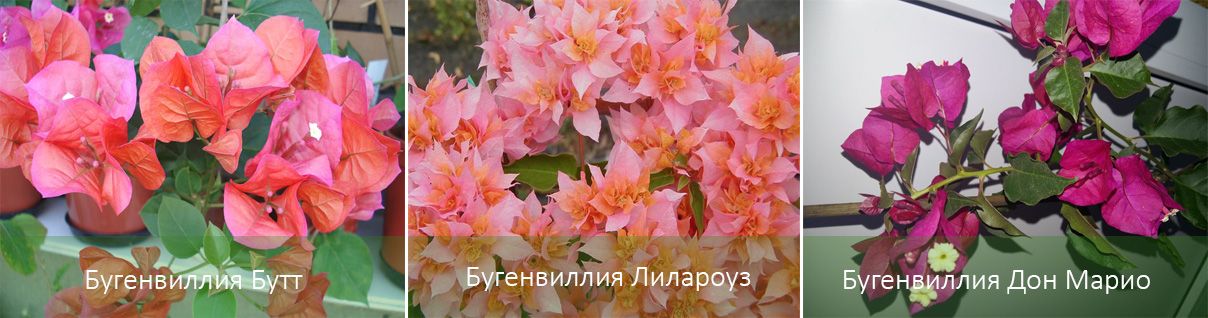
Also common is a hybrid of the naked and Peruvian varieties – Bougainvillea Butt, which is distinguished by its elongated dark green foliage and tiny snow-white corollas of petals, surrounded by three very thin light-scarlet bracts.
Other varieties
The terry varieties include the Lilarose bougainvillea, which is distinguished by its unpretentiousness, high decorative value and bright, long-lasting flowering.
The Don Mario variety is interesting with its red-burgundy apical leaf blades, delighting the owner with its picturesque appearance from early spring to late autumn.
Basic requirements for growing
Despite the plant's beauty, it's rarely grown indoors due to concerns about its difficulty in propagation. In reality, the process isn't all that difficult and is entirely possible if proper cultivation guidelines are followed.
The vine is considered a light-loving plant, tolerating direct sunlight well and requiring little to no shade, except in rare cases. A south- or southwest-facing windowsill is ideal, with supplemental lighting required. Insufficient light on a north-facing window or in a darkened room can cause bougainvillea to die.
The plant doesn't tolerate drafts; even simple ventilation can be harmful. It reacts negatively to movement; a permanent location should be chosen immediately.
During the winter, like other exotic flowers, bougainvillea goes into hibernation. During this period, it should be watered only once a month, avoiding the roots from drying out completely. It should be kept in a slightly darkened room at a temperature of 8°C to 15°C, but care should be taken to prevent the root system from becoming too cold.
In addition, for successful cultivation of bougainvillea and its long-term lush flowering, it is recommended:
- ensure proper lighting conditions;
- choose the right flowerpot;
- organize the necessary conditions for the dormant stage;
- carry out systematic feeding;
- replant the flower on time;
- monitor the possible occurrence of pests and carry out preventive measures.
Caring for bougainvillea at home
In summer, it's best to place the flowerpot on the balcony, protecting it from drafts. The optimal temperature is between 22°C and 30°C. However, a significant drop in temperature during the dormant stage (down to 7°C) can cause the development of pathogens and subsequent death.
The plant responds favorably to watering with soft, settled water: this moisture-loving flower requires regular, generous misting and spraying of the foliage on both sides, but this must be done very carefully to avoid drips on the petals. Stagnant moisture is also unacceptable for the plant, as it causes root rot. Therefore, after watering, remove excess water from the tray.
For spectacular blooms, bougainvillea should be fed with a complete fertilizer at least twice a week. Furthermore, the vigorously growing plant requires regular repotting. Under normal conditions, the size of the buds is determined by the pot size: cramped root space causes reduced growth and reduced blooms.
The optimal time for repotting is considered to be early spring, when the plant awakens from its winter dormancy. Preserving the roots is an important requirement for repotting, requiring great care during the process.
After flowering, the shrub requires pruning to encourage further bud formation, cutting back young shoots by half. In the fall, serious pruning is performed, and light crown shaping can be done throughout the summer.
Reproduction
Bougainvillea is propagated by cuttings in the spring and summer. The cut apical woody shoots are placed in warm water for several hours, then treated with a root growth stimulant and rooted in a substrate (at least 25°C) consisting of turf, soil, sand, and peat.
New, unique varieties of bougainvillea are created through grafting. This is done by making a superficial incision on the side of the rootstock, into which the scion is inserted, secured with medical glue and thread.
Top.tomathouse.com warns: potential problems when growing bougainvillea
Incorrect care of the bush often leads to complications during cultivation, for example, various diseases and pest attacks.
- When mold infects the leaves, white spots appear. This is caused by excess moisture and insufficient ventilation. The plant can be saved by moving it to a well-ventilated area.
- Aphids, visible on the underside of leaves, can cause depigmentation, curling, and leaf drop. Treatment involves applying a soap solution and insecticide.
- Mealybugs damage flowers and buds, inhibiting the growth of the plant. Treatment with a soap solution or alcohol is recommended, followed by pruning off the affected parts of the plant.
- To revive a vine with damaged roots, remove it from the pot and disinfect the roots, trimming off the damaged areas and sprinkling them with wood ash. Any broken branches should be trimmed to allow new shoots to grow later. Removed stems can be used to root new flowers.
Thanks to its decorative qualities, bougainvillea has won the acclaim of many gardeners, who are undeterred by the challenges of growing and caring for it. This luxurious tropical plant, native to Brazil, boasts long, abundant blooms that adorn greenhouses and successfully decorates south-facing windowsills. It can be shaped into any desired form.