Ceropegia is a succulent plant belonging to the Apocynaceae family. There are approximately 200 species, most of which grow in tropical climates. In Russia, Ceropegia is grown indoors.
Description
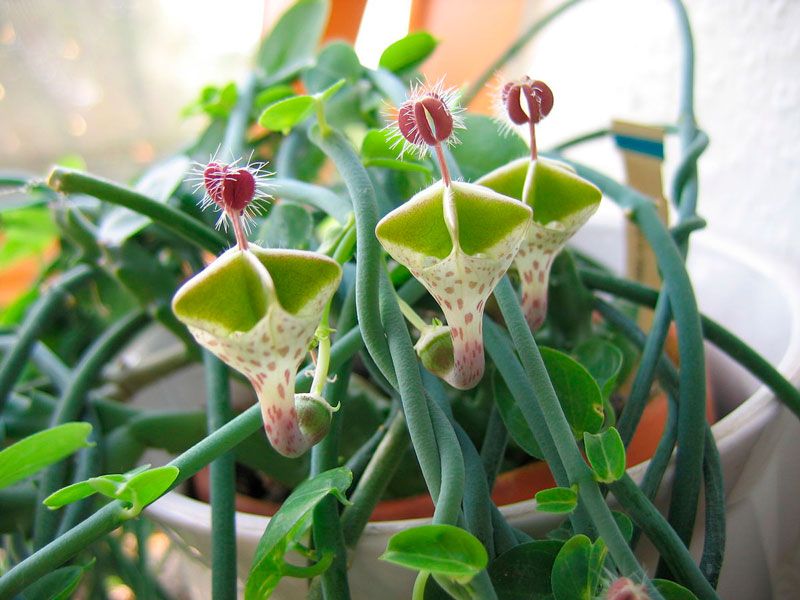
Ceropegia translates from ancient Greek as "candelabrum." This name was given to the flower due to its unusual shape, which often varies depending on the species. Some have upright stems, while others are climbing or creeping.
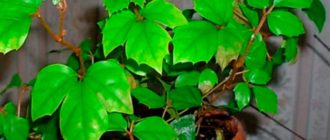
The leaves are heart-shaped, light green with small dark green spots. Ceropegia is a variegated flower, meaning it contains mutant cells that are incapable of producing chlorophyll. The word "variegata" means "spotted" in English.
Indoor species
There are several indoor varieties of the plant, which can be found in the table.
| View | Characteristic |
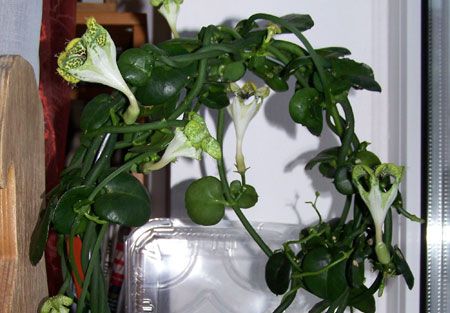
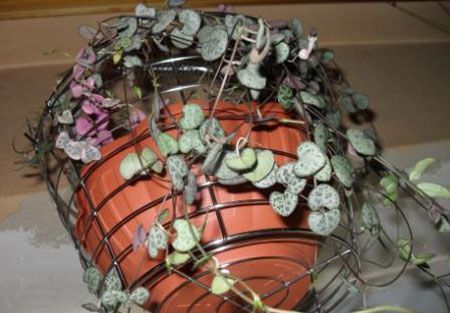
| Voodoo (Voodoo) (ceropegia woodii) | One of the most common species, it roots easily. Its leaves are marbled; when unfurled, they resemble purple and green beads. It is a trailing flower and resembles the Galeini's Senecio. |
| Ceropegia Sanderson | It has elongated, fleshy, and smooth dark green leaves. They are arranged in pairs along the stem. The branches are quite fragile, so the plant requires support. It blooms throughout the year. Five fused petals form a bud shaped like a lantern. |
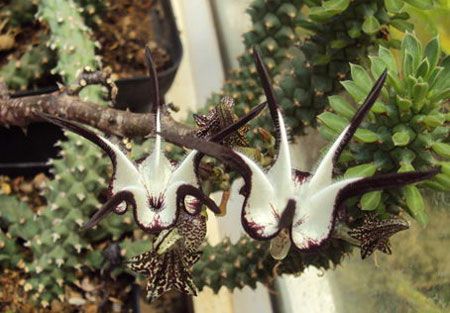
| Stapelian | This hybrid plant has a rather interesting appearance, and the presence of thick, three-ribbed stems with tendrils at the tips makes it easy to confuse ceropegia with certain reptile species. The flowers are quite large, white with purple speckles, and miniature in size. |
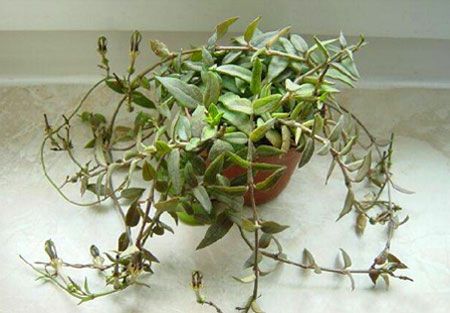
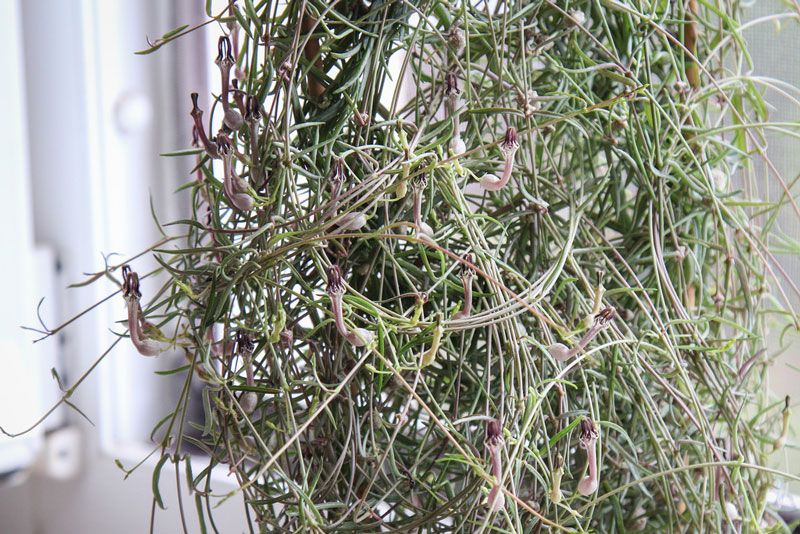
Another popular type of houseplant is Ceropegia Linearis, an image of which can be seen in the photo.
Peculiarities of home care
Caring for ceropegia at home requires following a number of rules for growing, watering and propagation.
Location, lighting, temperature, humidity and watering
Since the plant blooms throughout the year, regardless of the season, care for it should be almost the same.
| Location | Lighting | Temperature | Humidity | Watering |
| The plant is most often grown as a hanging plant (i.e., in pots, etc.), so it fits into any setting. Oak pots placed on a special trellis are considered the ideal growing container. | It's a light-loving plant. Even direct sunlight won't harm it, but it's best to avoid it during extreme heat. In summer, it's recommended to move the plant onto the balcony. | The optimal temperature for growing ceropegia is 20-25 degrees Celsius. During the winter, you can provide a cool overwintering environment by lowering the temperature to 15 degrees Celsius. | The plant is absolutely indifferent to air humidity. | Light watering. In summer, water immediately after the top layer of soil dries out. In autumn, watering is reduced, and in winter, it's reduced to a minimum. It's strictly forbidden to allow the soil to dry out. |
Pot, soil, replanting
To grow the plant, use simple soil for succulents, which is placed in a pot with wide holes for draining excess water and a large rim, and then the flower itself is planted in it.
Young plants require replanting every year, older ones – every 2-3 years.
Top dressing
Fertilization is performed using complex fertilizers for cacti and succulents. In spring and summer, the plant is fed twice a month.
After this, ceropegia will germinate better and root quickly. It's best to avoid using superphosphate.
Reproduction
There are several ways to propagate ceropegia:
- cuttings;
- dividing the bush;
- seed.
The first method is the easiest for plants to propagate; using seeds requires a lot of time and effort. Cuttings, however, root fairly quickly.
Mistakes in care, diseases, pests
| Diseases | Pests |
|
|
Benefit
There are a number of folk beliefs about placing ceropegia in the house:
- blocks negative energy;
- improves the atmosphere and human biofield;
- saturates the air with a pleasant scent.
The average price of a plant in Russia is 115 rubles.