Cyclamen, or alpine violet, is a distinctive houseplant with its vibrant and beautiful blooms. It often dies quickly after purchase and after flowering. For this reason, it is considered difficult to care for indoors. However, with proper cultivation, it can grow for 10 years, blooming annually.
Description
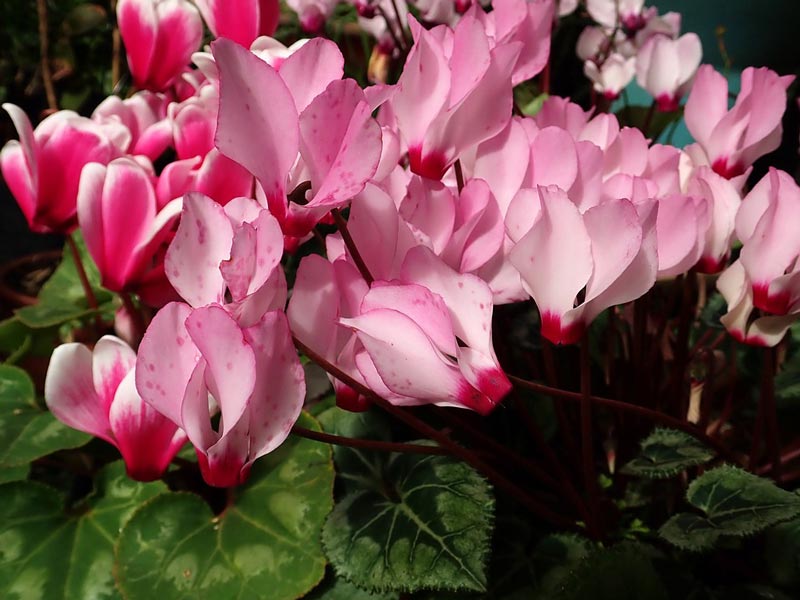
This is a perennial flowering plant in the primrose family. It is distinguished by heart-shaped leaves and flowers on tall stalks. They reach 8 cm in diameter and range in color from white to purple. Cyclamen has a persistent and delicate scent.
There are over 20 species in the genus. They range in height from 15 cm to 35 cm, and feature both double and single flowers. Cyclamen is native to the Mediterranean region. However, over time, they have been distributed to many countries.
It grows in Spain, Iraq, and northern and eastern Africa. In Russia, it is found on the Black Sea coast.
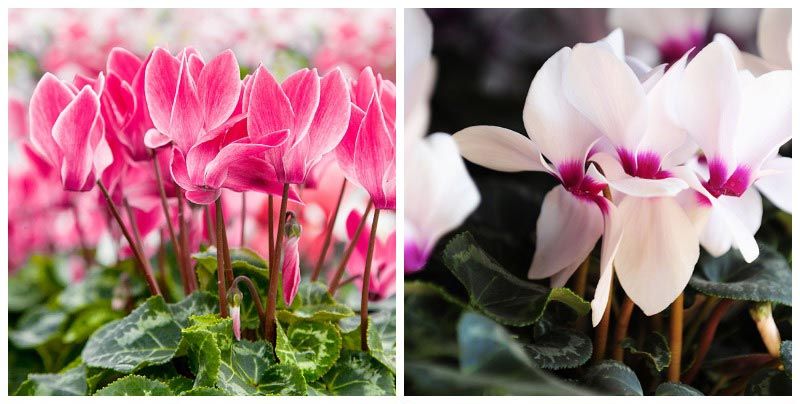
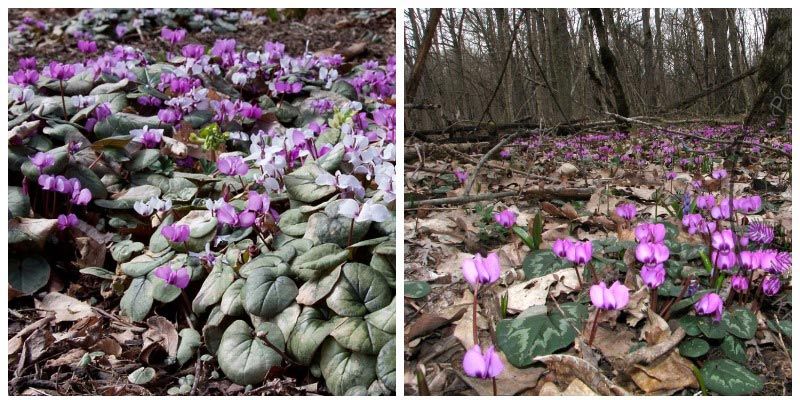
Persian and European cyclamen, their photos
Florists recommend the European (reddening) and Persian varieties for home cultivation.
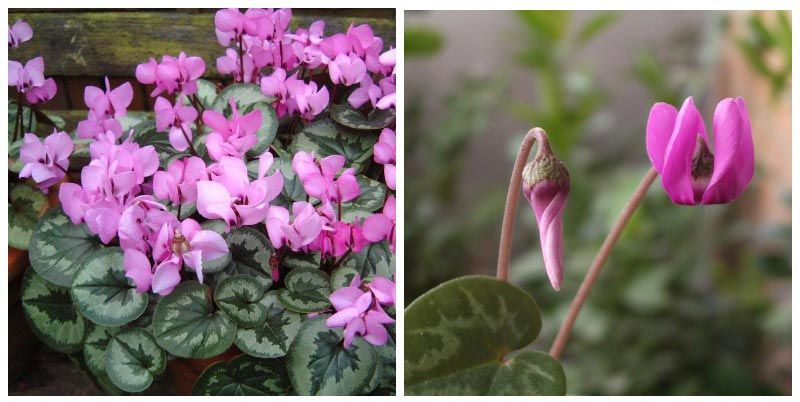
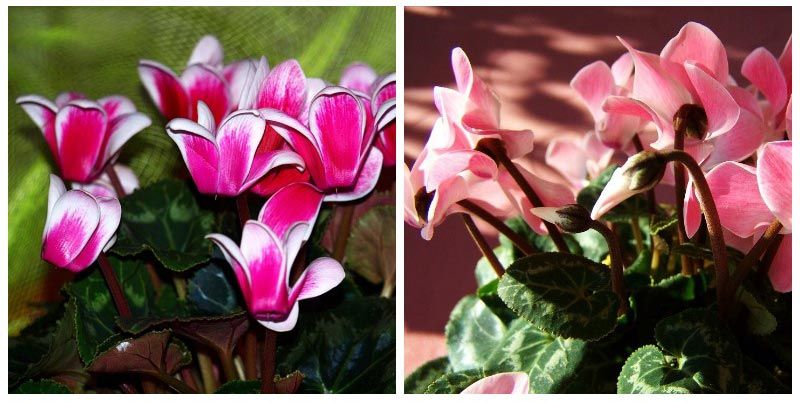
The latter is easy to care for indoors. It has beautiful leaves. The flowers are large and come in delicate shades. The plant grows up to 30 cm tall.
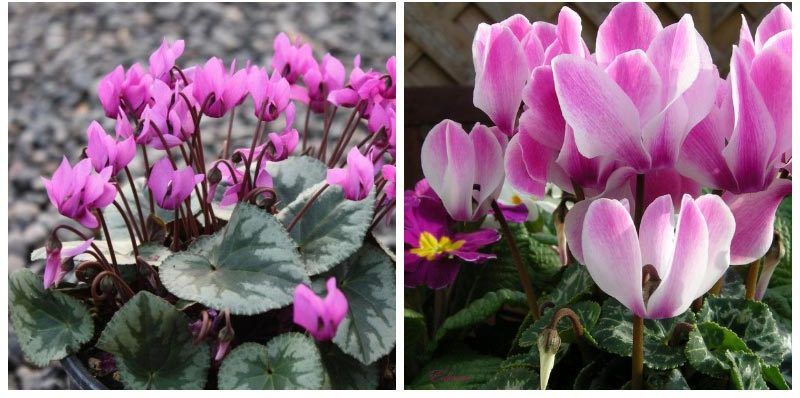
The European species of alpine violet has dark green leaves. Its flowers are small but vibrant. It's easier to care for because it doesn't have a dormant period.
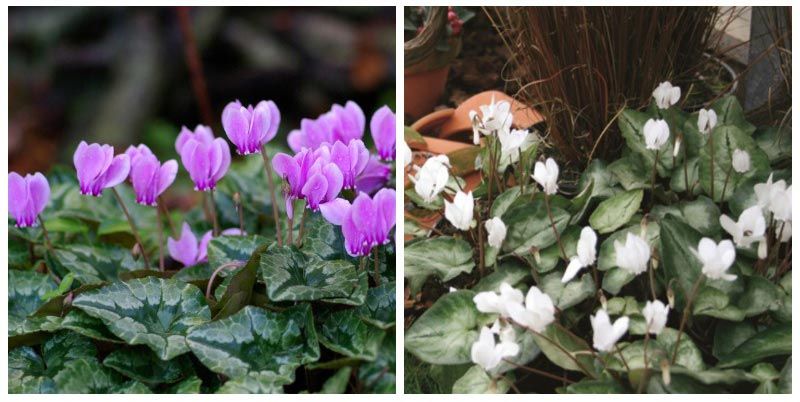
Gardeners are also trying to cultivate other varieties for indoor use, such as ivy-leaved, Cretan, and Kos varieties. However, these require challenging growing conditions, which hinders their widespread distribution.
Top.tomathouse.com explains: Cyclamen life cycles
In nature, cyclamen undergoes three growth phases. This flower grows vigorously in autumn, blooms vigorously in winter, and then rests in summer and spring. This cyclical nature differs from that of other flowers. However, this makes the alpine violet attractive for cultivation, as few other plants offer a pleasant winter display.
Hybrid varieties have been developed that bloom all year round.
The intricacies of caring for cyclamen at home
You should work with cyclamen with caution, it is a poisonous plant.
It's best to wear gloves to avoid skin irritation. Place the potty out of the reach of pets and small children.
Basic plant care techniques:
| Parameter | Conditions |
| Location | The best location is a window facing east or west. On a south-facing window, the plant will need some shade during the day, while on a north-facing window, it won't get enough sunlight to thrive. You can bury it in the garden during the summer, but protect it from direct sunlight. Drafts are avoided, although fresh air is beneficial. In winter, the pot should be kept away from hot radiators and moved around as little as possible. |
| Lighting | During the flowering phase, it's best to place the plant in a bright location. In summer, light is no longer required. You can place the plant on a north-facing windowsill or in a shaded area. However, some sunlight should reach the plant. It prepares for the next bloom, gaining strength and benefits, including from the sun. |
| Temperature | The plant prefers cool conditions. It thrives at nighttime temperatures of 17 to 12 ºC. In winter, protect the cyclamen from hot radiators and in summer from extreme heat. Failure to maintain the desired temperature will shorten the flowering period. |
| Humidity | The English violet requires high humidity. In its native habitat, it grows in a humid climate. Avoid spraying with a spray bottle, as this will leave brown spots on the leaves. Place the container on a tray filled with expanded clay or wet pebbles, and place cups of water nearby to allow for evaporation. |
| Watering | Watering depends on the plant's growth cycle. During the dormant period, continue watering; don't allow the soil to dry out. During flowering, increase watering, but avoid overwatering. Gradually reduce watering at the beginning of summer, but don't stop completely. The tops of the plants may die back, but the roots need moisture. Water from the tray, not from above. |
| Soil | The soil should be slightly acidic, with a pH of about 5. If you're making your own, mix equal parts sand, peat, turf, and leaf mold. When shopping, you can use a general-purpose soil with a neutral pH. Add a little sand to improve water permeability. |
| Fertilization | Universal fertilizers (Pokon for flowering plants, Uniflor Flower) are suitable for feeding. In autumn and winter, feed once every two weeks. More frequent use will result in excessive foliage but no flowers. Avoid fertilizing the plant in summer to avoid harm and disrupt its growth cycle. |
Landing, transplant
The plant should be repotted no more than once every three years during the awakening phase, that is, in early autumn. At this time, growth buds are already beginning to emerge, but the leaves do not unfurl.
Cyclamen doesn't need a large pot. The root system won't spread throughout the entire pot, which will slow growth and flowering.
The best option for this type of flowering plant would be a container that resembles a soup bowl.
Each new pot should be 2–3 cm larger in diameter when repotting. Leave at least 2.5–3 cm between the sides and the tubers. Holes should be made in the bottom. A drainage layer is essential.
Before filling, the soil must be sterilized. This can be done by steaming it, heating it in an oven, or freezing it in the open air in winter. The fastest way is to pour boiling water over the soil.
Repotting cyclamen is similar to repotting other houseplants. The tubers of two-year-old plants are completely covered with soil. For older plants, leave a third of the tubers exposed. When repotting, carefully inspect the roots. Trim off any rotted parts with a knife and sprinkle with crushed activated charcoal tablets or apply brilliant green.
Until the first leaves appear, about 10 days, the plant doesn't need watering. However, it should be protected from bright sunlight and low humidity.
Purchased cyclamen are repotted immediately, regardless of their developmental stage. To disinfect, the root system is soaked for two hours in a pale potassium permanganate solution. Then, soak for the same amount of time in a growth biostimulant, such as Kornevin.
Reproduction
The plant propagates successfully by dividing the tuber and growing seeds. Experienced gardeners prefer to collect and germinate the seeds themselves. In practice, store-bought seeds have poor germination rates, but home-grown seeds germinate well.
To improve pollen formation, use a soft brush to transfer pollen from the flowers of some cyclamen to the pistils of others. This process continues for several days.
If all goes well, the flower stalk will become deformed, thickening and curving. Fruit formation and seed maturation continue for a long time. A capsule will form on the plant, containing the seeds. They should not be dried, as this will reduce germination. Before planting, soak them for 24 hours in a solution of a biostimulant and 2-3 crystals of potassium permanganate.
Fill a flat container with soil, moisten it, and level it. Sow the seeds evenly. Add a 1 cm layer of fine sand. Cover the container with plastic wrap or glass. The plant doesn't need light until germination, but it's important to maintain a temperature of 18 to 20 ºC. Below 18 ºC, the seeds will rot, and at 20 ºC, they will go dormant. Finding a happy medium is essential for successful germination.
You need to air out the container every day and spray it with a spray bottle if it starts to dry out. This can happen in a month, sometimes in a few. It depends on the flower variety.
The emerging sprouts are brought into the light, but not into direct sunlight. The temperature is reduced to 15ºC. Moisten the soil daily until the first leaf emerges. After 2-3 leaves have formed (December), transplant them into small plastic containers. A week later, feed with any complex fertilizer, reducing the concentration by half. In mid-spring of the following year, plant them in pots of a suitable diameter. About 15 months after sowing the seeds, the cyclamen will delight you with its first flowers.
The vegetative method is simpler. So-called "babies," or growths, form on the tuber.
The procedure for propagation from a tuber:
- The plant needs to be carefully removed from the ground, shaken a little, and the “babies” separated with a knife.
- Put them aside to dry.
- Coat the cut surfaces of the tuber with brilliant green.
- The "babies" should be planted in small pots filled with soil for adult plants.
- Water moderately until new leaves appear.
- Protect cuttings from dry air and strong sunlight.
A single tuber is also cut into pieces for propagation. However, the growing point is located at the top, and it is often damaged when cut. The new plants may be stunted and die before they can gain strength.
Diseases and pests of cyclamen
Improper care leads to disease. The chart will make it easy to determine what's wrong with your cyclamen.
| Symptoms | Cause | Methods of elimination |
| Gray mold. Softening of the foliage, the appearance of a gray layer on the surface. | High humidity, excess fertilizing, excessive watering. | Replant the flower, reduce watering, treat with Fundazol. |
| Rhizoctonia rot. Whitish coating, sunken spots. | The soil is damp, it’s hot, there’s a lack of moisture. | Reduce watering and improve soil drainage. Repot the plant and apply Rovral. |
| Phytophthora rot. Leaves dry out, and the tuber surface becomes deformed. |
Soil contamination. |
Replant the plant, treat the soil with fungicides. |
| Fusarium wilt. Leaves turn yellow and dry out, and the bulb is damaged. | Actions do not lead to positive results. |
When placed next to infected flowers, pests attack healthy plants. This isn't always noticeable to inexperienced gardeners. This chart will help you spot signs of pest infestation early and save your cyclamen.
| Manifestations on leaves | Cause | Methods of elimination |
|
Sticky coating on the plant. They curl up. |
Aphid. Infection, plant is weak. |
Treat with soap solution and Actellic. |
|
The stem twists and the flowers fall off. Deformation occurs. |
Cyclamen mite. Insufficient humidity, pest infestation occurred. |
Remove infected leaves, spray with insecticides. |
| The plant becomes sticky.
Light spots and plaques appear. |
Scale insect.
The air is too dry, infection has occurred. |
Use alcohol and insecticides. |
| Twisting, whitish dots and a silvery coating are observed. | Thrips.
Low humidity. |
Treat with insecticides. |
Cyclamens are very demanding plants, requiring a lot of time. But they will reward you with lush blooms.