The herbaceous perennial plant black cohosh, or black cohosh, has been cultivated since the 18th century. In its native North America, its anti-inflammatory and medicinal properties for women have been known since ancient times. In modern pharmacology, an extract from the herb's roots is used to create dietary supplements. The drug is widely used to treat gynecological conditions.
The second, unattractive name was given to the plant because the leaves of the black cohosh were previously used as an insecticide, supposedly because of its unpleasant odor, which repels bedbugs. This myth was later debunked.
Description
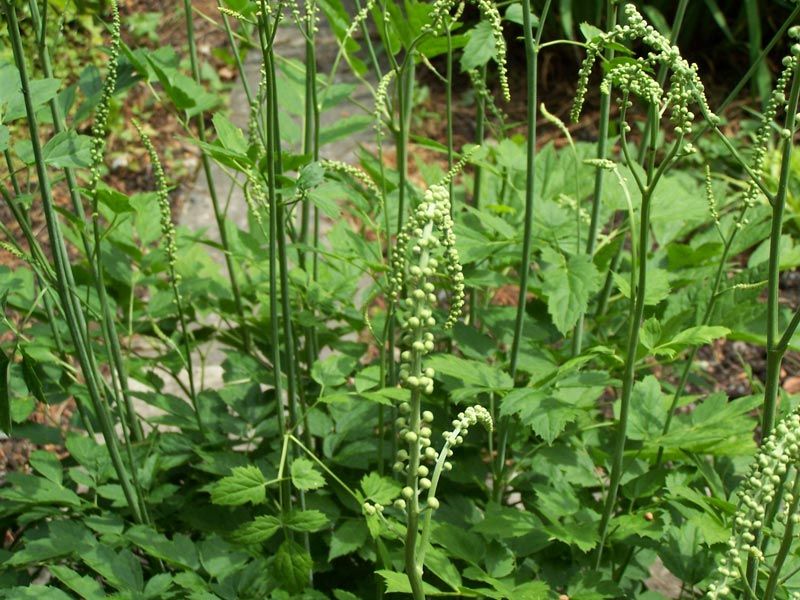
Black cohosh is a tall plant, reaching 2.5 meters during flowering. The flower stalk, when cut, exhibits a rectangular cross-section, allowing it to withstand windy weather without damage. The medicinal root has a fleshy structure, from which a smooth shoot extends upward, complemented by complexly shaped leaves of a rich green hue. The lower leaves, located on the ground at the base of the flower stalk, are long and wide, on separate petioles, dissected into two or three parts. The leaflets are arranged alternately, each of which can reach 12 cm in length, with a total of up to 70 leaves on the plant, making the black cohosh lush and beautiful.
The flowering period lasts all summer. In late spring, a raceme (inflorescence) of impressive size, up to a meter long, forms on the stem. A little later, flowers appear, distinguished by an unpleasant odor that attracts carrion insects. The white flowers are fluffy. The four sepals quickly fall off, leaving behind numerous cream-colored stamens. The petal itself is small, up to 0.3 cm in diameter. The pistil, with a large, flat stigma, produces only a single ovary.
The fruit is particularly intriguing; a capsule up to 10 cm in size contains approximately 7-10 seeds. During windy winter weather, the plant produces a rattle-like sound, hence the English name "rattleweed."
The plant thrives on the slopes of ravines, the banks of streams, thickets of bushes, and damp, shaded areas.
Varieties and types of black cohosh with photos and names
In addition to its medicinal properties, black cohosh has excellent ornamental qualities. It is used by landscape designers and gardeners. Today, at least 15 varieties of the plant are known, varying in bush size, height, and flower color.
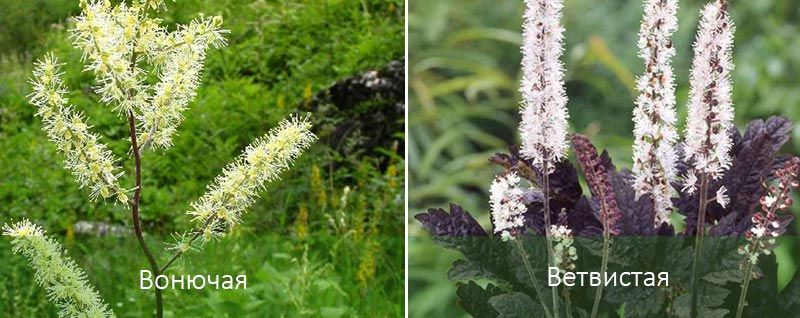
Wild species:
|
View,flowering period, height |
Description, height, flowering period | Leaves | Flowers |
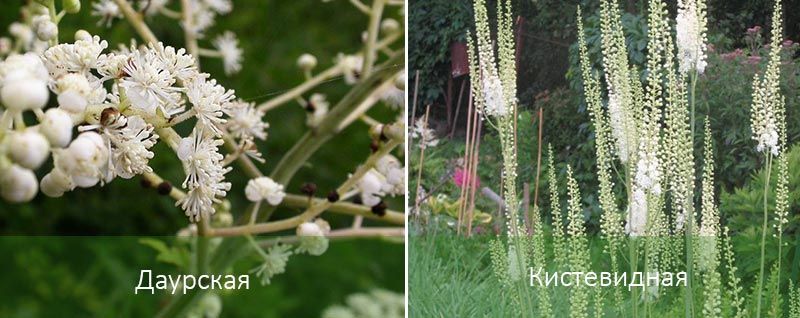
| Daurian | No higher than a meter. From July to August. |
The stem is pubescent, bluish in color, and bare right down to the base. | Slightly pinkish. |
| Racemose | About 2 m.
All summer. |
A wide bush with a diameter of up to 60 cm at the base. Leaves and stems are rich green. | The flower is white with cream stamens. |
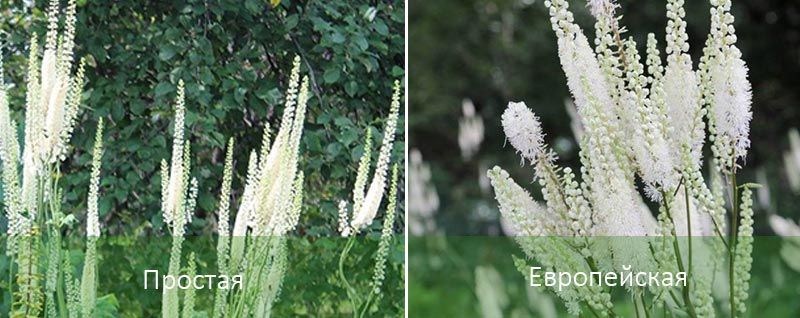
| Simple | Up to 1 m.
August-September. |
The color of the leaves and stem is classic green. | The inflorescence is drooping with white petals. |
| Stinky | High, up to 2 m. | Dark green foliage, stems and peduncle pubescent. | White. |
Breeders have developed new plant species, some wild ones have been domesticated and popular varieties have been created on their basis.
|
Species, flowering period, height |
Varieties | Leaves | Flowers |
|
Branched. In September - October. Up to 2 m. |
Atropurpurea | In early autumn the leaves are brown-red, later they turn green. | White. |
| James Compton | New variety with dark purple leaves. | White. | |
|
Mrs. Herms Dwarf variety up to 0.4 m in height. |
Classic dark green. | ||
| Pink Spike | Stems and leaves are beetroot-colored. | White and pink. | |
| Simple. August - September. |
Armleuchter | A highly branched green peduncle. | White. |
|
Brunette Tall, stem 1.8 m. |
Large, carved leaves have a purple-brown hue. | White petals with light purple stamens. | |
| Braunland | Leaves and stems are dark brown. | Snow-white | |
| Elstead | Late flowering. Slightly curved flower stalks. Dark purple hue. | ||
| Hillside Black Beauty |
The leaves are green-brown in color, the stems are vertical and straight. | ||
| White Pearl | Light green leaves and stems. Rare flower stalks. | Large, lush white inflorescences. | |
| Heart-leaved.
In July - August. Up to 1.5 m. |
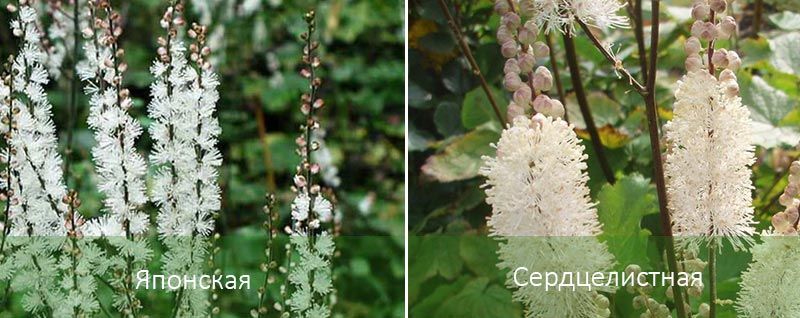
They don't stand out | The stem is round, bright green, the leaves are heart-shaped, carved. | Silvery white. |
|
Japanese. Up to 2 m. |
Normal | Dark green leaves and stems. | Silver or cream. |
| Compacta | Peduncles up to 0.6 m. | Large flowers up to 2 cm. Light cream. | |
| European. | They don't stand out | The leaves and shoots are light green, the peduncle is covered with grey hairs. | The flower is white with multiple stamens on long stalks. |
Landscape designers often use black cohosh in combination with other plants; it beautifully complements any composition and quickly establishes itself. Tall varieties are often used as hedges and as a backdrop for low-growing plantings. Low-growing varieties are most suitable for rock gardens. The bush's beautiful, complex foliage can be a garden decoration in its own right, especially striking when combined with cherry (Elstead) and salad (European) varieties. The plant also decorates ponds. When planted near a pond, moss and other cover crops complement the design beautifully.
Planting bugbane in the ground
The beauty of the black cohosh isn't reflected in its names; only the Germans were able to capture the plant's decorative qualities by calling it "silver candles." They are grown outdoors. This easy-to-grow plant requires little care and tolerates shade and dampness.
Planting under trees is not recommended; there should be sufficient space around the bush. When choosing a location for a flowerbed, consider areas protected from the wind. This is due to the height of the flower stalks of most varieties; strong gusts can break the stem.
The best time to plant is spring and fall. Fertilize the soil for black cohosh. Dig a hole no more than 30 cm deep, add organic matter to the bottom, and then plant the plant. Maintain high humidity; the plant is not drought-tolerant and may die. The broad leaves at the base of the plant interfere with each other when planted close together; a distance of about 60 cm is recommended. The plant is known to be toxic, so be sure to wash your hands after handling it.
Cimicifuga does not need replanting; it feels great in one place for up to 20 years.
Caring for bugbane in open ground
This unpretentious plant brings joy to gardeners:
- Maintaining well-moistened soil is not a problem. During hot and dry periods, watering is increased, and reduced towards the end of the season, and in October.
- It is recommended to cover the base of the black cohosh roots with a layer of leaves; this helps keep the soil moist and prevents weeds from appearing.
- If there is no goal to collect seeds, then dried inflorescences must be cut off.
- Varieties with tall flower stems are recommended to be staked. Gardeners use neat, thin base stakes that are virtually invisible in the overall arrangement.
- Preparation for winter begins with pruning the stems. Then, the growing area is covered with a thick layer of pine needles or fallen leaves.
Top dressing
Well-fertilized soil is what this plant needs. When planting, be sure to add compost and sand in a 7:3 ratio to the hole. During the season, black cohosh only needs additional feeding once, in the third year after planting; earlier stages, the plant doesn't need any help.
Fertilizer is applied in early spring. Complex formulations with high levels of nitrogen, potassium, and phosphorus are best.
Reproduction
There are three methods for propagating black cohosh: seed, cuttings, and division. Each method has its own peculiarities, but the results are always positive due to the fact that this species is more akin to a weed than a cultivated plant.
The simplest method is division. In the spring, dig up a bush that's at least six years old. The shoot is carefully separated from the main plant, and the original shoot is replanted. The shoot is placed in a container with a growth stimulant and, after a while, transferred to a pot with general-purpose soil. The seedling is kept warm until it begins to grow. Then it is transferred to its permanent location in the flowerbed.
Taking cuttings is also easy. Take a bottom leaf from the mother plant; it's important that the petiole contains a piece of bark from the adult plant. The cutting is buried in soil in a well-drained area and covered with a plastic bottle.
Sowing black cohosh requires some knowledge. To ensure good germination, seeds should be used immediately after harvesting. If they are left over from the previous season, prepare them six months before sowing:
- 3 months kept at a temperature of +20 °C;
- the rest of the period at +4 °C.
Regardless of location, whether in open ground or a pot, the first shoots can be expected no sooner than six months later. When planting, avoid over-watering the soil, as the seeds may rot. Young plants grown this way will bloom for the first time in the third year.
Diseases
This weed has retained its characteristics in both the wild and the garden. The black cohosh's strong immunity makes it virtually invulnerable. However, it can sometimes become diseased.
Pests infesting the bush are removed by treating it with insecticides. The store will recommend the appropriate product based on the type of pest.
Root diseases occur when the soil is overwatered. In this case, remove the protective layer of foliage covering the root area and reduce watering.
Top.tomathouse.com recommends: the medicinal properties of black cohosh
Since ancient times, the plant's rhizome has been used for medicinal purposes. Its best results are in reducing labor pain and regulating a woman's menstrual cycle.
Today, the range of conditions treated by black cohosh is much broader, and its beneficial properties have been studied in greater detail. In China, the herb is prescribed as an anti-inflammatory, to relieve various types of pain, and to reduce fever. The roots of this plant are known for their antitussive and antirheumatic properties. It is also prescribed for diabetes and kidney disease, and as a sedative for patients with nervous excitability. In hormone therapy, it is used to normalize estrogen balance and stimulate estrogen production.
When using black cohosh as a medicine, it's important to remember that its stems and leaves are poisonous. Preparations containing plant extracts should only be used under the prescription of a physician and strict supervision. There are a number of contraindications to be aware of:
- sensitivity to components or allergic reaction;
- periods of pregnancy and breastfeeding:
- tumors of various origins with a direct dependence on estrogen levels;
- liver disease.
There are various pharmaceutical forms based on black cohosh: liquid and dry extracts, powders, tablets, capsules.
Self-medication with medications is strictly prohibited. Consult a doctor.
Cases of overdose and side effects have been reported. Excessive doses can cause headaches and nausea. Weight gain has been observed in patients taking the medication on a regular basis. Allergic reactions and gastrointestinal upset are common.