Zinnia, or zinnia in the original spelling, is a perennial heat-loving shrub plant, cultivated in temperate latitudes as an annual.
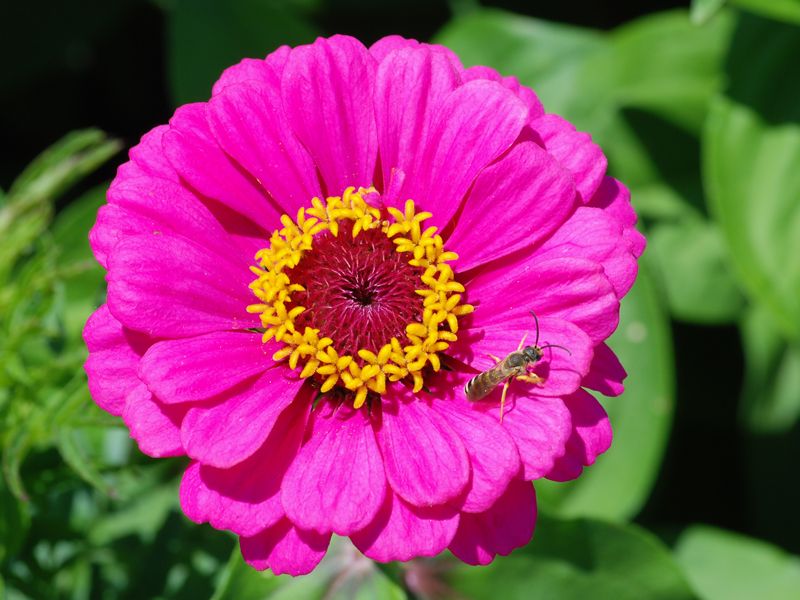
Named after the botanical garden's director, Johann Zinn. Another popular name is majora. It belongs to the Asteraceae family, with over 20 species and over 50 cultivars.
They differ in the shape and color of their cap-shaped buds, which can be hemispherical or flat. Tall varieties are grown for bouquets; cut flowers last up to 20 days. Medium-sized and low-growing shrubs are used in landscape design. Cultivation techniques are simple.
Content
- 1 Description and characteristics of zinnia
- 2 Types and varieties of zinnia
- 3 Planting zinnias
- 4 Features of growing zinnias
- 5 Caring for zinnia in open ground
- 6 Zinnia after flowering
- 7 How and when to harvest zinnia seeds
- 8 Perennial zinnia in winter
- 9 Pests and diseases of zinnia
- 10 Top.tomathouse.com recommends: The benefits of zinnias in the garden
Description and characteristics of zinnia
A flowering shrub with branched, upright or spreading, elastic stems with a stiff frond, it blooms from midsummer to late fall. This heat-loving plant is frost-tolerant and easy to care for. Like many plants in the Asteraceae family, zinnia is undemanding of soil and prefers good light. Depending on the variety, it grows from 20 cm to a meter. Majora's leaves are ovate with a pointed tip, dense, and dark or rich green.
They grow oppositely or in whorls. The fruit is an achene of a triangular, flattened, or oval shape.
It is used to decorate gardens and parks as an annual plant, although in the wild, marjoram is considered a perennial shrub. It grows in Mexico, North America, and South America. Breeders have developed profusely blooming varieties of varying colors and shades, with flower heads that are flat or hemispherical. The petals are ligulate, rarely growing straight, but often curl into a tube, forming a double bud, sometimes curling at the tip.
Flowering is multilayered and lasts up to two months, beginning 50–55 days after germination. In Russia, seedling cultivation is used.
The first row of large outer buds are the first-order flowers, in which the seeds ripen; the rest are inside the bush, blooming in the second or third order, and the seeds in them may not inherit the characteristics of the species.
Types and varieties of zinnia
Existing garden classifications group numerous flower varieties by appearance into 4 species groups of zinnias: graceful, narrow-leaved, thin-flowered, and linearis, although it is similar in appearance to thin-leaved mayra.
According to the length of the stem, there are:
- tall zinnias, grown for cutting into bouquets, these are bushes from 60 to 90 cm in height. With good care and lighting, some varieties reach a meter in height;
- medium-sized, from 30 to 55 cm in height, they are bred for decorative landscaping;
- Low-growing or flowerbed, dwarf, their height ranges from 15 to 30 cm, they look good in rockeries, on alpine hills, they decorate balconies with them, and are planted in pots.
The variety of colors is worth considering in detail.
Graceful
An annual zinnia with dense petals forming large, lush caps. It blooms from midsummer until freezing temperatures arrive. This group includes dwarf, medium-sized, and tall varieties. The flower rosettes are dense and vary in diameter, with a minimum of 3 cm and a maximum of 17 cm. The flowers come in a diverse palette: from white to purple, numerous shades of yellow from lemon to cream, reds from scarlet to deep burgundy, and carmine, orange, lilac, and lavender. Varieties:
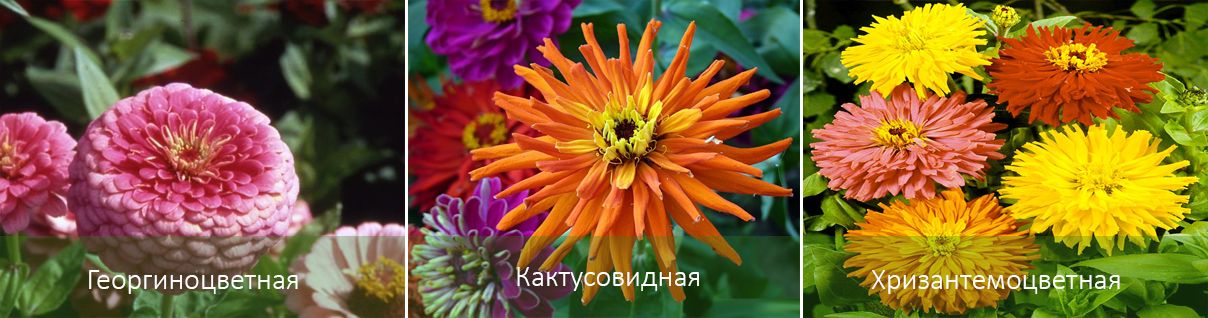
- The Dahlia-alphabet group of large-flowered, tall zinnias with dense, hemispherical caps is the most numerous. The petals are ligulate with a rounded edge, arranged in a tile-like pattern, and the inflorescences are large, double, ranging from 10 to 14 cm. They are grown for bouquets and retain their marketable appearance for up to three weeks. Popular varieties include California Giant, Denarys Giants, and the hybrid Russian Size F1. New selections include Polar Bear with snow-white inflorescences and Lavender, a surprisingly delicate blue-lilac hue. Crimson Monarch has carmine-colored flower caps, Dream has a rich, vibrant lilac color, and Hallo has coral-pink inflorescences. Purple Prince, or Giant Zinnia, has saucer-sized caps with a lilac hue and glossy, shimmering petals.
- Cactus-shaped or giant zinnias with pointed petals are tall-growing varieties. Their caps are loose, the petals are smooth at the base, and form a dense tube at the tip. The popular Giant Cactus Flowers series is designed for bouquets. The tall bushes, up to a meter tall, produce flower caps in shades of orange, scarlet, sunny, and deep crimson.
- Chrysanthemum-ales are considered a medium-sized species. Their petals are large and gathered into double buds. The petals are a single color and form a tube or curl.
- Pompon zinnias are low-growing, branched varieties characterized by their bushy growth and hemispherical flowers. They are cold-hardy, tolerate light ground frosts, and bloom from June to late October. Popular varieties include "Little Red Riding Hood," originally known as "Rotkopchen," which produces medium-sized bushes with deep red flower caps whose petals resist fading in the sun; and "Tom-Thumb," a dwarf variety resembling "Little Red Riding Hood," but with a less dense bloom.
- Fantasy is a medium-sized bush zinnia with loose flower heads 8–10 cm in diameter. The petals are narrow with a forked, jagged tip; in many varieties, they are twisted, and can be solid or variegated. The popular low-growing Short Staff variety branches well, producing small flower heads 3.5–4 cm in diameter in vibrant colors: red, coral, sunny, white, and cherry.
Narrow-leaved
This is a medium-sized group of zinnias, with a spherical bush growing 45–55 cm tall. The flower heads are small, up to 3.5 cm in diameter, flat or loose, like double flowers. The petals are medium-thick and curl into a tube. They are a solid yellow or orange color, with the rows of small petals near the center being darker than the rest. Narrow-leaved zinnias resemble marigolds in appearance.
Popular varieties often used in landscape design:
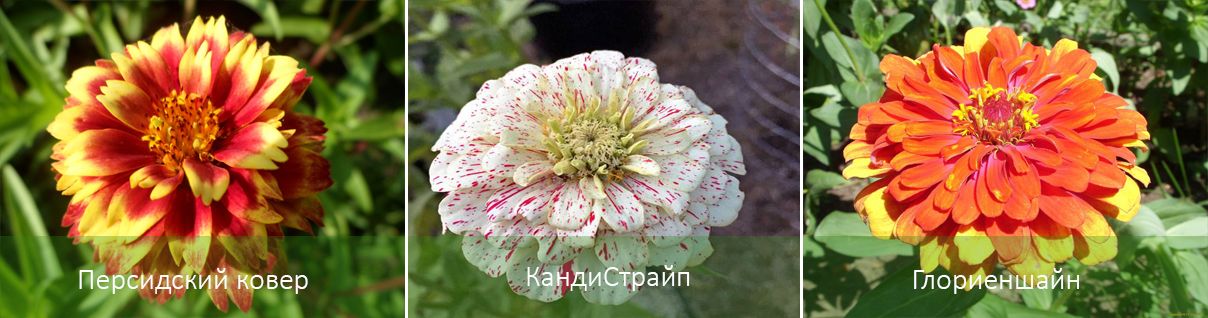
- Persian carpet, a dense bush with buds of different shades, from sunny yellow to saffron.
- CandyStripe, a zoned variant of the Persian carpet, is distinguished by its striped flower petals; the second name of the variety is Tiger.
- Glorienshine is a variety with a neat bush, covered with terry caps of a bright orange color, sometimes a narrow dark brown border is visible on the petals.
- Cherry is a dwarf hybrid with branched shoots, used for year-round home cultivation in pots, the buds are hemispherical, double, the color of the petals is changing, orange at the base, saffron at the tip.
- Persian Carpet is shaped like a Persian carpet, the petals are white or lemon-colored, and the bushes are dense and massive.
Hybrids
Breeders have obtained many ornamental species by crossing narrow-leaved and graceful zinnias; the most popular varieties used in landscape design are:
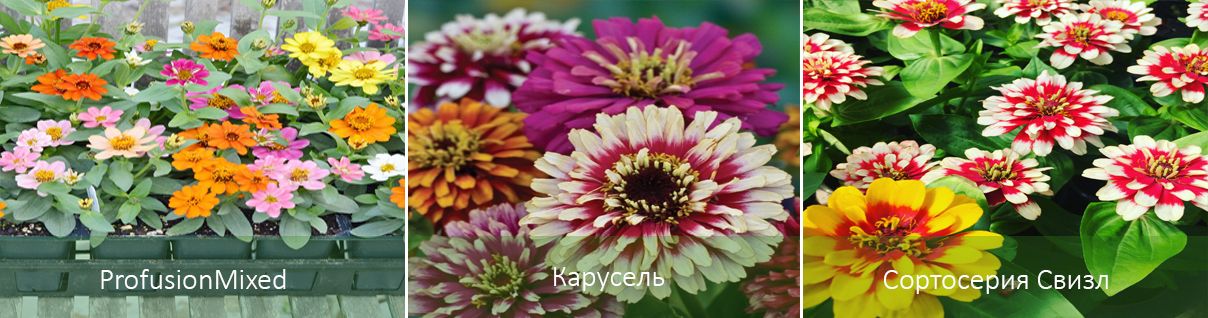
- "ProfusionMixed" is a brand that offers a wide range of color and height variations. The bushes are well-branched and covered with multi-layered flowers. The petals of these hybrid zinnias resemble daisies.
- The 'Carousel' flower mix is a medium-sized, large-flowered zinnia variety with dense caps and petals that taper to a point, varying in color, with small petals growing near the center in a different shade.
- The Swizzle series is represented in Russia by two varieties: Cherry Ivory, with dense, creamy-white buds whose petals fade toward the tips; and Scarlet Yellow, with deep red caps and petals edged with a small brown border.
- Shaggy Dog is a tall bush with loose buds and narrow, twisted petals.
- 'Magellan' is a low-growing variety with dense buds up to 10 cm in diameter. The hybrid's color variations include coral, salmon, orange, juicy cherry, bright red, rich yellow, and pale yellow.
- Peppermint Stick is a medium-sized hybrid with a smooth transitional color of petals from sunny to red.
- Envy is a branched shrub with hemispherical flower buds of various shades, used for landscaping city parks.
Fine-flowered
It resembles a cosmos in appearance. The bush is loose and medium-sized, with a thin, slightly reddish stem divided into small florets. The flowers are small, up to 3 cm in diameter. The petals are sparsely spaced, narrow, arching, and purple.
Linearis
A low-growing variety of zinnia, the shape of a small bush reaching 30 cm, spherical. This species is sometimes called narrow-leaved, but it has more branches. The petals are dense, narrow, pointed, and yellowish. Several selected cultivars:
- Golden Eye is snow-white, with a rosette of flowers like a daisy, and a dense row of small petals at the center.
- Caramel is a compact bush covered with small flowers with dark, wide centers; the petals are dense, matte, and pale yellow.
- Yellow Star – flowers are rich yellow.
Linearis is grown in apartments as a potted perennial plant, zinnias are unpretentious in care, valued for their abundant, long-lasting flowering.
Planting zinnias
The plant loves heat and does not tolerate frost well; only some selected varieties can withstand sub-zero temperatures.
Zinnias are grown from seedlings. They are kept indoors or in a greenhouse until the last frost has passed. Zinnia seeds are sown in March or April; individual pots or peat pellets are convenient. Prepared soil can be purchased, either universal or for tomatoes. Make your own soil by mixing equal parts of turf, river sand, and humus.
Before planting, check the seeds for germination; sprouts appear within five days. Planting dates are determined according to the lunar calendar. Peat tablets are most convenient; they are soaked without removing the reinforcing mesh. For planting zinnias, choose tablets with a diameter of 4 cm. Individual cups are second in convenience; cylindrical blister packs containing 6–8 are also available. Plant the seeds to a depth of 0.5–1 cm. When planting in groups, maintain a minimum spacing of 4 cm between plants. To ensure rapid germination, create tropical conditions: water the planting containers thoroughly, cover with plastic, and place them in a warm location. The recommended germination temperature is 25–27°C.
Seedlings emerge in 5–7 days. The film is removed, and the seedlings are moved to a bright, warm place.
Features of growing zinnias
During the active growth period, seedlings are fertilized with Agricola complex fertilizer for indoor plants. When planting seeds together in a larger container, transplant the plants after the third full leaf emerges.
The optimal growing temperature is no higher than 22°C to 24°C, and no lower than 17°C. If the seedlings are stretching excessively, provide additional light, increasing the daylight hours to 14 hours. The plant blooms 2.5 months after sprouting, and the seedlings are transplanted between 4 and 6 weeks old. During growth, pinching is done to encourage side shoots, and the stem tip is removed. This tip can be trimmed with scissors, disinfected beforehand.
During the growing season, fertilize no more than once a month. It's best to choose a complex fertilizer containing potassium, calcium, and phosphorus. Nitrogen fertilizers should be applied sparingly to prevent root rot. Superphosphate, ammophoska, potassium sulfate, and ready-made fertilizers such as "Tsvetochek" and "Raduga" are used for fertilizing. Before planting, harden off the seedlings by moving them to a cool place and allowing them to spend the night outdoors, first under a fabric cover, then without it.
Caring for zinnia in open ground
The complex of agricultural measures includes weeding the seedlings, watering during dry periods, fertilizing during budding, and removing shoots after flowering, which will encourage new ones to form in their place. If the soil is dense, loosening the soil is advisable.
Only bushy ornamental varieties are pinched. For bouquet zinnias, the stems are left single and straight to ensure the flowers retain their marketable appearance.
Zinnias are easy to care for. They thrive in bright spots, but will also thrive in shady areas.
Zinnia after flowering
After the bud's petals fall, a fluffy cone forms on the stem—this is the seed head. It is either picked or left to ripen. The brightest, most even buds in the first row are marked with thread, and the seeds are collected from them. If desired, the bushes can be moved indoors or into a winter garden.
How and when to harvest zinnia seeds
The cut seed heads are further dried until they crumble. They are then crushed between the palms of the hands to release the seeds. They are sorted before packaging. Zinnias have a distinctive feature: a single seed head can produce different plants. This is due to the stage of seed development.
Only the elongated, spear-shaped seeds with a pointed tip and the narrow, grayish-tipped ones are left for planting. The brown, heart-shaped ones are discarded; they grow into low-ornamental, basic plants, even if the seeds are collected from double-flowered bushes.
Experienced gardeners divide the seeds into groups. They select lance-shaped ones for growing loose, double, and flat buds, while elongated ones with a grayish tail usually retain all the decorative characteristics.
The seeds are placed in bags, labeled with the year of collection, color, and variety. The seeds are stored at room temperature in paper. Germination rates decrease in high humidity.
Perennial zinnia in winter
In warm regions where severe frosts are rare, zinnias are covered with spruce branches, dried pea tops, or other loose material. They are also protected from snow. The bushes overwinter in open ground, reviving in the spring and blooming again. If desired, they can be dug up, leaving a ball of soil, and transferred to pots, vases, or containers. They are then transferred to a conservatory or apartment for the winter. To prevent flowering, dry flower stalks are broken off.
Pests and diseases of zinnia
Zinnias are protected from slugs and flying insects by insecticides. Fungicides are used against fungal diseases. Zinnias rarely get sick.
Top.tomathouse.com recommends: The benefits of zinnias in the garden
The plant is cultivated for ornamental purposes and plays a key role in landscape design. It is prized by homeowners. Advantages of zinnia:
- A vibrant palette of colors, shapes, and shades, from yellow to purple. The exception is blue; only a lavender variety has been developed.
- The buds do not fade in the sun and stand well in a bouquet.
- They are undemanding to care in open ground, drought-resistant, and undemanding to soil composition and acidity.
- Flowers attract pollinating insects such as bees and butterflies. Birds eat the seeds.
- Duration and multi-layered flowering.
- Species diversity, grows to different heights.
- Zinnias do not suppress garden crops or greenery, and it is not difficult to choose a place for planting.
When choosing a location for zinnia, you should consider the advice of designers:
- It is better to plant them in groups; for single planting, large-flowered varieties are preferable.
- Low-growing plants are excellent for border decoration.
- Zinnia goes best with asters, marigolds, and saffron.
At the end of the season, the bushes can be transplanted into pots, where they will delight you with flowers all year round.