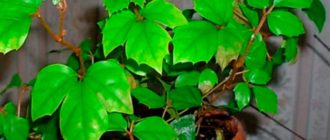
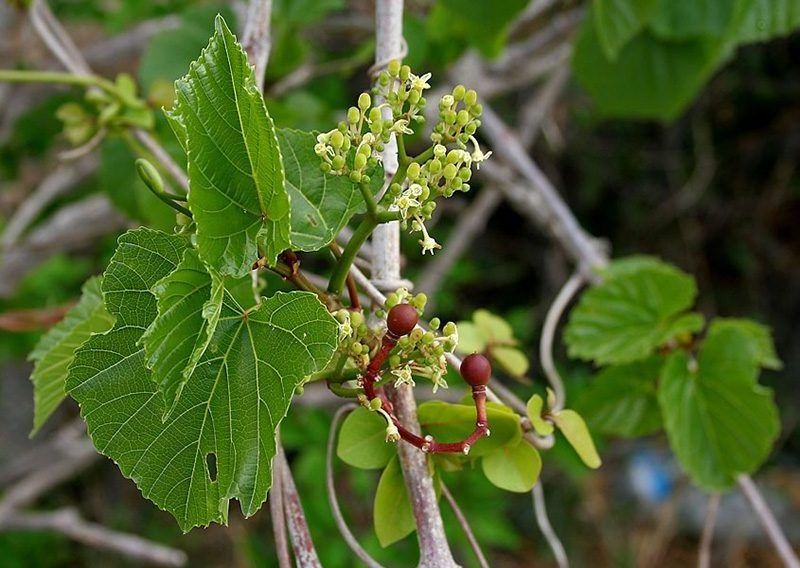
Cissus is a member of the grape family (vines). Ivy is native to Africa, South America, and Australia.
Content
Description
The plant grows to approximately 4 meters in length. Suckers and tendrils allow it to cling securely to adjacent surfaces. The root system is dense and does not spread. The plant is light green in color. It flowers in greenish tassels, which, after pollination, produce black or red fruits.
Cissus species vary considerably. Those native to drier climates have thicker stems and larger tubers.
Types for home
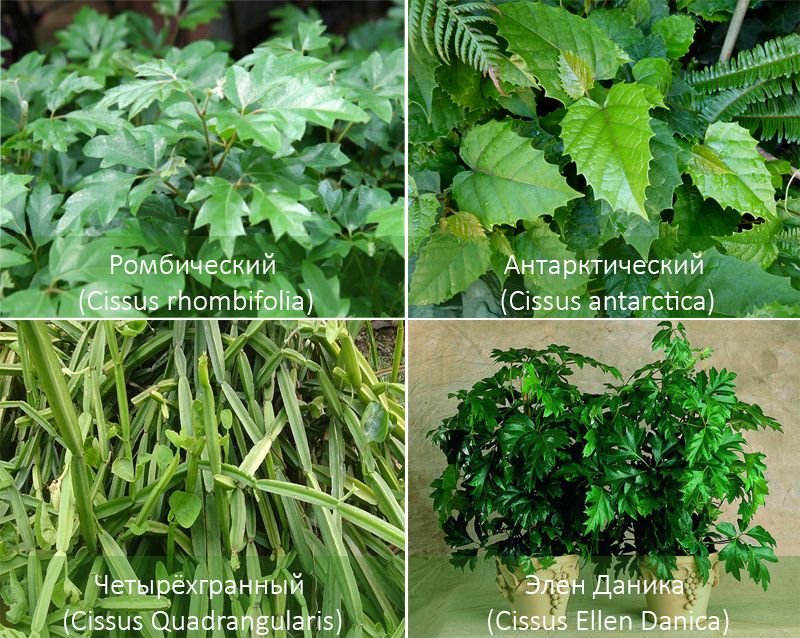
There are over 350 known species. Some varieties can be grown at home.
| View | Peculiarity |
| Rhomboid. | The name comes from its foliage. Its unique feature is its edible berries. |
| Arctic (Cissus antarctica). | Green all year round, oval-shaped foliage. Yellow-green flower. |
| Tetrahedral. | The medicinal function has developed. The shoots are about one and a half centimeters in diameter. No matter what we do, the growth is active, but slow. |
| Helen Danica. | Bright diamond-shaped leaves. |
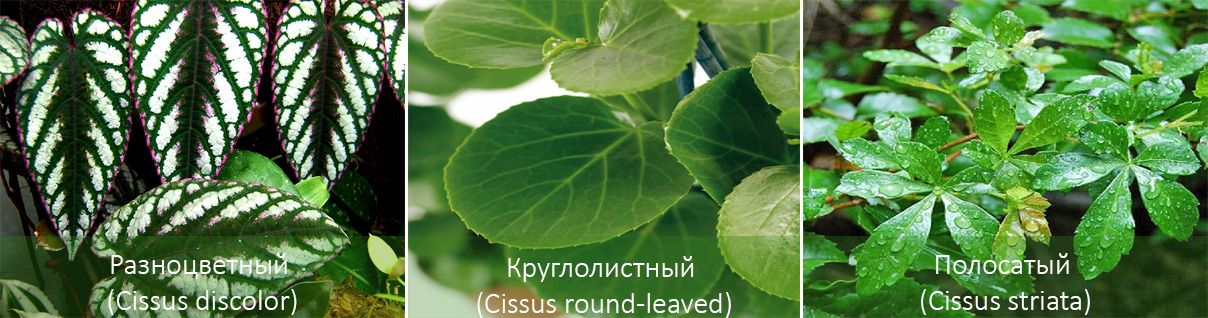
| Multicolored. | Silvery and burgundy-brown veins. The bulk of the foliage falls in winter. |
| Round-leaved. | Externally it gives the impression that it is covered with wax (gloss). |
| Striped. | It has the smallest leaves and black fruits. |
Growing conditions at home
| Time of year | Location | Temperature | Lighting | Humidity |
| Spring. | Eastern, western walls, internal piers, center of the room. | Average - +22ºС. |
Moderately bright. | The required humidity is about 60%. Daily spraying. |
| Summer. | Keep away from direct sunlight; you can move it outside to a shady area. Just make sure there's a container of water nearby. | Recommended +25ºС. |
Bright light, but protect from ultraviolet radiation. | Repeated and daily spraying with cool water. |
| Autumn. | Any place in the room will do. | Average - +22º. Antarctic — +12, multi-colored — +16ºС. |
Bright, diffused. | Regular spraying. |
| Winter. | Keep away from drafts. | +16-18ºС. | Bright, diffused light. Supplemental lighting is required as daylight hours are short. | Average humidity is 50%. Spraying - 5 times per week. |
Soil, replanting, pruning
Antarctic and diamond-shaped species grow well in our climate conditions:
- Soil. Growing beautiful ornamental indoor grapes is no problem—there are no special soil requirements.
- Like regular grapes, cissus requires periodic pruning. Watch for branches that are consistently shedding leaves, and remove old shoots. By shortening long stems, you can create a distinctive decorative look.
- Perennial grapevines should be repotted once every three years, while young seedlings should be repotted once a year. Spring is the best time to do this. Carefully pull the plant up by the roots, leaving some soil behind. If root rot occurs (due to over-transplantation), change the soil. Estimate the root system's volume and place the plant in a suitable pot.
Watering
The vine humidifies the air, so it's important to ensure the soil remains consistently moist. Adjust the watering amount as needed. As with any indoor plant, excess moisture can lead to root rot.
If the plant turns yellow, it needs more water. If the branches are drying out and the cissus is shedding its leaves prematurely, it's due to overwatering.
Top dressing
It's important to add fertilizer every few weeks in spring and summer. During the rest of the year, apply it once a month.
If brown spots appear on the plant, fertilize it with a mixture containing phosphorus. If, for unknown reasons, the vine begins to lose its natural color, feed it with mineral fertilizer.
When preparing the soil mixture, add a small amount of compost and a drainage system of small stones to the bottom of the pot. If the cissus is infested with pests, sprinkling it with garlic or orange extract at the initial stage will suffice.
Reproduction
The plant is propagated by cuttings. The key is that the cuttings must have leaves and be placed in water for a while (until young rhizomes appear).
The soil for planting should be standard (the same as for an adult plant). It's easiest and most convenient to consider propagation when replanting the main shrub. The new seedling is carefully separated from the main one, causing less damage to the roots.
When replanting in separate pots, ensure the root is intact and has a healthy, strong shoot. Propagation by seed is rare, but possible. The main difficulty is poor seed maturation. Several steps are important here:
- The container is filled with drainage and soil substrate.
- The seeds are not sown like carrots, but scattered in a thin layer over the soil surface and pressed in with light finger pressure.
- You should have a spray bottle on hand to timely moisten the seeds and the soil itself.
- To create a greenhouse effect, the seeds are covered with glass. The recommended room temperature is 25 degrees Celsius.
- Don't expect seedlings to appear the next day—the process can take up to six months.
- When several leaves appear on the flower, the weak ones are removed.
- After the seedlings have strengthened, they begin planting.
Mistakes in care
| Problem | Cause | Correction |
| The tips of the leaves dry out and the foliage itself bends. | Insufficient air humidity, the plant freezes. | Spray the plant frequently; in winter, keep it away from the radiator, stove, or fireplace, but in a fairly warm place. |
| The leaves become pale, turn brown, and mold may appear. | Poor drainage or waterlogged soil. | Add drainage regularly, do not overwater. |
| Leaves lose color and spots appear. | The ivy stands on the sunny side. | Move the plant, as direct sunlight is harmful to it. If it's near a window, move it around the corner or build a shade canopy for it. Artificial lighting should be adjusted at specific times. |
| The leaves become spotted and curl up. | The soil is not moist enough. | Do not allow the soil to dry out; water regularly. |
| Spot at the bottom of the crown. | Severe drying of the soil. | Increase watering. |
| Unexpected partial loss of leaves. | Excessive draft or hypothermia. | Place the bush in a calm and comfortable environment. |
Pests and diseases
| Pest | Symptoms | Methods of control |
| Scale insect. |
|
|
| Aphid. |
|
|
| Spider mite. |
|
|
Signs and medicinal properties
Cissus quadrangularis is a regular in the pharmacy. It emits microparticles that kill bacteria not only in the air but also in the human body. It helps those suffering from stomach ailments, while also suppressing allergens.
Furthermore, the vine absorbs all the energy emanating from the walls and the vapors, which negatively impact mood and overall well-being. There's a superstition that flowers from the grape-vine family are a talisman for girls.