Loosestrife willow-leaved belongs to the Lythraceae family. It is commonly known as loosestrife. It grows wild in North Africa, eastern Australia, Europe, and Asia (except Central and Southeast Asia). It can also be found throughout Russia, except for the far north. It has been introduced to North America and New Zealand. The flower is used in landscape design and folk medicine. Loosestrife is also a good honey plant.
Description of loosestrife
This herbaceous perennial prefers moist, nutrient-rich soils. In its natural habitat, it thrives near bodies of water, swamps, etc.
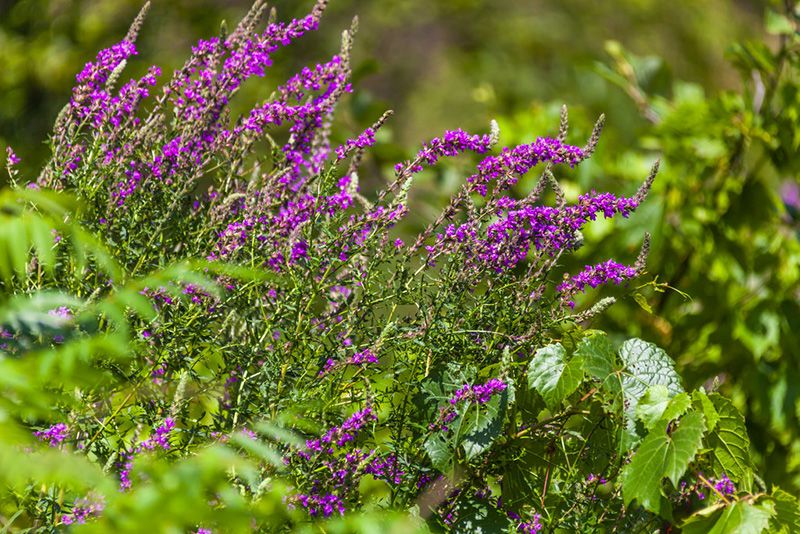
It reaches 80-200 cm. The stem is tetrahedral, covered with stiff hairs. The rhizome is woody, thick, and creeping. The leaves are oblong, up to 10 cm long, reminiscent of willow. The foliage is emerald in summer, turning crimson in autumn.
The flowers are star-shaped and numerous. They are gathered in spike-shaped inflorescences. They bloom in the second ten days of summer. After wilting, capsule-shaped fruits begin to form, containing numerous small seeds.
Produces amber-colored honey with a tart yet pleasant taste.
Varieties of loosestrife
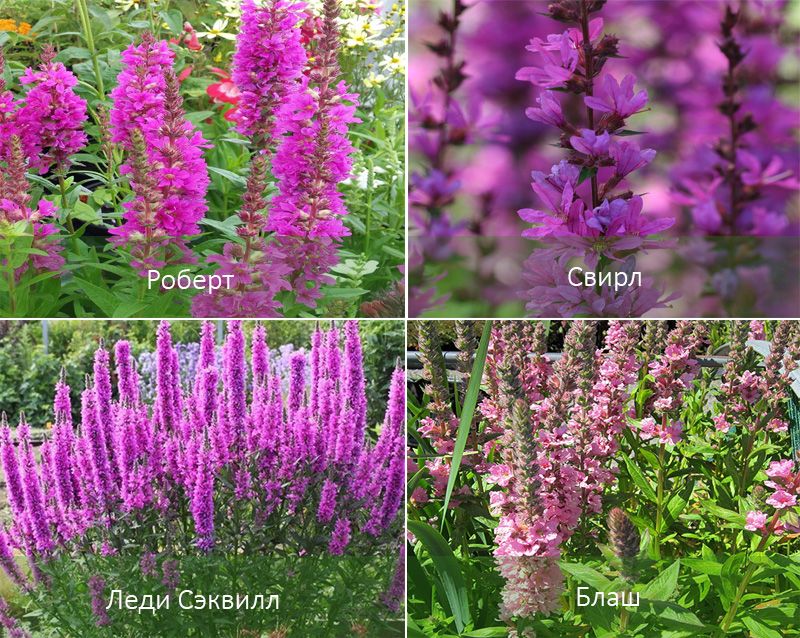
Willow-leaved loosestrife (or willow herb) is one of the most undemanding varieties of this plant. It can tolerate the harsh weather conditions of central Russia. Popular varieties cultivated by gardeners include:
| Name | Description | Flowers |
| Robert | The bush is small in size, not higher than 0.5-0.6 m. | Coral, closer to a reddish-salmon shade. |
| Swirl | Airy and translucent, this variety adds volume to floral arrangements. | Delicate, lilac-purple. |
| Lady Sackville | Forms a textured, tall bush. It is usually planted in the background. | Pinkish-crimson. |
| Blush | Pudding colored. | |
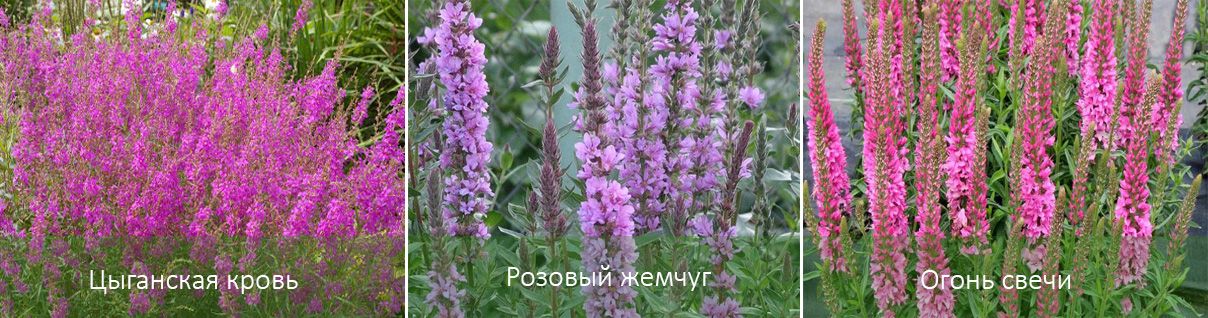
| Gypsy blood | Up to 1.2 m. Bright emerald greenery. | Purple-pinkish. |
| Pink pearl | Up to 120 cm. Forms large clumps of slender shoots. | Collected in dense, candle-shaped inflorescences, crimson. |
| Candle fire | With developed green mass of dark malachite tone. | Dark purple. |
Care, propagation and planting
Reproduction occurs:
- by cuttings;
- division;
- seeds.
If all instructions are followed, the germination rate of planting material is almost 100%. Propagation by cuttings is carried out in May-June:
- Separate the basal shoots that have reached 10 cm, with 4 true leaves.
- Place in Kornevin solution or regular water for rooting.
- After the roots have formed, plant in open ground under polyethylene.
- In the fall, prepare the soil mixture: dig the soil with high-moor peat (8-10 liters per square meter). To improve moisture retention, mulch the soil with loose compost.
- Move the bush to a permanent location. Flowering can be observed the following season.
Dividing a bush is a labor-intensive and difficult method of propagation. It must be done very carefully to avoid damaging the plant:
- Dig planting holes in spring or autumn.
- Place a thick layer of compost on the bottom.
- Divide the rhizome with an axe.
- The cuttings should be immediately planted in a permanent area.
- When planting, leave a distance of 40 cm between bushes.
- This method of propagation is usually used for young specimens, before the rhizome has become very woody.
Features of seed propagation:
- the seed material is collected in the fall and sown from January to March;
- seedlings are kept at a temperature of +17…+21 °C;
- seedlings will emerge in 3-4 weeks;
- transplantation is carried out in mid-May, when the threat of night frosts has passed;
- flowering can be expected only after several years;
- If you sow the seeds before the onset of winter, they will undergo stratification and buds will begin to form within a season;
- With this type of propagation, varietal characteristics are rarely transferred.
Planting and caring for loosestrife (Lythrum salicifolium) doesn't require any special skills or abilities. Even novice gardeners can grow it, as long as they follow these simple guidelines:
| Care | Recommendations |
| Location/lighting | Prefers sunny locations. The brighter the light, the more profuse and prolonged the flowering. Plant in a location free from strong winds and drafts. Otherwise, the stems may break. Ideally, choose a location near the water's edge and plant it 30 cm deep into the substrate. |
| Soil mixture | Oily and rich in humus. Medium to low acidity. |
| Watering | This is a moisture-loving plant. If it's not planted near a pond, it requires regular and abundant watering. However, it tolerates short-term droughts well. During such periods, water a couple of times a week (more if needed). On normally warm days, water once every 7-10 days. |
| Top dressing | Apply before flower bud formation. Use a low-nitrogen mixture. Excess nitrogen will cause stem lodging. |
| Trimming | It's prone to self-seeding, so remove flower stalks before the fruit ripens. Prune again in March or late October, removing any dried-out above-ground growth at the base. In spring, shorten the stems by 15-20 cm to encourage side shoots to grow better and create a fuller bush. Pinching can be continued throughout the summer, if necessary. Prune any overly long or misdirected branches. |
| Other care | Periodically remove weeds, loosen the soil around the trunk, mulch with compost or peat. |
Diseases and pests
Loosestrife is rarely affected by diseases or insects. Aphids occasionally infest the bush. They can be identified by the following signs:
- small moving dots of green or black color;
- sticky, syrupy coating;
- light small spots (puncture marks);
- deformation of shoots and leaves;
- developmental arrest.
If willowherb is used medicinally, poisonous substances should not be used for control. Insects can be exterminated using:
- solution of laundry soap or tobacco;
- a decoction of garlic, onion peel or tomato tops.
You can attract natural enemies of aphids to your garden: birds, ladybugs, and some species of wasps. The larvae of these insects are available at gardening stores.
In severe cases of infestation, insecticides should be used, but the plant should not be used for treatment or honey harvesting. The most effective poisonous preparations are:
- Intavir;
- Actofit;
- Trichopolum;
- Jaguar;
- Fitoverm and others.
Top.tomathouse.com recommends and warns: the medicinal properties of loosestrife and contraindications
Loosestrife contains useful elements:
- alkaloids in seeds;
- glucosides and tannic acids in the rhizome;
- anthocyanins in inflorescences.
The plant has the following medicinal properties:
- antiseptic;
- hemostatic;
- wound-healing;
- anti-inflammatory;
- sedatives;
- general tonic;
- painkillers;
- vasoconstrictors.
It is used to treat many pathological conditions:
- migraines and tinnitus;
- exhaustion of the body;
- colds;
- infectious gastrointestinal tract lesions;
- stomach and intestinal disorders;
- problems with stool;
- fever;
- convulsive seizures;
- nervous disorders (including depression and hysteria);
- cuts and other mechanical damage to the dermis;
- pathologies of the upper respiratory tract;
- toxicosis during pregnancy;
- sleep disorders;
- hemorrhoids;
- inflammation of the prostate gland;
- rheumatism;
- bruises;
- eczema;
- varicose veins;
- bites of rabid animals and snakes.
Willow herb can be used not only fresh. If harvested promptly and dried properly, it will retain its medicinal properties even during long-term storage.
The plucked plant should not be exposed to direct sunlight, but rather stored in shade and a drafty area. Drying takes about two weeks. For medicinal purposes, the dried herb can be used for three to four years.
Despite its numerous beneficial properties, loosestrife is not suitable for every patient. The herb has contraindications:
- high blood pressure (since it has vasoconstrictive properties);
- atherosclerosis;
- rapid blood clotting;
- chronic constipation;
- tendency to form blood clots.
To avoid adverse effects and complications, consult a doctor before using any folk remedy. Furthermore, loosestrife remedies cannot completely cure the condition. They only alleviate symptoms and speed up the recovery process. Therefore, the herb should only be used as part of a comprehensive treatment, along with pharmaceutical medications and other traditional treatments. Only then will loosestrife provide benefits and prevent further harm.