Dichondra is a member of the Convolvulaceae family. It is cultivated as a groundcover and trailing plant. It is often used to decorate apartments, flower beds, terraces, gazebos, and balconies. It is prized for its beautiful, dense foliage, reminiscent of the flowing streams of a waterfall. It is suitable for creating hedges, shade, and façade decoration. Trailing dichondra makes a striking display in hanging pots, while groundcover dichondra spreads across the soil in a beautiful, dense "carpet."
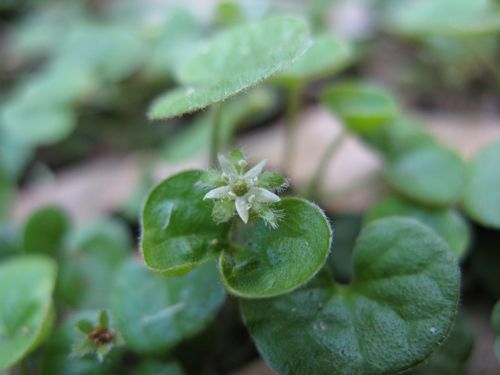
New Zealand is considered the plant's native land, but it is also found in Australia, America, and East Asia, where it grows as a common weed. The name "Dichondra" (from the Greek for "two grains") comes from the shape of its fruit. Florists began cultivating this plant relatively recently, but quickly came to appreciate and love it.
Content
Description
Dichondra is an evergreen, herbaceous plant with a shallow root system. Its stems quickly emerge from the nodes, allowing it to quickly form numerous new shoots.
Characteristic external features of the plant:
- The shoots rise up to 10 cm in height, and the vines grow up to 2 or even 8 meters in length. Densely covered with leaves, they lie on the ground in a beautiful, dense, fluffy carpet.
- The leaves are simple, coin-shaped or kidney-shaped, up to 2.5 cm in size, and come in two shades—silver or emerald. The petioles are up to 3 cm long.
- The flowers are small, 2-3 mm in diameter, with a cream, lilac or greenish hue, and bloom from spring to late summer.
- The fruit is a spherical capsule containing two capsules of hairy seeds in small quantities.
Popular types
Two varieties of Dichondra are particularly popular:
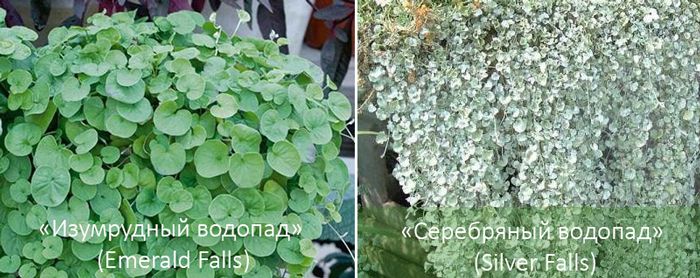
- Emerald waterfall - green, round, not too large leaves;
- Silver Falls – distinguished by its characteristic silvery-ash leaves, longer and less dense branches than the previous one.
Growing at home
Dichondra can be grown indoors. Planting and caring for it are relatively easy. All it requires is:
- timely watering;
- proper lighting;
- comfortable temperature;
- regular feeding;
- correctly selected soil during planting;
- appropriate container (flowerpot).
This plant harmoniously coexists with other plants, so it's often included in various arrangements. Dichondra is planted along the edge, so that its cascading foliage complements the beauty of the flowering plants.
Location, lighting, temperature, humidity
Unlike the Silver Waterfall dichondra, which thrives in bright light, the Emerald variety thrives in shaded areas. Its round green leaves are larger in the shade than in full sun.
The most comfortable temperature for this herbaceous plant is between 18 and 25 degrees Celsius. To avoid frost damage, it requires at least 10 degrees Celsius. Therefore, it is advisable to store dichondra in the winter either in a greenhouse or indoors.
Dichondra is a moisture-loving plant by nature. If the air in the room is dry, its leaves should be misted more frequently.
Choosing a pot, watering
Dichondra loves water, but it's important to prevent its root system from rotting. Stagnant water in the soil is detrimental to this plant. Therefore, the container should have a wide drainage layer. The plant can survive for a short time without water and quickly recover after watering.
To prevent leaf burn, water should be applied directly to the roots. This is best done in the evening. Watering should be gradually reduced as winter approaches.
Soil, replanting, pruning
Dichondra bushes can remain attractive for over five years if properly cared for. It's not picky about soil, but thrives in slightly acidic soils and loamy soils.
To create a dense crown, the plant needs to be pruned periodically. When roots begin to emerge through the drainage holes, the plant should be repotted in a more suitable container.
Repotting is done using the transshipment method. Place a thick layer of expanded clay on the bottom of the container and cover it with soil. Trim any protruding roots, then invert the pot while holding it at the top. At the same time, use your other hand to pull the pot off the plant. Place the roots in the prepared container, covering them with fresh soil.
Top dressing
For top dressing, use a standard fertilizer for ornamental foliage plants. In summer, feed four times a month, alternating organic and mineral fertilizers. During winter, the plant does not require additional feeding.
Reproduction
Dichondra reproduces in different ways:
- seeds;
- layering;
- cuttings.
Obtaining young plants from seeds should be done in January-February:
- Fill the container with fertile soil (loose substrate).
- Plant the seeds in the soil. Place 2-3 seeds per pot at a depth of up to a centimeter. Sprinkle with soil and water.
- Cover with glass, maintaining humidity and temperature from +22C to +24C at all times.
- When the seedlings sprout, remove the glass and place the container with the seedlings in a well-lit place.
- Artificial lighting can be used as additional lighting.
- After at least 2 leaves appear on the seedlings, transplant the plants one by one.
It is much easier to propagate a flower by cuttings:
- In March, cut the cuttings and place them in water.
- After 7 days, plant the stems in temporary containers with sand and peat.
- After another week, transplant the cuttings into a pot or planter and cover with a greenhouse. Once new buds form, remove the container.
Diseases and possible difficulties – table
Dichondra bush is as resilient to adverse conditions as other weeds. It's not particularly susceptible to pests or diseases.
The most dangerous pest for this plant is the nematode. It typically appears in overly wet soil. Treating Dichondra from nematodes is quite difficult. The best way to combat this pest is to maintain a regular watering schedule.
The main difficulties associated with growing Dichondra
| Cause | Signs |
| Insufficient watering. | The leaves are curling up. |
| Insufficient lighting. | The silver variety loses its color and turns green. |