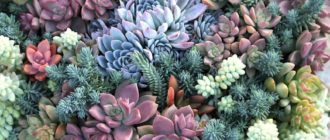
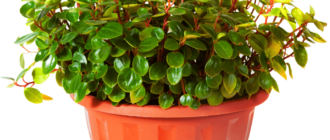
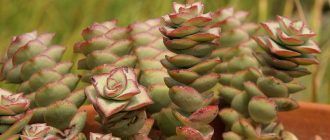
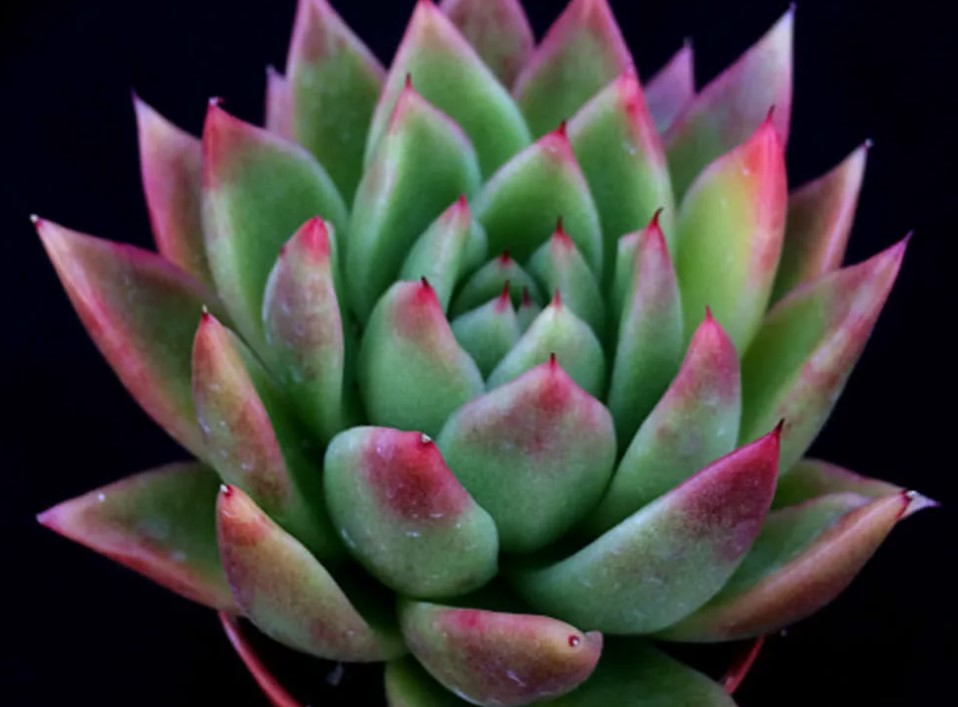
Echeveria is a group of perennial herbaceous succulents in the Crassulaceae family. The genus contains over 170 species. They are found in Mexico, the United States, and South America.
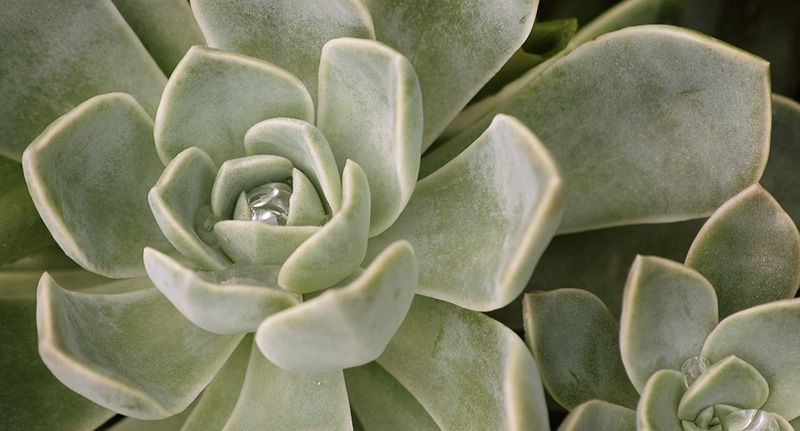
Description of Echeveria
The leaves are thick, fleshy, and succulent, gathered in rosettes 3-40 cm long. They can be flat, cylindrical, or oval with pointed tips. The coloring is green, red, or purple-pink. The blades are pubescent or have a waxy coating. Some varieties have no stem, while others have an elongated one.
The flowers are small, five-membered, bell-shaped, with succulent petals and sepals. They come in a variety of shades: yellow, reddish-brown, and fiery orange. They are borne in an erect inflorescence on peduncles up to 50 cm tall. At the end of these peduncles, offspring begin to form. The root system is superficial and threadlike. Some varieties produce creeping shoots.
Echeveria is similar to sedum, but they shouldn't be confused. The former doesn't tolerate low temperatures, much less frost. In our climate zone, it's grown exclusively as a houseplant. Sedum, on the other hand, survives the winter perfectly outdoors, even without shelter.
Types of Echeveria
Varieties for home growing:
| Variety | Stems/rosettes | Leaves | Flowers/blooming |
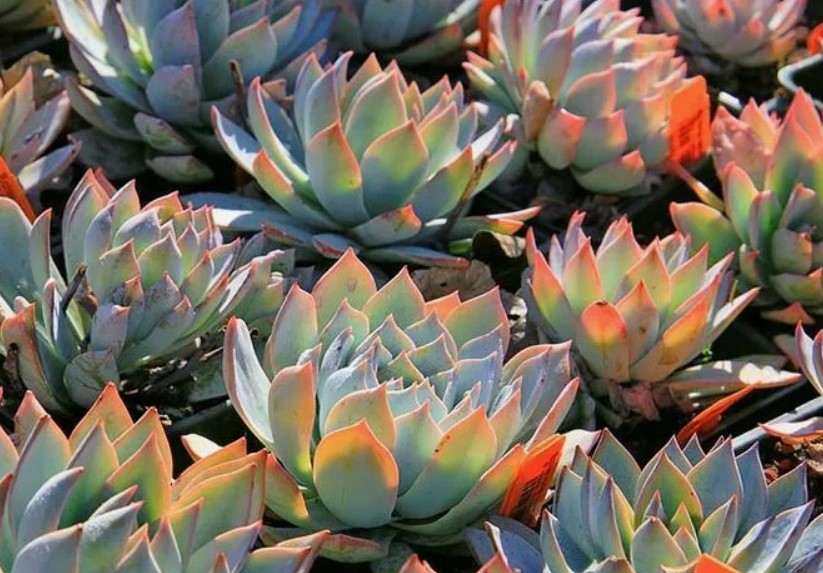
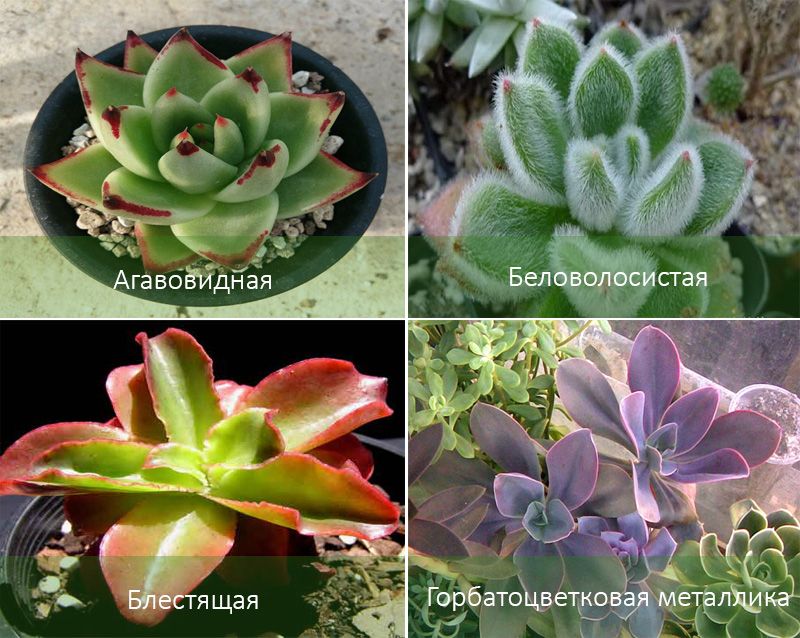
| Agave (Echeveria agavoides) 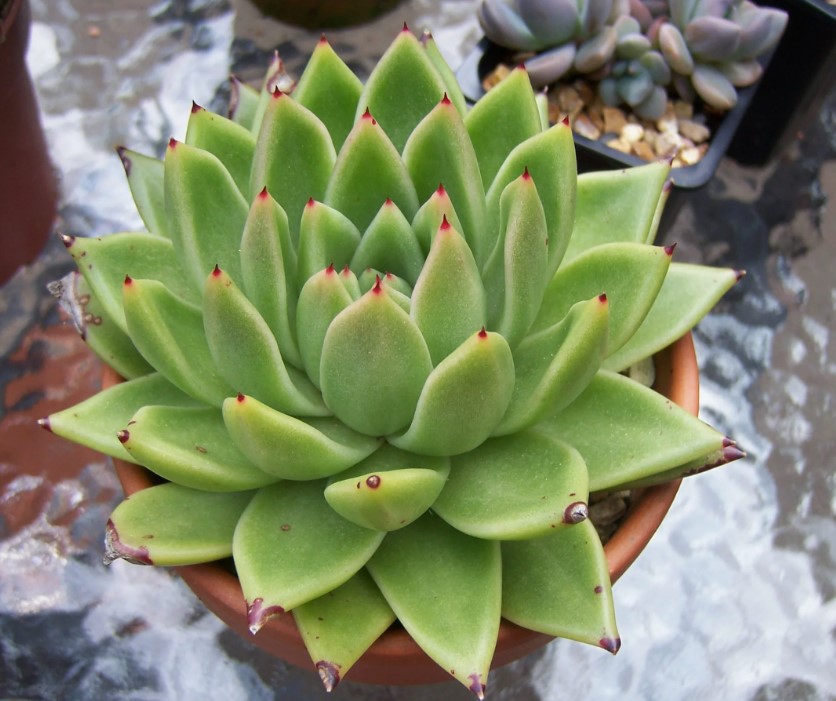 |
Shortened. Dense and roundish. |
Widened at the base, tapering toward the center. Delicate emerald hue. The pointed tips are yellowish-green with a gray-blue waxy coating. | Yellow or reddish, bell-shaped.
Spring - summer. |
| White-haired (Echeveria leucotricha) 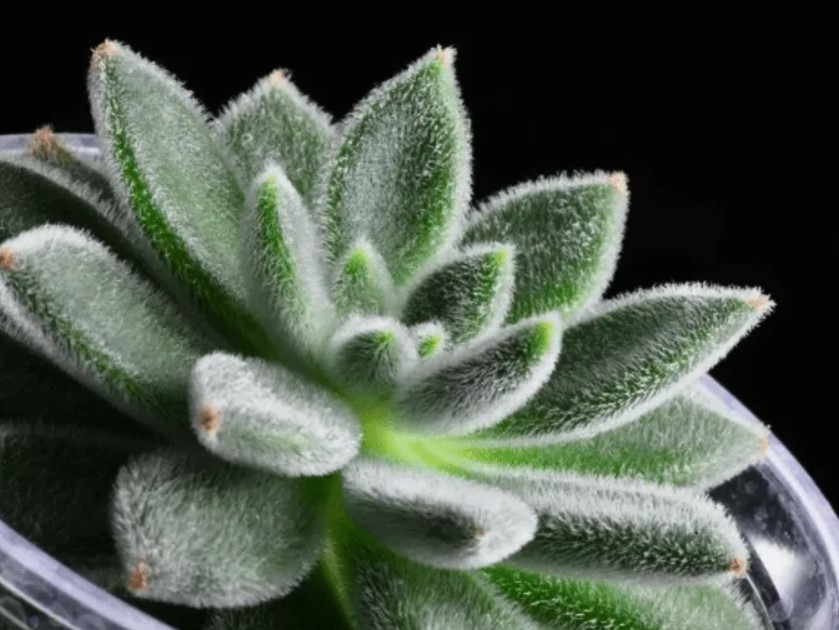 |
Shortened.
Up to 15 cm. |
Lanceolate, oblong. The outer surface is flat, the inner surface is convex. Emerald in color with a dark border and whitish hairs. | Reddish-brown on elongated peduncles.
Spring. |
| Brilliant (Echeveria fulgens Lera) 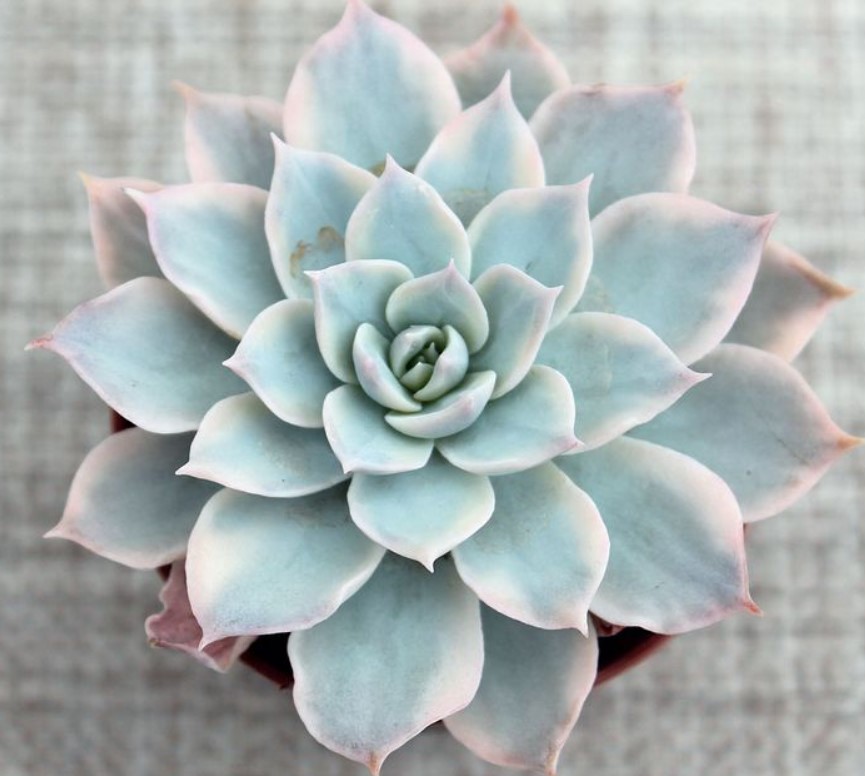 |
Thickened. Second-order shoots emerge from the main rosette. |
Oval-oblong with a pointed tip. Green in color and with a bloom around the perimeter. | Scarlet, 1-2 cm in diameter.
The end of winter is the beginning of spring. |
| Humpbacked Metallica (Echeveria ×gibbiflora 'Metallica') 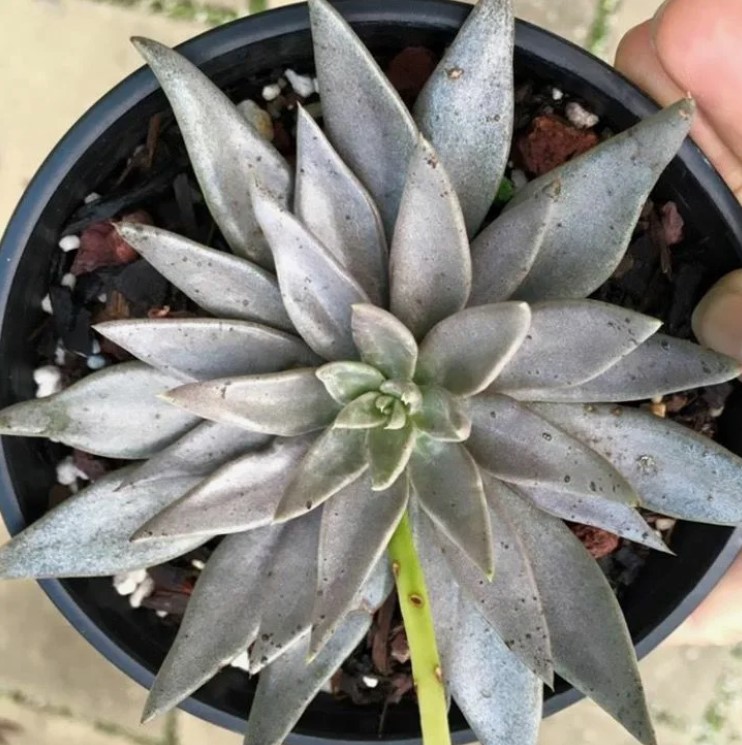 |
Unbranched, woody.
With 15-20 leaves. |
Lanceolate, with a pointed tip. Concave on the outer surface, convex on the inner surface. The edges are wavy. The color ranges from gray-blue-green to red-gray with a light border. | Reddish-yellow bells, up to 2 cm in diameter.
The last month of summer. |
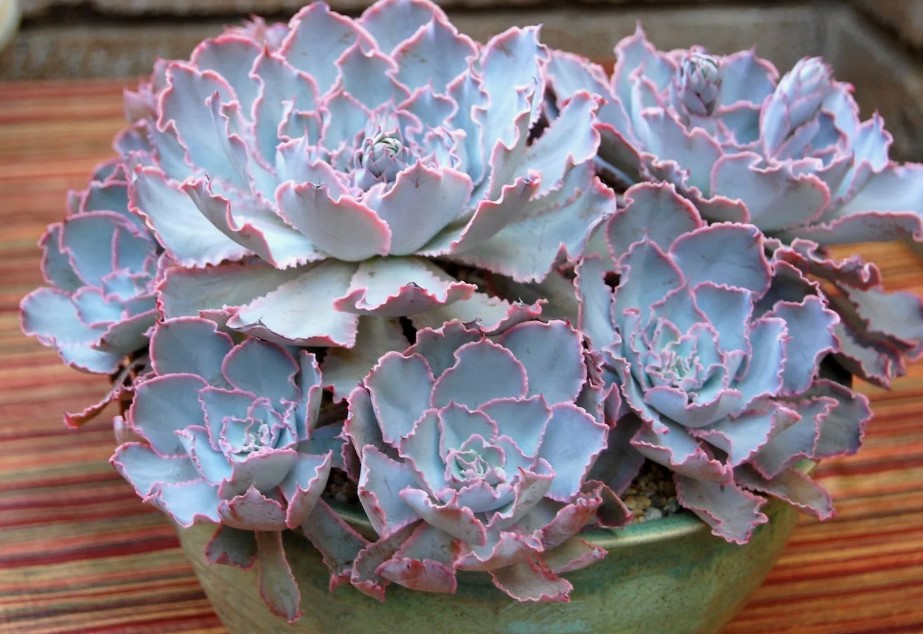
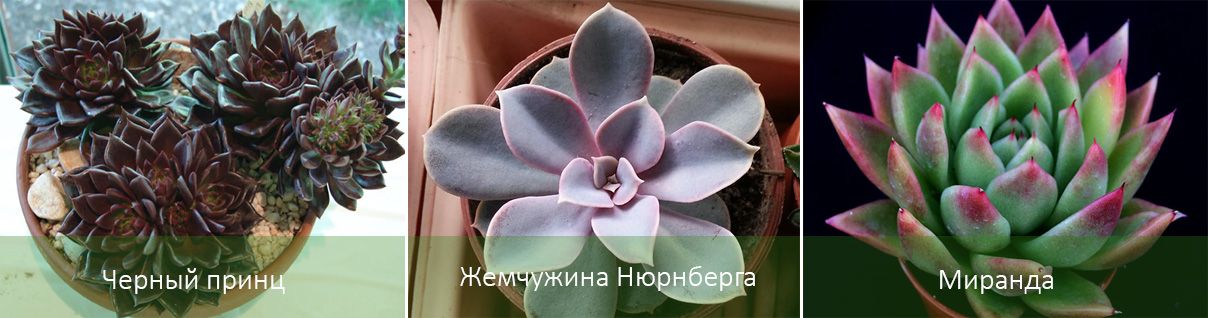
| Hump-flowered Pearl of Nuremberg (Echeveria ×gibbiflora 'Perle von Nurnberg') 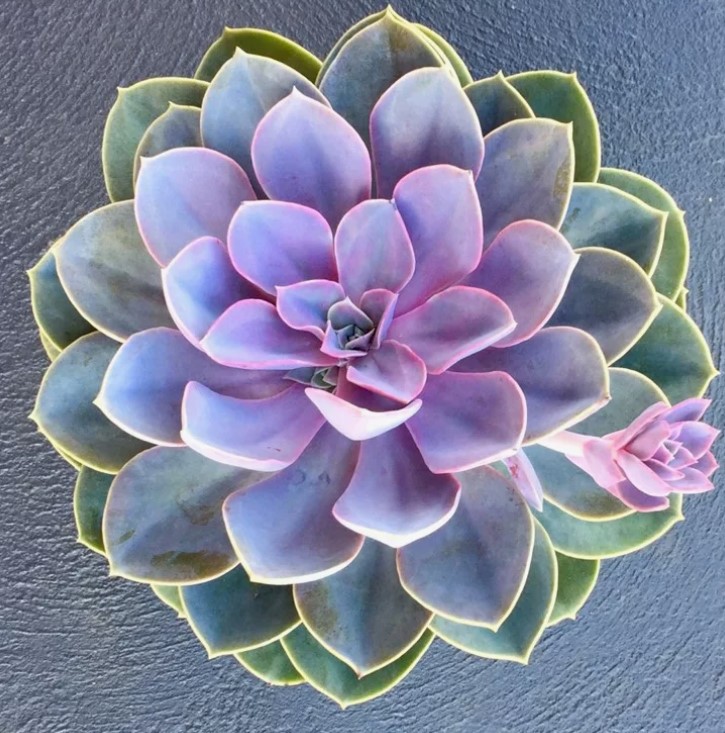 |
Erect, short.
Dense, large 10-20 cm. |
Wide and juicy, with a pinkish-gray bloom. | Muted scarlet.
Summer. |
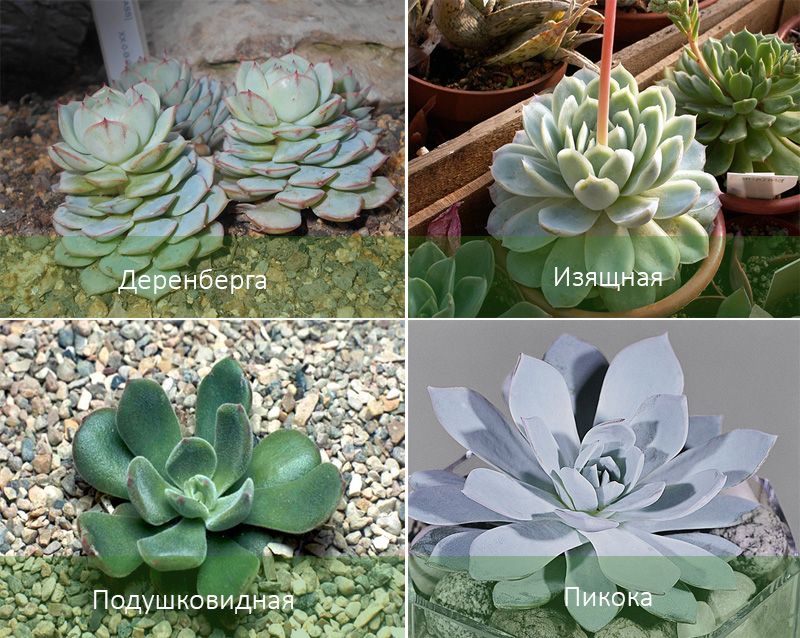
| Derenberg (Echeveria derenbergii) 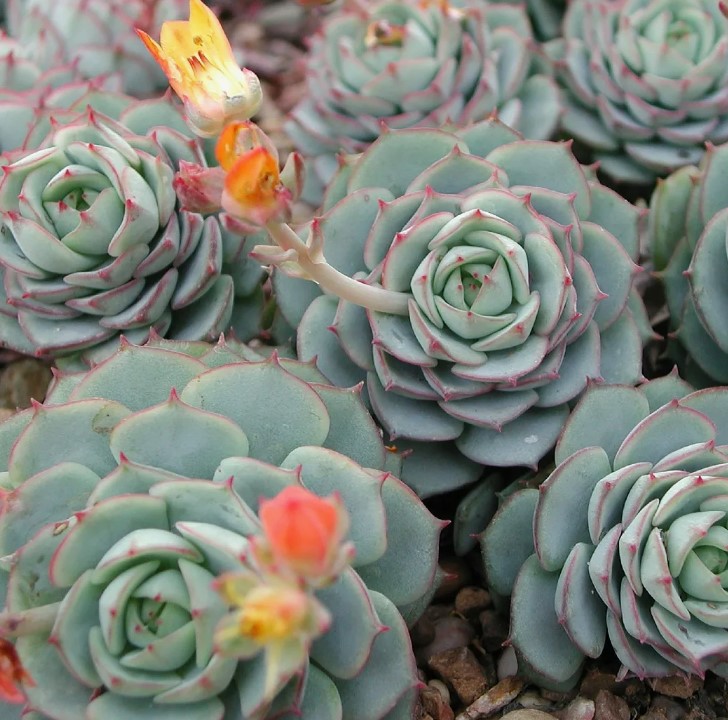 |
Compacted, creeping.
Correct form. |
Spatulate, green with a pinkish or dark border. | Reddish-yellow bells on peduncles.
From April to June. |
| Graceful (Echeveria elegans) 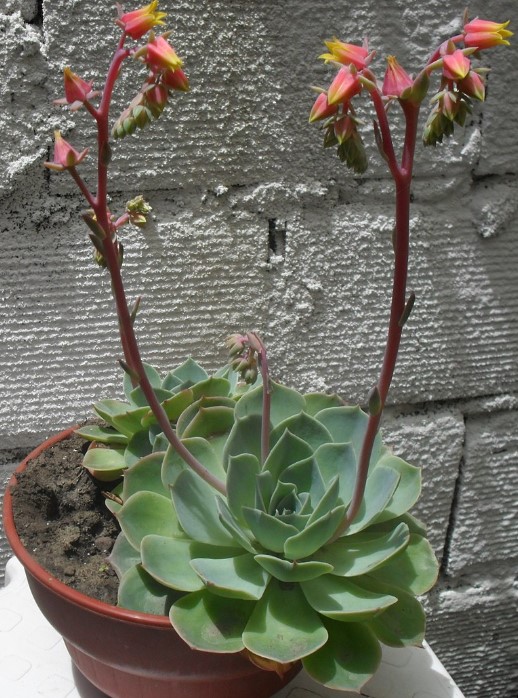 |
Underdeveloped.
Dense. |
Rounded, with a pointed end, with a light green or grayish-blue coating. | Pink, with a yellowish tip on branched peduncles.
May. |
| Cushion-shaped
(Echeveria pulvinata) |
Shortened, grassy.
Loose. |
Round, fleshy. Green with silvery hairs and spines at the ends. | Pubescent, reddish-yellow in color, 1-2 cm in diameter. First half of March. |
| Peacock
(Echeveria peacockii)
|
Not long, straight.
Loose. |
Spatulate, with a pointed end, grey-blue-green. | Red, located on drooping peduncles. May - June. |
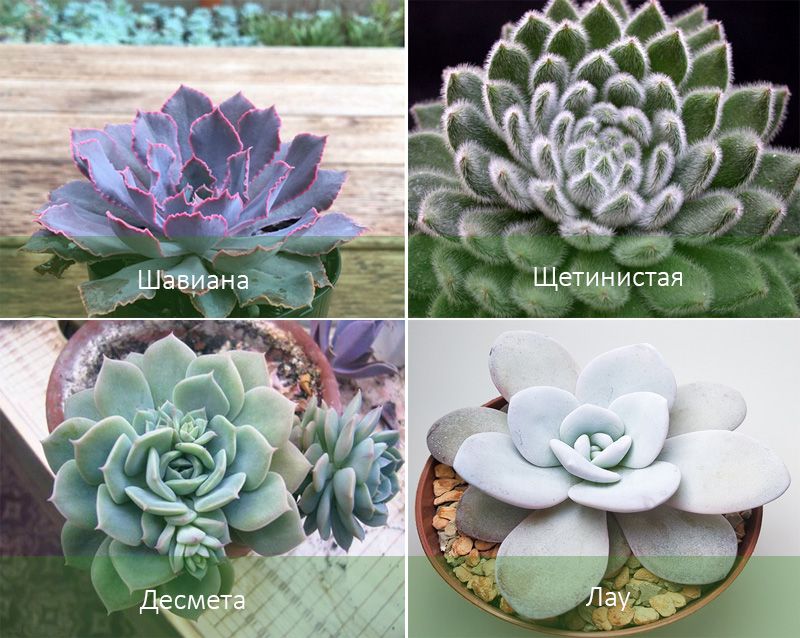
| Shaviana (Sho)
(Echeveria shaviana) |
Herbaceous, underdeveloped.
Compacted, regular shape. |
Flat, oval, with a pointed end. | Pink, located on straight, branched peduncles.
June. |
| Bristly (Echeveria setosa) 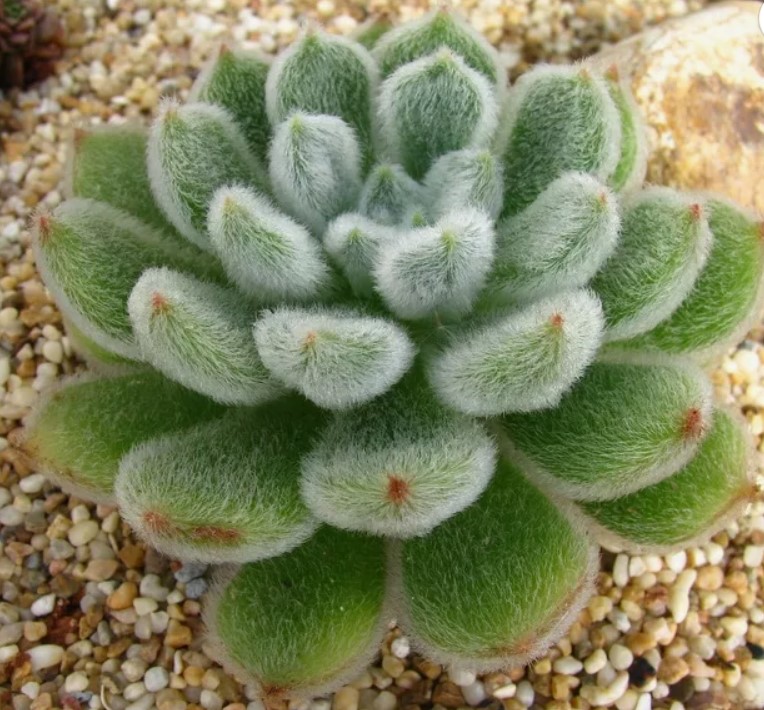 |
Almost none. Compacted. |
Lanceolate, fleshy. Uniformly colored bright green. The blade has silvery bristles. | Small, up to 1 cm. Collected in inflorescences of 30-40 cm.
The beginning of summer. |
| Desmeta (Echeveria desmetiana) 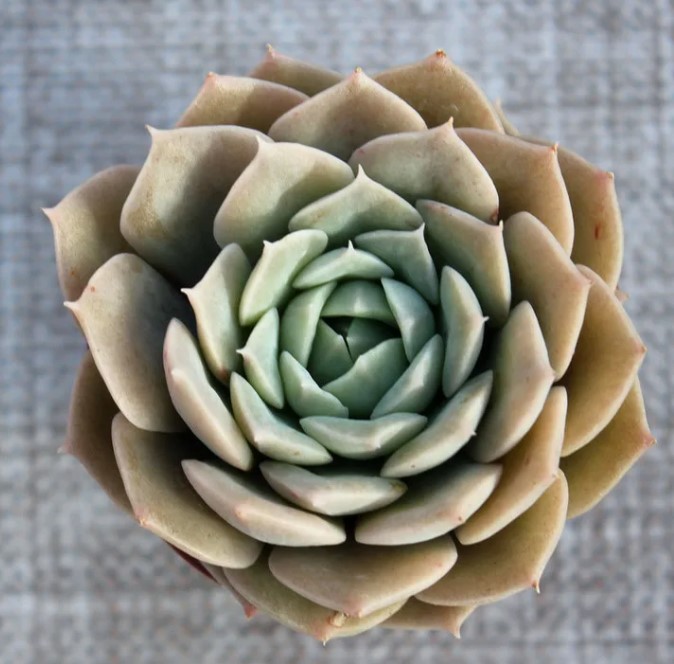 |
Long, drooping.
Compact, up to 10 cm. |
Small in size, bluish. | Yellow, on the side arrows.
Summer. |
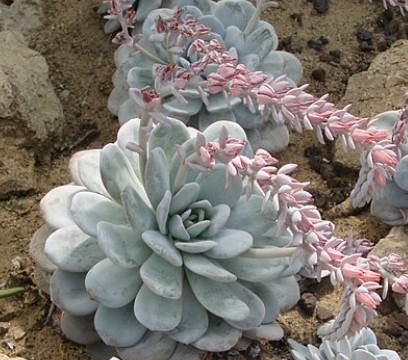
| Lau
|
Short or absent.
Juicy. |
Fleshy, oval, bluish-white. | Dark pink, collected in inflorescences.
April - May. |
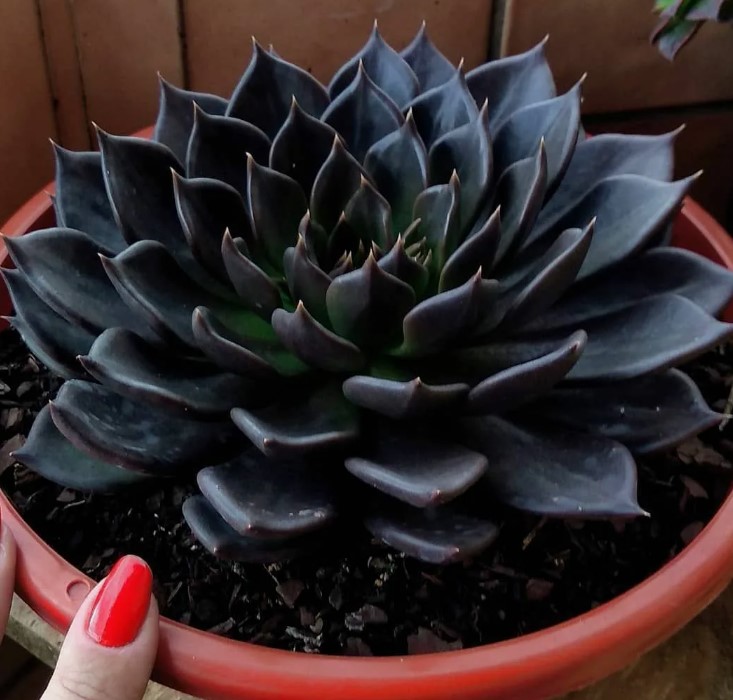
| The Black Prince
|
Almost invisible. Juicy, dense. |
Dark green and long with a pointed end. | Red, collected in a racemose inflorescence.
End of summer. |
| Miranda
|
None.
Small, neat, lotus-shaped. |
Blue, purple, scarlet, silver, yellow, pink. | Warm pinkish. Spring and summer. |
Caring for Echeveria at Home
Echeveria is an easy-to-care-for plant that thrives in apartments. Here's how to care for it at home based on the seasons:
| Parameter | Spring/summer | Autumn/Winter |
| Temperature | +22…+27 °С. | In a dormant state - +10…+15 °C. During flowering - not below +18 °C. |
| Humidity | Need dry air, do not spray. | |
| Watering | As the top layer of soil dries out. | Once a month. During winter dormancy - only when the leaves wrinkle. |
| Lighting | Direct ultraviolet rays. | |
| Top dressing | Once a month. | Not needed. |
Landing, transplant
Some gardeners recommend repotting the plant immediately from its shipping container, as the soil in it is designed for the echeveria's development. Others believe that leaving the plant in the same soil for a month won't harm it. On the contrary, the succulent will acclimate and adapt to the new conditions. To do this, place it in a shaded area to dry gently until aerial roots appear.
The substrate is made from the following components in proportions 3:1:1:0.5:
- garden soil;
- pebbles;
- peat;
- charcoal.
You can buy soil for cacti and succulents and mix it with small stones at a ratio of 4 to 1. After preparing the substrate, it is recommended to test its suitability: squeeze a lump of damp soil in your fist; it should crumble when released.
The pot should be 1-1.5 cm larger than the previous one. The succulent has a shallow root system, so it needs a wide but shallow container with drainage holes.
When the planting material is small, it is recommended to transplant it into cups for further growth. Once the bushes have established themselves, they can be moved to permanent pots. Large containers are used to accommodate several Echeveria plants at once. Water the bushes carefully to avoid waterlogging.
Step-by-step landing:
- Lay out a 2 cm drainage layer.
- Pour a small amount of substrate and place the flower in it.
- Add soil up to the root collar.
Into clean gravel:
- Fill 1/3 of the pot with stones.
- Place a bush in it.
- Cover the remaining space with the remaining gravel.
The larger the plant, the larger the stones should be.
Young plants should be repotted once a year. Mature plants should be repotted as needed, when their roots become overgrown or when they are affected by disease or pests.
Reproduction
Echeveria is grown:
- leaf cuttings;
- apical and basal shoots;
- rarely by seeds, as this is a labor-intensive process.
The first method of reproduction occurs like this:
- Separate the formed lower leaves. Dry for 2 hours.
- Press into the ground at a slight angle.
- Spray, cover with plastic.
- Leave at a temperature of about +25 °C. Remove the cover daily and moisten the sprouts.
- After 2-3 weeks, young rosettes will emerge. When the seedling leaf dries, replant the shoots.
Planting basal or apical shoots:
- Cut off the shoots, remove 3-4 lower leaves, leave in a dark place for several hours.
- Pour the substrate into the pot, insert the rosettes into it, and moisten.
- Keep at +22…+24 °C, water every day.
- After 2-3 months, they can be transplanted into separate containers. If the plant is growing slowly, it's best to postpone the transplant until spring.
Growing from seeds:
- In February-March, distribute evenly over the surface.
- Moisten, cover with glass.
- Keep at +20…+25 °C, water and ventilate.
- After 2-3 months, transplant the shoots into smaller containers. When the bushes reach 3 cm, move them to their permanent pots.
Problems with growing echeveria
If care is improper, echeveria will lose its decorative appeal or die. Causes and solutions:
| Symptoms | Reasons | Treatment |
| Grayish spots, disruption of the waxy coating. |
|
|
| The bush is fragile and takes on a grey or black tint. | Excess moisture and cold. |
|
| The rosette has become loose and elongated. The foliage has become dull. | Lack of light. | Increase the light level gradually. Doing so abruptly will stress the plant and cause it to become ill. |
| The flower grows slowly, the leaves become smaller. |
|
|
| The plates and rosettes are wrinkled and dry. | The soil is not moistened in hot weather. |
|
Diseases and pests of Echeveria
Echeveria is susceptible to diseases and insects.
| Disease/pest | Symptoms | Ways to get rid of it |
| Mealybug | The presence of a dirty-white, cotton-like fluff on the stem and rosettes. If severely affected, the foliage wilts and falls off. |
|
| Root mealybug | Insects suck the sap from the roots. The foliage turns pale, yellow, and wilts. A grayish-white, wax-like coating is visible around the edge of the pot. Pests can be noticed during repotting. |
|
| Root-knot nematodes | These are small worms that suck the sap from the rhizome. This causes swellings to appear on the rhizome, where the pests live. If the infestation is severe, the root system dies, and the plant dies. | |
| Root rot | The roots, stems, and leaves become loose, soft, and black. The foliage becomes smaller, turns yellow, and falls off. As a result, the bush dies. |
|
Reviews of growing echeveria
Such a variety of Echeverias (including an unusual cristate one)! I'll explain and show you in detail how they grow over four years. Care tips are also included.
I have a lot to tell and show about Echeveria! My plant collection currently includes two mature specimens of varietal Echeveria, one of which (my pride!) is cristate (and there's also an unnamed baby whose varietal identity I haven't yet figured out).
Echeveria Purpusorum
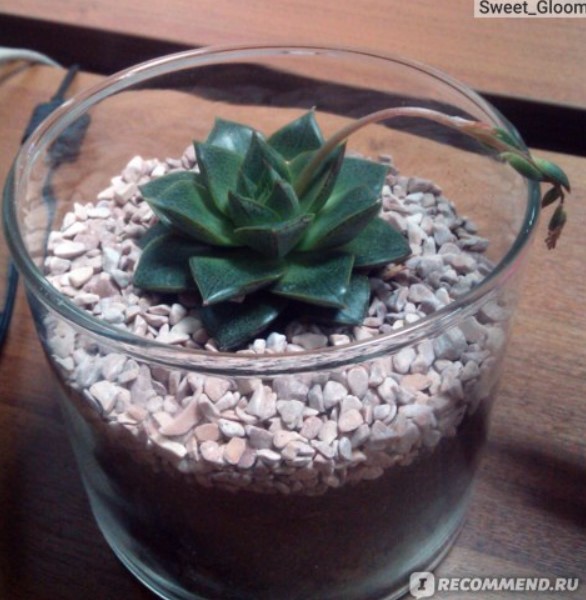
First, let me tell you about my Purpuzorum. I got it a little over four years ago. It happened at work. Our then-boss bought succulents for the staff, planted in glass vases. For office feng shui, so to speak. I had the honor of being the first to choose any of them for myself. My choice fell on Purpuzorum. Back then, I had no idea what variety it was and only vaguely guessed it was an echeveria. I liked the plant for its compact rosette of dense, dark green leaves. The rosette was crowned by a thin, now half-drooping flower stalk. I have a photo from that very first day (May 2016):
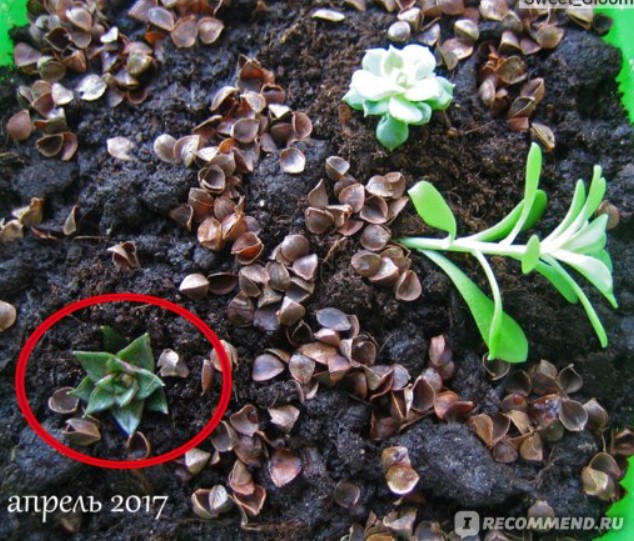
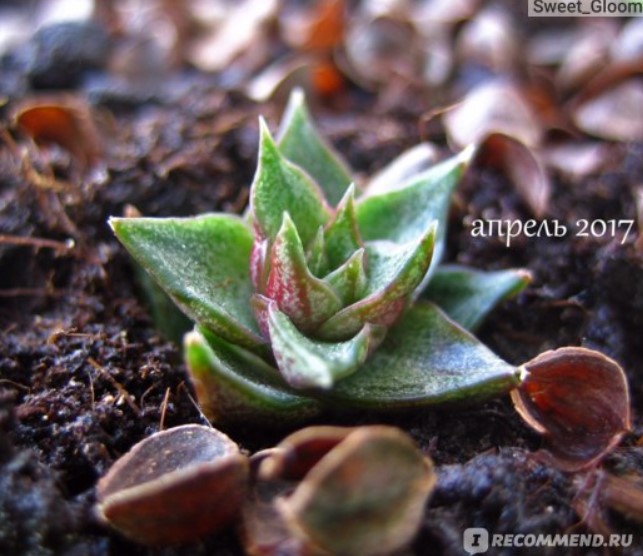
I had a purple succulent growing at my work for almost a year. Our office at the time was in the basement, and there were no windows at all in our part of the office. Because of this, the poor plant had become stretched and lost its decorative appeal. I decided not to torment the plant any further, carefully cut off its top, and took it home to root. I simply stuck the top into loose soil. Here's a photo from April 2017 (a couple of other succulents are rooting in the pot at the same time, and I singled out the purple succulent):
Here it is:
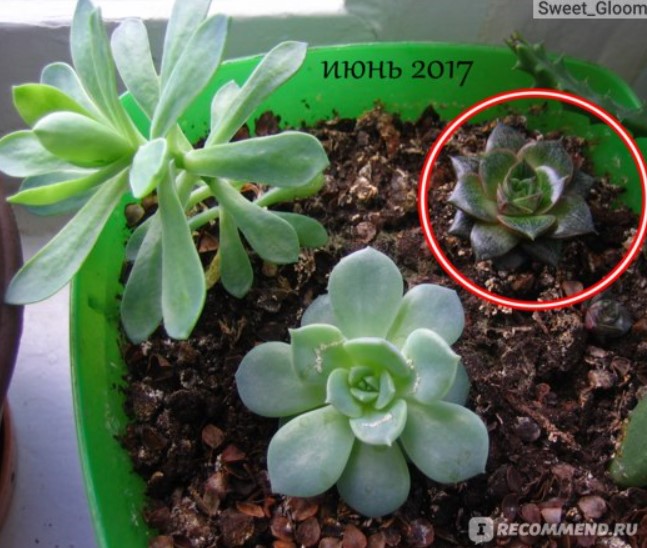
This photo was taken in June 2017, two and a half months later (you can see that the cutting has successfully rooted and started growing, and its neighbors have also been pretty upset):
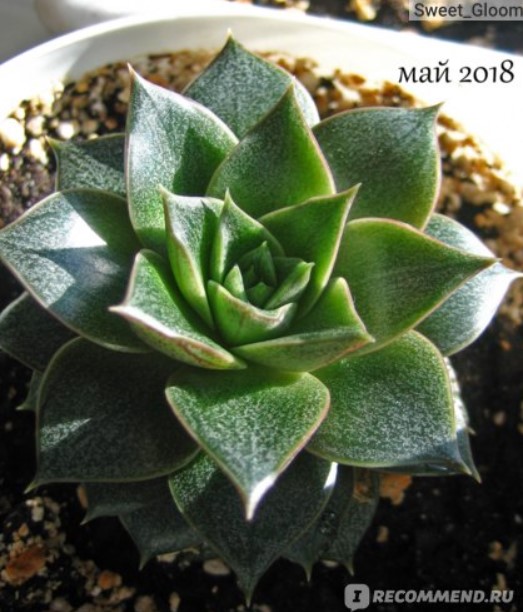
Almost another year has passed. The next photo is from May 2018. The echeveria has grown.
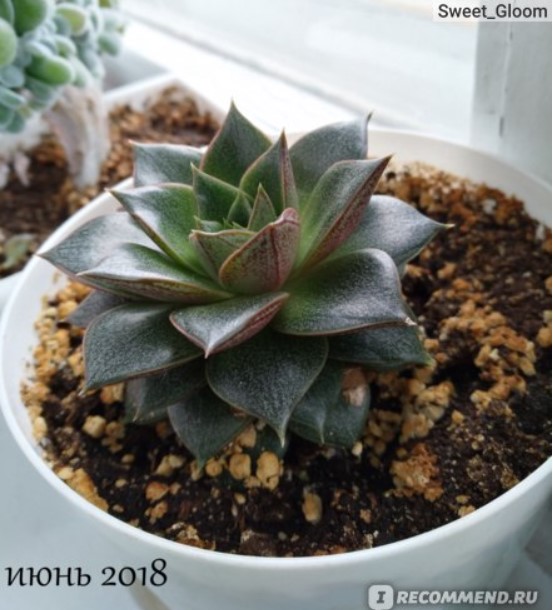
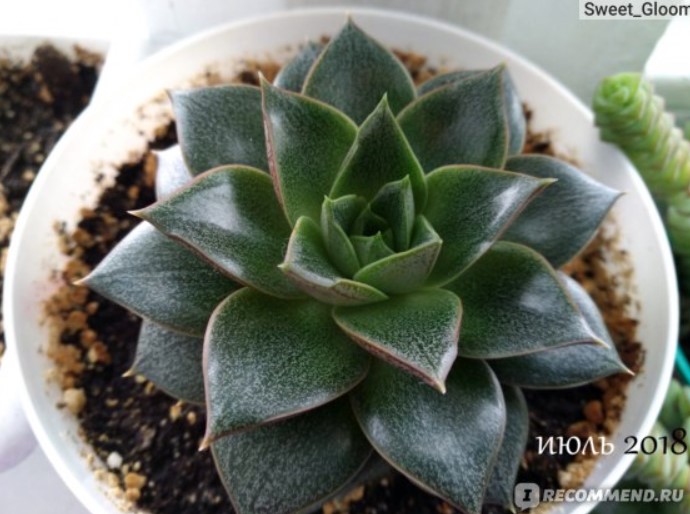
This is June and July of the same year (the summer sun has made the leaves brighter, making the characteristic "purple-rum" pattern even more noticeable):
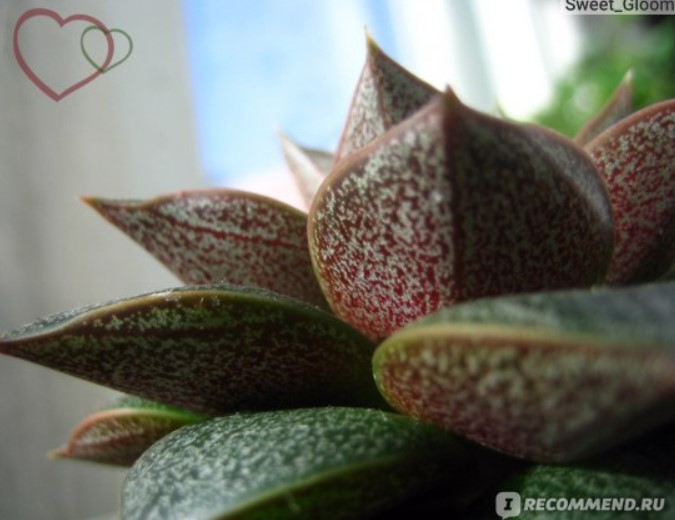
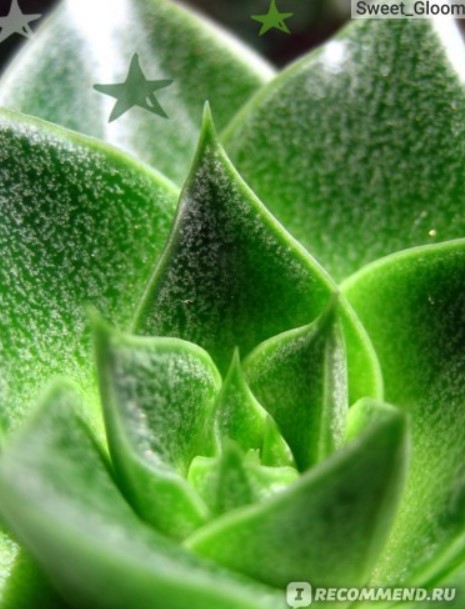
The underside of the leaves is a purple pattern. The top side is dark green with stunning silver speckles. When I reach for my Purple Pattern with my camera, I can't drag myself away from it! Admire it yourself!
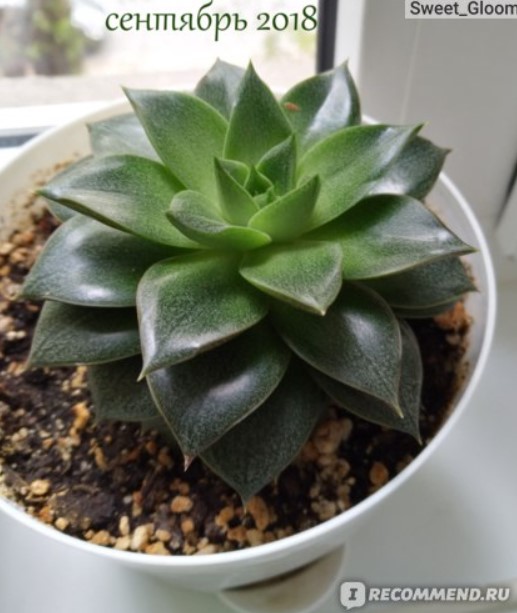
The next photo is from September 2018. The leaves show that daylight hours are waning. The color has become greener and noticeably lighter.
But even in this "garb," I like Echeveria purpusorum. How can you not love it?
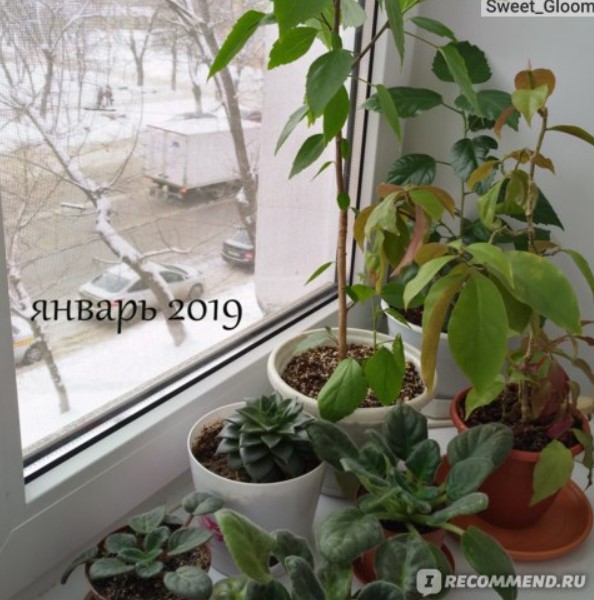
This is an echeveria in winter, missing the warm sunny days with its neighbors.
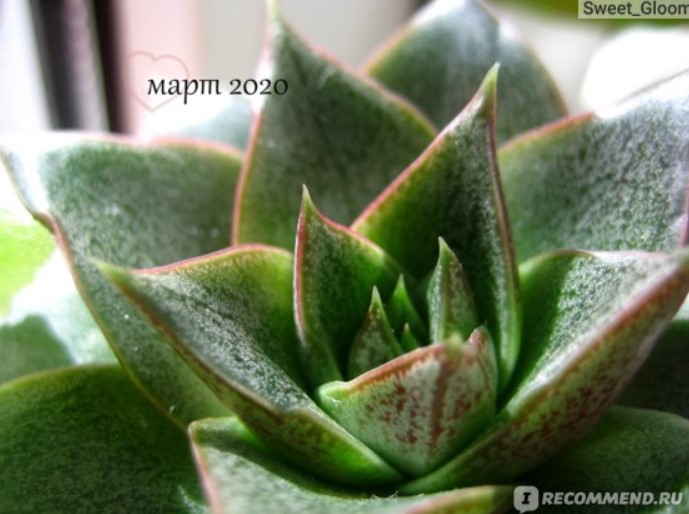
And this is March. True, it's already 2020. Smile You can't hide spring from the plants. You can immediately see how the tips of the leaves are covered with a delicate blush.
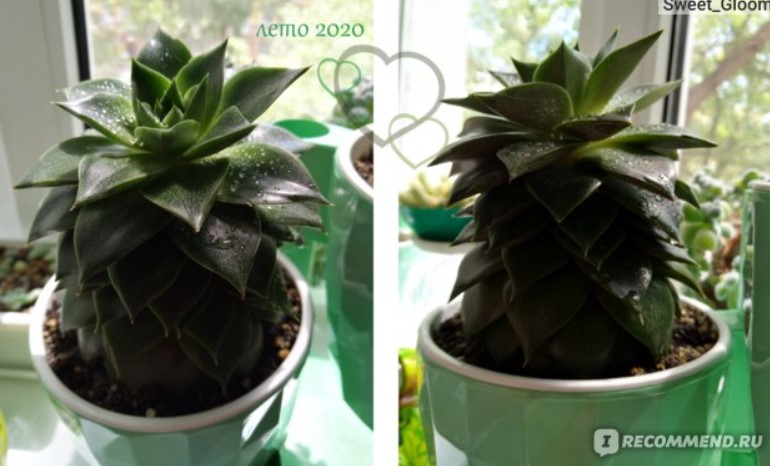
Well, this is what my Echeveria Purpusorum looks like today.
This beautiful plant grew without much effort or diligence on my part. It's not difficult to care for at all. So...
Care
Light. If you already have any succulents, caring for echeverias won't be a new experience. Choose a well-lit spot for the pot. Even direct sunlight is fine! Just avoid placing it in the shade. The plant will stretch out and lose its beauty (which, as you've seen, is completely reversible—you can take cuttings and grow it again).Temperature. My echeverias grow year-round in the warmth of my apartment. During cold weather, the heating is central, from about October to April. So, I don't give my plants a dormant period. However, reputable sources claim that the plants overwinter at temperatures of 6 to 8°C. So, if you have a cool corner of your windowsill, you can safely move your echeveria pots there for the winter. In summer, the optimal temperature for them is considered to be 22 to 27°C.
Watering. They need to be watered moderately; less frequently than their non-succulent counterparts. In winter, watering is reduced even further. Overwatering can lead to rot. Furthermore, the plant will grow faster and stretch more, even in bright light. If you want a compact, dense plant, follow a watering schedule. It's better not to overwater than to underwater. Echeverias easily tolerate underwatering. If you notice that the leaves have become thinner and flatter, it means they haven't been watered in a while. Smile
Humidity. Echeverias don't care at all about ambient humidity. So you don't need to bother with misting or using humidifiers. In some of my photos, you can see droplets of water on the plant. I do this very rarely and only for the sake of the photo.
Fertilizing. Echeveria can be fed with a standard cactus fertilizer at a low concentration. During the active growing season (spring and summer), once a month is sufficient. No additional feeding is necessary in the fall and winter.
Soil. The soil for planting/repotting should be loose and breathable. If the soil is too heavy, the roots will suffocate. A good commercial succulent soil will do. Or you can make your own mix, as I usually do. In this case, add perlite, sand, charcoal, and a little sod soil to the general-purpose soil.
And here is a short “cheat sheet” with basic care rules:
Lighting is bright, direct sunlight is possible.
Summer and spring temperatures range from 22 to 27°C. It tolerates wintering at lower temperatures, but warm wintering is also possible.
Watering is moderate, restrained in winter.
Fertilize in spring and summer once a month.
The soil should be loose and permeable, with the addition of cultivators such as perlite, sand, and charcoal. The soil pH should be approximately 6-7.Echeveria pulvinata Frosty cristata
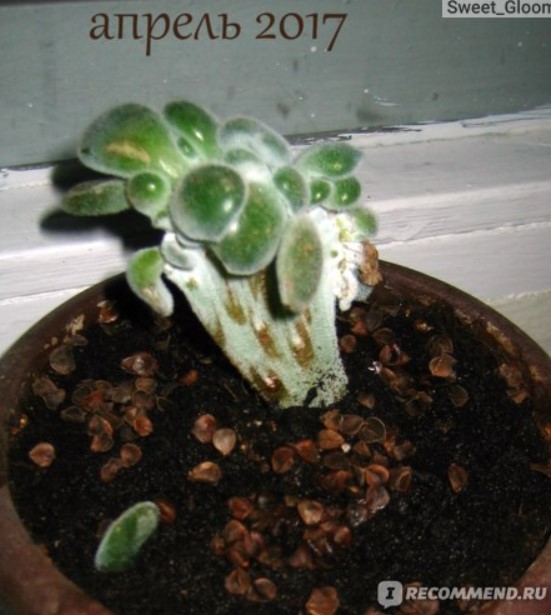
I saved my second favorite for last! This exotic beauty came to me by chance, as I did with many plants—from the clearance section of a large hypermarket. I bought this strange-looking plant along with some other predators: a sarracenia and a nepenthes. What a lucky day it was! For less than a hundred rubles, I acquired three fascinating plants (about 30 rubles each). That was April 2017. The echeveria and nepenthes are still happily living with me. The sarracenia had a sad story.But let's get back to our Frosty (as I sometimes affectionately call her). This is what she looked like right after we bought her:
Some of the leaves were damaged, and the echeveria looked like a strange, unkempt oddity. Its pot bore no identifying marks except the proud label "Succulent Mix." At first, I had no idea what kind of plant it was and simply called it "fluffy." But you can't immediately tell it was an echeveria. Its shape was completely different from all "normal" echeverias. And I learned much later that plants could be cristate.
What is a cristate plant? Very simply put, the stem of a typical plant is a rod with a single growth point. But sometimes a mutation occurs, resulting in a growth anomaly. Instead of a rod with a single growth point, the stem becomes a wide "comb" with a continuous line of growth points. This is called cristate. The word "cristate" itself comes from the Latin "crista," meaning "comb." Cristate plant forms are prized by many gardeners. Some even collect them. Cristate cacti and succulents are especially popular and spectacular.
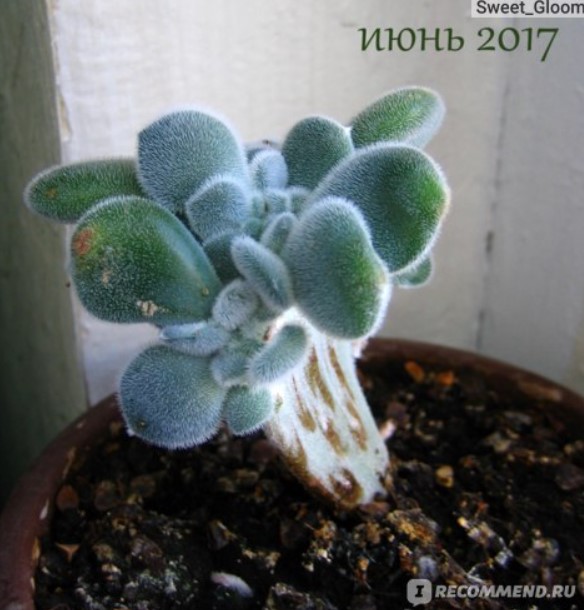
What luck can happen! I snagged a cristate echeveria in the clearance section for next to nothing! I can't believe it myself! SmileAfter two and a half months, my new charge has noticeably come to life and become more beautiful. New delicate leaves have begun to appear, and her "comb" has become fluffy.
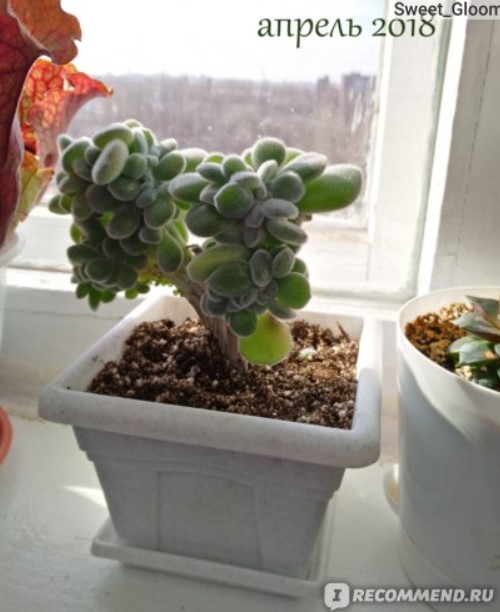
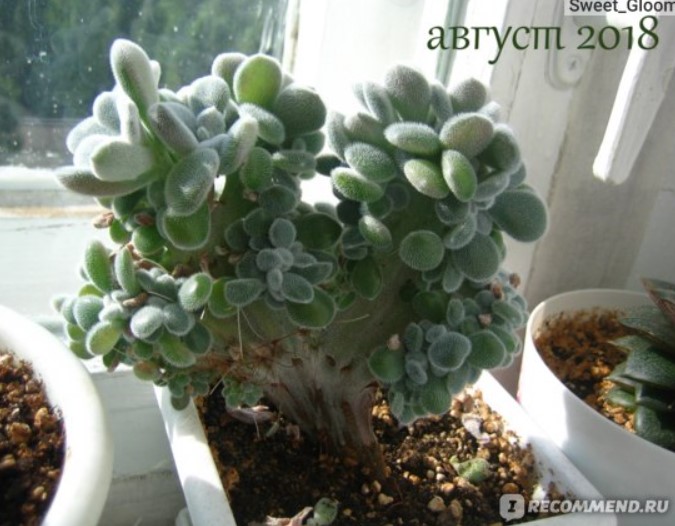
And now a year has passed since the purchase, it’s April 2018. My little animal has grown noticeably, the comb has begun to divide into two parts.
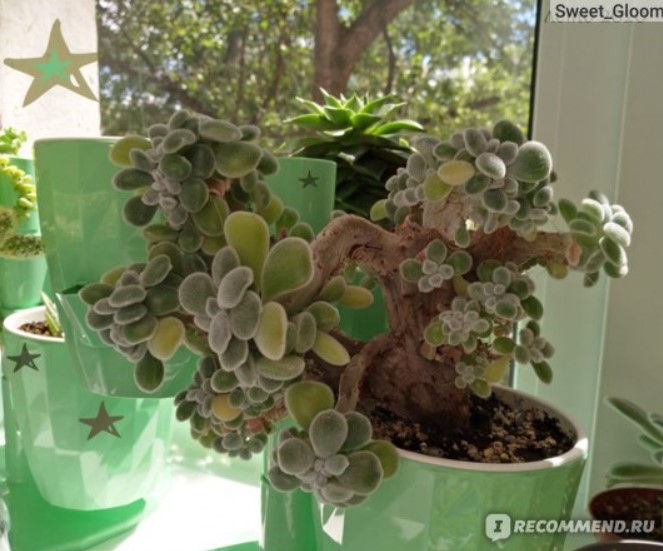
And how big we've gotten over the summer! It's hard to believe this is the same puny, discounted runt I brought home from the store. The comb has started to branch out, and the plant is starting to take on the shape of a tree.
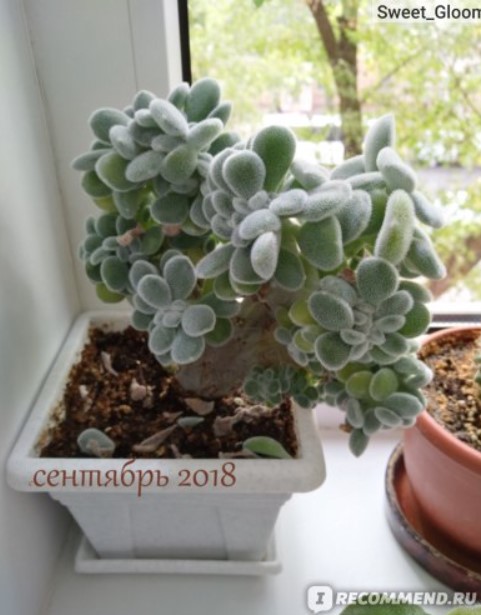
And this is the end of September. We moved to a new apartment, and all our green friends followed us. Smile You can see that the echeveria has begun to lean to the side under the weight of its asymmetrical stem. I didn't mind and let it continue to grow.
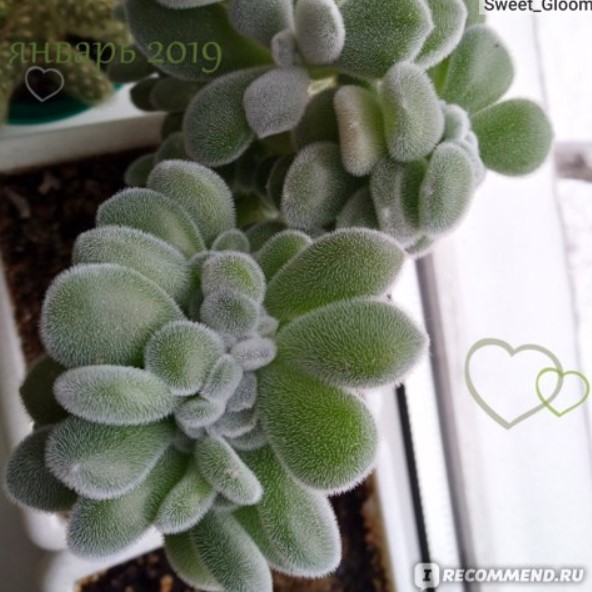
The next photo was taken in January 2019. I'm admiring the beautiful scallop. Join us!
Sometimes, cristate echeverias develop regular, round stems with a single growth point. This is quite common.
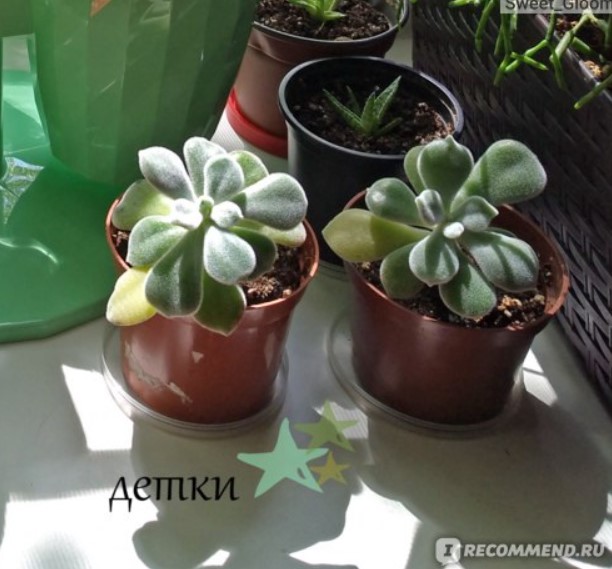
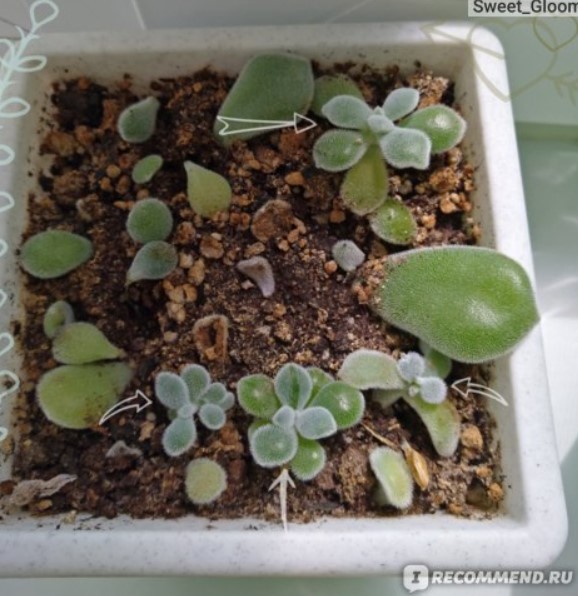
If you want to keep your bush in its cristate form, simply remove non-cristate stems as they appear. Incidentally, they root very easily. Just stick them in the soil and voila, you have a new echeveria! Smile. These are the babies growing on my "fluffy plant" today:
They're not cristate yet. And it's not a given that they will be. But the very first cutting I took from this echeveria also cristates over time.
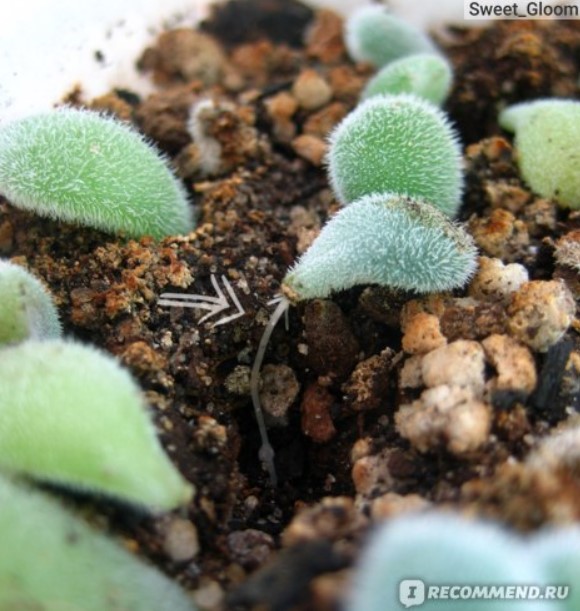
Echeveria pulvinata is very easy to propagate. If a leaf accidentally falls into the ground, it will quickly take root.
And after a while, little ones start appearing nearby. I even set aside a special pot for the "nursery." I put all the fallen leaves in there. And this is what happened:
This is what my Echeveria pulvinata Frosty cristata looks like today. A whimsical, spreading "tree." And I'm already thinking about pruning it for shape...
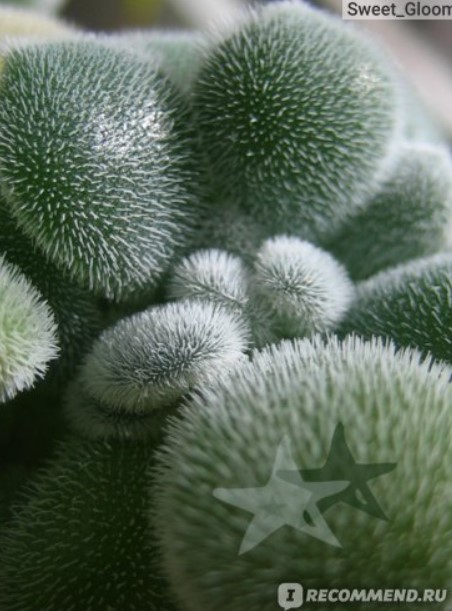
And finally, a few more photos of my Frosty's unusual beauty:
I hope my review was interesting. I'd be thrilled if it inspired you to get to know these beautiful echeverias better, and hopefully develop into a lasting friendship! ♥
Advantages
Beautiful
Unpretentious
Flaws
No
Sweet_Gloom
recommends