Aechmea is a perennial tropical rainforest flower from the bromeliad family, native to Central and South America. It grows on the trunks of old trees (epiphyte).
There are rare terrestrial species. Florists value them for their decorative, funnel-shaped leaves and unusual flowering, which is long-lasting, occurring only once per rosette.
Content
- 1 Description of Aechmea
- 2 Indoor types of Aechmea
- 3 Growing Aechmea indoors
- 4 The subtleties of planting and replanting Aechmea
- 5 Fertilizing and watering Aechmea
- 6 Reproduction of Aechmea
- 7 Top.tomathouse.com recommends: helping your Aechmea bloom
- 8 Diseases and pests of Aechmea
- 9 Mistakes in caring for Aechmea
- 10 The benefits and harms of Aechmea (its impact on the energy of a room)
Description of Aechmea
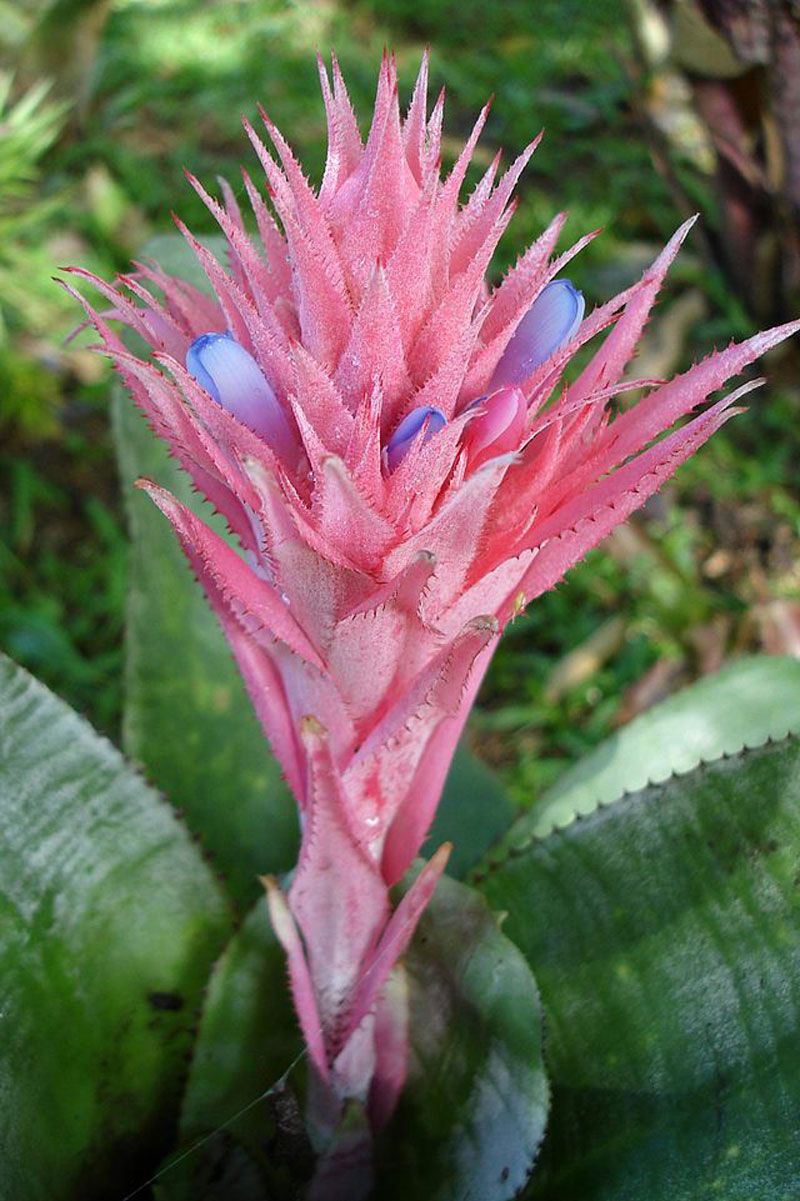
The name means "spearhead," from the Greek "aechme." The brightly colored, pointed bracts are often mistaken for the flowers themselves:
- The stem is shortened. The leaves are long, with spiny-serrate edges, forming a funnel-shaped rosette. Their coloring can be green or gray-green, solid or striped.
- The inflorescences are varied: panicles, capitulums, and spikes. The bracts are red or pink. Small red, blue, or purple flowers are located in their axils.
- The root is poorly developed; its main role is to hold the plant on support.
There are 280 species of Aechmea. Knowing the proper care instructions allows you to grow them indoors.
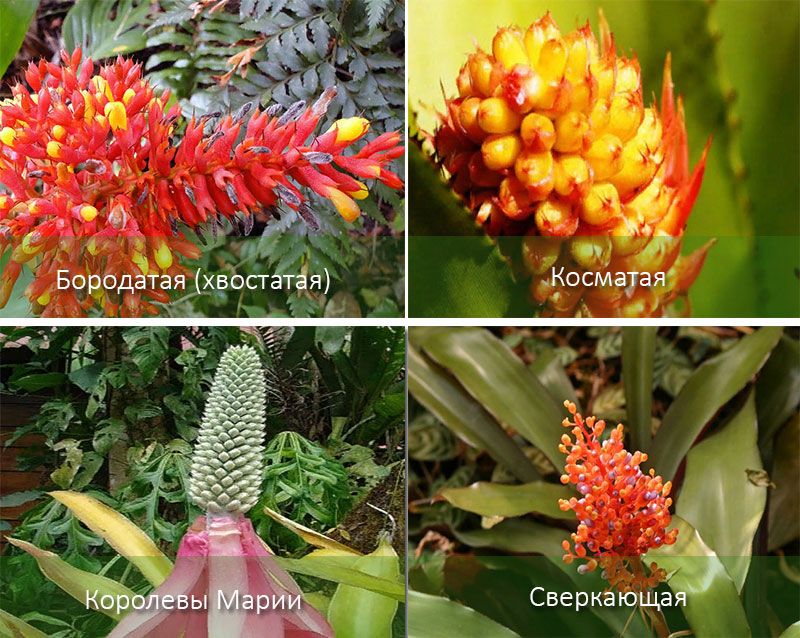
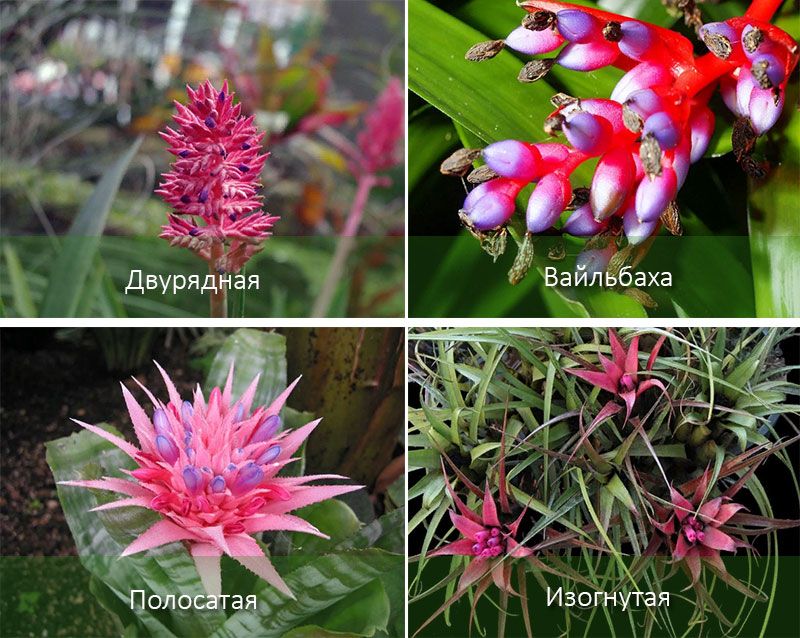
Indoor types of Aechmea
| Name | Leaves | Flowers |
| Sparkling | The top side is green and the bottom is purple. It is the easiest to care for. | Coral-colored with a bluish border. Inflorescence is a panicle. |
| Double-row | Green, narrow, form a spreading rosette (up to 1 m in diameter). | Lilac in color. |
| Bearded (tailed) | Bright green, hard. | Golden. The inflorescence is a panicle. It has a tall peduncle covered with a whitish bloom. |
| Striped (fasciata) | Broad, leathery green leaves with whitish transverse stripes. Contain toxic substances that can cause inflammation on exposed skin. | Blue. Large inflorescence head up to 30 cm. |
| Weilbach | Soft-skinned green with a reddish tint at the base. | Bluish with a white border. |
| Curved | Narrow. Can grow as an epiphyte and on the ground. | The inflorescence head can reach 20 cm. |
| Shaggy, or Lindena | Wide, up to 1 m long. | Yellow color. |
| Queen Mary's Aechmea | Rare species. | It has bisexual flowers. It is pollinated by hummingbirds in the wild and artificially indoors. The spectacular inflorescence reaches up to 50 cm. |
Growing Aechmea indoors
| Season/conditions | Spring | Summer | Autumn | Winter |
| Location | Windows facing west or east. Protect from drafts. | |||
| Temperature | +22…+28 ºС | +19…+21 ºС | ||
| Lighting | Diffused bright | Extend daylight to 14-16 hours using a grow light. Attach it 50 cm above the pot. | ||
| Humidity | Spray daily. Use soft, warm water. Place on a tray with damp pebbles. | Spray in the morning if the temperature is above 20°C. If below, protect the funnel from water. Wipe dust from the leaves with a damp cloth. | ||
The subtleties of planting and replanting Aechmea
To successfully plant, you need to know some features.
For Aechmea, it's best to choose a wide rather than a deep pot, as the roots are shallow. A drainage hole is essential.
A plastic container is preferable to a ceramic one. The latter will be cooler, while a tropical plant prefers warmth. The pot should be slightly larger than the root ball. A planter will add stability and beauty.
Soil for bromeliads is sold in specialized stores.
You can also prepare the soil yourself. It's important that it's loose.
There are several composition options:
- Pine bark, coarse sand, and crushed sphagnum moss in a 1:1:1 ratio. It's a good idea to add peat and horn shavings.
- Leaf mold, humus, sphagnum (1:1:1). It is useful to add crushed old red brick.
Homemade soil mixture must be sterilized by roasting it in the oven or pouring boiling water over it.
Repotting is necessary once a year, in March.
Transplantation step by step:
- Create a drainage layer in the prepared container, filling approximately ⅓ of its volume. This will protect against over-watering;
- pour 1-2 cm of soil mixture over the drainage;
- carefully remove the flower from the container, lightly shake off the soil, cut off dry rosettes and roots;
- sprinkle the cuts with crushed activated carbon and dry for 2 hours;
- place in a new container, add soil without compacting;
- shake gently to distribute the soil evenly;
- After transplanting, keep in the shade without watering for 2-3 days; this is the time for the roots to adapt.
Fertilizing and watering Aechmea
For watering, use soft, settled water, preferably warm. In spring and summer, water regularly and thoroughly, first into a funnel, then into the soil. The water in the rosette should be changed every two weeks, avoiding stagnation. Excess water can be drained by tilting the plant, holding it firmly, or by removing it with a napkin.
Water less frequently during the fall and winter. At temperatures below 20°C, it's important to keep the rosette dry.
Fertilize with bromeliad fertilizer every two weeks from March to October, using foliar application in conjunction with watering. Spray the solution or pour it into a funnel.
Reproduction of Aechmea
Aechmea reproduces by seed and vegetative means.
It is recommended to sow seeds in April in loose peat. Cover the seedlings with film or glass. Ventilate and moisten the soil daily. Maintain a room temperature of 23–26°C and provide bright but diffused light.
When two leaves appear, transplant. Seedlings thrive at temperatures starting at 22°C. After a year, transplant them into a suitable pot as an adult. They will bloom in about four years.
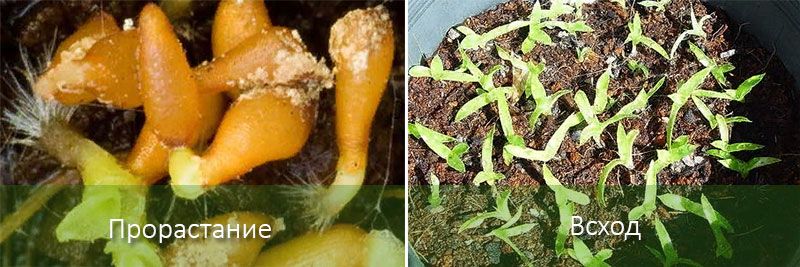
The vegetative method is less labor-intensive.
After flowering, the mother plant produces several new shoots—offspring. These need to grow and develop their own roots. When they reach 15-20 cm, they can be repotted. This should be done in March, carefully removing the plant from its pot. Separate the offspring with their roots using a sharp knife. Treat the cuts with crushed activated charcoal. Repot into pots up to 9 cm in diameter.
Use a soil mixture of leaf mold, sand, and peat (2:1:1). Cover the transplanted plants with transparent film and keep them in a warm, bright room. Transplant into larger pots after rooting. They will bloom in 1-2 years.
Top.tomathouse.com recommends: helping your Aechmea bloom
Aechmea blooms well with proper care. You can help the plant bloom faster by placing a ripe apple or orange near the pot. Cover the entire area loosely with plastic wrap. These fruits emit ethylene gas, which stimulates flowering. Calcium carbide also has a similar effect. Place it in a funnel filled with water. When the two interact, the same substance—ethylene—is released.
Diseases and pests of Aechmea
| Pest | Manifestation | What to do |
| Spider mite | The leaves, covered in cobwebs, have brown spots. They dry up and fall off. | Treat all parts with Fosbecid or Decis. Good soil and air moisture are essential for prevention. |
| Scale insect | The leaves turn yellow, dry out, and have sticky marks from the insect. The plant's growth slows. | Dampen a cloth with soapy water or alcohol and use it to remove insects from the leaves. Treat all parts of the plant with Karbofos and Actellic. |
| Mealybug | The leaves fade, especially the variegated ones, and the plant does not develop. | Use Karbofos. |
| Root mealybug | It attacks the roots, causing them to rot. Whitish lumps, like cotton balls, appear at the roots. Growth is stunted, leaves turn pale, curl, dry out, and fall off. |
Reduce watering. Treat with Fazalon and Karbofos. |
| Root rot | Leaves turn yellow and fall off due to excess moisture. | Remove the Aechmea from the pot and rinse the roots with room-temperature water. Remove any damaged parts, replant in new soil, and water with a solution of Carbendazim. |
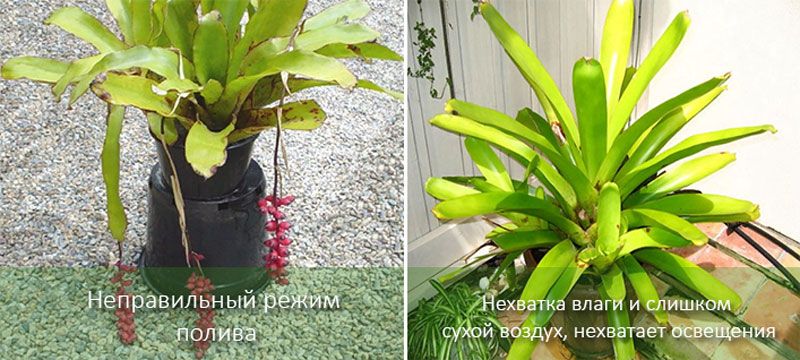
Mistakes in caring for Aechmea
| Problems with leaves and more | Cause |
| There is no flowering for a long time. | Solid-colored plants probably lack fertilizer, while variegated plants may lack light. |
| They turn yellow. | The soil does not allow enough air and moisture to pass through, or there is a lack of fertilizer, or there are pests. |
| They turn brown and dry out at the ends. | Cold room. |
| They turn brown from the base. | A sign of rot due to overwatering in a cold room. |
| They fade, the pattern disappears. | Sunburn, protection from direct sunlight is required. |
| They wither, wrinkles appear, and dry out from the ends. | Lack of air and soil humidity. |
The benefits and harms of Aechmea (its impact on the energy of a room)
Aechmea increases vitality and determination. It is not recommended to place it in the bedroom, as it may cause insomnia in sensitive individuals.
But the office, the desk, is the perfect place. It helps maintain a cheerful mood, alertness, and the ability to make and implement life plans.