Evening primrose (primrose, night candle) is a plant in the Onagraceae family. It is a large genus with a wide variety of species.
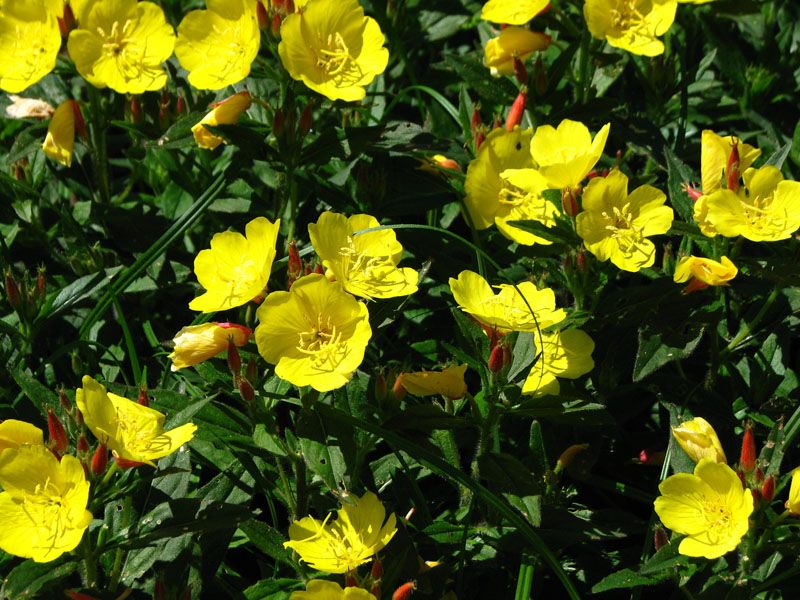
They can be herbs or shrubs, straight or branched, with leaves of completely different shapes. This is an ornamental plant, and a huge number of cultivars have been developed.
Description of evening primrose
Planting and caring for this plant does not require much effort, and therefore almost anyone can grow it.
Evening primrose flowers are vibrant yellow, white, red, and blue (they can be striped). Each leaf axil bears a single flower, or rarely two or a cluster. The calyx contains four fused leaves with a long, tetrahedral tube, a corolla with four petals, eight stamens, and a pistil with an inferior four-locular ovary and a style on four stigmas. The fruits are multi-seeded capsules.
Popular varieties of evening primrose
There are more than 100 species of evening primrose: perennial, annual, tall and low.
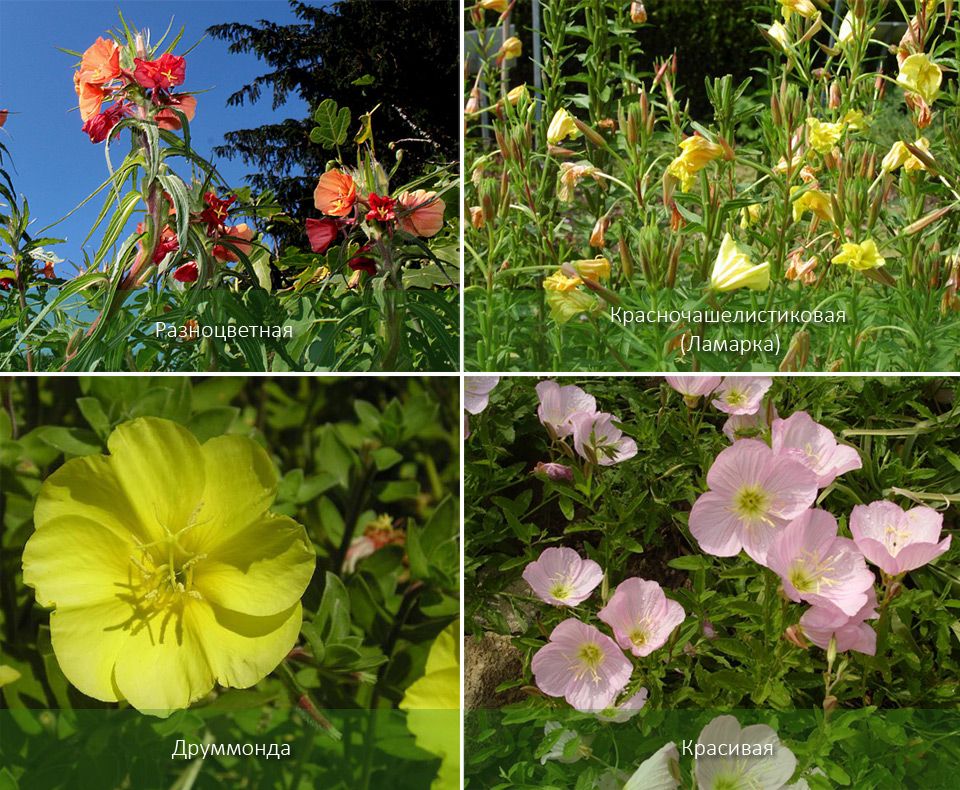
In the central zone of Russia, biennial species are grown:
| View | Description | Leaves | Flowers |
| Drummond | Grows up to 0.8 m. The stem is thickened and highly branched. | Oppositely arranged, pointed at the top, long, lanceolate, dark green. | They consist of four yellow petals, the size of which is 70 mm. |
| Multicolored | Height – 1.2 m. In gardening, the Sunset Boulevard variety of this species is quite often used (its height is 0.4 m). | At first oblong, they become lanceolate towards the end. The leaf blades are arranged alternately. | Painted red. |
| Evening biennial (night candle) | Reaches 1.2 m. The shoots are erect, covered with a huge number of small hairs on top. The "Evening Dawn" variety is very popular, reaching 100 cm in height. | Rarely toothed, solid, approximately 20 cm long. | The diameter is 50 mm. Their color is lemon, and the flowers open either on cloudy days or in the evening. The evening glow is yellow with a red tint. |
| Beautiful | The height of this bush is almost half a meter. | Oblong, with sparse teeth along the edge. | The flower is cup-shaped, about 50 cm in diameter, the color is either pure white or with a pinkish tint. |
| Red-sepal (Lamarck's) | No one knows exactly how this biennial originated. It's believed to have originated in the Old World through a mutation. It's an upright shrub, approximately 100 cm tall. | Oval, smooth, greenish in color. | The inflorescences consist of yellowish flowers. |
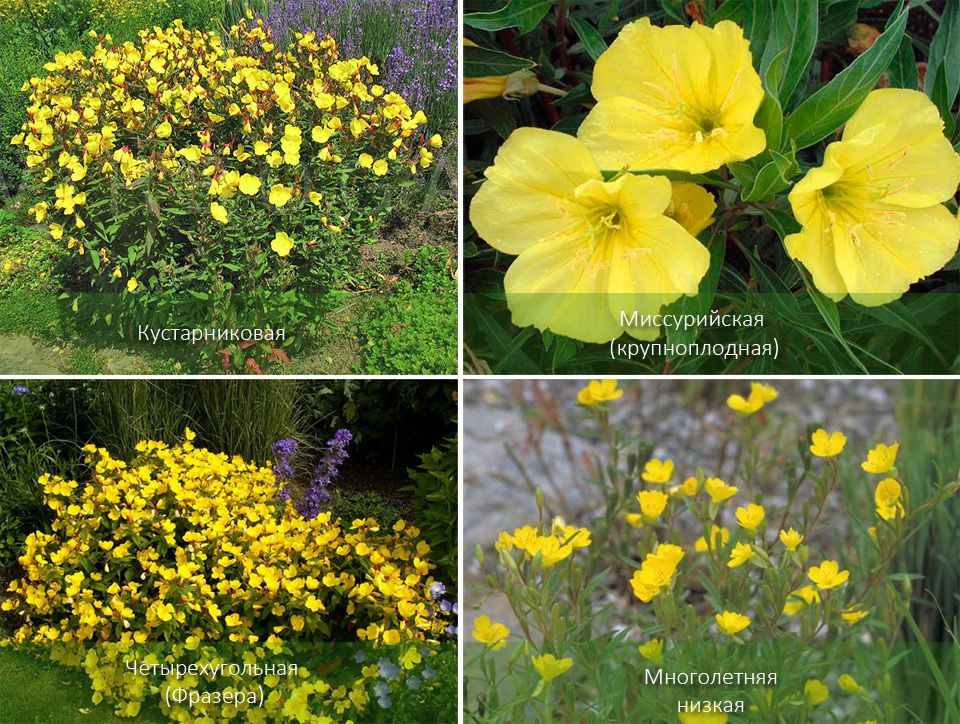
In the middle latitudes, yellow perennial winter-hardy species of evening primrose are used:
| View | Description | Leaves | Flowers |
| Missouri (large-fruited) | Native to southern North America in 1811. Grows up to 0.4 m. Rarely used. | Dense, oval, narrow, lanceolate. | Golden, solitary, almost lying on the ground, usually 100 cm in diameter. Blooms from July until frost. Has a citrus aroma. |
Perennial low Pernis (pumila) |
Native to North America, it grows to a height of approximately 25 cm. | The width of the narrow-lanceolate leaves is approximately 15 mm. | Yellow, arranged in spikelets and usually up to 15 mm in diameter. |
| Quadrangular (Fraser) | This plant, like the previous one, appeared in the east of North America. Height – 0.7 m. |
Oval, green-blue, turning pale red in autumn. | The shields consist of yellowish flowers. |
| Shrub | This species came to us from the east coast. It reaches 1.2 meters. | Oval, slightly elongated, dark green in color. | Yellow, fragrant, 50 mm in diameter. |
Reproduction of evening primrose
Oenothera is propagated in several ways:
- Seed. This is a good choice for perennial evening primroses, as they produce only rosettes of leaves in the first year, and by the second year, a full-fledged bush, flowers, and capsule ovaries appear. The seeds of this plant are very small, so it's best to mix them with sand before planting. They should be planted shallowly—5 mm is sufficient. After the first shoots appear, thinning should be done.
- Seedling. Seeds are planted in small indoor greenhouses in February. The depth is the same as in the first case. The soil should be carefully maintained—it should never dry out. Temperature should be between 20 and 21°C. If all instructions are followed, the seedlings can be planted in the garden as early as May, and the plant will bloom later that year. The spacing between seedlings depends on the species of evening primrose. Taller seedlings should be spaced further apart than smaller ones.
- Dividing the bush. This involves replanting shoots growing near the main bush. The site must be well prepared: dig small holes and add organic fertilizer.
Planting evening primrose
Evening primrose grows best in full sun, but can also survive in partial shade. Soil composition isn't particularly important, but avoiding waterlogged or excessively wet areas is essential, as this plant tolerates drought much better than overwatering. Light, sandy soil (with a pH of 5.5-7.0) is ideal.
Evening primrose can be grown from seedlings. To do this, plant the seeds in a nursery bed in late February or early March. Once they sprout and become strong, transplant them into holes 50 cm apart.
You can plant the seeds directly in the flowerbed. To do this, water the soil before winter or in the spring—in early May—and sow the seeds shallowly in holes, two or three at a time, spaced at least 30 cm apart.
The soil must be well prepared. First, it must be dug over, adding two cups of nitrophoska and 3 kg of compost soil.
Once the seedlings emerge, they should be pricked out at a distance of 10 cm. Repotting may be necessary to give the plants more room to grow and develop—this depends directly on the evening primrose variety. The root system will develop during the first year, and flowering will begin only after a year.
Care of evening primrose
When caring for the plant, ensure the top layer of soil has time to dry out, otherwise the root system may rot. The best guide is weather conditions: for example, during dry and hot periods, water three times a week in the evening, and once a week during rainy periods. Approximately 16 liters per square meter.
Care should also be taken with fertilizing, as evening primrose is planted in fertile and already fertilized soil. It's best not to fertilize it during the first year. Then, the following year, add compost mixed with wood ash and sodium sulfate.
During the gardening season, the soil is loosened. Some varieties of evening primrose need to be tied up due to their height. To prevent spontaneous reproduction, faded parts are removed. In the fall, shoots are pruned and the plant is covered with spruce branches or fallen leaves. Many varieties are frost-resistant and winter-hardy, so they do not require additional shelter.
Diseases and pests of evening primrose
If the plant is not properly cared for, it can be susceptible to various diseases and pests. The most common are aphids and fungi.
- If fungus is found on the leaves of evening primrose, they should be removed and burned.
- The situation with aphids is completely different. Special insecticides (Actellic, Aktara) are needed.
Top.tomathouse.com informs: the benefits and harms of evening primrose
Evening primrose has many benefits. The plant's roots contain beneficial substances, making them a popular infusion for colds and tuberculosis. Evening primrose seed oil is highly prized and also used medicinally.
Despite the benefits of evening primrose, there are some contraindications. It should be used in moderation for treatment, otherwise unwanted symptoms may occur. Medicinal products containing this plant should not be taken by people with schizophrenia or epileptics.