Epipremnum is a perennial, densely branching vine. The name means "on the trunk," indicating the plant's habitus. It belongs to the Araceae family. The genus comprises over thirty species.
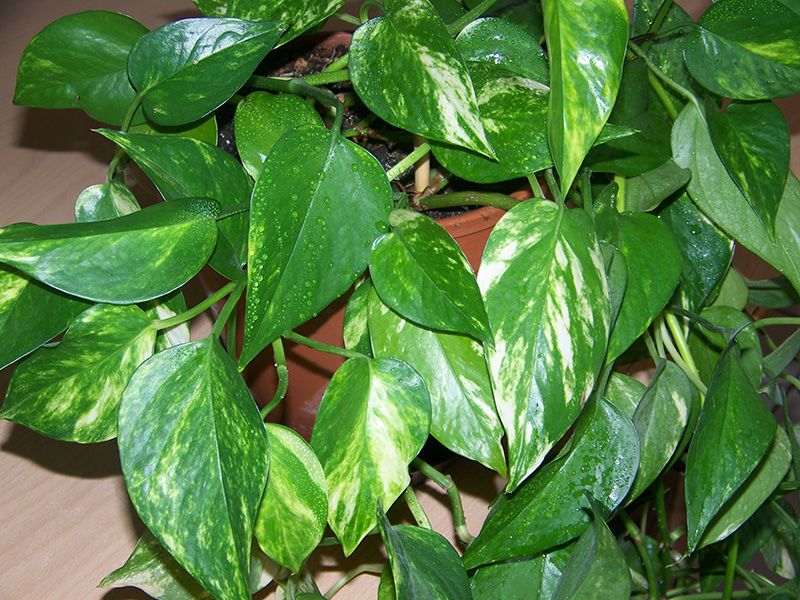
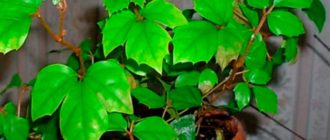
It has dissected or entire pinnate leaves arranged on an elongated petiole. Their shade varies depending on the cultivar. The plant has a leathery, smooth texture. It flowers only in the wild; no one has yet succeeded in cultivating it indoors.
Types and their differences
Caring for vines at home is easy, which is why this trailing plant is so popular. Common varieties that require little care and their distinctive features include:
| View | Description, differences |
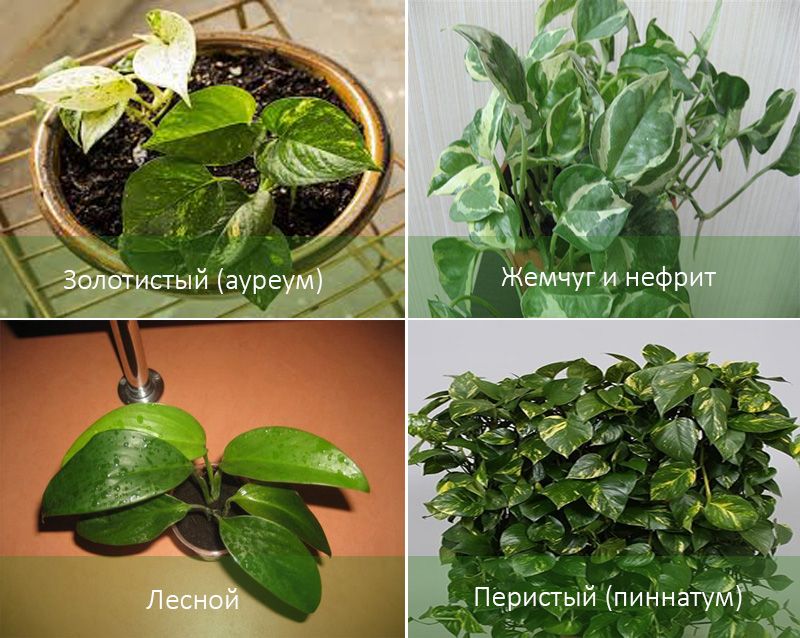
| Golden (aureum) | Dense, stiff leaves with golden spots and lines on a dark green base. They grow up to 0.6 m long and 0.3-0.4 m wide. Different varieties have different patterns. For example, the Golden Pothos has a solid yellow pattern. The variegated Marbled Queen has a silvery-white pattern. |
| Pearls and jade | Small in size. The blades are 8 cm long and 5 cm wide. They have a mottled coloration: green, white, and gray. It's rare to find two leaves that are identical in color. They have a bumpy surface rather than the usual smooth one. The stem is green with light longitudinal lines. The petioles are elongated, almost as long as the blades. |
| Forest | Reaches 6 meters. The leaves are oval-lanceolate with an emerald-green, glossy surface. The blades are up to 15-20 cm long and 5-6 cm wide. |
| Pinnate (Pinnatum) | The largest variety. In the wild, it reaches 35-40 meters. When cultivated indoors, it grows up to 10 meters. Mature specimens have pinnately dissected leaves of a dark greenish hue. |
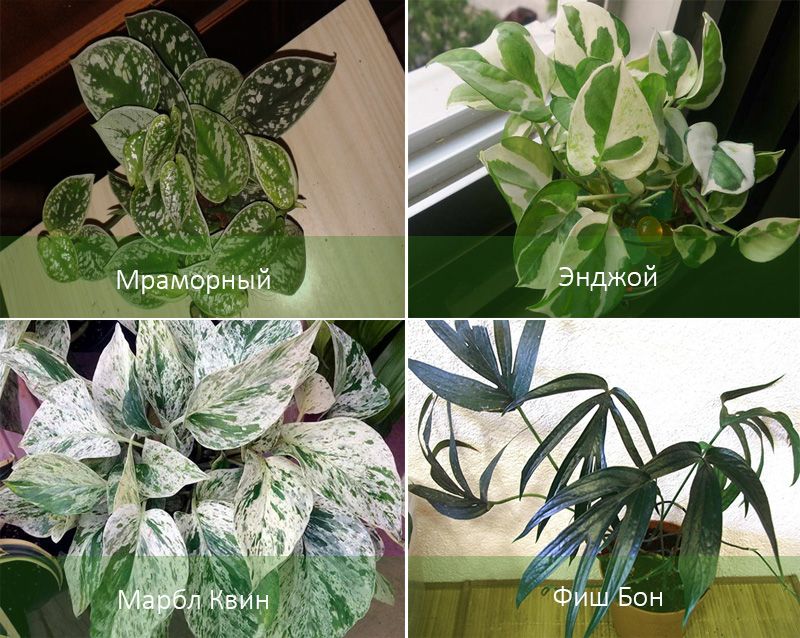
| Marble | The vine grows up to 15 meters tall. Young seedlings have smooth stems, but with age, numerous plaques appear. The older the specimen, the more plaques appear. The leaves are ovate on shortened petioles, 12-15 cm long and 6-7 cm wide. There are two varieties: argyraeus and exotica. The first has underdeveloped green leaves with silvery spots. The second has blades with elongated silvery streaks. |
| Enjoy | The angular stem is 13-15 meters tall. In mature specimens, it is covered with warts. The petiole is underdeveloped, 2-3 centimeters long. The ovoid blades are rigid and dense, with diffuse silvery spots on a dark greenish background. |
| Marble Queen | Reaches 4.5 meters. Grows well in filtered light and adapts to shade. |
| Fish Bon | It is distinguished by large, multi-lobed leaf blades and elongated internodes. Support and shade are required. |
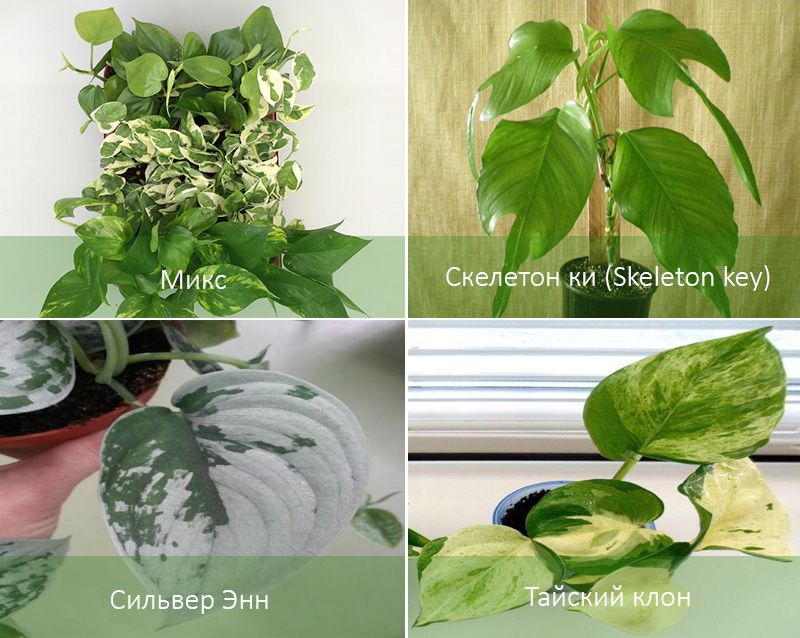
| Mix | The decorative period is year-round. In Britain, the vine is called "devil's ivy." In the USA, it's called "golden pothos." |
| Skeleton key | A rare variety with large green leaves. |
| Neon | Grows slowly. Leaves are golden, internodes are shortened. |
| Silver Ann and the Thai Clone | Varieties that are extremely rare. |
You won't see any flowering on any variety at home, but thanks to its decorative appearance, the vine will decorate any interior.
Home care
To ensure the vine thrives indoors, certain care requirements must be followed. These vary depending on the season:
| Parameter | Spring/summer | Autumn/Winter |
| Location/lighting | It's recommended to place the vine near an east- or west-facing window. If the pot is placed on a south-facing windowsill, it should be shaded from direct UV rays. Completely isolating the vine from the sun is not recommended, as it will stop growing and lose its decorative appearance. The light should be diffused. | |
| Temperature | There's no need for special temperature conditions. The recommended temperature is no higher than 25°C. | The temperature must be lowered, but not less than to +12°C. |
| Humidity | It is not important for the plant; it takes root well at normal room humidity. | When heating devices are operating, there is no need for spraying. |
| Watering | Once every five days. | Once every week and a half. Allow the soil to dry out between treatments. |
Planting, soil, choosing a pot
The planting pot should be of medium depth and width. The root system grows quickly, but if there's too much space, it will rot due to the oxidation of unused soil. Young plants are planted in several pots.
Planting is done as follows:
- the sprout is soaked in water for several days;
- The material is placed into the soil for ornamental plants to a depth of three to five centimeters.
Use airy soil. You can buy it or make your own: mix turf, leaf mold, sand, and peat. Don't forget to add a drainage layer. Fill the container to 1/3 of its capacity. This will help prevent water stagnation and further rotting.
Fertilizer
The growing season lasts from April to October. Fertilizing is necessary every two weeks. Use organic fertilizer for indoor plants.
From October to April, the Epipremnum is dormant. It doesn't need fertilizing if it's kept in a cool room. Fertilizing isn't necessary during rainy weather either. If the plant is kept in a warm room, fertilize it once every four weeks.
Features of pruning, replanting, propagation
Young vines are repotted annually in the spring. Mature vines are repotted every three years. Overgrown shoots are removed and placed in water. Once they have established roots, they are repotted. The plant becomes more luxuriant. It doesn't require pruning, but for a more decorative appearance, it can be done periodically.
The vine is propagated by cuttings. These are cut into small sections containing 2-3 leaves and planted in 7-9 cm containers. Rooting occurs within 14-17 days. After this, the plant is pinched to promote good branching. Once the root system has grown around the soil, the vine is repotted in a separate 10 cm tall container.
Diseases and pests
Epipremnum is affected by the following pests:
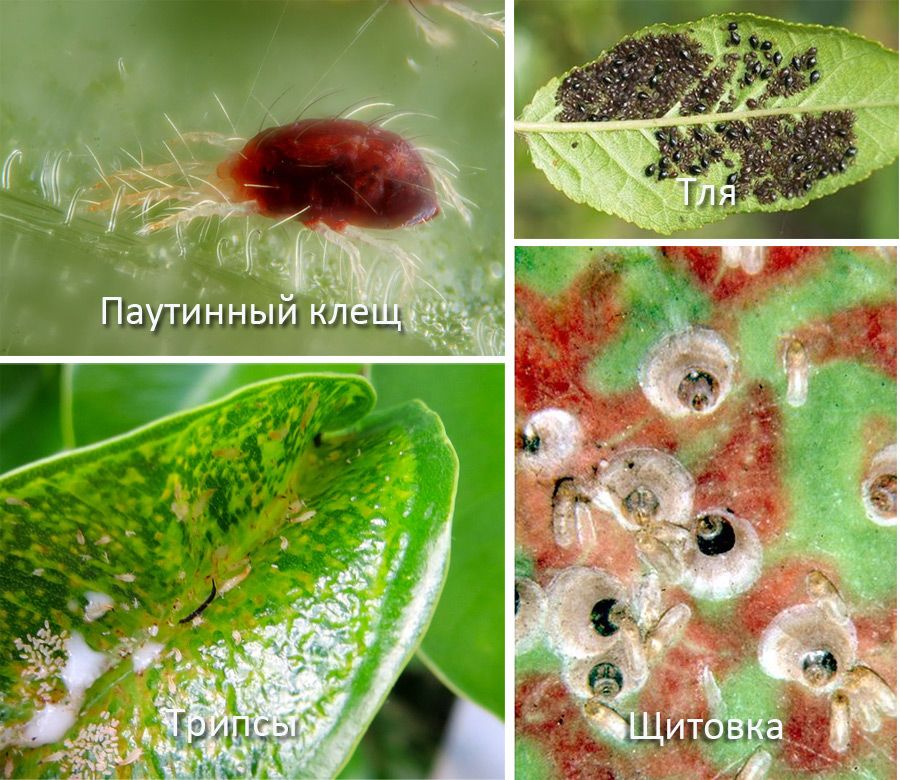
- Aphids: They feed on plant extracts. To get rid of them, treat the vine with a soap solution or spray it with an infusion of citrus peels. Products such as Fitoverm, Trichopolum, Fufanon, and others are also used.
- Scale insects: brown spots appear on the leaves. This condition can be treated with commercially available products (Aktara, Actellic, and others).
- Spider mites: The plant begins to dry out, and a fine web appears. It's recommended to rinse the vine in the shower. If this doesn't help, treat it with commercially available pesticides (Actellic, Fitoverm, etc.).
Diseases arise from care errors: excess or stagnant moisture, improper temperature, insufficient or excessive light. These conditions cause the plant to wilt, and the leaves to dry out, darken, or turn yellow. To eliminate these unpleasant symptoms, you need to correct these care errors.
The benefits and harms of Epipremnum
Scientists have found that the Epipremnum purifies the air. It's recommended to place the plant in a pot in the kitchen, where a lot of oxygen is used, and the vine filters the air, removing xylene, benzene, and formaldehyde.
In the East, there is a belief that Epipremnum energizes, improves endurance, helps develop mental abilities, and facilitates career advancement and social activities. It improves physical and emotional well-being. A home where this flower grows always has a pleasant atmosphere.
However, epipremnum can also be harmful to humans and pets. This is because the plant is toxic. If its extract comes into contact with mucous membranes, irritation will occur. In severe cases, swelling may develop. To avoid adverse effects, it is recommended to keep the vine away from children and animals, for example, in a hanging pot.
The difference between Epipremnum and Scindapsus
Two closely related genera from the same family. Yet, they are distinct plants. Originally, only Scindapsus existed. Later, the genus Epipremnum was created, and some species were transferred to it.