Episcia is a chameleon-like plant from the Gesneriaceae family. In the wild, it prefers shady, moist forests located up to 2,000 meters above sea level.
Content
Description
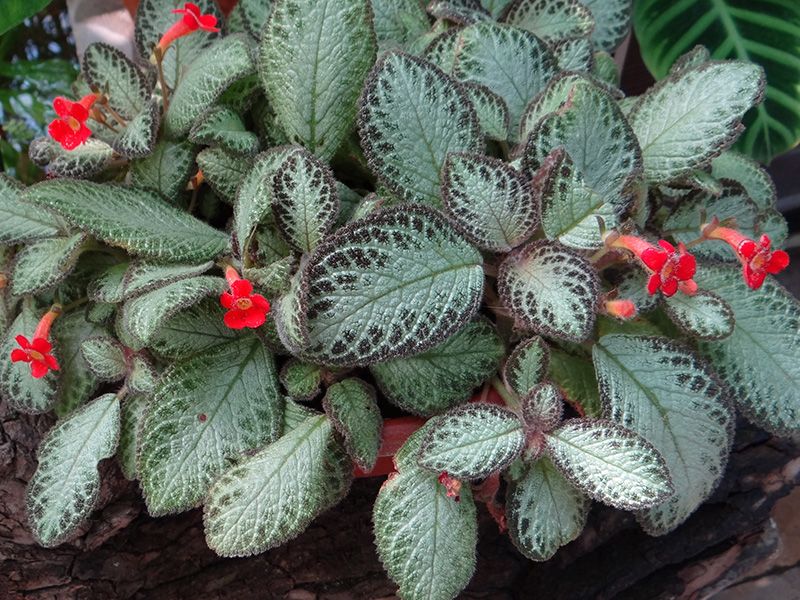
Episcia is prized for its foliage. It comes in a variety of colors: emerald, jade, bronze, copper, and silver. The greenery has a pearlescent shimmer. Many species have a patterned center of the leaf.
Leaf blades come in various shapes: round, oval, and elliptical. Their surfaces can be smooth and shiny or downy, like velvet. The edges are smooth and serrated.
A bell-shaped inflorescence on a shortened stalk with five petals. It blooms from July to September. The fiery red buds form singly or in clusters.
It has creeping shoots and tendrils, similar to strawberries. These are used to propagate the plant.
Domestic species
Not every plant variety has made the transition from the wild to indoor conditions. Episcia has the following varieties that can be grown indoors:
| Variety | Description |
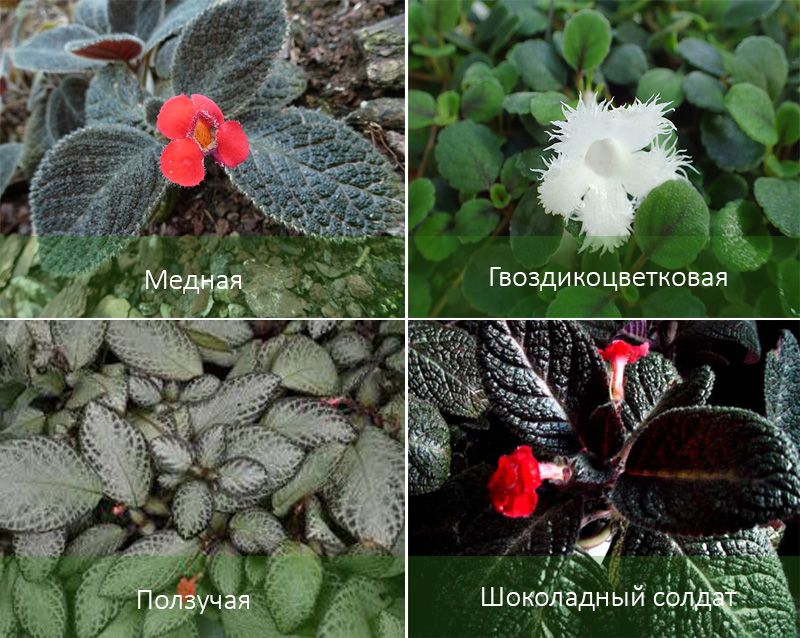
| Copper. | A large species with an oval blade that widens at the base. The brownish-green foliage with a reddish tint, fading to copper, is velvety. A white vein appears along the central zone of the leaf, creating a contrast. The lower zone of the blade is reddish. The scape is a bright green hue, shimmering in the sunlight. The inflorescence is a bright scarlet or fiery red. The petals begin with a yellowish tint. Flowering continues throughout the summer. |
| Carnation. | Some experts classify this variety as a separate genus, Alsobia. Like all species, it has tendrils with daughter rosettes, short shoots densely covered with small leaves at the tips. The blade is dark green, almost black. A purple vein runs down the center. The flowers are white with red freckles at the base. The edges of their petals are fringed. |
| Creeping. | The name derives from the extensive branching that forms a dense network of shoots. This variety has small leaves (9 cm long and 4-5 cm wide). The blade is olive-colored on the upper surface, dull red underneath, and covered with hairs. The leaves are heart-shaped. The flower stalks are crimson. The petals are crimson on the inside and blood-red on the outer surface. Flowering occurs from July to September. |
| Chocolate soldier. | It has thickened leaves. The blades are covered with a network of veins, giving them volume and texture. The foliage is greenish-purple. Flowering continues for a long time. |
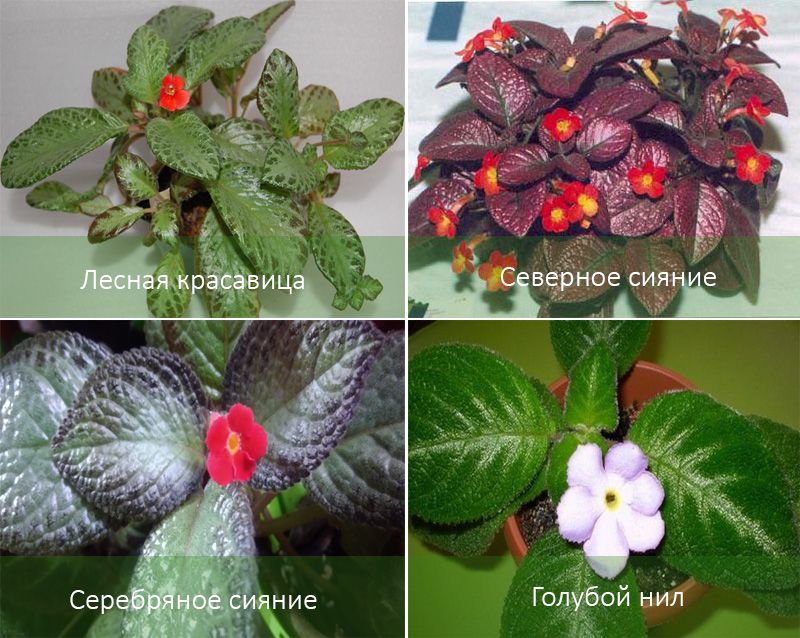
| Forest beauty. | The foliage is silvery-lavender with a bluish tint. Pastel pink flowers are sparse and small. |
| Northern lights. | The leaves have a unique combination of lilac-gold and dark green with a brownish tint. The blades are pubescent, with crisscross veins. The petals are bright scarlet. |
| Silver glow. | The leaves are elongated, oval, and pointed at the tips. The foliage is a soft light green with a silvery sheen. Rare scarlet flowers can be seen between the leaves. |
| Blue Nile. | Quite rare. It produces sky-blue flowers with a lavender tint. The centers are yellow. The foliage is brownish-green and downy. A central olive-green stripe with central veins is visible. |
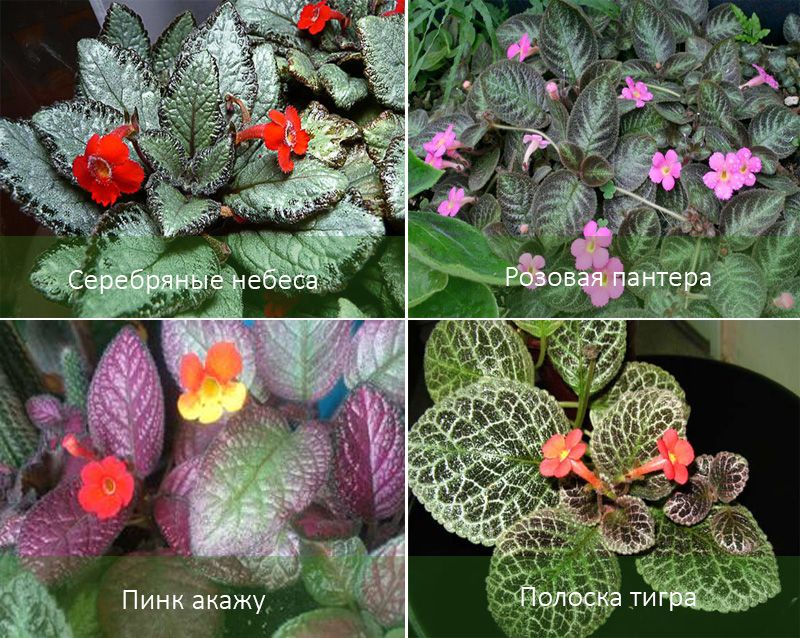
| Silver skies. | The reddish-orange inflorescences contrast strongly against the silvery foliage. |
| Pink Panther. | It requires little care and grows to a large size. The flowers are large and bright strawberry-colored. The foliage is green with a limestone, bronze sheen. The leaves can reach fifteen centimeters. |
| Pink akaju. | The leaves are silvery-green with snow-green stitches and pink splashes. It blooms with reddish-orange inflorescences with a yellowish center. |
| Tiger stripe. | Similar to tiger episcia. A distinctive feature is the fine green foliage with silvery veins. |
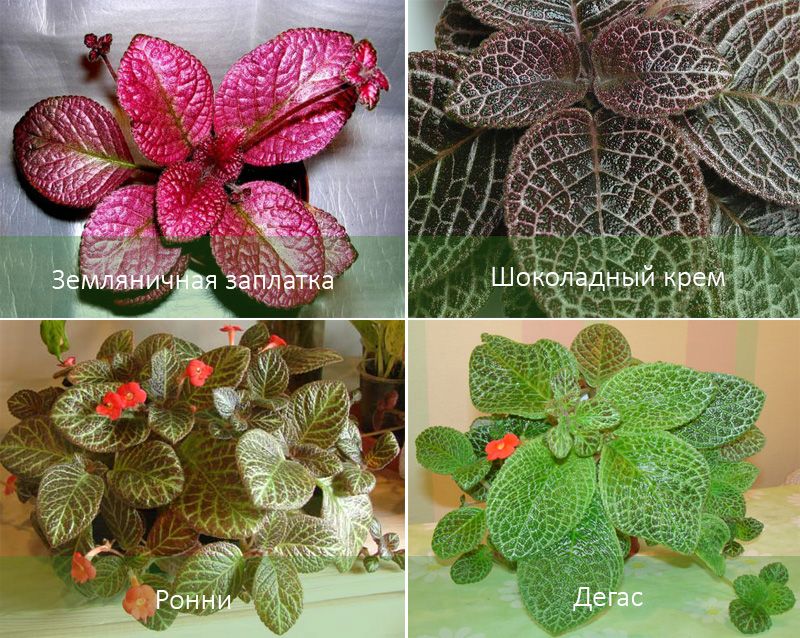
| Strawberry patch. | It has small leaves with pointed tips. The foliage is bright, pinkish-red. The buds are scarlet with a lemon-colored base. |
| Chocolate cream. | Silvery-brown foliage with pinkish lines. Red inflorescences. |
| Ronnie. | The buds are coral, the leaves are brown with silver-green veins. |
| Degas. | The leaves are brownish-green with lines. The inflorescences are large and red. |
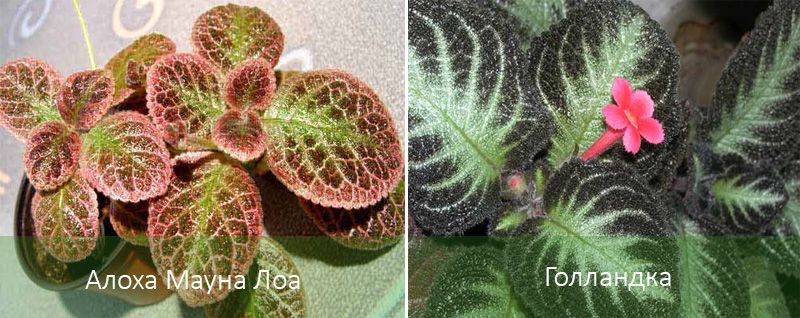
| Aloha Mauna Loa. | It is distinguished by its quilted leaves, resembling dark green velvet, and its reddish-brown flowers. It is a hybrid bred specifically for indoor growing. |
| Dutch. | The leaves are dark brown, velvety, and medium-sized. The light green, silvery-pearlescent veins have a herringbone pattern. The inflorescence is red with a pinkish tint. |
Watercolor varieties are also grown at home. They are distinguished by their unusual foliage coloring and are not found in the wild. Popular varieties among gardeners include: Danae, Inessa, Black Queen, Strawberry Mist and Strawberry Patch, Safari, TM-Sahara, Tiger Stripe, Tricolor, Brown Beauty, Panama White, Lilacina Viridis, Sun Gold (Chimera), Dixie Dynamite, Smoky Topaz, Country Kitten, Coco, Gray Lady, Longwood, Seafoam, Neptune, Silver Sheen, Miniature Symphony (Symphony), Temptation, Sport, Suomi, and Helen Dixie.
Home care
Home care for episcia must be carried out according to all the rules:
| Factor | Recommendations |
| Location | Location is important when growing. It's recommended to place the pot on a north-facing windowsill. If placed on a south-facing window, move the plant a couple of meters away. When placed on a west- or east-facing window, hang it on the left or right side of the windowsill. |
| Lighting | Light should be diffused. The plant dislikes direct sunlight. In winter, supplemental lighting is needed to extend daylight hours by a few hours. |
| Humidity | The minimum humidity level is 60%. To increase it, it is recommended to place containers filled with water solutions or moss, expanded clay, coconut fiber, or peat near the episcia, keeping them moist. If this is insufficient, the plant pot can be moved to the kitchen (where the humidity is higher). Spray and wipe down the plant regularly. |
| Temperature | Episcia has no dormant period. It thrives in temperatures ranging from 22°C to 26°C. In winter, the temperature can be lowered to 18°C. At 16°C, the plant dies. It will survive at 30°C or higher, but only if properly watered. |
Pot, soil, replanting
The flower's rhizomes are thin and fragile. They grow close to the soil surface. Therefore, choose a shallow pot or wide container for planting. The plant is planted in groups of three or more.
When growing the flower using the "carpet method," choose a large pot to provide enough space for the tendrils to hang. If planting in a hanging basket, a smaller container is recommended, as the tendrils will droop.
The soil is light and moderately acidic. It consists of leaf mold, peat, and sand (3:1:1). Sphagnum moss and ash are added. Drainage is essential: the bottom is lined with expanded clay or polystyrene foam (a three-centimeter layer).
The plant grows quickly and needs to be repotted every twelve months. This is done as follows:
- the episcia is watered and carefully removed from the flowerpot;
- the root is examined: dried and rotten areas are removed;
- a 3 cm drainage layer is placed on the bottom and soil is poured on top;
- planting and watering are carried out.
The circumference of the pot for transplanting should not exceed 20 cm.
Watering
Proper watering is necessary from early spring through October, every other day. When watering, take into account the air temperature and humidity. In winter, you can water less frequently: wait until the top soil is completely dry. Any water that drains into the tray should be discarded immediately. Excess moisture will kill the plant, as will allowing it to dry out completely.
Use soft water that has been left to stand for 2-3 days. Temperature: 28-30ºC. Tap water is softened with lemon juice.
Care should be taken to prevent drips from falling on the greenery: use a watering can with an extended spout. Water should be poured around the edges of the planter.
Top dressing
During active growth, fertilizing with organic or complex fertilizers for indoor plants is recommended. Fertilizers for ornamental foliage and flowering plants are also available. These can be purchased at a specialty store.
The dosage indicated on the fertilizer packaging is reduced by 2-2.5 times.
Fertilize twice a month. No need to fertilize in the fall or winter. Avoid fertilizing when the soil is too dry, as this can burn the roots.
Shaping and pruning
Young shoots shouldn't hang over the pot, as this can expose them and cause damage. This can be avoided by inserting a 20-cm-wide trellis into the planter and securing the shoots to it. Once the shoots have filled the trellis, they can be allowed to grow on their own.
Long shoots take root in adjacent flower pots, so they need to be trimmed. Daughter rosettes can be planted in the same pot as the mother episcia. The plant will become even more beautiful and lush.
Reproduction
Methods:
- seed;
- daughter sockets;
- lateral shoots;
- by cuttings.
When propagated by seed, the plant loses its varietal characteristics in 90% of cases. Planting is done in January or June in the surface layer of soil, without covering. The seeds require greenhouse conditions of +20ºC. The first shoots appear after 10-14 days. After a month, they can be transplanted into individual containers.
When propagating by rosettes, they are buried in soil without separating them from the mature episcia and rooted. After this, the flower is placed in a new pot or replanted next to the mother plant. Roots appear within a week.
Carefully cut cuttings, pre-treated with Kornevin, are planted in prepared soil and covered with glass. Within a few days, the cuttings will take root.
Developed tendrils are cut from the mother plant. Each is divided into three parts and rooted in water. Then, the tendrils are planted.
Possible problems
When care errors occur, problems arise:
| Problem | What is the reason and how to fix it? |
| Irregularly shaped brown spots form on the greenery. | The water used for watering is too cold. It needs to be warmed up before use. |
| The greenery turns yellow and falls off. | The soil has an excessive amount of nutrients: the plant needs to be fertilized less frequently. This may be due to prolonged exposure to ultraviolet rays or overwatering. |
| The leaves curl into a tube. | The flower is watered rarely, but abundantly. |
| The ends of the leaves turn brown and dry out. | Lack of moisture in the air or in the soil. |
| The leaves fade, become dull, and shrink. | The plant is experiencing insufficient light. It should be moved closer to a window or supplemental lighting should be used. |
| The greenery becomes covered with a pale, dirty or grey coating. | The flower does not have enough fresh air: the room needs to be regularly ventilated, or it needs to be repotted. |
| Does not bloom. | Episcia is watered very infrequently, allowing the soil to dry out. This could be due to too much nitrogen in the soil, insufficient fertilizer, or dry or cold air. |
| Poor flowering, elongated stems. | The plant does not have enough light. |
Diseases, pests
Methods for eliminating diseases and pests:
| Disease | How to recognize? | Prevention and treatment |
| Mealybugs | The plant turns yellow and dries out, and a grey coating and cotton-like lumps appear on the leaves. | Maintaining high humidity in the room is recommended to prevent pest reproduction. Remove dried leaves. The plant can be treated with a cotton ball soaked in soapy water or sprayed with the same solution. Pest control products such as Tanrek and Apache are available at the store. |
| Nematodes | These are worms that attack the rhizome. The plant grows poorly, and its leaves curl. | It's important to maintain the required temperature and follow watering guidelines: heat and excess moisture encourage nematodes to reproduce. To eliminate the parasite, immerse the plant's roots in hot water at 50°C. Solutions of Mercaptophos and BI-58 are effective. If the plant is severely infested, it must be destroyed and the soil discarded. |
| Root rot | The roots become soft, the leaves wither. | To prevent rot, drain excess water promptly and avoid stagnant water. When planting and repotting, it is recommended to use Gliocladin. To prevent rot, disinfect the pot and tools. |
| Spider mite | The foliage becomes translucent, dull, and dries out. A webbing pattern appears along the petiole. Beige-yellowish plaques appear at the base of the leaf blades. | Increase humidity and apply quartz lamps (especially to the underside of the leaves) two to three times a week. To get rid of the pest, disinfect the pot; poison is available at the store. The problem can be dealt with by keeping the plant in a container with onion, horseradish, tobacco infusion, or kerosene, wrapped in plastic, for three to four days. Dust the flower with dried henbane powder. |
| Thrips | The parasites can be seen with the naked eye by shaking the leaves. They are small and dark brown or black. Grayish-brown lines, resembling scratches, appear on the foliage. The greenery turns whitish or silvery. | To prevent disease, ventilate the room and maintain humidity. It's recommended to place fly traps near the pot. Other plants should be kept away from the episcia. To kill the pest, use a commercial poison. Place onion and garlic infusions nearby. Water the plant with herbal decoctions. |
Signs and superstitions
Signs and superstitions associated with the flower: since ancient times, there has been a belief that a gift of episcia brings love and happiness to the home. For this reason, it's worth keeping several specimens at home. Moreover, the flower is easy to care for.