Eremurus, or Shiryash, is a perennial plant belonging to the subfamily Asphodelaceae of the family Xanthorrhoeaceae. The genus contains approximately 60 species. Translated from Latin, the perennial's name means "desert tail."
The names "Shirish, Shiryash, or Shrysh" are given for the ability of some Eremurus roots to produce gum arabic. The plant was first described in 1773 by the Russian explorer and traveler P. Pallas. The first hybrids were bred in the early 20th century, and work on propagating the plant's varieties is still ongoing.
Description and characteristics of Eremurus
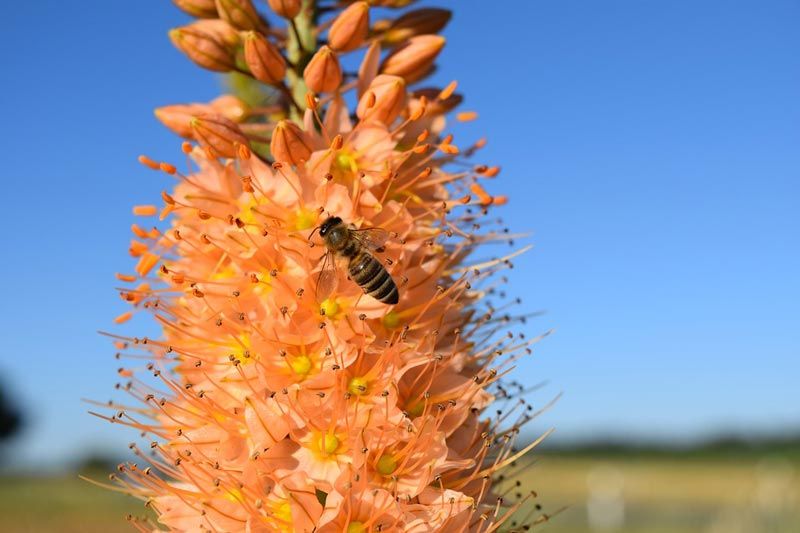
The branched rhizome, resembling a spider or sea anemone, has a large diameter. Numerous leaves are linear and triangular, and the species are named according to their habit.
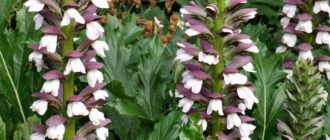
Eremurus is an excellent honey plant, attracting insects with its loose, orange or red inflorescences as early as early June. Cultivars and hybrids are the most common flowers available for sale.
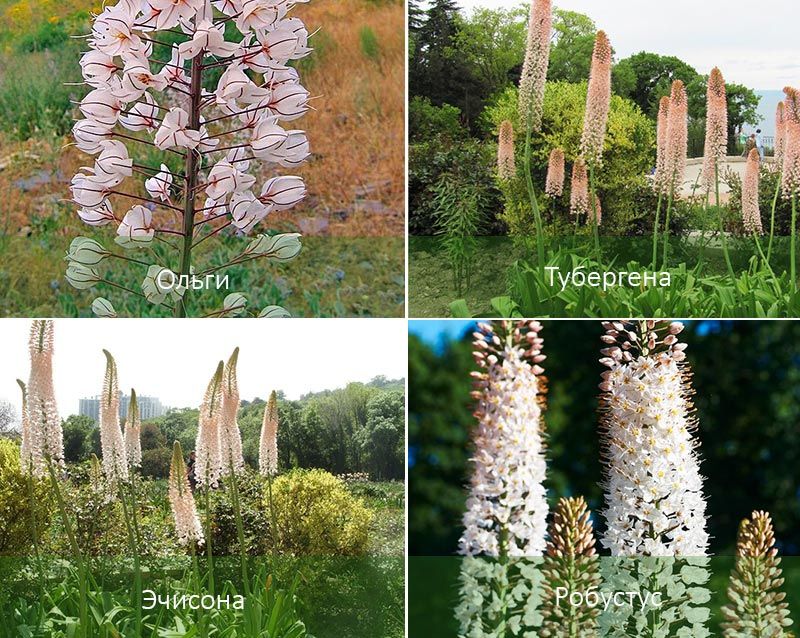
Types and varieties of Eremurus
|
Type / Variety |
Height / Description | Flowers |
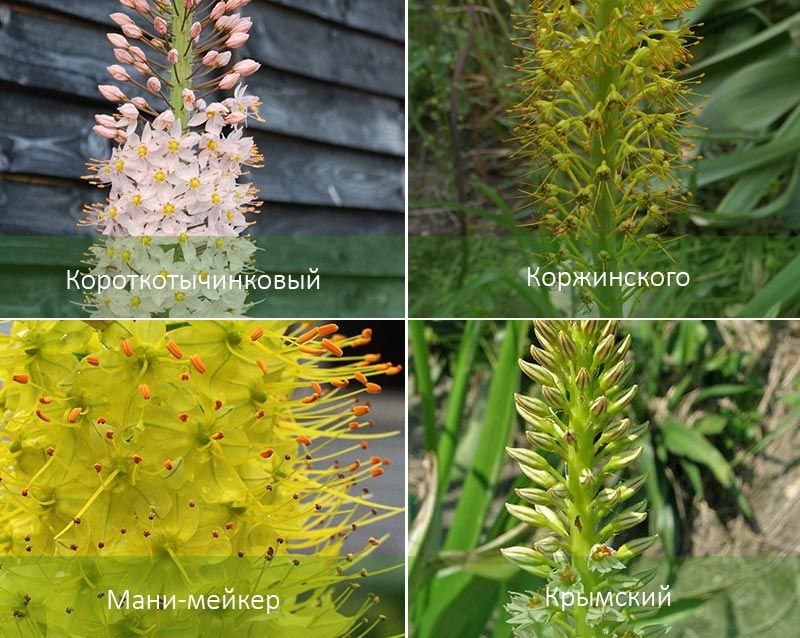
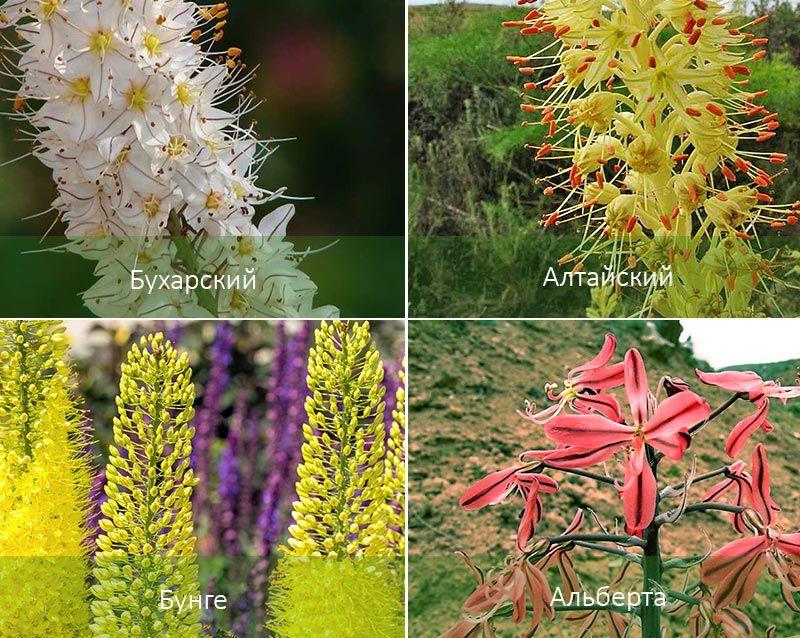
| Altaic | 1.5 m. The stems of the flowers are directed at an acute angle. |
Green-yellow. |
| Alberta | Loose peduncle 60 cm high. | Gray-blue. |
| Bunge or narrow-leaved | 2 m.
The leaves are narrow, glaucous in color, the inflorescence is made up of small flowers, 60 cm. |
Golden. |
| Bukhara | Peduncle 1.3 m, seed capsule pear-shaped. | White or pale pink. |
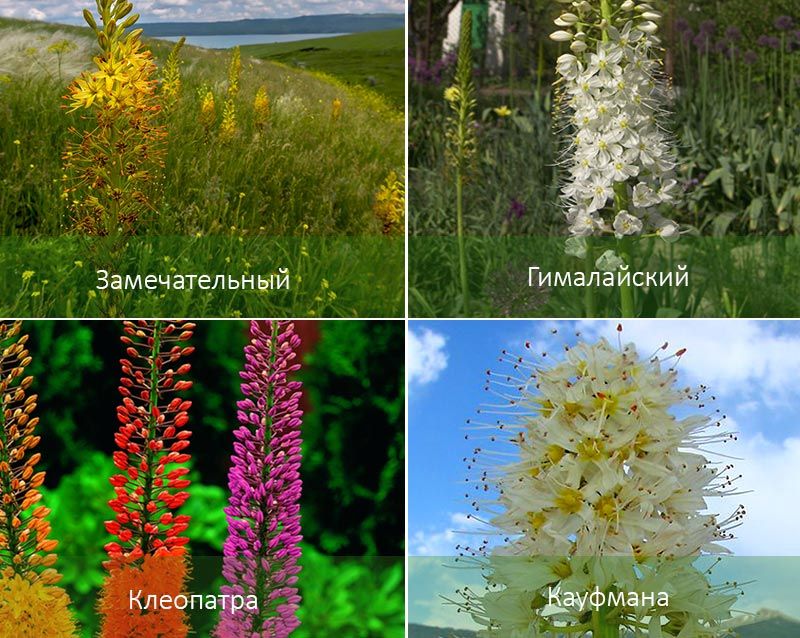
| Himalayan | 2 m. Inflorescence 80 cm. |
White, covered with green stripes. |
| Wonderful | 1.5 m.
Narrow leaves with three edges. |
Yellowish. |
| Kaufman | Leaves with white pubescence, inflorescence 70 cm, diameter 7 cm. | White with a creamy tint and a bright yellow center. |
| Korzhinsky | Peduncle 50 cm. | Yellow-red. |
| Short-stamened | Inflorescence 60 cm. | Pale pink, thickened, short. |
| Crimean | 1.5 m. | White. |
| Lactiflora | 1.5 m.
Long flowering without petal shedding, leaves with a slight bluish bloom. |
Whitish. |
| Robust or robustus | 2 m.
Peduncle 1.2 m. |
Light pink or white. |
| Olga's | 1.5 m.
Leaves are glaucous, inflorescence is 50 cm. |
Pinkish or white. |
| Tubergena | Dense peduncle. | Gray-yellow. |
| Echison | 1.7 m.
The earliest flowering among the species. |
White and pink. |
Through extensive breeding, hybrid varieties of Eremurus in a variety of colors have been developed. The Russian market primarily offers Ruiter hybrids.
| View | Flowers |
| Cleopatra or Cleopatra's Needle | Pink. |
| Money maker | Yellow. |
| Obelisk | Snow-white |
| Odessa | Yellow with a greenish tint. |
| Romance | Pinkish pastel. |
| Sahara | Coral pink with dark purple veins. |
Eremurus (Liatris) alba is widespread, but it belongs to the Asteraceae family.
Eremurus: planting and care
Eremurus is unpretentious in care and reproduces well with due attention.
Planting Eremurus in open ground
Flowers are planted in a permanent flowerbed in late September or early October. Choose a sunny location with good drainage, such as broken brick, expanded clay, pebbles, and similar materials.
Prepare the site in advance. A 5-cm-high drainage layer is covered with a thin layer of soil consisting of compost and turf. The seedlings are placed on top of this layer, spreading their roots, and covered with soil. The rhizomes are planted 5-7 cm deep, the planting hole 25-30 cm deep, and the distance between plants 30 cm. Water thoroughly.
A key condition for rapid flowering is limited fertilization of seedlings. With abundant feeding, they develop foliage at the expense of flower bud formation.
When planting purchased rhizomes, leave a distance of 40-50 cm between the divisions for large ones, 25-30 cm for small ones, and set the row spacing at about 70 cm. After this, the soil is thoroughly soaked.
Caring for Eremurus in the Garden
The plant is easy to grow. In early spring, uncover the flowers, then feed them with a complex fertilizer (40-60 g) and 5-7 kg of rotted manure or compost per square meter. Water the plant well until flowering, which occurs in June.
If the soil is poor, add nitrogen fertilizer (20 g per square meter) in May. After flowering, watering is no longer necessary. If the summer is rainy and the soil is damp, watering is avoided. Loosen the soil and weed regularly throughout the season.
After flowering, the bushes are dug up and left in a well-ventilated area for at least 20 days to protect them from rotting in the damp soil. If digging is not possible, place an umbrella-like shelter over the flowers to prevent moisture from getting in.
In autumn, a phosphorus fertilizer mixture is applied under the plantings in the amount of 25 g per square meter.
Dried roots should not be left until spring. They must be replanted in the soil in the fall. The plant is very winter-hardy, but before frost, eremurus should be covered with fallen dry leaves and peat for better preservation. In the absence of snow, it is good to cover them with spruce branches.
Reproduction of Eremurus
Dividing the flower occurs when new rosettes grow near the planted one and separate easily. If this proves difficult, propagation is postponed until the following season.
The rosette's division is cut so that it and the main rosette have several roots each. The cuts are then sprinkled with ash to prevent rot. The entire family is replanted in the ground until next year.
Once each division has developed roots and buds, the bush can be separated into individual plants. This division is recommended once every 5-6 years.
Propagation from seeds
Sowing seeds directly into the ground isn't a good option. It's more reliable to sow them in seedling trays and then transplant them.
In late September or early October, pots about 12 cm high are filled with loose soil. Each seed is placed 1 cm deep and then kept at a temperature of 14 to 16°C. Germination can take 2-3 years. The top layer of soil should be kept slightly moist at all times.
During the first few years, seedlings are not planted in open ground but left in the same pots to grow and strengthen. They are kept in a well-lit area; when the leaves dry out, they are moved to a shady spot.
Water the seedlings so that the soil always remains slightly moist. During cold weather, cover the pots with sawdust, spruce branches, dry leaves, and, more recently, with covering material. Once the bush has established itself and is large enough, it is transplanted into the soil. Plants grown from seed take 4-7 years to bloom.
Diseases
Flowers are susceptible to pest and disease attacks.
| Pest | Control measures |
| Slugs | Sprinkle the soil with tobacco dust, ash or ground chicken shells. |
| Rodents | Lay out bait and pour water into the holes. |
| Aphid |
Wash the flowers with soapy water. Insecticides (mixed with water):
|
The plant may be susceptible to diseases.
| Symptoms | Cause and disease | Elimination measures |
| Brown and dark spots on leaves, plant weakness. | Dampness. |
Treatment with fungicides once every 2 weeks (with water):
|
| Fungal infection. | ||
| Rust. | ||
| Leaf mosaic. | Viral infection. |
It is not curable. Digging up and destroying the plant. |
Top.tomathouse.com recommends: Interesting facts about Eremurus
In Central Asia, the flower roots are dried, then ground and used as a plaster. They are also boiled and used in food; their taste is very similar to asparagus.
The leaves of certain species are also used in cooking. All parts of the flowering bush are used to dye natural fabrics yellow.