Aeschynanthus is a perennial flower in the Gesneriaceae family. There are 80-194 species of this type of plant. Aeschynanthus belongs to the angiosperm class of plants, which have opposite lateral cotyledons in the embryo.
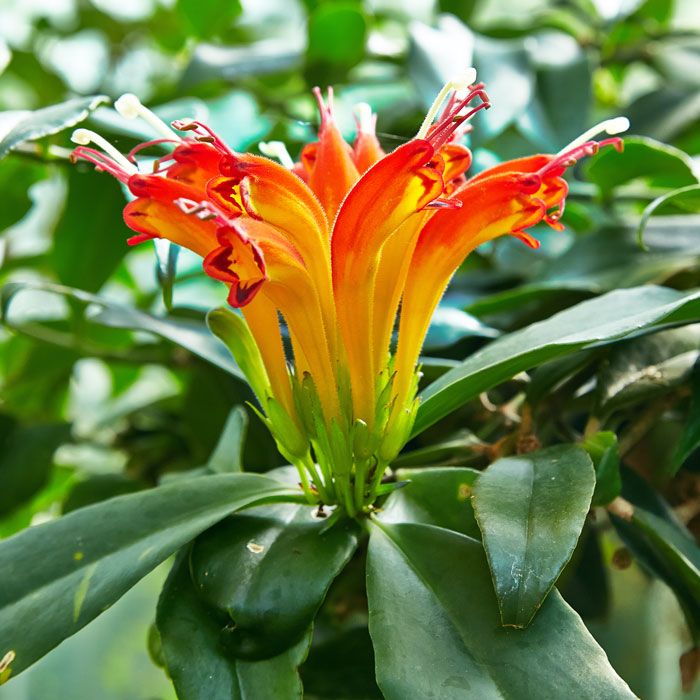
The areas where these flowers can be found are Asia, India, Indochina, Malaysia, Philippines, Brunei, East Timor, Thailand, Vietnam, Singapore, Sumatra, Java and China.
Content
- 1 Description
- 2 Indoor species, their comparison, differences in care
- 3 Basic rules of home care
- 4 Location, lighting, temperature, humidity, and watering - a table by season
- 5 Choosing a pot, soil, replanting
- 6 Pruning, support
- 7 Top dressing
- 8 Time of flowering and dormancy
- 9 Reproduction
- 10 Diseases and pests
- 11 Mistakes in care and their correction
- 12 Signs and superstitions
Description
Aeschynanthus are epiphytes that use trees for support, twining around them. In northern countries, they are often grown as houseplants in hanging pots and planters. The flowers are variegated, meaning some cells do not produce chlorophyll. This causes the leaves to be spotted.
Indoor species, their comparison, differences in care
The average flowering period is from summer to autumn. Large clusters of inflorescences grow on drooping shoots up to 50 cm long. The color can range from red to burgundy.
| Name | Description | Difficulty in care |
| Beautiful, wonderful, or magnificent | The most common type, the structure of the peduncles is 5-10 flowers, which look like narrow tubes, the length of the leaves is up to 10 cm and the width is up to 3 cm, quite plump, bright green in color, and occupy almost the entire area of the stem. | Normal. |
| Gephrolepis | Tubular bright red corollas with a yellow back, curly shoots. | High, requires the most precise adherence to all instructions. |
| Lobba | The pubescent inflorescences are a rich red color, the stems are elongated with a large number of small leaves of a bright green color, the lower part is lighter. | Medium, typical for eschynanthus. Climbing, requires careful maintenance of shoots. |
| Mona Lisa | Fleshy, expressive green color and disc-shaped leaves, scarlet, curved inflorescence. | Low, relatively unpretentious species. |
| Twister | Curled, glossy leaves are dark green, asymmetrical inflorescences are red-orange in color. | Average, follow recommendations. |
| Caroline | Elongated leaves that curl up to 8 cm in length, dark red flowers. | |
| New Guinea | The coloring is soft pink, the leaves are green. | |
| Rocky | This is the rarest species, which has tapered foliage with wavy edges and elongated lilac-colored flowers. | |
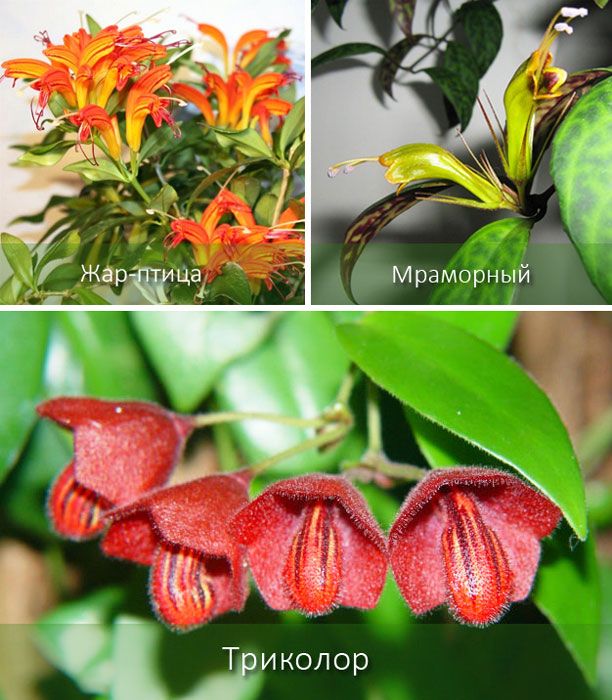
| Tricolor or tiger | A variety with small oval foliage, short red flowers, decorated with longitudinal burgundy stripes. | |
| Firebird | Bright red flowers. | |
| Marbled or long-stemmed | It has decorative foliage, dark green above, interspersed with irregularly shaped, lighter-hued stripes. The underside of the leaf is marbled with a bright brown pattern. The flowers resemble green tubes. The plant grows in width through new shoots. | Tall. Requires more frequent watering. |

Basic rules of home care
The main conditions are sufficient light, high humidity, and no drafts.
The plant needs to be repotted every four years. It's recommended to keep it on a west or east exposure. Aeschynanthus kept on a north exposure will not bloom. The plant should be periodically misted with clean, warm water.
A proper reduction in temperature during the cold period of the year has a beneficial effect on future flowering, which usually begins in the spring.

The plant requires moderate watering no more than once a week, using warm, settled water. Excess water promotes root rot.
Location, lighting, temperature, humidity, and watering - a table by season
| Time of year | Light | Humidity | Temperature |
| Spring | Place the pot on an east- or west-facing window. If the apartment faces south, it will need shade. The marbled variety requires the most light. All other eschynanthus can tolerate semi-darkness, but they will not bloom well. | Aeschynanthus require very high humidity, up to 60-70%. It's essential to mist the plants, moisten the soil, use trays and pots with double bottoms, and place a humidifier nearby. If the plant is flowering, avoid watering the buds and open calyxes. | Not less than +18, but the plant should not be exposed to drafts. |
| Summer/Autumn | Aeschynanthus shouldn't be exposed to direct sunlight at midday. In summer, the plant requires bright, filtered light. | It's best to keep the eschynanthus indoors, where the temperature is between 20 and 25 degrees Celsius. It's not recommended to move it to an open balcony. Once buds have formed on the eschynanthus, it should not be moved further. | |
| Winter | Artificial lighting is not necessary. If the room is sunny, flowers may appear in winter. | Avoid placing it near heating appliances. If the room is cool, there's no need to humidify it. The warmer the house, the more humidity the eschynanthus requires. | The most important thing is to keep the room temperature stable and not let it drop below 15°C. A sudden change in temperature can cause the eschynanthus to become diseased, causing leaf drop and rot. |
Choosing a pot, soil, replanting
The pot should be shallow and have drainage holes. The soil should be airy and loose, with a pH of 5.0 to 7.0. A minimum drainage depth of 3 cm is recommended.
It's best to repot flowers annually in the spring. A gentle repotting method will protect the root system from damage. Plants of this type prefer tight containers.
Procedure:
- Prepare a place for planting; it should be a vessel slightly larger than the one used previously;
- Lay down a drainage layer of at least 3 cm and add fertilizer. Important: do not water the plant for 3-4 days before repotting.
- Turn the pot upside down and remove the plant, making sure to support the roots with your hand. Repot immediately, avoiding leaving the root system outside the pot for too long. Water.
Every year after flowering, old shoots should be pruned to ensure a neat and lush plant. The eschynanthus's flowering period is limited to five years, after which the plant must be replaced.
Pruning, support
Aeschynanthus grow very tall very quickly. Over time, the stems become brittle. They absolutely need support. You can choose any kind—bamboo, trellises, or vines. It's best to install the support right away, when the plant is still small. Help the stems grow by gently wrapping them around the trellis. Otherwise, the plant won't climb.
As soon as flowering is complete, you need to trim the shoots a little.
Top dressing
A universal fertilizer for flowering plants is added to the soil from May to September.
Time of flowering and dormancy
During the winter, the dormant period should be maintained at 16 to 18 degrees Celsius and moderate watering. If the soil is sufficiently fertilized, flowering will occur in the spring.
Reproduction
Propagation by cuttings:
- cut off the upper cuttings, 7 to 10 cm in size, with 5 nodes;
- remove the leaves located at the bottom;
- place the cuttings in water or in a damp mixture of sand and peat;
- wait for the roots to appear.
It is also possible to propagate using a leaf, in which case it is necessary to cut it as close to the trunk as possible.
The recommended air temperature during breeding is +26°C.
The shoots need to be allowed to breathe every day if they are covered with plastic wrap. Rooting will take two weeks.
Diseases and pests
| Symptoms | Pest | What to do? |
| Brown spots, similar to rotten flesh, mold on the inflorescence. | Gray rot. | Spray with benomyl, reduce watering. |
| Cobwebs on leaves, insects, leaf fall. | Spider mite. | Spray with insecticide-acaricide. |
| Light spots on the leaves. | Thrips. | Spray with a special solution of Actellik. |
| The shoots are rotting. | Gray rot of stems. | Remove affected tissue and cover with activated charcoal. If severe rot occurs, destroy the plant. |
| The leaves turn yellow and become covered with white spots. | Chlorosis. | Spray with phytoferm, antichlorosin and feed. |
Mistakes in care and their correction
| Error | What to do? |
| Lack of heat - leaves fall in winter. | Raise the temperature above +16 degrees. |
| The flower is too dry, and its leaves fall off in summer. | Water more often. |
| The leaves turn yellow and dry out from the heat. | Shade the flower. |
| Light spots caused by sunburn. | Do not place in the shade, but protect from direct rays. |
| Slow growth – lack of nutrients. | Feed. |
Signs and superstitions
According to folk beliefs, the eschynanthus is a husband-killer. It can make its owner's love life difficult.