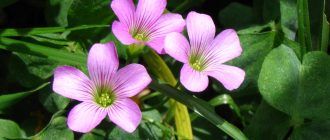
Eucharis is a bulbous plant belonging to the Amaryllidaceae family. It is native to central and southern America.
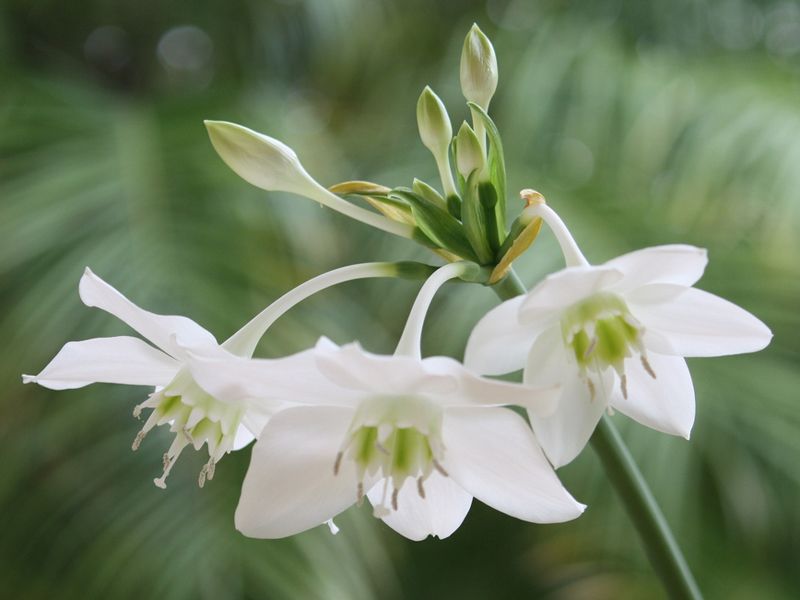
The appearance of Eucharis
The bulb measures 2 to 5 cm. The leaves are lanceolate, sit on large, elongated petioles, and reach 1 m in height and up to 30 cm in width. There are no more than 3-4 leaves on one plant.
Flowering occurs in late summer or early fall. The buds are white, daffodil-shaped, and clustered in clusters of 3-10. They reach a height of up to 85 cm. The crown color ranges from yellow to dark green.
Eucharis toxicity
Eucharis is considered an ornamental houseplant, but due to the presence of lycorine, it is considered poisonous. When ingested, this substance causes nausea and vomiting.
When growing eucharis at home, it should be kept away from children and pets.
When trimming shoots, leaves, or bulbs, or replanting them, dispose of all waste immediately and wash your hands thoroughly with soap. Gloves should be worn when handling the lily.
Common types of Eucharis for indoor growing
The following varieties of Eucharis are excellent for indoor growing:
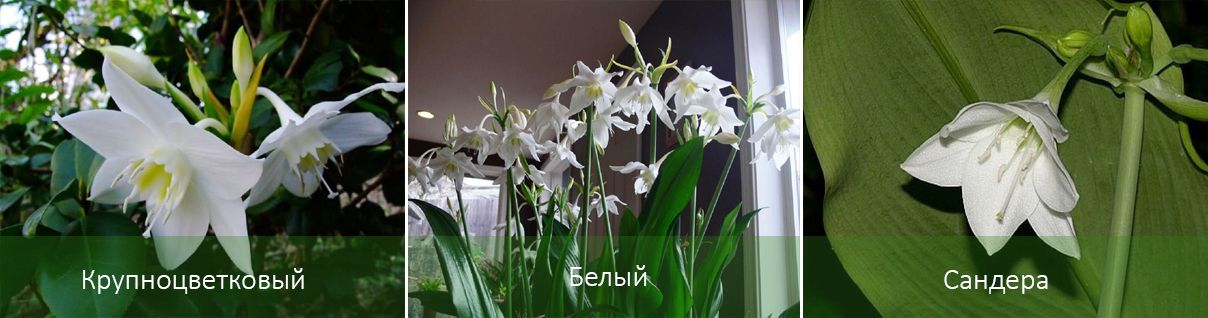
| View | Description | Leaves | Flowers. The period of their formation |
| Large-flowered | The bulb diameter is 3.5-5 cm. It is considered one of the most widespread species. | Dark green. Oblong. | 2-6 flowers, up to 85 cm long. Distinctive, pleasant aroma. White buds. December, May, August. |
| White | Elongated bulb, sizes – from 2.5 to 5 cm. | Brownish-green. Oblong, tapering at the end. They reach 40 cm in length and 12-15 cm in width. | From 2 to 10, length up to 52 cm. White buds. October, March. |
| Sander | The bulb is large, up to 7 cm in diameter. | Light green. Elongated. | 8-10 flowers, up to 50 cm long. White with a yellow center. September, February. |
Caring for Eucharis at home
When caring for eucharis at home, you should focus on the season of the year:
| Factor | Spring-summer | Autumn-Winter |
| Location/lighting | Place the plant on the east or west side of the house. A north-facing windowsill provides the plant with sufficient light. Bright, but diffused. |
They provide additional illumination with phytolamps. |
| Temperature | +19…+20 °С. Sudden temperature changes are prohibited. | +15 °C and above. |
| Humidity | Level – 50-55%. Occasionally spray or shower. | Level 50-55%. Spraying is stopped. |
| Watering | Once every 2-3 days, use settled water. | Once every 7 days. |
| Top dressing | Once every 14 days, alternate mineral fertilizers and organic matter. | The contribution is suspended. |
Trimming
Amazon lilies should winter after flowering, although all buds and leaves retain their natural color for a long time. Therefore, gardeners monitor the end of the growing season, after which they remove all dead foliage and faded flowers with scissors or mini-pruners.
Eucharis transplant
When purchasing a plant from a store, pay attention to the pot size. This is because Amazon lilies grow quickly, and roots begin to protrude. Therefore, if the container is small, repot it immediately.
The ideal time is March or early April. Eucharis is repotted every 1.5 to 2 years after flowering. Don't rush repotting; do it when the bulb has almost filled the entire diameter of the pot.
Particular attention is paid to the soil. It can be purchased at the store; any soil designed for bulbous flowers will do, but you can also make your own at home. When making your own, use the following ingredients in a 2:1:1:1 ratio:
- leaf soil;
- turf and peat soil;
- sand.
The rhizome and foliage of the Amazon lily are quite fragile, so the flower should be replanted with care.
It is forbidden to disturb the integrity of the root ball.
After removing the flower from the pot, loosen the new soil, straighten the roots, and carefully wash them with water.
Place a drainage layer at the bottom of the new pot. Then, place 3-4 bulbs in each container. Once they're in the containers, straighten the roots and cover with soil.
If the plant is young, the bulbs are planted at a depth of 1.5 cm. However, when the eucharis has no leaves yet, the tip of the bulb is placed above ground, and then its development is observed.
Once repotting is complete, the Amazon lily is watered generously. During this time, carefully monitor the humidity level and prevent the soil from drying out.
Reproduction of Eucharis
Gardeners recommend propagating Amazon lilies using "pups," which appear on lilies aged four years or older. To do this, remove the flower from its pot, separate the bulbs, and harvest the planting material. The cut areas are dusted with charcoal to promote rapid healing.
If the "pup" is small or lacks leaves, it's best not to cut it off, as there's a high risk it won't survive. Planting is similar to that for an adult plant. Pups are planted in groups of 3-5 per pot, spaced 20-25 cm apart.
Amazon lily propagation by seeds is also practiced, but in rare cases, since with this type of cultivation the first flowering of the eucharis occurs after five years.
To obtain a seed capsule, the flower is pollinated artificially. To do this, run a cotton swab over the pistil and stamens. The capsule is left in place until it begins to dry out and crack.
The prepared seeds are placed in a bowl with moistened soil, sprinkled with dry soil, covered with plastic wrap, and placed in a warm place. After a few weeks, the first leaves will form. When two or three leaves have emerged, the seedlings are transplanted, 3-4 at a time, into individual containers.
Mistakes in caring for Eucharis, diseases and pests
When grown indoors, eucharis can be susceptible to pest attacks and diseases caused by improper care:
| Problem (effect on foliage) | Cause | Method of elimination |
| Yellowing and falling off. | Over-hydration. | Adjust the watering regime. Prevent the soil from drying out or standing water, as this can cause root rot. |
| Withering. | Lack of moisture. | Adjust the frequency of watering and move it to a room with more humid air. |
| Twisting. | Inappropriate temperature conditions. | Place in a room with a temperature of +20…+25 °C. |
| Dry ends. | Lack of moisture. | Change the watering regime. |
| Yellow spot. | Exposure to direct sunlight. | Shade or move to partial shade. |
| Frequent death and emergence of new ones. | Lack of light or nutrients. | In winter, they are provided with additional lighting using phytolamps and fed with nitrogenous substances. |
| The children do not appear. | Tight container or immature plant. | The babies appear on the adult bulb immediately after flowering; if this does not happen, the flower is transplanted into a more spacious container. |
| Lack of flowering. | Incorrect dormant period. | Move the plant to a cooler, less-lit room, reduce the frequency of watering, and stop fertilizing. Leave the plant in these conditions for 4-5 weeks, then return it to a comfortable environment. |
| Dying off. Root system decay. | Gray rot. | Remove affected foliage and trim off rotted roots. Treat with 1% copper sulfate. |
| Red spot. | Fungus. | The plant is removed from the pot, the damaged areas are removed, and the cut areas are treated with brilliant green. It is then dried for two days and replanted in new soil. |
| Lethargy, with a cluster of dark midges present on the inside. | Sciarids. | Treated with Akarin. |
| White thin web. | Spider mite. | Spray with Fitoverm. |
| The buds become distorted and scales appear, under which pests hide. | Amaryllis mealybug. | The following drugs are used: Vertimek, Aktara, Akarin. |
| Bright red spotting on bulbs, buds and flower stalks. | Stagonosporosis. | Cut out the rotten areas, treat the cut areas with brilliant green, dry for 1-2 days and transplant into new soil. |
Top.tomathouse.com explains: signs and superstitions about eucharis
The Amazon lily is a noble flower that improves the overall energy of a room and, during its flowering period, gives household members a feeling of comfort and relaxation.
When considering omens and superstitions, it's worth noting that the plant absorbs negative emotions and prevents the formation of new ones. Lilies have a beneficial effect on children's mental development, encouraging them to explore the world around them and gain new knowledge. In many countries and cultures, the plant is considered a symbol of home comfort.
In Colombia, eucharis is woven into a bride's wreath to protect the future family from discord.