
A perennial herbaceous plant of the Araceae family. Other common names include calla lily, arum, and zantedeschia. Translated from Greek, it means "beautiful."
The calla lily is native to Africa, which is why it's also known as the Ethiopian lily. It's also common in South America. In the wild, it grows in marshy soils and reaches a height of 2.5 meters. Although domesticated long ago, indoor calla lilies have their own specific cultivation techniques.
Content
Description of indoor calla lily
The leaves are large, glossy, light to dark green, singly arranged on long stems, reminiscent of a heart or a marsh lily leaf. They reach up to 25 cm in width and 40 cm in length.
It blooms, producing a long stalk. The flowers are small, gathered in a cylindrical inflorescence—a spadix—wrapped in a spathe, a bract that resembles a funnel. This spathe is often mistaken for a calla lily. It lasts a very long time—up to four weeks.
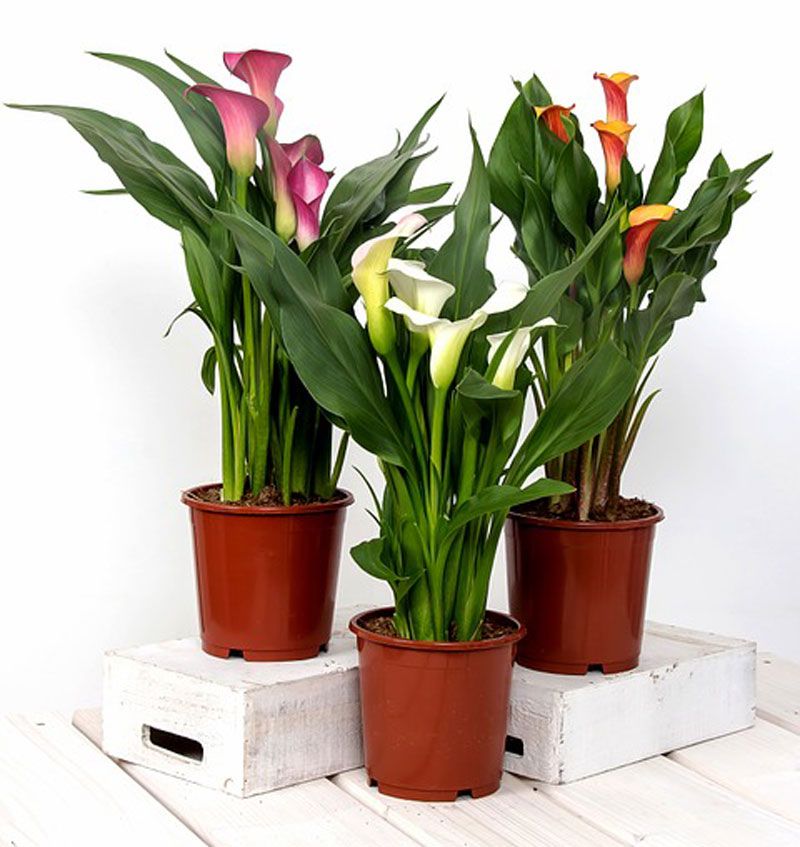
Traditional varieties have white, funnel-shaped leaves. Modern gardening has developed many varieties with different colors. Photos of calla lilies demonstrate their diversity and the beauty of their colors.
White calla lilies have strong rhizomes, while colored ones have medium-sized bulbs. Depending on this, care requirements for the plants vary slightly.
Types of indoor calla lilies
Calla lilies come in a wide variety of colors, from snow-white and lemon-yellow to pink and purple.
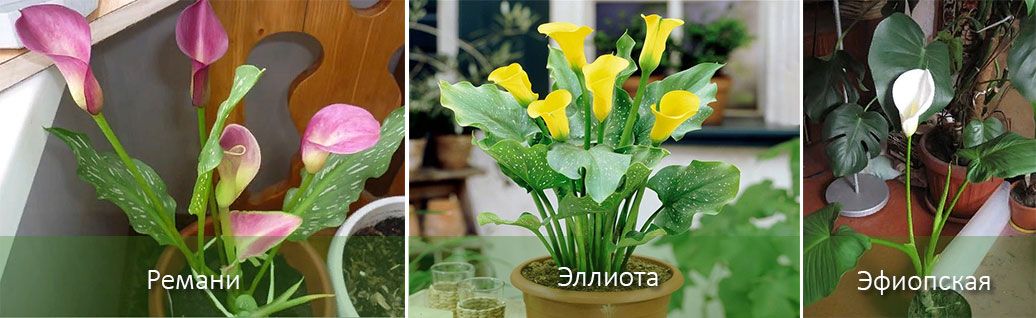
However, botanists distinguish only eight species, and only three of them are found in indoor floriculture:
- The classic variety is the white Ethiopian calla. The plant is quite large, with flower stalks and stems growing up to 1 meter. The leaves retain their vibrant color and do not die back even during dormancy. Instead of a bulb, there's a robust rhizome.
- Calla remana is a compact plant no taller than 70 cm. It is easily distinguished by its characteristic red, pink and purple colors of the spathe.
- Calla elliotii is characterized by large, mottled leaves. The spathe's color varies between the outer and inner surfaces. The flowers are typically bright yellow above and greenish below.
Growing and caring for calla lilies at home
Caring for calla lilies at home only seems complicated. In reality, all you need to do is create conditions as close to their natural habitat as possible and stick to them.
The plant is sensitive to drafts and is prone to rot. Wilted leaves and flowers should be promptly removed with a sharp knife to minimize damage to the stems.
If you leave a spent ear, seeds—berries—will begin to form on it. However, this is not recommended, as seed maturation takes a lot of energy. And propagation by seeds is a very complex and time-consuming process.
The plant's sap is poisonous, so wear gloves when repotting, removing flower stalks, and wilted leaves. Take extra precautions if there are children in the house.
Also read the article about caring for calla lilies in open ground.
Lighting
Calla lilies are very demanding of indoor light. They need diffused light during the day and direct light in the evening. For blooming, they require 12 hours or more of daylight.
During the dormant period, 10 light hours per day is sufficient, but not less than 8.
Watering
Calla lilies require abundant, regular watering and high humidity, which can be achieved by periodically misting the plant. It's important to avoid moisture getting on the bracts, as this can cause them to become spotted and lose their attractive appearance.
You can increase humidity by placing the pot on a tray filled with wet sphagnum moss or damp expanded clay. For the same purpose, periodically wipe the leaves with a damp, soft cloth or sponge.
Don't allow the soil in the pot to dry out. Increase watering during flowering, and reduce it to a minimum during the dormant period.
It's important to consider the differences in care between rhizomatous and bulbous varieties. White calla lilies, which have rhizomes, require ample, consistent watering. Even during dormancy, they don't shed their leaves completely. Colored calla lilies are less demanding in terms of watering.
The plant is a natural barometer. It is very responsive to changes in air humidity, and before rain, dewdrops appear on the tips of its leaves.
Air temperature
Calla lilies are heat-loving. Their optimal temperature range is 20 to 25°C. In summer, they can be placed on the balcony, but remember that cool temperatures below 8°C can kill them.
If a flower has lost all its leaves, it doesn't mean it's dead. It's simply entering a dormant period. The pot should be moved to a cool, shaded spot, and watering should be stopped until daylight hours increase and the first shoots appear.
Transplantation and soil selection
Calamus, like many bulbous plants, requires a spacious container. They won't bloom in a cramped pot.
To ensure flowering, individual varieties should be potted individually. Choose a container made of porous materials to allow the roots to breathe. For 6-centimeter tubers, the pot diameter should be at least 20 cm; the optimal capacity is 3 liters.
A large drainage layer, approximately 5 cm high, should be poured onto the bottom of the container to prevent water stagnation.
Repotting should be done in April as the bulbs grow. After that, it's sufficient to replace the top layer of soil in the pot once a year.
For growing calla lilies indoors, it's best to use a mixed soil mixture: equal parts compost, sand, peat, and garden soil. Care must be taken to prevent the soil from becoming acidic, which can impede natural moisture circulation.
Reproduction
When the bulb reaches vegetative maturity, it will produce sprouts. These can be carefully separated from the adult plant and transplanted into a separate container, being careful not to damage the delicate roots.
It is important not to plant mature tubers deeper than 5 cm to prevent them from rotting.
If they cannot be separated, it means they are not yet mature enough, and reproduction will have to wait.
Top dressing
Calla lilies require moderate fertilizing when grown indoors. Fertilizing for a month immediately before forcing and during flowering is sufficient.
During the dormant period, additional feeding can cause the plant to become “fat”, that is, it will produce a lot of leaves but will not bloom.
It's best to use a complete liquid fertilizer and add it to the water when watering once a week. During the period of flower stalk formation, growth stimulants should contain nitrogen. Once buds appear, switch to potassium-phosphorus fertilizers.
Problems with indoor calla lilies and their solutions
| Problem | Cause | Solution |
| The stems stretch out. | There is not enough light, it is very warm. | Change the location, install additional lighting, lower the room temperature. |
| The plant does not bloom. | The dormant period was not observed. | During wintering, stop watering and reduce light. Fertilize before flowering. If the rhizome grows too large, divide or replant the tubers. |
| Brittleness of petioles. | Lack of nutrition. | Every week, fertilize with fertilizers containing nitrogen and superphosphate. |
| Plaque on leaves. | Fungal disease powdery mildew or gray mold. | Treat the leaves with a solution of potassium permanganate or washing soda and soap. Spray with fungicides such as Fundazol, Vekta, Topaz, etc. |
| Non-seasonal leaf shedding. | Root rot. | Reduce watering, replace soil. |

Calla lilies in floristry and folk beliefs
Breeders have developed many varieties of calla lilies in a wide range of colors, which provides unlimited possibilities for use in both mono-bouquets and mixed compositions.
Beautiful, large, dense buds, as if made of porcelain or ivory, last a long time when cut. Therefore, they are used in the most expensive and elegant bouquets.
Calla lily bouquets are a staple at high-level meetings and important diplomatic negotiations. They are believed to bring success in financial deals.
A number of omens and superstitions are associated with this plant. Calla lilies are considered the flowers of death. There are several reasons why this interpretation has taken root in our consciousness. None of these theories can be confirmed or refuted.
- Appearance: The white covering resembles a shroud, and the flowers on the cob resemble a wax funeral candle.
- European traditions. Since the Middle Ages, calla lilies have been planted in cemeteries near the graves of the deceased.
- Flowering period. The flower typically blooms at night, when otherworldly mystical forces are activated. Varieties grown outdoors also exude a subtle, sweet, fruity-floral aroma.
- Folk omen: A calla lily blooming means there's a death in the house.
- A poisonous plant. Its juice was used in various potions and as an antidote for snake bites.
Equally plausible are the accounts that this flower bears an aura of divinity. It is mentioned in the Bible, the divine scripture. The calla lily blossomed at the foot of the cross on which Jesus Christ was crucified.
With its perfect whiteness, beauty, and perfect lines, it symbolizes the purity and innocence of the Virgin Mary. In iconography, it can be seen in the hands of angels bringing good news.
In some regions of the country, calla lilies symbolize innocence and are used in bridal bouquets. In this case, they serve as a talisman, protecting the wearer from evil and envious glances.





I love calla lilies and don't believe in the bad omens associated with them.