Phalaenopsis is an ornamental flower of the Orchidaceae family. It is native to Southeast Asia and northeastern Australia.
Content
Description
Phalaenopsis is an epiphytic herbaceous shrub. Large leaves extend into thick, strong roots that have the following characteristics:
- contain chlorophyll;
- have a spongy structure;
- covered with a wax film;
- participate in photosynthesis;
- serve as a support;
- provide nutrients;
- turn green when saturated with moisture.
In the spring and fall, flower stalks emerge from the axils of fleshy, oval-shaped leaves. Their structure varies depending on the species. They can be long, short, straight, curved, branched, or drooping.
During the growing season, 1-3 leaves grow on the shoot. These last for several years. As new foliage forms, the old leaves die off. The length of the leaves varies depending on the phalaenopsis variety, ranging from 0.2 to 1 m. Coloration: light green, dark green, and spotted.
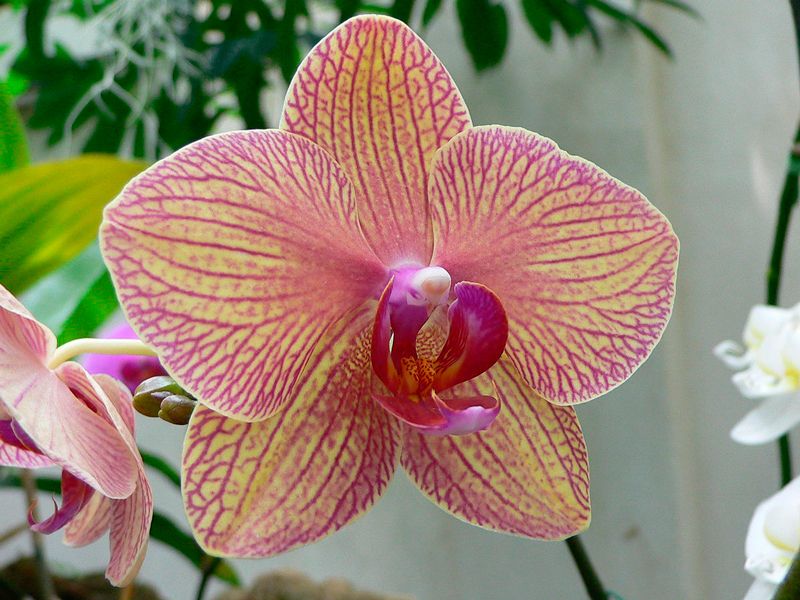
A single plant produces 5-60 flowers, each 2-15 cm in diameter. Their shape and petal pattern resemble a butterfly. Round and star-shaped flowers are also common. Phalaenopsis's natural color is white.
Phalaenopsis species
| Variety | Description | Flowering period |
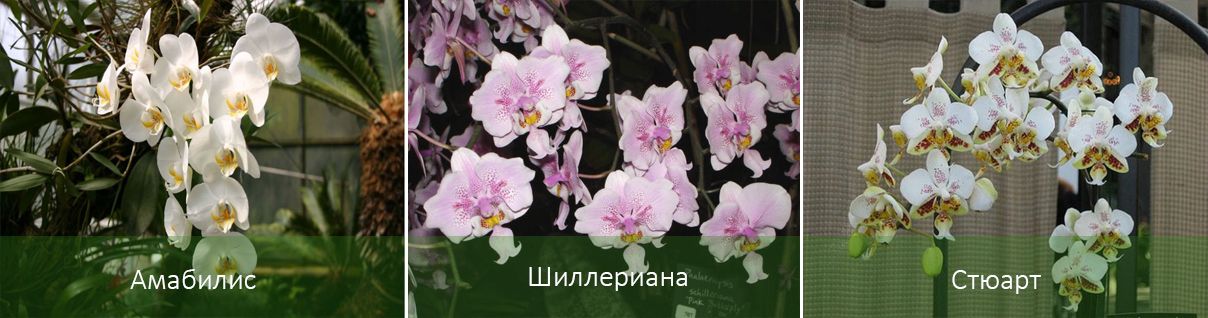
| Amabilis | Dark green leaves arranged in two rows. A curved peduncle 1.5 m tall. The most advantageous variety for crossbreeding. It has a delicate aroma. | October – March. |
| Schilleriana | Silvery flat roots with a pink tip. It impresses with the enormous size of its speckled leaves. Up to 200 light pink-purple flowers with a pleasant scent are produced simultaneously. | May – February. The peak of active flowering is the winter months. |
| Stuart | A tall plant with a curved stem, glossy white roots, variegated leaves, and white petals. Up to 60 buds open simultaneously. | January – March |
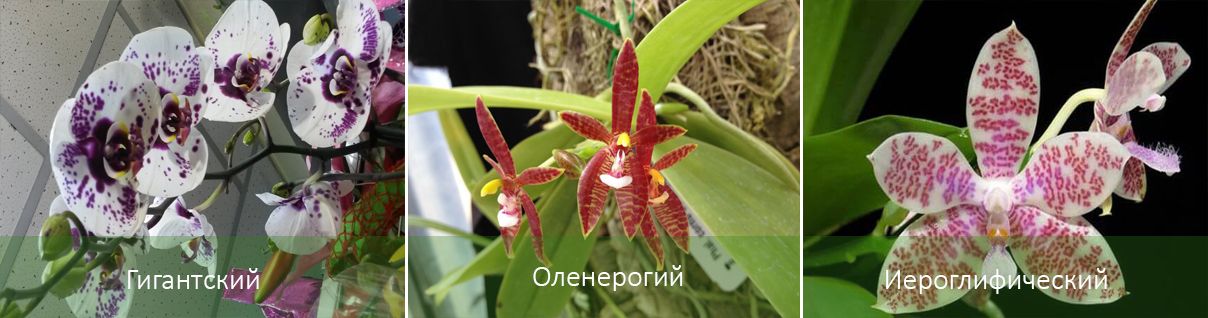
| Giant | Tall, drooping stems with numerous buds. Petals come in a variety of colors. Stiff, malachite-colored leaves are covered with light speckles. In favorable conditions, it blooms year-round. | Constantly. |
| Deer-horned | Small, golden-red flowers with brown spots. Their structure resembles deer antlers. Where buds form, growths resembling a comb develop. | All year round. |
| Hieroglyphic | The leaves and flower stalks are green. The white waxy petals have distinctive hieroglyphic-like markings. It has a pleasant scent. | Duration: 30 days. |
| Parish | A milky-white variety with a fruity aroma. The short stem is covered with leaves. The flower has a wide lip with a lilac center. | Continuous. |
| Luddeman | A miniature variety with elliptical, salad-like leaves. Mature specimens bloom successively year-round. Dense petals are smaller than sepals. Purple, chestnut, and light violet streaks are scattered across a white background. It has a distinct, pleasant aroma. | Permanent. |
| Sander | The most expensive variety. Tall, drooping stems are adorned with a large number of flowers in a variety of colors. | All year round.
Peak activity is spring and summer. |
| Ambon | 3-5 oval leaves. Flower stalks lengthen annually. Petals are variegated – brick-colored transverse stripes on a light background. | Continuous flowering.
The phase of greatest activity is summer. |
| Pink | A miniature variety with white, milky, and pink flowers. The undersides of the leaves have a reddish tint. | All year round. |
| Horse | A short stem with paired dark green leaves. Pastel pink and purple flowers. | 5 months. |
| Mini Mark "Maria Teresa" | White flowers with orange, bright yellow, and brown speckles. Spring and fall. | 3 months. |
| Amsterdam Jordan | A rare variety. Pink petals are adorned with small dark spots. The lip is cherry-colored. | All year round. |
Home care
| Parameter | Necessary conditions |
| Light, temperature | Place in a west- or east-facing window. Provide 12-hour light. Rotate the pot periodically (once every ten days) relative to the light source. Do not disturb the plant during the budding period. Maintain at normal room temperature:
|
| Watering, humidity | Regular watering is performed after the soil has completely dried out using the immersion method. Fill the container with settled water. Submerge the flowerpot for 30 minutes. Then place it on a tray to allow excess moisture to drain through the holes in the bottom. This procedure is repeated once every ten days. Humidity: 40%. Phalaenopsis is not misted. Periodically, the plant is placed in the shower, then the leaves are wiped dry, and the plant is left in a dark place for 45 minutes. |
| Fertilizers | Rules of use:
Use growth activators according to the attached instructions. |
Pot, soil, replanting
The soil is prepared from a mixture of conifer bark, charcoal, sphagnum moss, and shells. The drainage layer consists of small pebbles, expanded clay, and polystyrene foam beads. A small amount of peat is added to maintain the acidity of the substrate. To prevent mold, the bark is boiled and dried before use.
Features of the pot:
- transparent walls – light reaches the root system;
- Perforation – bottom holes provide good aeration.
Transplantation is carried out in 2 cases:
- replacement of soil mixture – once every 3 years;
- strong root growth.
This procedure is performed after flowering. Step-by-step instructions for repotting a Phanelopsis:
- soak the pot with the plant for half an hour;
- take out of the ground;
- free the roots from the substrate, remove the diseased ones;
- Place drainage at the bottom of a new, larger pot and orchid soil mixture on top;
- place the flower in the center, fill the voids with substrate;
- choose a place with high humidity;
- water after 3 days.
Bloom
Duration: 2-6 months. The plant can bloom multiple flowers twice a year. This depends on the condition of the bush and growing conditions.
After wilting, the old, drying stalk is removed. The green flower stalk is cut to the height of the fork and placed in water to produce offspring. These offspring are then used for propagation.
Reasons for lack of flowering:
- insufficient lighting;
- overuse of nitrogen-containing fertilizers;
- plant fatigue.
Once the underlying cause is identified, it can be addressed by adjusting the growing conditions. Flowering can be stimulated by watering with Bud and Ovary preparations and lowering the nighttime temperature.
Rest period
Growth slows, metabolism decreases. The plant becomes more resistant to cold and drought. During this time, lower the temperature, reduce watering, and stop fertilizing.
Trimming
After flowering has finished, the old, withered shoot is cut off above the third bud.
Choosing the Right Phalaenopsis
You should buy a healthy orchid with a developed root system and firm, shiny leaves. The Phalaenopsis pot should be free of moss. An important feature of orchids is that some of their roots are exposed to the air, protruding from the soil surface.
After leaving the store, the plant is kept in its packaging for 24 hours. The flower is adapted to home conditions:
- inspection of leaves, roots, flowers – removal of dry, damaged parts;
- irrigation by conventional immersion;
- weekly wrapping of plant pots with sphagnum bandage to identify existing pests;
- removing dust and white plaque from leaves with a cotton pad soaked in warm water;
- spraying the peduncle.
Healthy, treated plants are placed on the windowsill.
Reproduction
Only high-quality plants free of disease are used. Vegetative propagation involves lateral shoots. These shoots form near the root rosette, on the flower stalk. In most cases, their appearance is induced artificially.
At the base of the flowering stalk, select a dormant bud and remove the covering scales with tweezers. Treat it with a growth stimulant such as aloe vera juice, Epin, or Kornevin. To create a greenhouse effect, cover the flower stalk with a plastic bag. The first leaves appear after 60 days. Roots form after a month.
The offspring is separated from the mother plant and dried for 24 hours. The planting substrate is selected to be fine-grained.
To root the seedling, create greenhouse conditions by covering it with a plastic cap. The ideal temperature for rooting is 25°C.
Another method of vegetative propagation is dividing the stem into parts:
- cross-section;
- section along the axis;
- combined division.
The cuts are treated with cinnamon, the buds with cytokinin paste, dried, and placed in a solution containing a crushed activated charcoal tablet. The water is changed weekly and Forte orchid fertilizer is added.
After six months, a young flower stalk appears on the rooted cutting. It is ready for planting in the substrate.
Diseases and pests
Improper care of phalaenopsis leads to the development of diseases and the appearance of pests.
| Manifestation | Disease/pest | Elimination measures |
| Dark spots, softening of leaves. Loss of elasticity of roots. | Bacterial spot | Removal of lesions. Cauterization with iodine, treatment with crushed charcoal or activated charcoal. In advanced cases, use fungicides such as Ridomil or Fitosporin. |
| The appearance of large white spots on the leaves, which eventually affect the entire leaf blade. | Hives | Changing growing conditions: reducing humidity, increasing temperature, optimizing ventilation. |
| Dark brown spots appear on petals, leading to wilting. A gray coating is visible at the base of young stems. High humidity facilitates the spread of the infection. | Botrytis | Creating favorable conditions for maintenance. Treatment with bactericidal agents such as copper sulfate, foundation, and HOM. |
| Redness appears on the roots and stems. In some places, sunken necks are observed. Over time, the red areas darken, and white, pink, and purple spore deposits form on them. Large-scale yellowing of older leaves and loss of elasticity of young shoots are observed. The plant dies. | Fusarium | Treatment is possible only in the early stages:
The quarantine period is 20 days. If there are no signs of recovery, the plant is destroyed as non-viable. |
| The leaves turn yellow, wither, and fall off. | Mealybug | Treatment with soap solution. |
| Formation of a thin, shiny, steel-colored mesh on the leaves. | Spider mite | Spraying with a solution of laundry soap, using acaricidal agents - Sumiton, Actellic. |
| Brown spots on flowers and leaves. | Thrips | Insecticide treatment – Fitoverm (least toxic), Isatrin, Actellic. |
| Formation of tubercles on the leaf surface. | Scale insects | Using a soap solution. Treatment is carried out twice, with a weekly interval. |
| The appearance of jagged edges on the leaves, damage to the petals | Slugs | Mechanical methods include using vegetable bait (cucumber and carrot pieces) and collecting pests. Spraying with spices such as allspice, rosemary, cilantro, and ground parsley is also possible. Insecticides such as Mesurol and Metheldehyde can also be used. |
Viral diseases (such as mosaic—the first sign of which is yellowing foliage) that affect ornamental plants are incurable. Affected plants must be destroyed.
A hybrid member of the Phalaenopsis orchid, it symbolizes love, beauty, and family comfort. It is a talisman against male impotence. Low-maintenance phalaenopsis orchids, with proper attention, delight with their blooms almost year-round.