The Miltonia orchid is a plant native to Brazil. It is a perennial member of the Orchidaceae family. The genus was named after the renowned English orchid collector Viscount Milton.
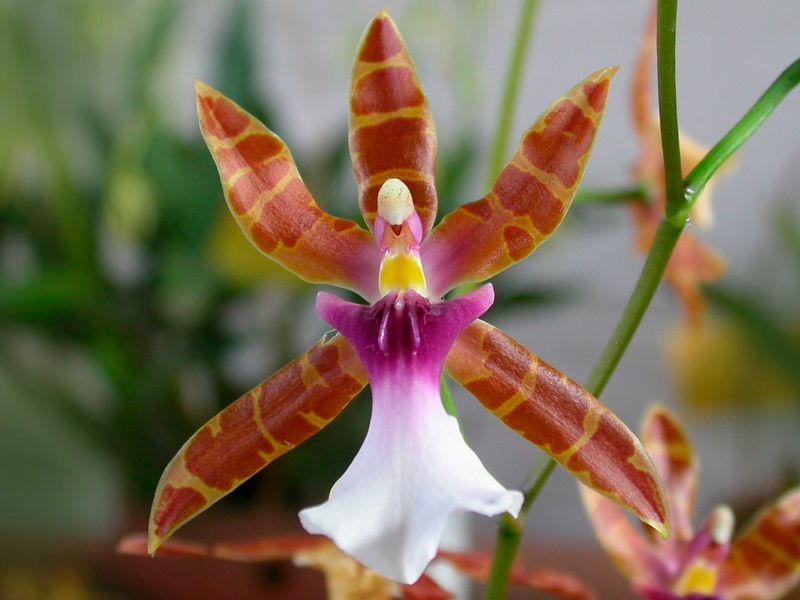
Description of Miltonia
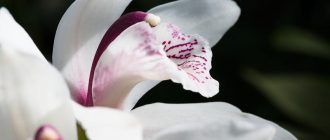
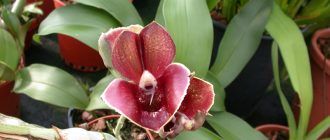
The Miltonia orchid is ideal for indoor cultivation. This genus is characterized by large flowers measuring 10-12 cm in diameter and gray-green, pointed leaves up to 40 cm long. Coloration is varied: pink, burgundy, and pure white petals are common, and some hybrids also have a patterned throat. Miltonia grows to no more than 40 cm in height, but some species can reach up to a meter. Blooms last 5-6 weeks. The roots are aerial, with pseudobulbs at their base. This genus produces false bulbs, which later develop into paniculate stems of varying color.
Miltonia orchid species
Miltonia has many species and hybrids that differ not only in color, but also in plant size.
| View | Description | Flowers
Flowering period |
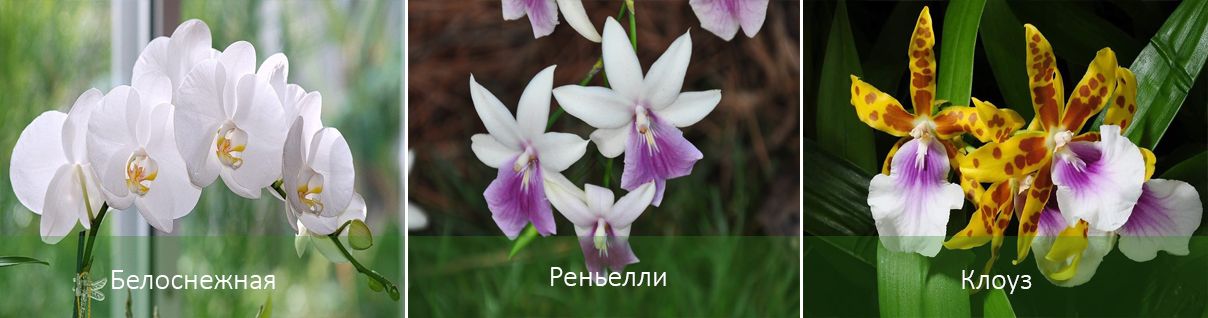
| Snow-white | One bulb produces 1-2 peduncles measuring 40 cm. |
Large, up to 9 cm in size, the white lip of the plant has a purple marking at the base and contrasts with the yellow calyxes. There are 3-5 in total. Autumn. |
| Renielli | The leaves are thin and iridescent due to the secretion of a special plant wax on them. | 3-7 snow-white. The lips are pink, with purple stripes and a border. Spring. |
| Close | No more than 10 inflorescences reaching 40 cm. Small pseudobulbs with yellow-green leaves. |
7-10 alternately blooming. The upper half of the lip is white, the lower is purple with yellow lines. Spring-autumn. |
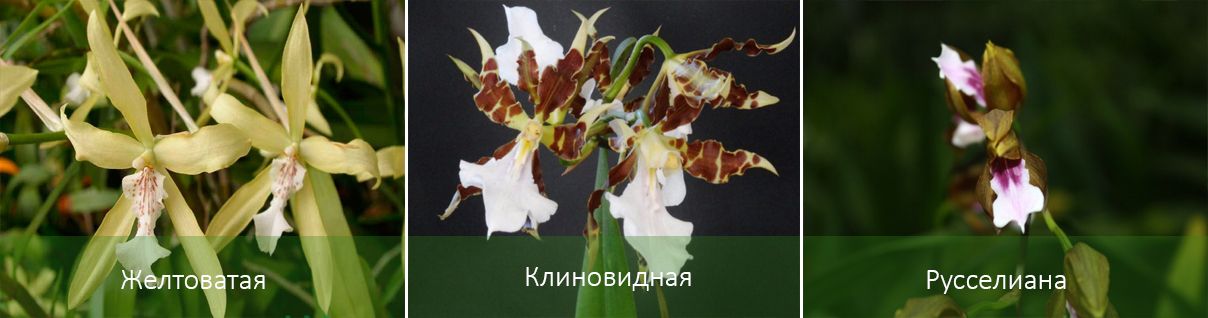
| Yellowish | Reaches 50 cm. Ovoid pseudobulbs of a rich green hue. Peduncle: 1 m. | 15 with yellow pointed petals. It has a wavy white lip with purple stripes. Spring-summer. |
| Sphenoid | Low, about 35-40 cm. The leaves are pointed and shiny, widening towards the top. |
4-6 flowers with a vibrant fragrance. The white, trapezoid-shaped lip contrasts with the brown petals. Winter-spring. |
| Russeliana | Small in size. The pseudobulb is oblong and dark green. | About 6 cm in diameter. 5-9 flowers. Petals and leaves are brown, the lip is white with a purple spot at the throat. Autumn-winter. |
| Varshevich* | It has large inflorescences, reaching 30-50 cm. | Brown or burgundy sepals and petals. The flat, wide lip is pink, with a bright light pink spot in the center. |
| Phalaenopsis* | Grows up to 30 cm. A pointed leaf appears at the top of a green pseudobulb. | 3-5 flowers, each up to 6.5 cm in diameter. The lip has purple stripes, while the rest of the flowers are pure white. They resemble pansies. |
| Roezla* | Reaches 28-38 cm. A single, pointed, dark-green leaf grows on pseudobulbs covered with small scales. Peduncles are 30 cm long. | 2-5, about 10 cm in diameter. White with purple spots, the lip has an orange disc. |
| Cymbidium* | Grows 50-100 cm. | The color of the inflorescences is varied, and the corolla is 13 cm. |
*Warszewicz, Phalaenopsis, Roesla and Cymbidium bloom in spring and autumn.
Miltonia care at home
In order for miltonia to delight its owners with its flowers and leaves, it requires proper care.
| Parameter | Necessary conditions |
| Location/lighting | Unpretentious. Grows in both sun and shade. Place the pot on an east or west exposure. Avoid direct sunlight. Requires increased light in winter. |
| Temperature | It cannot withstand fluctuations in temperature. Maintain temperatures between 18 and 24°C. At lower temperatures, it stops blooming and dies. |
| Humidity | 70-80%. At low temperatures, flowers fall off. |
| Watering | Water abundantly, especially in spring and summer when the plant is actively growing. Use water at +30…+45°C, avoiding drying out or stagnant water, as this will cause miltonia to rot. |
| Soil | Prepare a special soil mixture of peat, humus, sphagnum moss, and sand in a ratio of 1:1:1:0.5. Sprinkle the topsoil with chopped pine bark and charcoal. |
| Top dressing | In spring and summer. Orchid fertilizers are available in stores. Prepare a solution at half the recommended concentration. You can also feed them monthly with a soluble houseplant fertilizer. |
| Trimming | It requires almost no maintenance. However, if pests appear, carefully trim off the affected parts of the plant. As for the flower stalk, it should be cut off after flowering. |
Flowering and dormancy period
For the plant to continue blooming fully, a dormant period is necessary. This begins when new bulbs begin to form and lasts several months. Maintain a temperature of 15–18°C and water once a week. With proper care, the orchid will bloom throughout the year, except during the dormant period.
Each species has its own blooming season, most often spring or summer. Immediately after flowering, every two years, it is recommended to repot the orchid in new, nutritious soil.
Repotting should be done by transferring the plant from one container to another, then adding bark around the edges of the pot. The plant's roots are delicate and fragile, so care must be taken.
Reproduction
Miltonia orchids can be propagated only by division. The seed method at home lacks the necessary sterility. The plant must be disease-free during propagation, and at least six pseudobulbs must be present.
- The plant is taken out of the pot and the soil is carefully shaken off the roots.
- Then, using disinfected scissors or a knife, cut the bush so that the division has a root and three pseudobulbs. The cut areas are treated with charcoal powder.
- Before planting, the resulting parts are dried for 5 hours.
- Place the cuttings in a pot with prepared soil mixture, but do not bury them more than 5-8 cm deep, as this may cause rot.
- Water sparingly for the first 3-4 weeks. The orchid will only begin to grow fully after this time.
It is also possible to propagate Miltonia using air layering, but this method is most often used in botanical centers.
Mistakes in Miltonia Care
| Manifestation | Reasons | Elimination measures |
| Short flowering period. | Lack of fertilizer, nutrient deficiency. Short dormancy period. Incorrect temperature (too hot). | Place the plant in a suitable place without direct sunlight, increase feeding. |
| The leaves are turning dark. | Lack of light. | Increase lighting by moving the pot or adding additional sources such as phytolamps. |
| The leaves turn reddish. | Bright lighting. | Remove the orchid from the light and cover it with a cloth. |
| Unopened buds fall off. | Temperature disturbances (hot), low air humidity, drafts. | Create favorable conditions: protect from drafts and place a container of water next to the plant. |
| The ends of the leaf have dried out. | Soil mineralization due to the use of tap water. | Water with melted boiled water. |
| The roots are rotting. | Watering too frequently. | Repot in new soil. Water no more than once a week for the next two months. |
| Black spots on the surface of the leaves. | The water in the container stagnates and becomes unusable. | Make drainage holes (if there are none) or change the soil to a lighter one, without clay content. |
| Light transparent spots on the leaves. | The plant has a burn due to prolonged exposure to direct sunlight. | Remove the plant from direct sunlight and cover with gauze. Spray the leaves every 3-4 days. |
| Flower growth slows down and ribbing appears on the leaves. | Insufficient watering and substrate saturation. | Place the miltonia in new soil. |
Diseases and pests of Miltonia
| External manifestation | Cause | Methods of elimination |
| Black spots appear on the leaves and pseudobulbs, and there is a characteristic rotten smell. | Root rot. | Remove the orchid from the pot and use disinfected scissors to remove any parts of the flower showing the symptoms mentioned above. Treat the cut areas with ground cinnamon. Then, place the orchid in new soil with Trichoderma. Water with Topsin for the next three days. |
| It is manifested by small round black marks on pseudobulbs and leaves, which subsequently become covered with a yellow coating. | Anthracnose. | Remove infected parts of the plant and treat the cuts with Mikosan or any other antifungal drug. |
| The plant is covered with a fine web, and orange circles can be seen on the back of the leaf. | Spider mite. | Generously moisten the flower and cover it with plastic wrap for several days. Use Neoron, Omite, or Fitoverm for a month. |
| The leaves are covered with beige lines, the pseudobulbs are black sticks. | Thrips. | Treat with soap solution, oil emulsion, Inta-Vir and Nurell-D. Do not repeat more than twice. |
| Small white butterflies living inside a flower. | Whitefly. | Place syrup traps around the plant. Water with Fitoverm and Actellic twice a week. |
Top.tomathouse.com explains: signs and superstitions about miltonia
Purple and red miltonias help combat laziness and old habits. Yellow orchids promote financial growth, while orange ones bring inspiration. Beige orchids can help you gain insight, while white ones can help you overcome depression. Pink orchids add femininity and charm to women, but it's best not to use them in men's rooms.