The vanilla orchid is the only member of the Orchidaceae family that produces edible fruit. It is native to Panama, Mexico, and the Antilles.
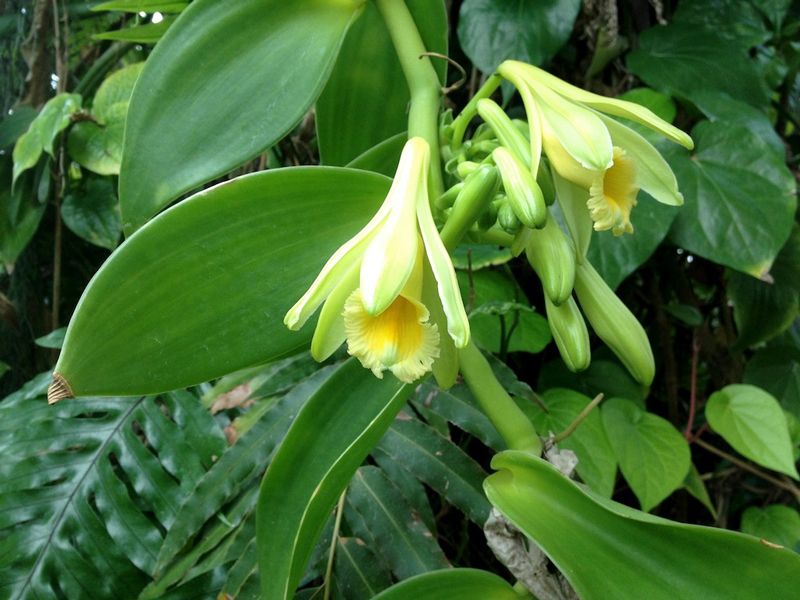
Description and distinctive features of the vanilla orchid
It is a vine and can reach 30 meters in the wild, or 3 meters when grown indoors. The flowers are pure white, yellow, or light green. The bud lasts only 24 hours. It has dense green foliage and an aerial root system.
Thanks to its delicate aroma, it is widely used in the perfume industry. This particular vanilla scent has been considered trendy for several years now.
Caring for a vanilla orchid at home
This vanilla is variegated, so when caring for it, you should take into account a number of nuances:
| Parameter | Conditions |
| Location/lighting | Diffused light. Place in a southwest or east-facing window. Protect from direct sunlight and ensure good air circulation. |
| Temperature | +25…+30 °C at any time of year. The permissible minimum temperature is +18 °C. |
| Humidity | 80-90%. To achieve this level, the plant is constantly watered and sprayed (using soft, warm water). |
| Watering | Use a shower. Give it a generous shower, but don't let the top layer of soil dry out. |
| Soil | Breathable and rich in beneficial components. Suitable substrate: garden soil, pine bark, crushed fern roots, moss. The components are used in a ratio of 2:1:1:1. |
| Top dressing | Once every 21 days. Use a special fertilizer for orchids. |
Transplantation, pruning
Orchids can be pruned at any distance; branching and downy growth can be observed in the cut area. After this procedure, flowering can be expected only after three years.
Repotting is done every 2-3 years, as this is when the roots become cramped in the old pot. The optimal time is spring.
Replanting a flower is not difficult; you just need to remove it from the container in such a way as not to damage the root system.
If a part is damaged, these areas are sprinkled with charcoal, and only after this is the plant placed in a new pot.
Methods of reproduction
The most popular method of propagating vanilla orchids is by cuttings. For this, select a cutting with at least three nodes containing aerial roots.
To speed up the rooting process, the cutting is treated with any growth stimulant; you can use Heteroauxin.
The cutting is placed in a container with moistened substrate; sand is recommended. The container is then covered with plastic film and maintained in greenhouse conditions. The cuttings are aired daily. Once the cutting begins to grow, the plastic film is completely removed. After 3-4 leaves appear, the plant is repotted in soil suitable for mature orchids.
Vanilla Orchid Diseases and Pests: How to Control Them
The plant is resistant to pests (the only exception being scale insects), but improper care can cause the development of a number of diseases:
| Manifestations | Reasons | Elimination |
| Root and stem rot. | Over-hydration. | The orchid is repotted, replacing all the soil in the pot, and watering is reduced. |
| Dryness of foliage. | Moisture deficiency. | Increase the frequency of watering and spraying. |
| Light spots on the leaves. | Burn. | At midday the plant is moved to partial shade. |
| Blackening of aerial roots. | Excessive amount of fertilizers. | Adjust the frequency of fertilization. |
If you don't make any mistakes in your care, a healthy and beautiful plant will delight you with its aroma and long flowering period (the vanilla orchid has many flowers that bloom at different times).