The Saintpaulia "Summer Twilight" recently celebrated its 10th anniversary. The variety was bred in 2007 by Konstantin Lvovich Morev, a student of Russia's most distinguished breeder, Boris Mikhailovich Makuni.
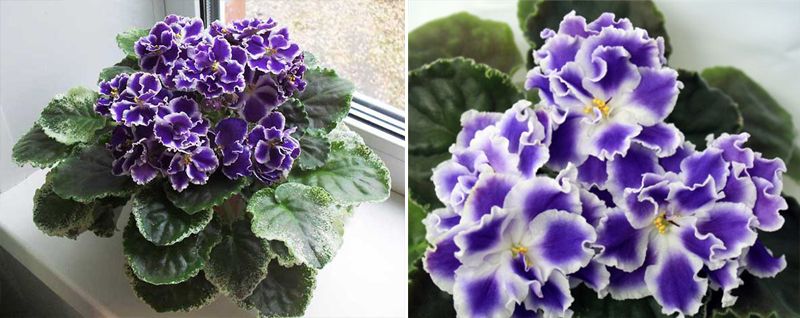
Morev's varieties are distinctive and equal in quality to foreign varieties, often surpassing them. Summer Twilight has already become a treasure trove of the best domestically bred violets.
Content
Description of the Moreva variety
Violet class: compact standard. The rosette is neat and display-worthy.
Leaves
The foliage is a rich, medium-green, almost dark, with a white border along the edges. The shape is harmoniously oval, with a quilted surface.
Flowers
The flowers are semi-double stars with 7-12 wide, slightly pointed petals arranged in gentle waves. The edges are slightly ruffled. The flower shape is voluminous and lush. The diameter is 5-6 cm. The color is lilac-violet, with a thin, irregular white border and eye. The edge color gradually, but without a prolonged stretch, flows into a rich, cool violet tone, giving the flower a watercolor-like appearance.
The buds are collected in clusters of 3-5 on each stem. They are strong, stocky, and short, bending slightly under the weight of the flowers, which effortlessly form a neat head in any growing conditions. Blooming is persistent and abundant, lasting up to 3 months.
Advantages
The Summer Twilight violet has many advantages, thanks to which it has become not only a popular collector's item but also a sought-after variety for interior decoration:
- A distinctive decorative appearance evoking associations with the night sea, storm clouds, and evening twilight. A beautiful, elegant combination of variegated foliage and white-purple flowers.
- Exhibition quality. Compact, not sprawling, rosette, stable flower stalks, abundant flowers.
- No special requirements. This is a reliable variety that will thrive with standard violet care. It doesn't require any special care, and is stable and reliable.
The violet will only show its full potential after its second or third bloom. The first flowers may be small and simple.
Growing conditions
This variety is undemanding. No special conditions are required. It grows well in ordinary apartments.
Conditions of detention:
| Parameter | Conditions |
| Location | Western and eastern windows |
| Lighting | Plenty of diffused light without direct sunlight |
| Temperature | +16…+18 °C |
| Humidity | 80% |
| Priming | Loose, with excellent hygroscopicity. Ready-made or homemade, made from peat (2 parts) and perlite (1 part). |
| Pot | Plastic, 1/3 higher in height than in width, compact, diameter no more than 1/3 of the socket. |
Why choose plastic containers? They're easy to clean, separate easily from the sides of the root ball when replanting, aren't affected by temperature fluctuations, and offer good protection against hypothermia or overheating of the roots by sunlight.
Reproduction of violets
Saintpaulia is easily propagated by leaf cuttings and flower stalks. The second method is for professionals and is usually used only by breeders to enhance the characteristics of a particular flower bud. At home, propagation by leaf cuttings is preferred.
Rules for choosing a cutting:
- The leaf should be selected from the middle row, not too old and not too young.
- It should be healthy, strong, elastic, and free from damage.
- It's essential to evaluate the quality of the buds above the leaf; these characteristics will be inherited by future young plants. The flowers should fully match the official description: large, with a clearly visible white border and eye, abundant, and double.
Avoid taking cuttings from flowers with too thin a border and a dark shade - there is a risk of getting spores with purely purple flowers without white color (specimens with genetically absent traits).
Next steps:
- The cutting is cut at an angle, the cut is dipped in crushed activated carbon, and the cutting is immediately placed in clean water without drying.
- The cut should be inspected periodically for signs of rot. If rot does appear, the affected area is cut off again and the cuttings are placed in fresh water. The water should be changed daily thereafter.
- Roots will appear in 1-1.5 weeks.
- As soon as the roots reach 1 cm, the cutting is planted in standard soil for violets.
- In a month, young plants will appear from under the ground.
- They are carefully planted in small pots or plastic cups.
- The mother leaf can be re-rooted.
If the cutting is too large, the process of producing offspring may be delayed. To stimulate their growth, the upper half of the leaf blade is cut off.
Caring for violets
Variegated violets are somewhat more demanding than common violets, although the Summer Twilight variety is highly reliable and will thrive with standard care. However, it's worth considering its peculiarities.
- It is advisable to keep the plant in a cool place, at a temperature slightly lower than normal room temperature: the white border and the color of the flowers will be more expressive.
- More attention to lighting will be required. If the leaves are too green, the plant is not getting enough light.
- If you want a year-round flowering plant, it is advisable to provide up to 12 hours of daylight.
- Violets don't like being misted, but they do require fairly high humidity. This can be achieved by placing the plants on a tray with wet pebbles, misting the air nearby, or installing ultrasonic humidifiers.
- Saintpaulias' shaggy leaves actively collect dust, so the room where the plant is kept must be spotlessly clean. An occasional shower is acceptable for plants that haven't yet bloomed, but proceed with caution.
Top.tomathouse.com warns: mistakes when watering violets
A major mistake is choosing the wrong soil. The violet root system is very sensitive to excess moisture. And if this moisture is too cold, bacterial rot and viral diseases cannot be avoided. Therefore, good drainage and light, air- and moisture-permeable soil are essential.
Mistakes when watering:
- Very cold water. The water temperature should always be 5 degrees higher than the ambient temperature.
- Water should be taken straight from the tap and not allowed to settle. Salt deposits in the soil suffocate the roots, impeding the plant's nutrition, and can even lead to its complete death. The best water is rainwater or melted snow (frozen in the freezer and then thawed).
- Frequent watering. Water Saintpaulias only as needed. Feel the soil. If it's dry (but not completely dry), it's time to water. Frequency depends on the time of year and the room temperature, so there are no universal recommendations. Just test it with your hand.
- Too shallow. Water only wets the top layer. The roots below are deprived of moisture, creating a damp zone on the surface, increasing the plant's risk of disease. Water thoroughly, ensuring that water passes completely through the root ball and appears in the tray. Drain off any excess moisture.
Top dressing
Violets don't require much fertilizing. In the spring, immediately after repotting, the soil's nutrients are sufficient. During the budding period, use any complex fertilizer for flowering houseplants. If there are light spots on the leaves, the plant is lacking nitrogen. "Clean Leaf" fertilizer is recommended.
Transfer
Repotting should be done as needed, regardless of the time of year. As soon as the container becomes too crowded (the violet leaves are more than 2/3 larger than the container's diameter), the young plant is transplanted into a pot 2-3 cm larger than the previous one. This method is called transshipment. This means placing the plant in a new container without disturbing the integrity of the root ball.
Subsequently, plants are repotted once a year in the spring. Very old plants, over 5-6 years old, will require rejuvenation. The rosette is cut off at the root, old leaves are removed, and the rosette is placed in water. As soon as roots appear, it is planted in the soil as usual.
For abundant flowering, violets need a slightly cramped pot. A large pot will cause the plant to focus all its energy on the tops.
Diseases and pests
Possible diseases and pests are described in the table:
| Problem | Cause and symptoms | Elimination measures |
| Root rot | Fungal activity, activated due to poor care (overwatering, chilled roots). Poor and slow growth, deformed leaves, limp, and lacking turgor. | Remove the plant from the pot, carefully inspect the roots, remove any damaged parts with a sharp knife, and replant in sterile soil. In severe cases, cut the rosette off at the root and reroot. |
| Gray mold | Caused by bacteria, buds and flower stalks become covered with gray spots, flowers fail to open, and become deformed. | Spraying with Topsin-M. Check for maintenance errors (incorrect soil, improper watering, ceramic pot, dampness, cold, plant injury, overheating or overcooling of roots). |
| Powdery mildew | Caused by certain types of fungi, it causes a white coating to appear on leaves and flower buds. | Treatment with Topaz, Fundozol, Bayleton, revision of conditions of detention. |
| Insects: scale insects, aphids, thrips, mites, whiteflies | Rarely affects Saintpaulias, typical for plants kept in extremely oppressed conditions. | Spray with insecticides such as Bazudin, Actellic, Fitoverm, and Vermitek. Remove affected parts. Provide proper plant care. |
To avoid the above-mentioned problems, simply keep the plant in suitable conditions and follow standard houseplant care guidelines. Showering and preventative insecticide treatments are essential for all new plant growers. This will help prevent pests.
Creating a comfortable environment for the Summer Twilight Saintpaulia is easy in a typical apartment. Healthy specimens successfully cope with diseases on their own, delighting with fresh leaves and vibrant flowers.