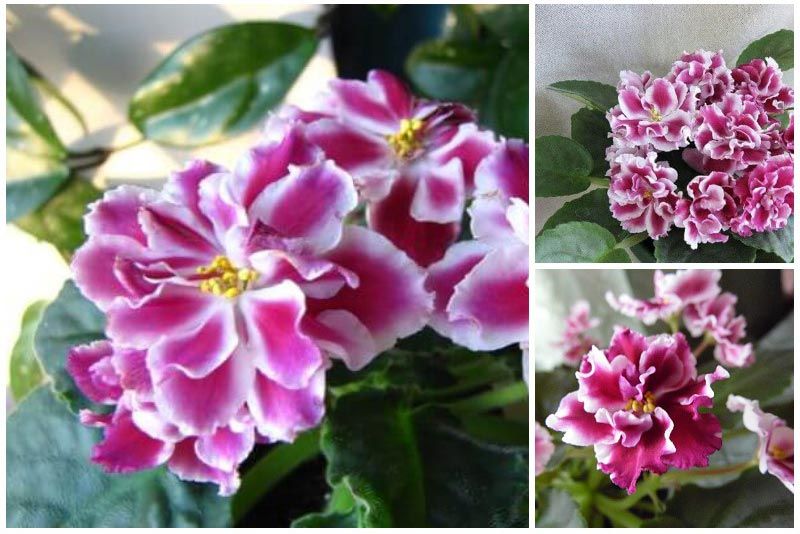
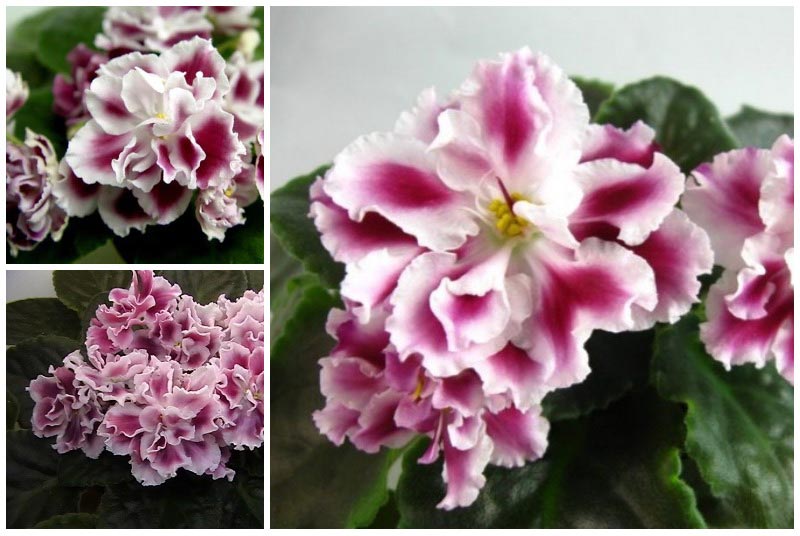
The Frosty Cherry violet, a selection by K. Morev, is a unique, rare, and beautiful plant variety. Its flowers can change color depending on growing conditions. The creator spent 11 years creating this new variety. This violet was first introduced in 2005 and amazed the public with its large, double petals.
Features and benefits of the Frosty Cherry violet
Some of the main factors determining flower size are the age of the bush and the number of shortened spore-bearing shoots. The older the plant, the larger the petals. The flower itself can grow up to 4 cm in diameter. The rosette is standard in size, and its shape is regular and symmetrical. Young bushes have rich green leaves that darken with age.
The cherry-colored flower is adorned with a white border. The base color can vary from pink to deep ruby, depending on the temperature. If the plant is grown in cooler temperatures, the violet will lighten, while if grown in warmer temperatures, it will become more vibrant. Numerous buds typically appear in the center of the bush, growing like "caps." The flowering period itself lasts a very long time—sometimes up to 10 months. This duration is determined by proper care. To recover, the Saintpaulia requires a short rest period.
Planting and growing conditions for the Frosty Cherry violet
A description of the basic requirements for growing will help avoid common mistakes made by inexperienced owners.
| Parameter | Conditions |
| Location | An east or west exposure is best. The south, which is exposed to excessive amounts of direct sunlight, is considered harmful. |
| Lighting | To admire the rich hues of the flowers, ensure they receive sufficient light. Insufficient light will cause the flowers to fade and the leaves to become elongated. Too much light will lead to the opposite extreme—the center will become clogged with leaves. |
| Temperature | The plant's low maintenance allows it to bloom beautifully in both winter and summer. When temperatures drop, the white color predominates on the bush, but as temperatures rise, this color fades or disappears. A comfortable environment for growth is considered to be between 20 and 25°C. At higher temperatures, the flowers become smaller, and at lower temperatures, when the temperature falls below 15°C, their production ceases. |
| Humidity | Heat and high humidity are the plant's enemies. Optimal humidity is 50-55%. |
| Priming | It should include essential micro- and macronutrients. A suitable mixture can be purchased at a store or made at home by mixing garden or sod soil, peat, and a rooting agent (perlite/vermiculite). A soilless version is also possible. In any case, the resulting mixture should be lightweight, moisture-absorbing, breathable, and have a pH of 5.5-6.5, live microflora, and a range of nutrients (additional fertilizers are added at your own discretion). |
| Pot | A suitable plastic container is one with multiple holes to improve root aeration. Smooth walls prevent damage to the plant during repotting, as the underground portion of the plant cannot attach to the surface. If the pot is reused, remove any salt deposits and soak it in soapy water for two hours to disinfect. A suitable container size is one-third smaller than the rosette. Choosing a pot that's too large will cause the root system to fill it, which will negatively impact the development of the above-ground portion of the plant. |
Proper care of the Frosty Cherry violet (watering and fertilizing)
Proper watering is essential for the health and vigorous growth of Saintpaulias. The amount of water supplied is determined by many factors. If a plant that was wick-watered at the store arrives home, over-watering the soil is detrimental to it—the roots have already become accustomed to a moist environment.
When a violet is growing in a cool room or is unhealthy, the amount of water added should be reduced, but not eliminated completely.
Violets require increased watering during the following periods:
- Bloom.
- The period of active growth (spring-autumn).
- During placement on the sunny side.
- When the temperature rises in summer or when located near a heater that is on.
When watering, it's important to pay attention to the quality of the water. Experts recommend using settled water at room temperature. For additional nutrition, use special fertilizers for violets. For young shoots, use formulations with a higher nitrogen content to promote foliage growth. Potassium and phosphorus are essential before bud formation and during flowering. These fertilizers are applied to the substrate at the roots. The first application of the nutrient mixture is two weeks after repotting. During the winter, remove the fertilizer to allow the plant to rest and recuperate.
Transplanting and propagating violets
Typically, the plant's location is changed every six months. Propagation can be done with repotting. To do this, cut off a leaf so that a 3-4 cm stalk remains. Plant the violet blade in the prepared nutrient mixture and cover it with a transparent container to promote rooting. After 3-4 weeks, the first leaves will appear, and after 3 months, the violet can be repotted. The large parent leaf should be removed, and the shoots should be distributed among smaller pots. Watering the seedlings with water (15 to 25°C) after planting is essential.
Problems with growing Frosty Cherry violets
Temperature imbalances, excessive humidity, tap watering, and uncontrolled lighting can all cause plant diseases. The main problems associated with improper care and their solutions are listed in the table.
| Problem | Cause, manifestations | Elimination measures |
| Late blight | Brown spots appear on the leaves, which then increase in size. Initially, the disease affects the older, lower leaves. As a result, the plant wilts. | The soil and lower crown should be discarded. As a preventative measure, neighboring plants should be treated even if there are no signs of damage. |
| Powdery mildew | The defect is caused by fungal spores transferred from infected specimens. When infected, the leaf becomes uneven and develops a white, indelible layer. Ulcers may develop on the leaf blades or they may die. | Flower stalks and damaged leaves should be removed. In the early stages, spray with products such as Topaz, Sapropel, soda (4 g per 1 liter of water), or dust with sulfur powder. In later stages, Bayleton is a good choice. Repeat treatment after 7 days. |
| Rust | First, a brown coating appears on the bush, followed by deformed leaves. This problem is usually caused by overwatering. | Avoid adding liquid to the soil for a while. Treat the leaves with a rust remover. |
| Fusarium | An insidious disease that attacks the roots. The rot spreads to the trunk and leaves. Risk factors include the flowering period and temperatures below 16°C. | To prevent this, it's important to maintain suitable environmental conditions and water with warm water. An infected plant cannot be saved—the violet will die. |
| Gray mold | The problem arises from spraying by an inexperienced owner. As a result, mold forms on the flowers and stems. | Damaged parts of the plant should be removed, the room where the bush is located should be ventilated, treated with a fungicide and watering should be reduced. |
Top.tomathouse.com recommends: How to change the flowers of the Frosty Cherry violet variety
In low light on a windowsill and cooler temperatures, the plant's owner will see light-colored petals, as the dark area shrinks. Sometimes, a pink tint is observed, as in the Le Isolde or Whipped Cream varieties. Flowering with a large white hue may also occur only during cooler weather.
When the chimera violet receives sufficient light, its base color darkens, even turning burgundy in the presence of excessive sunlight. During periods of high ambient temperatures, the red pigment becomes abundant (the white pigment disappears).
To maintain the effect of the double petals, it is necessary to ventilate the room, since Saintpaulia does not tolerate significant humidity and heat well.
The Frosty Cherry violet is an attractive houseplant, popular with both novice growers and collectors. This variety is easy to care for, tolerates temperature fluctuations, and to avoid color variations, simply root cuttings from beautiful, richly pigmented flower stalks.