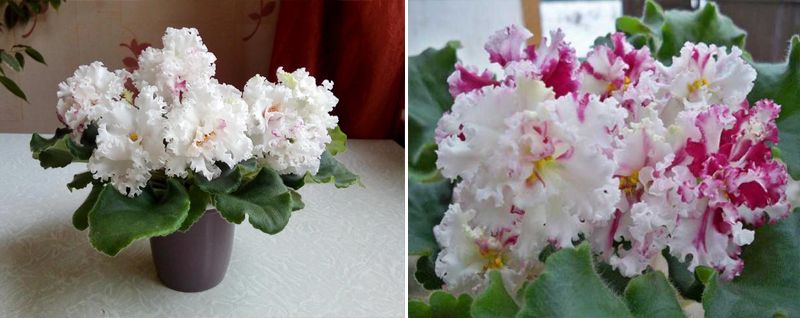
The "Whipped Cream" violet is the work of Elena Lebetskaya, a Vinnytsia native and the creator of over 400 exquisite Saintpaulia varieties. Introduced in 2011, it immediately captured the hearts of Saintpaulia lovers and became a coveted addition to most collections.
Content
Description and characteristics of the violet Whipped cream
The main characteristic of this variety is its powerful potential for continuous flowering and the exceptional symmetry of its rosette of leaves. These traits are common to all of the breeder's works.
The cultivar's name fully matches the author's description: the lush cap of fully blossomed buds resembles a favorite delicacy.
Whipped Cream forms a compact bush with a diameter of 17 cm. The leaves are uniformly light green, with a reddish underside. The edges are slightly wavy. Chimeras of this variety sometimes have variegated leaf coloring, adding additional charm to the plant.
A relatively small rosette is crowned with large, double inflorescences. The flowers have tightly fringed margins and range in color from medium to dark crimson. The petal coloration is uneven—even on a single flower, white and crimson tones coexist. The appearance of these shades is related to ambient temperature and light levels. Therefore, the same plant seems to constantly change its appearance.
The buds form on strong stems that don't droop under the weight of the large, 5-6 cm diameter flowers. Blooming lasts 60 days, and after a 3-4 week rest, blooming resumes, completely changing the bouquet's color scheme.
Unfortunately, the foamy white and pink splendor of Whipped Cream is gradually fading. The cultivar is considered short-lived, with a tendency to gradually lose its characteristics: mature bushes increasingly produce solid red flowers.
Whipped cream is often confused with other varieties – Frosty or Winter Cherry, which have a predominantly burgundy color.
Planting and growing conditions for the Whipped Cream violet
Planting of Saintpaulia is carried out according to general rules:
- Place a 2-centimeter layer of expanded clay or broken brick in a clean, disinfected pot with drainage holes.
- Fill the prepared substrate to approximately half the depth.
- Place the seedling, add soil, compacting it slightly.
The first watering should be done only 24 hours after planting. This ensures that the wounds on the roots caused during planting have already healed, preventing any potential for rot.
The conditions that best satisfy the plant's needs and promote flowering are listed in the table.
| Parameters | Conditions |
| Location | Western or eastern windowsills. Complete protection from drafts. |
| Lighting | Daylight hours range from 12 to 14 hours. Color temperature ranges from 4000 to 6200 K, which corresponds to natural sunlight in the morning. |
| Temperature | In summer, within the range of +24…+26 °C. In winter, not below +16 °C. |
| Air humidity | Not less than 50%. |
| Priming | A special mixture for Saintpaulias or one made independently from turf, leaf and coniferous soil, sand or peat in equal parts. |
| Pot | The diameter is selected so that it is one-third the size of the leaf rosette. The material is not important. |
The nutrient substrate is sometimes composed of high-moor peat and perlite. The ratio is selected based on the watering method: top water – 2(3):1; bottom water (wick water) – 1:1.
To avoid overloading the plant with sprays that are contraindicated for it, fungicides in the form of activated carbon or sphagnum moss are mixed into the substrate.
To provide violets with sufficient light, you need to resort to additional lighting. The optimal choice is Fitosan phytolamps, which do not affect the microclimate, do not emit harmful substances, and maintain excellent performance for many years.
Proper care of violets Whipped cream
If all the necessary conditions are created for the flower, caring for it turns out to be quite simple - regular watering and fertilizing.
Watering
This procedure must be carried out very carefully: excess moisture, especially in hot weather, will destroy the violet in a matter of days.
Basic rules:
- The water should be at room temperature or 2-3° higher, soft, and settled for 2 days.
- Hard water is softened with lemon juice at a rate of 1-2 drops per 1 liter.
- After 20-30 minutes of watering, drain the excess water from the tray and wipe it dry.
Whipped cream is watered either from above, carefully applying moisture along the walls of the pot, or from below, through a tray.
Top dressing
The first feeding should be administered no earlier than a month after planting/repotting. Use specialized formulas for Saintpaulias or universal formulas for flowering plants, such as Kemira Lux, Royal Mix, and others. When choosing a formula, pay attention to its composition: it should contain a minimal amount of nitrogen, lest you end up with pure green leaves instead of a lush, white-crimson haze.
Experienced gardeners recommend applying fertilizer weekly, reducing the dosage by 2-3 times the recommended amount. This schedule ensures that flowers receive nutrients and microelements in a more balanced amount.
Transplanting and propagating violets
Plants are repotted annually in the spring. The day before, the soil under the plant is thoroughly moistened and a new container, fresh substrate, and drainage are prepared. The size of the new pot is determined according to the following rules:
- if the bush is divided, the diameter of the new container remains the same;
- otherwise, the new container must be of such a volume that the old one fits in it with a gap of up to 1 cm.
Propagation by dividing the bush
As the bush grows, it produces a daughter plant, which is easily separated from the mother plant during repotting. The baby plant is then planted in a separate pot.
Rules for propagation by cuttings
Select a healthy, young leaf with a long petiole from the center of the rosette. Cut it with a sharp, disinfected knife at an angle of at least 45°. Place the cut leaf in water prepared for irrigation, and add one tablet of activated charcoal.
Once roots appear, the cutting is planted in soil, covered with a transparent cover, and placed in a well-lit area. After 10-15 days, when the first tiny leaves appear, the greenhouse is removed.
Propagation by seeds
Collectors often use this method to develop new violet varieties. Seed germination algorithm:
- Only high-quality seeds purchased at exhibitions or from collectors are suitable for planting.
- Soil for violets, purchased or prepared independently, is sifted and placed in a seedling box, and watered with any fungicide.
- When the substrate dries out a little, make shallow furrows in it at intervals of 3-5 cm and lay out the seed material.
- Add a 2-3 mm layer of the same soil or fine sand.
- Moisten the plantings using a spray bottle.
- Until the seedlings appear, the seedling box is kept in a shaded place.
Top.tomathouse.com warns: problems when growing violets Whipped cream and their elimination
| Problem | Cause | Methods of elimination |
| The leaves are stretched upwards, unnaturally raised. | Light starvation. | Move the flower to a well-lit place. |
| The leaves have fallen over, but retain their natural texture. | Excess of light. | Shade the plant slightly. |
| Soft petioles and peduncles, black spots on them. | Over-watering of the soil. | Remove the violet from the pot along with the lump of soil and wrap it in paper towels. |
| Brown spots on leaves. | Violation of temperature regime. | Restore the required temperature. |
| Whitish coating on all green parts. | Powdery mildew caused by improper watering. | Treat the roots with fungicides, strictly adhere to the watering schedule and quantity. |
| Lots of leaves, no flowers. | Excess nitrogen or improper growing conditions. | Use special low-nitrogen fertilizers. Maintain the required light levels, temperature, and humidity, and protect from drafts. |