The Cinderella Dream violet, a selection by A. Deikun, is particularly popular among other varieties. It has a unique petal shape and is prized for its low maintenance and distinctive flowering habit.
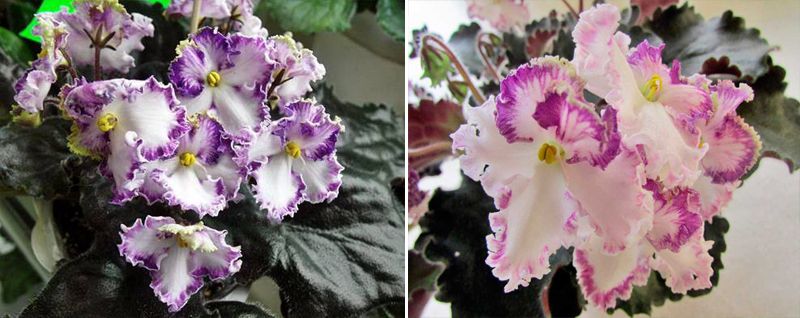
Description of the violet Cinderella's Dream
This variety quickly became a favorite among houseplant enthusiasts for its low-maintenance nature and magical appearance. Its wavy, dark-green leaves, gathered in a small rosette, are quite large and have a distinctive red tint on the underside. Young flowers are white, but with age, a lilac edge develops on each petal. The flowers can grow up to 4 cm in diameter. Each stem bears 5-6 buds. Flowering is often followed by petal shedding, and the total flowering period can last up to 40 days.
Advantages
The main attraction is the unusual shape and color of the flowers. The contrast between the lilac ruffled upper part of the petal and the white rest is remarkable. It is distinguished by continuous blooming and a smooth rosette shape. In addition to the basic color variant, there are varieties with a reddish mesh and a brownish-strawberry border.
Growing conditions
| Factor | Conditions |
| Location | It will thrive near windows facing any direction except south. During the summer heat, it's worth periodically shading it with gauze to prevent sunburn and soil dryness. |
| Lighting | Strong, diffused light is preferred, away from direct sunlight. Daylight hours should reach up to 16 hours in summer, while 12 hours is sufficient in winter. Artificial light sources are also acceptable. Insufficient light adversely affects the shape of the rosette, reducing the number of buds and causing the leaf petioles to stretch. |
| Priming | A nutritious, loose, and moisture-retentive soil is required; forest soil is ideal. A mixture of turf, decayed leaves, and sand would be beneficial. Once the plant blooms, it will require additional feeding. Any general-purpose soil from the store will do, adding a little perlite. |
| Pot |
The violet grows laterally, not downwards into the soil. Therefore, it doesn't require a deep pot. Drainage in the form of expanded clay or broken brick at the bottom is essential. Container dimensions vary depending on the size of the Saintpaulia:
|
| Temperature | It reacts poorly to both high and low temperatures. The ideal temperature range is considered to be +20…+22°C; in winter, +18…+19°C is sufficient. |
| Humidity | It requires a lot of moisture (60%), but don't spray it; it's best to always keep a container of water nearby. The room where the Saintpaulia is located requires frequent ventilation. Before this, it should be moved to avoid exposure to drafts. |
Top.tomathouse.com informs: watering and fertilizing techniques
Watering Cinderella's Dream should only be done when the top 1/3 of the soil is dry. Otherwise, the gardener risks overwatering the plant, and drought is also detrimental to Saintpaulias. Typically, water 1-2 times a week, avoiding water getting on the plant and leaves. To simplify and automate the process, use a wick watering system. This method allows the plant to regulate the moisture itself. To make such a device, make a wick cord, preferably made of synthetic fabric (resistant to rot), no more than 0.5 cm in diameter (depending on the size of the pot). Pass it through the drainage layer, forming a loop in the soil. The end of the cord is placed in a container of water placed under the pot. However, this type of watering requires increased soil looseness, which can be easily achieved by adding perlite.
For irrigation, use water at room temperature and it is better if it is soft water rather than hard tap water.
Fertilizing is carried out depending on the time of year:
- Organic fertilizers (winter);
- Mineral fertilizers with a frequency of 1 time per 3 weeks (spring);
- Only in case of illness (summer).
Young plants under two months old, infected violets, or those infested with insect pests do not require fertilizing. Fertilizers are also unnecessary during the flowering period.
Planting and propagation
One proven method of propagation is vegetative propagation, but this method requires only a middle-aged plant. It is necessary:
- Cut off the cuttings located in the 2nd row;
- Dissolve a tablet of activated charcoal in a glass of water;
- Leave the cutting in it until roots appear;
- Transplant into soil.
Another method is based on the greenhouse effect - in this case, the cutting should be planted directly in the soil and covered with polyethylene, after making small holes in it.
Pinching out side shoots is considered an effective method. This houseplant isn't the most prolific breeder, so to ensure side shoots appear, it's worth encouraging their formation by pinching off small leaves in the center of the Saintpaulia. Once they appear, use a scalpel to separate one from the mature plant and keep it in a glass of water until a root emerges. After 1.5 months, the plant will be independent.
Plant transplantation
When the soil has lost all its nutrients and the plant’s root system has grown, the violet should be replanted.
A white coating on the surface of the violet is usually a sign that it needs repotting. This appears due to a lack of oxygen and excessive mineral fertilizers. Repotting is recommended during the warmer months, in bright light, but avoid doing so during the flowering period. Before placing the violet in a new pot, remove any old, rotten roots and prepare the soil.
For this you will need the following composition (5:3:1:1:1):
- A mixture of leaf and turf soil;
- Peat;
- Sand;
- Vermiculite.
It's a good idea to add wood ash; its presence will positively impact the soil's nutritional value. Immediately after this procedure, the plant won't need watering; it's best to cover it with plastic.
Diseases and pests
Timely prevention is the most reliable means against unwanted insects, fungi and infections.
If negative effects cannot be avoided, it is worth taking the necessary measures to eliminate them in a timely manner, since plant diseases are most effectively treated in the early stages.
| Problem | Cause, manifestations | Elimination measures |
| Fusarium | Root rot caused by sudden temperature changes, such as when watering with cold water. It starts at the roots and then spreads to the upper parts, such as the stems and leaves. | As a preventative measure, treatment with phytosporin is recommended. Proper care virtually eliminates the possibility of this disease developing. However, if a plant is infected with fusarium, it cannot be cured. It should be destroyed, preventing contact with healthy specimens. The soil from under the diseased violet should be discarded, as it is also infected. |
| Powdery mildew | A white coating caused by excess moisture and low temperatures. This symptom is accompanied by stunted growth and wilting foliage. | Preventative measures include fertilizing with phosphorus and potassium fertilizers. A fungicide promotes rapid recovery from powdery mildew. Among folk remedies, spraying with a solution of soap and baking soda diluted in 1.5 liters of water is worth mentioning. |
| Late blight | Leaves dry out due to improper watering, over-cooling, or insufficient lighting. The Saintpaulia dies within 3-4 days. | Remove all damaged leaves, provide proper care, and treat with pesticides. Roots are also susceptible to damage. Remove the violet from the pot and discard any diseased roots—they don't hold the soil in place, unlike healthy white roots. |
| Gray mold | Leaf rot occurs due to water getting on them. | |
| Mites, aphids, flies | The root system and foliage are damaged. Flower development ceases, all visible parts wilt, and the plant dies. | Remove affected parts, treat with pesticides or insecticide 3 times at weekly intervals. |