The Bengal fig (Ficus benghlensis) belongs to the Mulberry family. As it grows in width, it takes root and transforms into a large tree—a banyan—that can cover several hectares. The crown circumference can reach up to 610 meters in diameter.
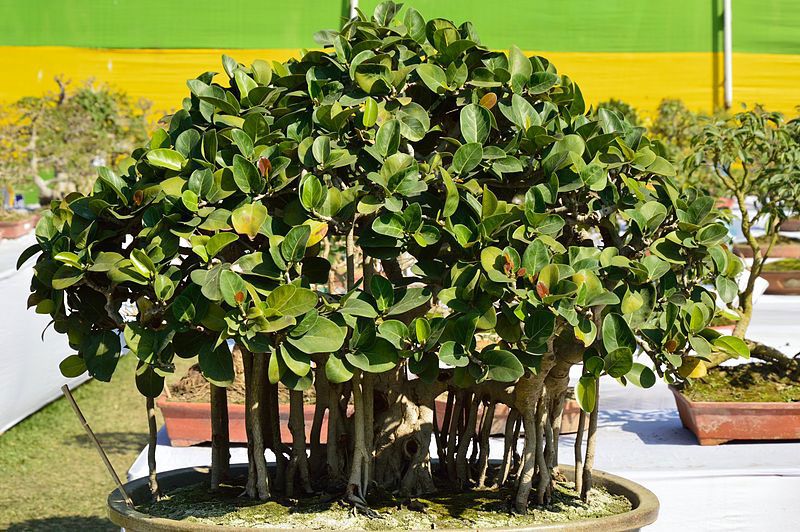
It produces ovoid or oval leaves. When flowering, it forms round, orange-colored spheres up to 3 cm or more. However, gardeners often grow it as a bonsai (a Bengalese ornamental ficus).
Content
How to choose a miniature tree?
For planting, buy high-quality material:
- Avoid buying an Indian indoor ficus during the cold season. It doesn't adapt well to the environment.
- You don't need to choose a large, mature plant, as it is difficult to adapt and is more expensive.
Care
Ficus needs care when kept at home.
Lighting
The tree is a big fan of light, so it is advisable to place it on the sunny side near a window.
Insufficient light can cause leaves to fall off. To prevent this, simply install artificial lighting.
Temperature
For favorable plant development, the temperature should be +15 -+ 25 C.
It's not recommended to place a fan or radiator near it. It's better to place a pan of water nearby to balance the microclimate.
Humidity
Summer is favorable for ficus. However, the hotter the air outside, the more misting it requires. Winter care is complicated by low humidity in the apartment due to the constant use of radiators.
To neutralize it, place a pot of wet moss on a tray next to the plant and wipe the leaves with water or spray it.
Watering
Overwatering is not recommended. When watering, always drain excess moisture from the tray. Stagnant water in the soil can cause root rot and fungal diseases.
In summer, the plant needs to be watered every 3-4 days; in winter, once a week.
Fertilizer
Bengal ficus should be fed starting in early spring. It requires chemical fertilizers and organic matter, diluted with water at a low concentration. During the summer, when growth is active, add 1-2 doses of high-nitrogen fertilizer monthly.
Transfer
Seedlings are repotted annually in March and April. The pot should be 2-3 cm larger than the stem. Only the top 4-5 cm of soil needs to be changed.
Compost consists of peat, leaf mold, humus, turf, sand, charcoal, and organic matter. A secondary feeding is required six months after replanting.
To prevent root rot, the plant needs a good drainage layer (expanded clay, clay shards or tree bark).
Trimming
The tree tolerates pruning well:
- the formation of the main part should be natural, no unnecessary details;
- It is recommended to use treated tools for work;
- The stems are cut at an angle to the edge.
Reproduction
Propagation is done using cuttings. Seeds are not suitable for this purpose. First, remove the sap from the cut stem. Then, place it in a jar of water or wet sand. Rooting itself takes about a month after planting, once the shoot has established roots.
Diseases and pests
Ficus is often attacked by aphids and powdery mildew. To combat these, treat with Actillik and Tanrek.
In unfavorable climates, fungus and rot develop on the plant. In severe cases, it dies. To ensure good growth, treat the leaves and soil monthly with a potassium permanganate solution.