Ficus elastica (rubber tree) is a species of evergreen tree in the Mulberry family. It is native to the Indonesian islands of Sumatra, Java, and the Indian state of Assam.
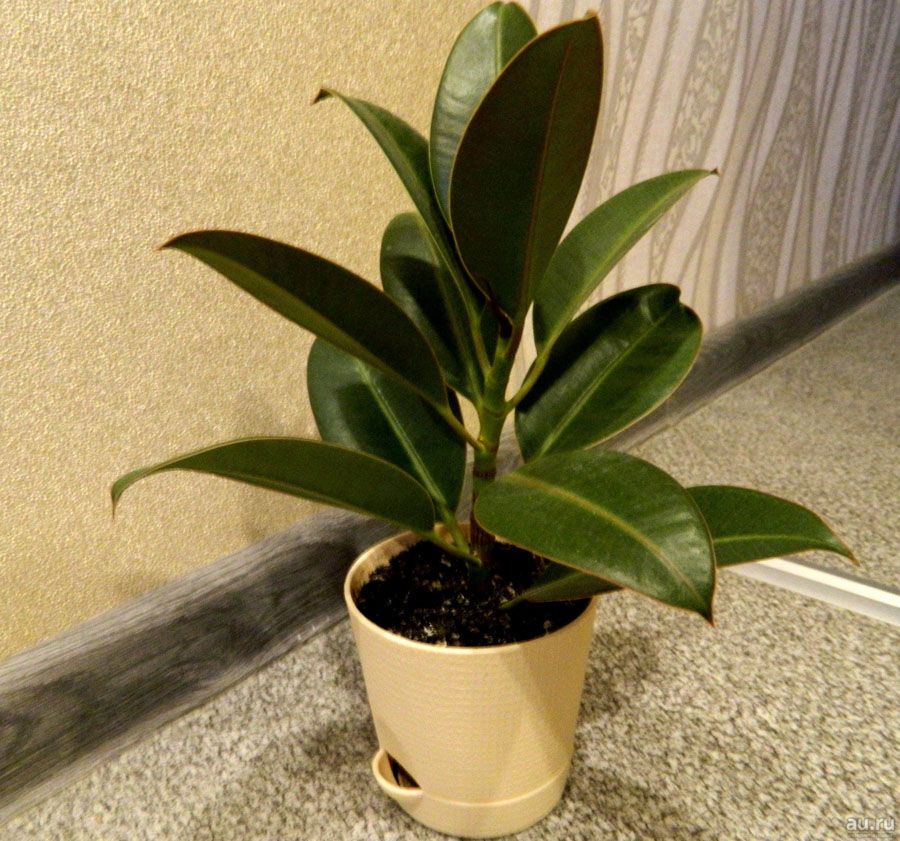
It got its name from the milky juice containing rubber.
Content
Description of Ficus elastica
In its natural environment, the plant reaches a height of 40 m, when grown indoors it grows up to 10 m, but this is a rare case, as a rule, the height is no more than 1 m.
The tree's leaves are glossy oval-shaped with a pointed tip, quite large (up to 30 cm long). When young, they are pinkish-brown; when old, they become dark green.
The fruits are yellow-green, oval, 1 cm in diameter. When grown indoors, flowering of the ficus is a very rare occurrence.
Types of elastica for home cultivation
The rubber plant has many indoor varieties, differing in foliage, growth height, and care requirements.
| View | Description | Care | |
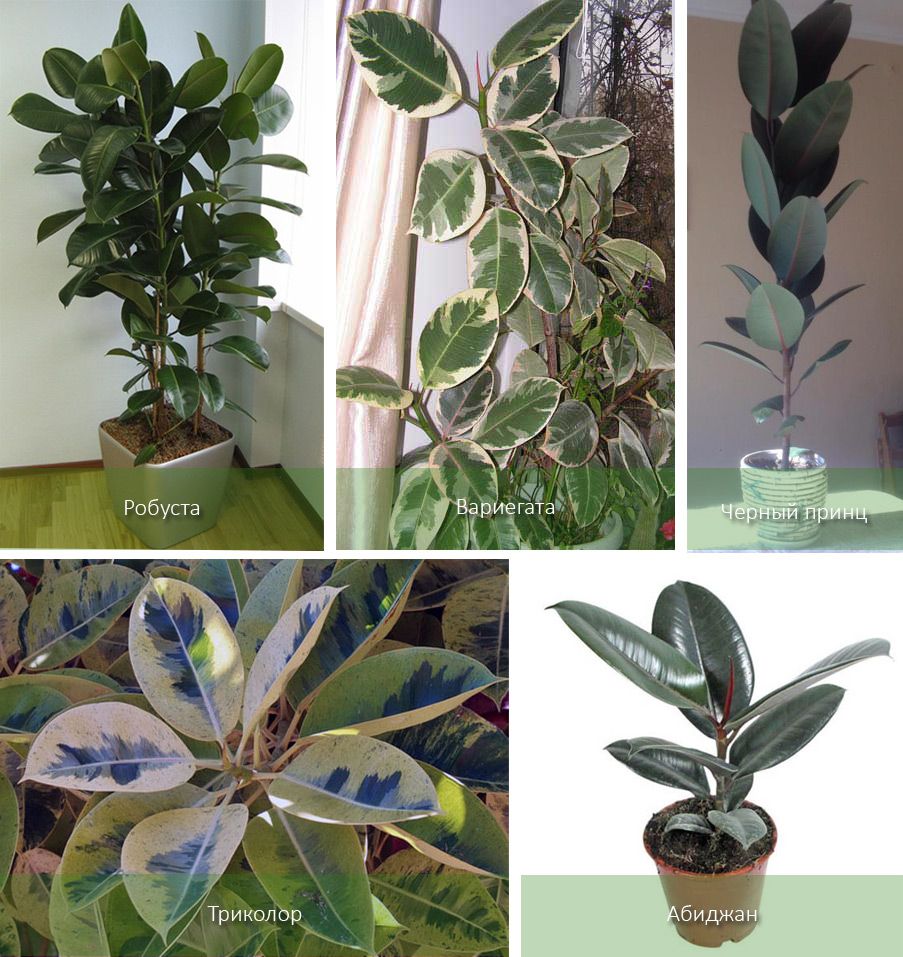
| Robusta | Tall, branched, with thick leaves. Effectively purifies the air. | Unpretentious and hardy. Requires support. Suitable for beginners. | |
| Melanie | Compact, decorative, bushy, leaves are not very large, dark green. | Unpretentious. | |
| Abidjan | Fast growing, it has wide, dark burgundy, glossy leaves that shine in the light. | Unpretentious. Needs pinching to prevent the plant from becoming leggy. | |
| The Black Prince | Dark rounded leaves change color depending on the light. | Hardy, tolerates temperature changes, and can be replanted at any time of year. | |
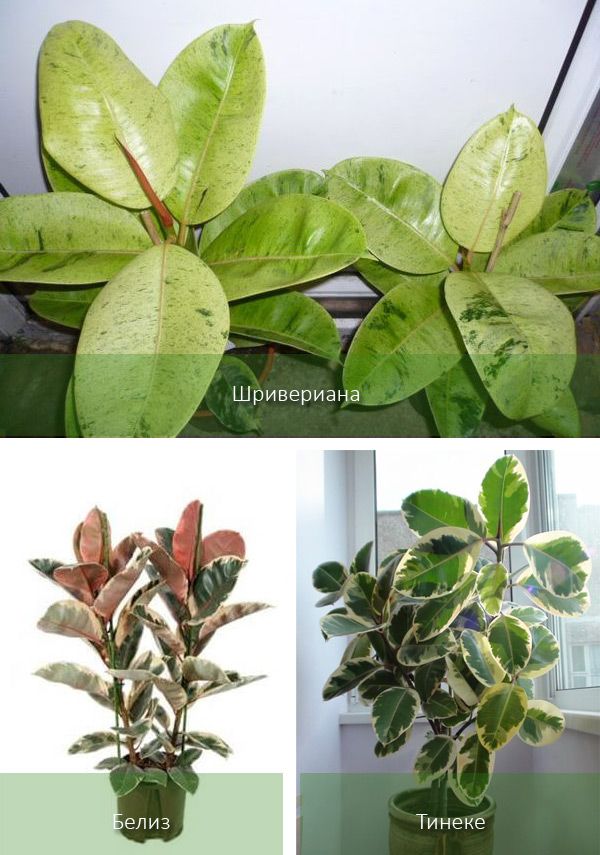
| Belize | The leaves have characteristic light streaks along the edges. | It requires good lighting. In summer, it prefers open, airy spaces but dislikes direct sunlight. It's capricious. | |
| Tineke | Variegated. | Unlike Belize, there are no pink hues in the stains. | It loves heat and does not tolerate drafts. It prefers layering. Fertilizer should contain nitrogen. Pinching can be used to shape the bush or tree. It is capricious. |
| Shriveriana | Yellow-green streaks cover almost the entire leaf. | It requires warmth and water. If there's too much water, the leaves curl and fall off. | |
| Tricolor | The stains on the leaves can be colored from white, light green, to pink. | It thrives in warmth and good light. Insufficient light will cause the unique coloring to fade. Water moderately; excess water will cause leaf loss. It is susceptible to pest attacks, but insecticide treatments can protect it. | |
| Variegata | The tallest of the variegated varieties, but the leaves are small. | It thrives in warmth and does not tolerate drafts. It will die in cold, drafty rooms. It requires generous spraying with water once a month and pinching. | |
Caring for Ficus elastica at home
Ficus elastica varieties are generally easy to care for. However, a few guidelines should be followed to avoid damaging the plant.
Location, lighting
The flower prefers a bright location, but with filtered light. Shade and partial shade will stunt its growth, and direct sunlight can be harmful. When choosing a location, keep in mind that variegated varieties prefer more light than solid-colored ones.
Avoid placing the plant in drafts; when the window is open, care must be taken to ensure that cold air currents do not reach the plant.
Temperature
During the spring and summer, maintain temperatures of +20…+25 ºC. In winter, keep the temperature at least +15 ºC. Only species with uniform leaves can tolerate short-term temperature drops to +5 ºC.
Humidity, watering
Water the plant regularly, but not excessively; the soil in the pot should always be slightly moist.
Excessive or insufficient moisture affects the health of the ficus, it wilts, and the variegated leaves become discolored.
Spray with boiled warm water in the spring and summer. In winter, simply let it sit at room temperature for a few days. Wipe the leaves on both sides with a damp sponge.
Choosing a pot, soil, replanting, fertilizing
Young plants are repotted annually, in spring or summer. Adult plants, if they have grown significantly (3 years), should be repotted slightly too small. To inhibit root growth, it's best to leave the older plants alone. Only the top layer needs to be replaced annually.
Soil - a ready-made substrate for ficuses or the following composition:
- turf soil (2 parts);
- leaf, peat and sand (1 part each).
The transplant is carried out using the transshipment method.
Fertilize twice a month in spring and summer, and only during winter when the plant is growing (reduce the concentration by half). Liquid fertilizer is used (for ornamental foliage plants). Well-rooted mature plants are fed with a mullein solution, after moistening the soil.
Crown formation
Ficus pruning, to stimulate new shoot growth and crown formation, is done in late winter. This is done after fertilizing, a month before repotting.
The instruments used for the procedure—a sharp knife, scissors, or blade—are disinfected with alcohol.
To add volume, shoots are cut back to 10-15 cm (three internodes), both apical and lateral, with the latter being cut off leaving the outer bud.
The secreted milky juice is washed off, and the cuts are treated with charcoal.
Reproduction
At home, ficus is propagated in the spring using three methods.
Leaves
Place the leaf and stalk in warm water. After roots form, plant it shallowly, down to the base, in soil (special soil for ficus). Roll the leaf and secure it with thread.
Cuttings
The remaining cuttings are placed in a glass of water after pruning. After the milky sap has released, they are transferred to another container or directly to a pot with soil for rooting.
To speed up the process, cover the seedlings with a transparent jar, creating a greenhouse-like structure. Rooting will occur within a month.
Layering
This method is the most effective. Make a cut (no more than 5 mm) in the trunk and insert a matchstick into it. Wrap the matchstick in moistened moss. Wrap the resulting branch in plastic film. After roots appear (3-4 months), separate the trunk and replant.
Mistakes in care, diseases, pests
Like any ficus, the rubber plant is susceptible to disease, especially if improperly cared for. To avoid this, try to avoid mistakes.
| Manifestations on leaves, etc. | Cause | Elimination | |
| Yellowness, falling off. |
|
|
|
| Spots. | Dark. | Cercospora is a fungal disease. | Remove parts affected by the disease and spray with fungicidal solutions (Fitosporin). |
| Yellow. | Anthracnose or botrytis. | ||
| White at the ends. | Lithocysts are a natural phenomenon. | No measures are being taken. | |
| Brown at the ends. | Sunburn. | They are moved to a place more protected from direct rays. | |
| Paleness, growth retardation. | Lack of nutrition. | They fertilize. | |
| White coating. | Powdery mildew is a fungal disease (poorly ventilated area). | Remove affected leaves, treat with fungicides, periodically ventilate the room, avoiding drafts. | |
| Wavy and lightening. | Excessive lighting. | They are removed to the back of the room with artificial lighting. | |
| Torsion. | Low temperature. | The pot is moved to warmer conditions. | |
| Graying and wilting of stems. | Root rot. | Reduce watering. If the infestation is severe, destroy it. | |
| Pale green color, appearance of cobwebs. | Spider mite. | They are treated with one of the following means: solutions of alcohol, garlic, onion peel, soap; predatory insects - phytoseilus, amblyseus; chemical (actellic, fitoverm). |
|
| Stickiness, small pimples. | Scale insect. | Spray with solutions of soap, garlic, hot pepper, onion; Aktara, Vertimek. | |
| White cottony coating, growth retardation. | Mealybug. | Clean with a sponge and soapy water, treat with alcohol, and spray with Aktara and Fitoverm. | |
| Stickiness. | Whitefly. | Use sticky tape for insects, soap solution, Aktara, Vertimek. | |
| Shrinking, wilting, nodules on the roots. | Nematodes. | Treated with Fosfamide and Bak Ecogel. | |
| Colorless spotting, wilting and dropping. | Thrips. | Wipe with soapy water. Use Fitoverm or Vertimek. | |
Top.tomathouse.com informs: Rubber plant signs and superstitions
This plant, according to folk belief, is a husband-killer; men will not thrive in a house where the plant is located. However, it also attracts financial luck. Therefore, its ideal placement in the workplace or office will boost your career, increase your salary, or attract wealthy sponsors.
Even our grandmothers believed that the ficus tree had a beneficial effect on pregnancy and made childbirth easier. Placing the plant in the kitchen will guarantee you plenty and prosperity. However, don't place it in the bedroom; it will disrupt family relationships.