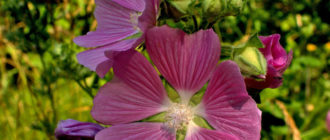
Freesia is a perennial plant in the Iridaceae family. It is native to southwest Africa. It has been cultivated in Europe since the early 19th century. It is found among shrubs and along river and lake shores. Named after the German botanist Friedrich Fries, this luxurious and fragrant flower is popular for cut flowers.
Content
Features of freesia
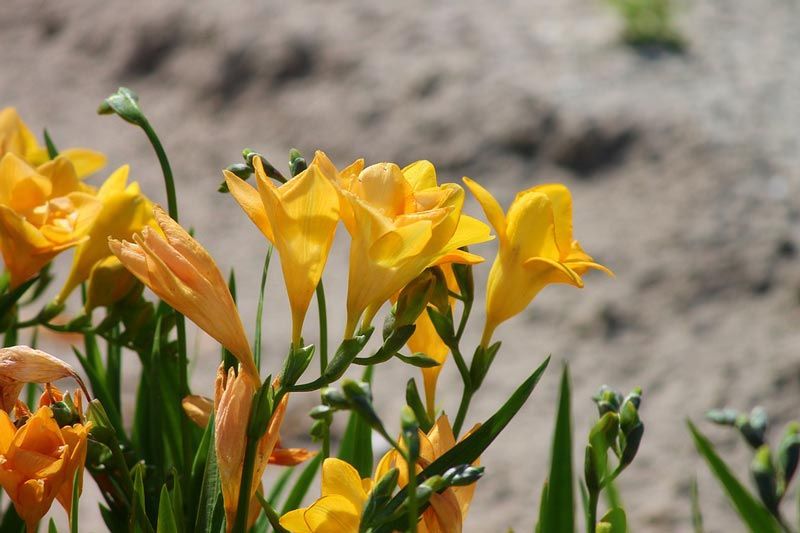
Freesia has a persistent, pleasant scent, and is known as "Cape lily of the valley." The plant's tubers are represented by an atypically shaped bulb covered in light brown or white scales, which are renewed every second season (the bulb dies, and a new root emerges). The leaves are thin, linear, elongated, with a central vein, 15-20 cm long and 1.5 cm wide. They grow directly from the ground.
A single-sided inflorescence with a narrow tube, widened at the base, and 3-6 flowers in various shades. Flowers come in cream, purple, pink, blue, white, and orange. They bloom in mid-August and delight with their appearance until frost. The branched, smooth stem reaches 20-70 cm in height. The fruit is a capsule.
Freesia features:
- It has different aromas: citrus, lily of the valley, fresh grass.
- It can be cut and stored for up to 10 days, remaining fresh and fragrant.
- Florists make a bridal bouquet out of it.
- Used to create perfumes.
- The yellow-red variety grows the fastest.
- Popular with landscape designers, creating a beautiful look in flower beds and gardens.
Freesia can be successfully grown in a summer house, a greenhouse, a hothouse, or a room.
Types and varieties of freesia
Of the 20 species of the plant, flower growers cultivate three.
| View | Description | Flowers | Aroma |
| Armstrong | Stem up to 70 cm. Inflorescence is paniculate. Blooms in May-June. | Bell-shaped, crimson, pink, lilac, purple. | Citrus. |
| Broken (refracted) | Low-growing (40 cm) with weak, spreading shoots. Inflorescences are 2-4. Blooms in April. | White, light orange. | Lily of the valley. |
| Hybrid | Reaches a height of 1 m, with 7-9 inflorescences. | White, scarlet. | Various: floral, faint, odorless. |
There are varieties with petals in one row (double), two or more.
| Variety | Description | Flowers | Aroma |
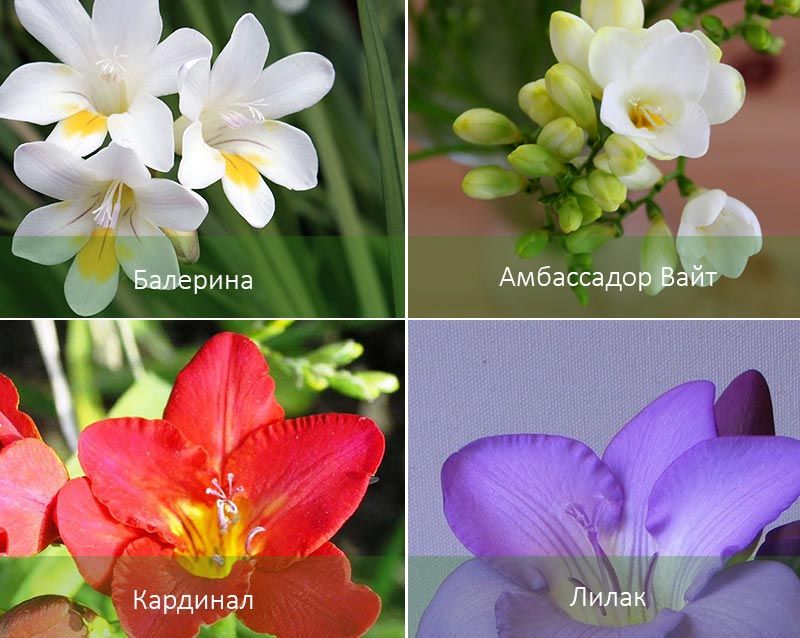
| Cardinal | Up to 70 cm, has three peduncles 30 cm long. | Scarlet, pink with yellow spots. | Almost imperceptible. |
| Ballerina | There are about 12 flowers on a 25-30 cm high peduncle. | Corrugated, white, yellow base. | Tart. |
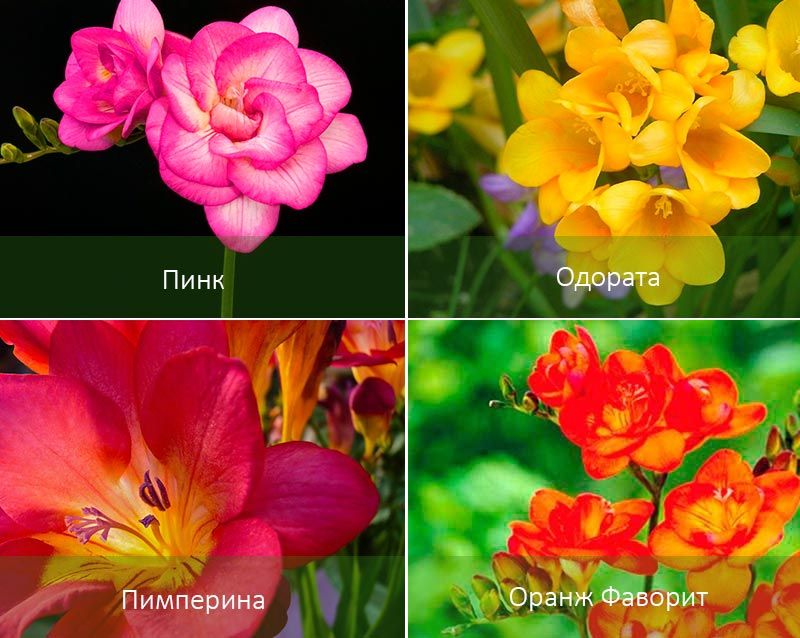
| Odorata | Height 30 cm, inflorescences 3-7. | Yellow with orange. | Lily of the valley. |
| Pimperina | Low-growing, up to 20 cm, 7 inflorescences. | Large, dark red at the edge, yellow in the middle, corrugated. | Very weak. |
| Lilac | 80 cm tall. Two straight flower stalks, spike-shaped inflorescence. Quickly fades. | Single, lilac, white in the center. | Not expressive. |
| Caramel | Tall, up to 80 cm, 7-8 flowers. | Large, reddish-brown. | Not strong. |
| Helsinki | Reaches 60-70 cm, soft, drooping leaves. | Purple, lilac, with a yellow throat. | Strong, subtle. |
| Sonnet | Grown in greenhouses, up to 85 cm, 11 flowers. | Scarlet with an orange spot. | Distinctly sweet. |
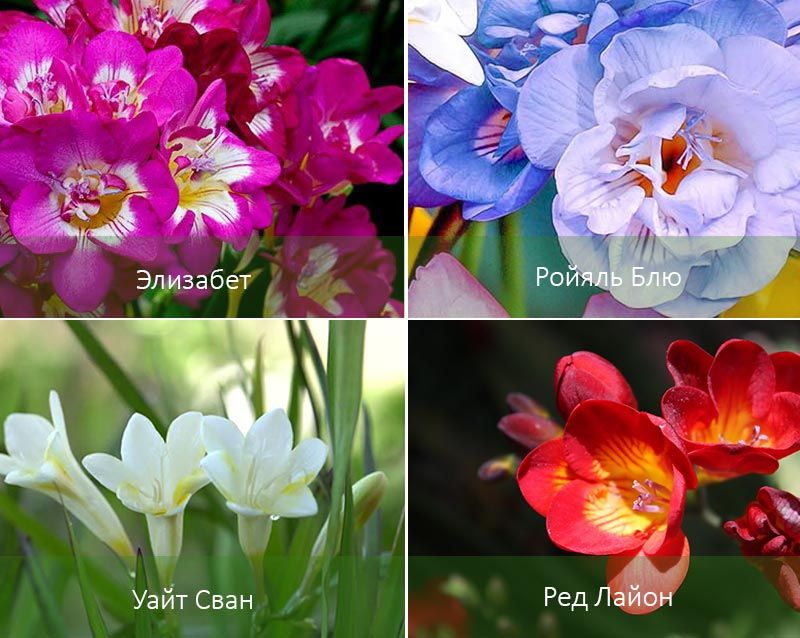
| Elizabeth | Perennial up to 85 cm. 3-4 flower stalks on one plant. | Bright purple, non-double. | Subtle. |
| Red Lion | Tall, up to 80 cm. | Large, double, bright red. | Lily of the valley. |
| Pink | Perennial, blooms for up to 25 days. | Soft pink, large with a white center. | Strong, fresh. |
| Ambassador White | Up to 50 cm, long, light green leaves. | Snow-white, with beige specks at the base. | Spicy. |
| Orange Favorite | Up to 40-4-50 cm. | Orange with a dark throat. | Jasmine. |
| White Swan | Strong peduncle up to 50 cm. | White with cream stripes. | Coolness turning into floral. |
| Royal Blue | Different heights from 40-70 cm. | Large, blue. | Not expressive. |
Growing freesia in open ground
Planting and caring for this flower in open ground requires some special considerations. Buds up to 40 cm tall form on the bush in July and bloom in August. Enjoy the blooming freesia until October. After cutting all the flowers, water it again and leave it until you dig it up.
Growing conditions
Tall bushes require support, such as a horizontal net or trellis. Freesia prefers 12-14 hours of daylight, a draft-free site, and direct sunlight with some partial shade. The soil should be well-dug and loosened. Narrow-leaved varieties should be planted closer together, while broad-leaved varieties should be planted further apart.
The required temperature is +22°C. In hot or cold weather, the flowers lose their shape.
Freesia can be pruned when two or more buds appear. Faded flowers are removed. The soil is loosened, and weeds are removed. In the evening, the shoots and leaves are sprayed.
Landing
First, prepare the corms: treat them with Fitosporin, plant them in containers 5 cm apart, moisten them, and leave them in the light. After two months, place them in loose, breathable soil with a neutral or slightly acidic reaction.
Plant the bulbs after all danger of frost has passed, 9-12 cm deep and 3-5 cm apart, with row spacing of up to 15 cm. Choose a bright location, free from shade from trees and shrubs, in April or May. Temperatures should not fall below 15°C or rise above 18°C, otherwise the freesia will not bloom. After planting, mulch the soil. Water the bulbs generously; they germinate for three weeks, then reduce watering.
Top dressing
After germination, apply ammonium nitrate 3-4 times during active growth. Then, apply superphosphate and potassium salt every two weeks.
Watering
Water the plant at the base, usually before lunch, to prevent bacterial damage. Evening watering can prevent the leaves from drying out, and a drop in temperature can cause disease. The plant prefers moist soil, but not stagnant water. After flowering, reduce watering and stop completely in early October.
Freesia at home
Growing and caring for the plant indoors is easier than keeping it outdoors. Choose low-growing varieties up to 25 cm tall. If planted in the fall, the plant will bloom throughout the winter.
Creating conditions
Place the plant on east- or west-facing windowsills, away from drafts. In winter, use artificial lighting. Its stems are fragile; to prevent breakage, provide support (a decorative trellis or wire frame).
Water as the soil dries, using settled, rain, or filtered water. Spray in the evening, being careful not to touch the petals or buds.
Fertilize with mineral fertilizers twice a month. Dead flowers are cut off to preserve nutrients for others.
Landing
Select a pot up to 15 cm in diameter and disinfect it. Add expanded clay or pebbles to the bottom, then add charcoal and a mixture of turf, peat, and sand, with bone meal and ash added. Place six bulbs per pot at a depth of 5 cm. Set the temperature to 15°C, increasing it when the first leaves appear, then water.
Caring for freesias after flowering
In the fall, after flowering has finished, the tubers are dug up and stored until the following year.
In the house
Aboveground shoots are cut off, and the roots are watered for 1-1.5 months to encourage the formation of offshoots. They are then removed, treated with potassium permanganate, and dried at 25-28°C. They are then sorted, removing any damaged or rotten ones.
In open ground
When the corms turn yellow in October, dig up the corms, trim the stems, clean them, and sort them. Disinfect them (treat them with Fitosporin or Azobacterin), dry them, and store them.
In warm climates, planting material is left for the winter, covered with a layer of mulch.
Storing bulbs
The planting material is stored in a dark place, in nets, at high humidity and a temperature of +29…+31 °C, for 12-16 weeks, then reduced (two weeks before planting) to +12…+13 °C.
Freesia propagation
The flower is propagated by bulbs and seeds.
After digging, the bulblets are separated from the mother bulb and planted separately in the spring. The baby bulblets will grow in this area. In the fall, they are removed, disinfected, dried, and stored until spring, where they will bloom in the summer.
The day before planting, the seeds are disinfected with potassium permanganate. They are then planted 1 cm deep in boxes containing a mixture of sand, peat, and humus in equal parts. Cover with plastic wrap, ventilate regularly, maintain a temperature of 20–25°C, and irrigate the soil. Seedlings are expected in 23–25 days. Water, weed, and fertilize with a potassium-phosphorus solution weekly.
Keep in bright light. Seedlings are pricked out at a distance of 5 cm from each other. A temperature of +20°C and high humidity is preferred, then lowered to +14°C. They are planted outdoors in late May.
Top.tomathouse.com warns: Freesia diseases and pests
If the bulbs are not disinfected or are not cared for properly, freesia is susceptible to fungal diseases and pests.
| Disease/Pest | Manifestation | Processing |
| Gray mold | Brown spots with a grey coating. | Alirin-B, Trichodermin. |
| Mosaic virus | The plant has wet spots in a pattern, then it turns yellow. | Fundazol. |
| Fusarium | The leaves become thinner, turn yellow, and dry out. | Fitovit, Previkur. |
| Scab | Yellowing and wilting of leaf tips. Brown spots at the base of the stem. The plant is lodging. | It cannot be cured. |
| Spider mite | There is a web on the leaves and stems. | With Actellic, Fitoverm or tar soap. |
| Aphid | The shoots and leaves are sticky, wither, and turn black. | Remove damaged parts with a soap solution containing wood ash or with Karbofos or Tanrek. |
| Thrips | The leaves are discolored, have many spots on them, and brown spots on the underside. | Mospilan, Aktara. |
Uses of freesia
The flower looks stunning in flowerbeds, borders, and bouquets, pairing well with cyclamen, lilies, and magnolias. Freesias adorn bouquets for any occasion and are used in perfumes and body care products.
Moreover, its aroma helps with nervous tension and depression, relieves insomnia, and increases vitality. The flower is believed to bestow energy on its owner, impart courage, and protect strength.