The perennial evergreen fuchsia belongs to the Onagraceae family. It is native to central and southern America and New Zealand.
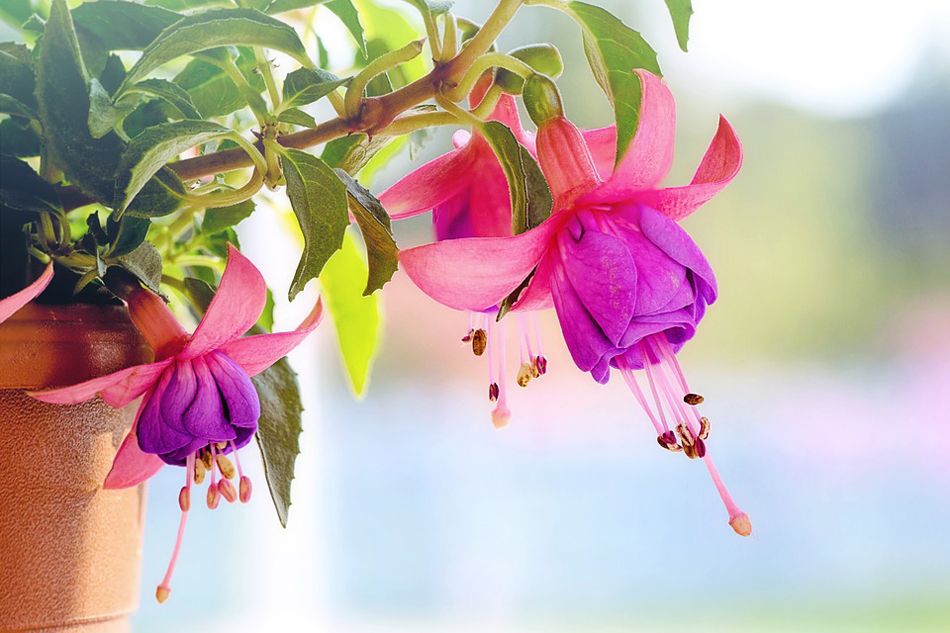
There are approximately 100 species, from which numerous hybrid varieties with a wide variety of shapes and flower shades have been bred.
Content
Description of fuchsia
Depending on the species, the plant is a tree or a shrub. Flexible branches are covered with opposite, oval-lanceolate leaves that are green or slightly reddish. They are no more than 5 cm long, pointed at the ends, with serrated or smooth edges.
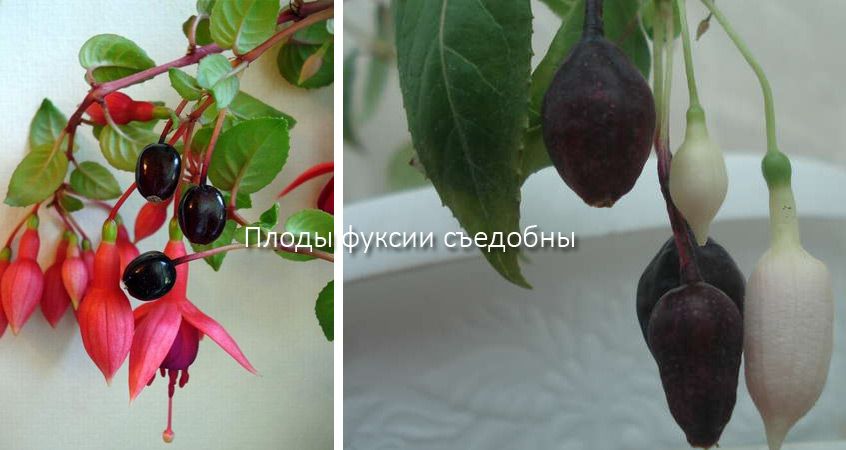
The flowers have an elongated tubular calyx and long stamens. Edible fruits appear after them.
Types and varieties of fuchsia
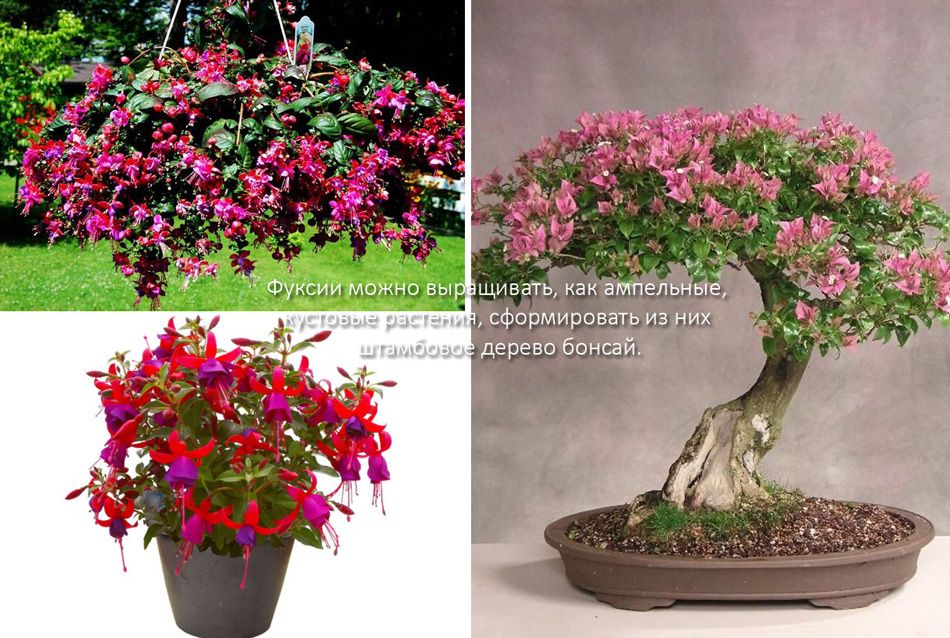
Fuchsias can be grown as hanging or bush plants, and can be formed into pyramidal or standard trees.
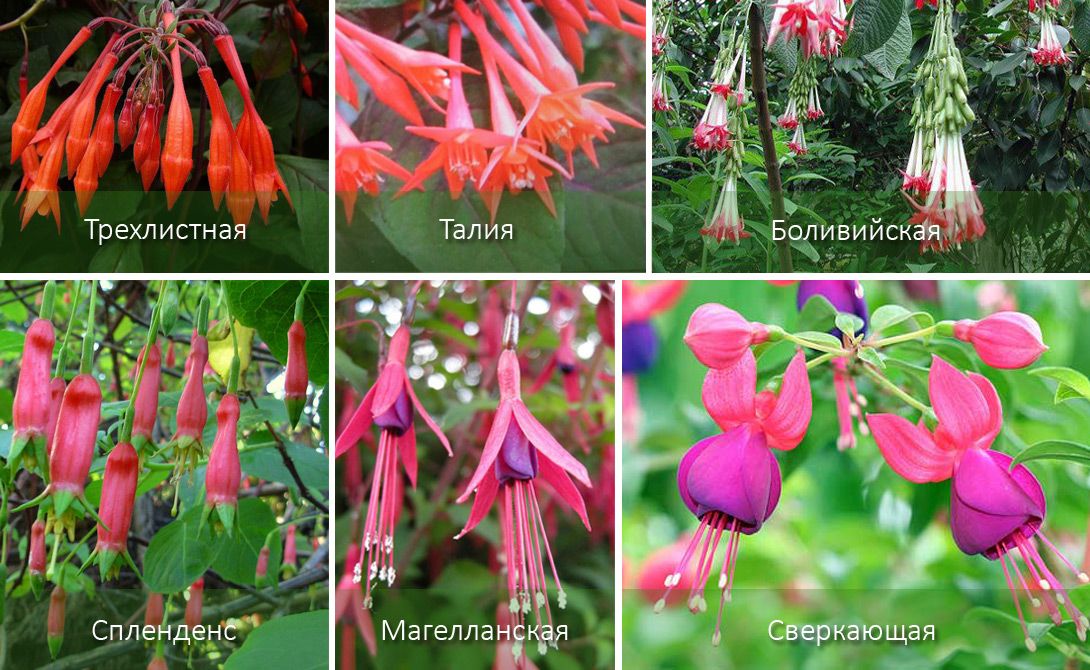
Varieties can bloom at different times of the year. Generally, almost all varieties produce edible fruits (berries), but they are difficult to ripen indoors; you must wait until they turn black to eat.
Bushy
| View | Description | Leaves | Flowers, their blooming period |
| Three-leafed | 60 cm in size. Grows in width, so it is good to place in a hanging container. Large berries (5 cm). |
Ovoid-shaped. 8 cm long, reddish in color, with a greener back and brown underside. | A large number of bell-shaped flowers, connected by fiery sepals into inflorescences. May - October. |
| Waist | Height - 50 cm. The fruits have a delicate taste. |
Velvet dark green with shades of burgundy. | Bright orange medium ones.
Spring - fall. This can be extended throughout the winter by providing a temperature of +25°C and at least 12 hours of light. |
| Magellan | Reaches 3 m. Sweet, tart. |
Small, pointed (up to 4 cm). | Tubular, red to white in colour.
Spring - autumn. |
| Sparkling | 2 m in size. The fruits are edible. | Large serrated. | Scarlet.
Summer. |
| Shiny (shiny) | Height from 40 cm to 1 m. The berry is edible, rich in vitamins. | Large oval, green with a purple tint. | Crimson-purple.
April - November. |
| Graceful | Up to 1 m. Similar to Magellan's. |
Elongated oval (up to 5 cm). | Voluminous, bright pink, may have a purple center, sit on small stalks.
Spring - late autumn. |
| Splendance | Multi-leafed. The fruits are larger than those of other varieties (5 cm) with a tart, lemony flavor. | Simple oval-lanceolate. | A type of long red tube with light green petals at the ends.
All year round. |
| Bolivian | Beautiful, spectacular. Grows up to 1 m. The berries have a mild narcotic effect. A light lemon-pepper flavor. |
Large velvety ones. | Collected in large red and white clusters.
March - April. |
| Bright red | Reaches 1-1.2 m. The fruits are difficult to grow at home. |
Lanceolate (3-5 cm). | Tubular sepals are red, petals are purple.
Beginning of April – end of October. |
| Thin | Grows up to 3 m. Narrow, drooping reddish branches. Can be pruned to direct its growth in width. |
With a burgundy tint. | Numerous violet-purple flowers, collected in racemes.
July - September. |
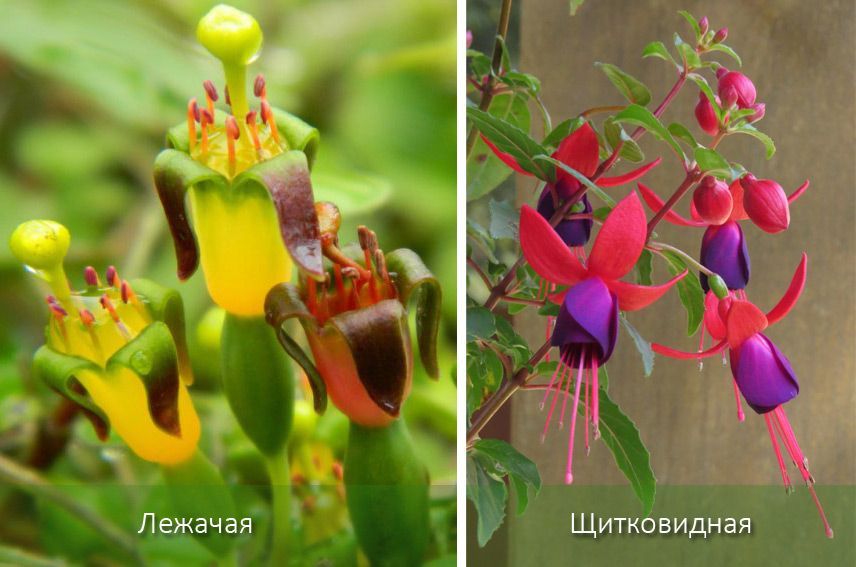
| Thyroid | Height - 3 m. The fruit is rich in vitamins. |
Oblong-oval, up to 7 cm. | White, red with purple core.
Mid-summer – early autumn. |
| Lying down | 40 cm-1 m. Thin creeping shoots. Distinguishing feature: heterosexuality. Light red berries. | Round or heart-shaped. | Yellow, growing upwards. April - November. |
Other beautiful varieties with double and semi-double flowers:
- Alisson Bell (purple-red);
- Annabelle (white);
- Ballerina (scarlet in the middle of a light pink skirt);
- Henriette Ernst (sepals - deep pink, petals - soft lilac).
Ampelous species:
- Blue Angel (double, white with lilac);
- Holly's Beauty (lilac-blue);
- Imperial Crown (scarlet);
- Prince of Peace (white with red center).
Growing and caring for fuchsia at home
The flower undergoes active growth from April to August. It goes dormant from December to January.
| Factor | Spring | Summer | Autumn | Winter |
| Location | Windows on the west and east sides (plenty of diffused light). | |||
| Lighting | Can be placed in open space. | Not less than 12 hours. | They provide illumination when there is not enough sun. | |
| Temperature | +18…+24 °C. | +5…+10 °C. | ||
| Humidity | Spray with warm filtered water every evening and morning. | Once every 3 days. | No need. | |
| Watering | When the top layer of soil dries out. | They reduce but do not allow the soil to dry out completely. | No more than 2 times a month. | |
| Top dressing | 2 times a month with mineral fertilizers for flowering plants. | They don't use it. | ||
Rules for propagating fuchsia
There are two methods of obtaining new fuchsias: seed and cuttings.
Seeds
This is a rather labor-intensive process, which typically doesn't preserve the individuality of the mother flower. Seeds are sown in early spring:
- Since they are very small, they are mixed with sand and scattered on the surface of the soil.
- Sprinkle with a small amount of substrate.
- Cover with film or glass.
- Maintain a temperature of +15…+18 °C. Water into the tray.
- Sprouts appear after a month.
- When two leaves form, they are pricked out.
Vegetative
Old or young shoots (approximately 10 cm) are used as cuttings, which are pruned at the end of winter:
- The lower leaves are removed. The cuttings are placed in a glass of water, liquid substrate, or sand.
- Create a mini greenhouse using a plastic container or bag.
- After 2 weeks, when roots appear, the cutting is transplanted.
How to plant fuchsia seedlings
The seedlings are planted in small containers no more than 9 cm in diameter. Proper drainage is essential. Fill the pot completely with soil to ensure there are no air pockets. Shake and tap the pot, but do not compact it by hand; the soil should be porous.
Repotting is done once a year in the spring. A mature bush is shortened by 1/3, and the roots are trimmed (except for trailing varieties).
The substrate used is slightly acidic, there are several options:
- sand, peat, leaf soil (1:2:3);
- sand, greenhouse, clay-turf soil, peat crumbs (1:2:3:0.2);
- ready-made mixture for flowering plants.
The next step-by-step process:
- The pot is made of ceramic, to protect the root system from the summer heat, approximately 4 cm larger than the previous one.
- Add drainage material (expanded clay, pebbles) to 1/5 of the new container to protect the plant from rotting.
- Sprinkle with substrate.
- Using the transshipment method, the fuchsia is removed from the old container without shaking off the soil and placed in a new one. The voids are filled.
- Spray and water until the container becomes moist. After a while, remove any excess liquid.
- Do not feed for 30 days.
- After another 60 days, they expect flowering.
Methods of pruning fuchsia
Fuchsia is pinched to stimulate good flowering, the appearance of a large number of young shoots, and also to form the plant into a ball, bush, or bonsai tree.
It is pruned twice a year: after flowering in October and during the dormant period - January.
Autumn
Remove stems that have finished flowering. Dormant buds are left 2 cm below the cut.
Winter
Thin shoots are removed, woody old shoots are trimmed, since flowers are formed mainly on young shoots.
Bonsai
When shaping a small tree, leave one or more shoots, which can be twisted. The top is pinched to create a lush crown.
Bush
If you cut the flower down to the stump, it will remain dormant longer and bloom late, but will produce many young shoots, and the plant will take on the appearance of a large bush.
Problems with growing fuchsia, diseases and pests
If there is insufficient care and agricultural practices are not followed, the plant suffers from various diseases.
| Manifestation | Cause | Elimination measures |
| Curling of leaves. | Elevated temperature. | They shade. |
| Fall of leaves. | Insufficient lighting, low air humidity. | Spray in hot weather. |
| Dropping of buds. | Over- or under-watering, insufficient light and nutrients. Plant distress during the growing season. | Ensure proper watering. Don't disturb the plants when they're budding. Feed them appropriately. |
| The flowering is short and small. | The dormant period took place in conditions that were too warm. | Provides coolness during winter. |
| Browning of foliage. | Overwatering at low temperatures. | Reduce watering. |
| Root rot. | Excessive watering and spraying, stagnation in the tray. | Treat with fungicides (Fitosporin). Reduce watering. |
| Covering the leaves with a white web. | Spider mite. | Spray with an acaricide (Fitoverm) 3-4 times every 7 days. |
| The appearance of white insects. | Whitefly. | Insecticides (Aktara, Fufanon) are used 6-7 times every 3 days. |