Haemanthus, or "deer tongue," is a flower in the Amaryllis family, genus Bulbaceae. It grows in tropical Africa, woodlands, and mountain slopes. It gets its name from the shape of its leaves, which resemble a deer's tongue. It translates from Greek as "blood flower."
This evergreen plant was brought to Europe in the 18th century by Carl Linnaeus, the renowned botanist. It proved undemanding and quickly adapted to the new continent. Its varieties bloom not only red, but also white and orange.
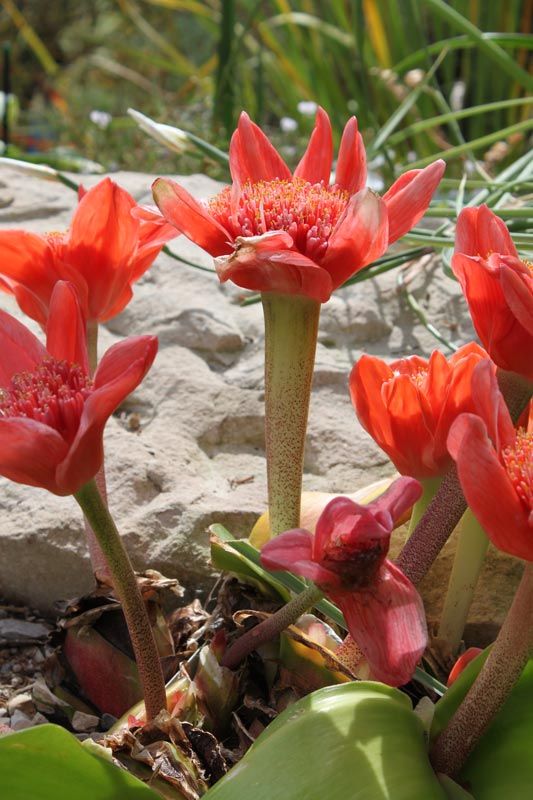
Description of Haemanthus
Haemanthus grows from a bulb and has drooping leaves arranged in opposite pairs, their color varying depending on the variety. They also vary in shape: wide and rounded at the sides, elongated with pointed edges, and are renewed annually. They are covered in short hairs, and some are smooth and sticky. The bulbs are dense and scaly.
It blooms in summer, and some varieties in autumn. Umbelliferous inflorescences appear in July or August; the fragrance is not very pleasant. Orange fruits ripen by December, and the seeds are used for propagation. "Deer Tongue" is capable of self-pollination.
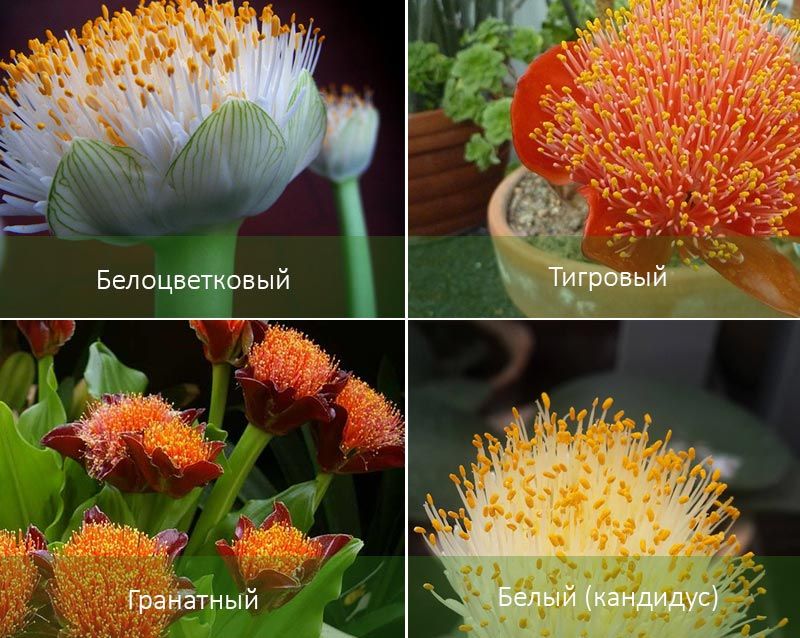
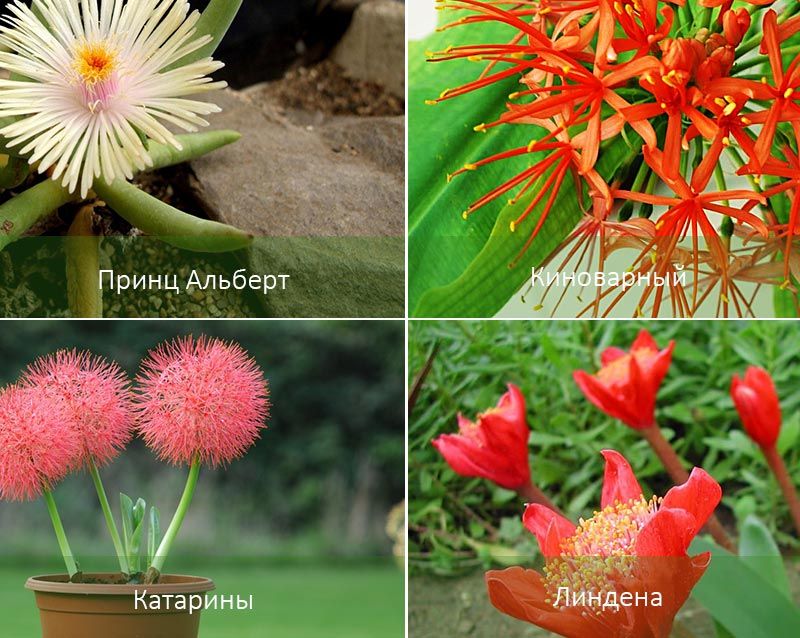
Variety of Haemanthus species
There are over forty species of haemanthus. In addition to indoor varieties, there are also varieties suitable for outdoor decoration. The Catharina and White-flowered varieties are the most popular among gardeners.
| Variety | Description |
| Katarina | A distinctive feature are the elongated, narrow leaves with wavy edges. They are located on a tall, wide stem, up to 15 cm long. Bright red flowers appear in spherical inflorescences on the stalk. |
| White-flowered | A base variety from which many hybrids have spawned. The wide, dense oval leaves are 20 cm long, smooth on top, with hairy margins. The white inflorescences have yellow anthers on top, giving the plant a powdery appearance. The flower stalk is short and thick. It blooms from late summer to mid-winter. |
| Prince Albert | Derived from the white-flowered haemanthus, bred by breeders, it is characterized by inflorescences twice as large and an orange color. |
| Garnet | Long, wavy, light green leaves with burgundy petals along the edges of the orange umbrellas. |
| Tiger | The species is distinguished by its spotted, small, spherical, bright red flowers. |
| White (Candidus) | Snow-white with short fluffy hairs. |
| Cinnabar | It has two or four elongated leaves, a tall, round peduncle, and blooms early, in April. |
| Multi-flowered (scadoxus) | Light red flowers are located on a long peduncle, the leaves are veined. |
| Linden | A variety for open ground, it has six wide and long leaves, similar to lilies of the valley, bright red. |
| Scarlet | Characterized by red-pink umbels and leaf edges. |
Caring for Haemanthus at Home
The indoor "deer tongue" prefers bright spots but doesn't like direct sunlight. It's easy to care for, undemanding indoors, and delights with its beauty.
The plant tolerates dry air well, even near a radiator. It's usually placed on the east or west side, and can be moved outside in the summer.
Sometimes you need to clean the leaves from dust with a damp sponge.
The optimal temperature is 18 to 22°C. In summer, water with melted, settled water after the soil has dried to a depth of 2 cm. Drain the water from the tray regularly. No misting is required.
The flower is not afraid of drying out. Evergreen varieties do not require watering during the dormant period. In spring and summer, haemanthus should be fertilized with mineral mixtures for bulbous plants, 1-2 times a month. The soil in the pot should be loosened.
Bloom
Haemanthus blooms in summer, continuing until November, producing a distinctive scent. Flowering occurs under specific conditions. It requires watering in summer, rest in winter, and optimal seasonal temperatures.
Regular fertilizing promotes flowering; it requires a small container. If the fruits are not to be used for propagation, the flower stalks are cut off.
Rest period
A dormant period begins in October, the leaves dry out and are cut off. Watering is limited. Keep the plant at a temperature of 12–15°C. The soil should be slightly moist.
In February, the plant is repotted, and watering is resumed. During the winter, the haemanthus is kept in a shaded area.
Transfer
The plant is repotted once every 2-3 years, separating the resulting bulblets. This is done in late February or early March to ensure rapid rooting.
The planting soil should consist of equal parts turf, leaf mold, humus, and sand. The container should be wide and shallow, with drainage at the bottom. The bulb should be planted one-third of the way down.
It should be remembered that the plant is poisonous, be sure to use protective equipment.
Reproduction
Haemanthus is propagated in three ways: by cuttings (leaves), seeds, and bulbs.
The outer leaves are cut off, treated with charcoal, dried, and then planted in peat and sand. When the bulbs appear, they are separated. Haemanthus will bloom in 3-4 years.
To ensure that the seeds do not lose their germination capacity, they are immediately sown on a light substrate consisting of greenhouse, leaf, and turf soil with the addition of peat and bone meal.
No soil or deepening is required. Place the plant under plastic film, maintaining moisture. This way, flowering occurs within five years.
The daughter bulbs are separated and transplanted into another container. After three years, inflorescences will appear.
Mistakes in caring for haemanthus
If not properly cared for, haemanthus may fail to bloom due to high winter temperatures, insufficient light, insufficient watering, or a container that's too large. The most common causes are:
- The bulbs are rotting, which means the plant is affected by a fungal infection.
- Gray plaque occurs due to watering with hard water.
- Yellow spots on the leaves appear when the plant is exposed to the sun or is watered too much.
- The lower pair of leaves turns yellow, which means the flower is preparing for dormancy.
- Black buds indicate cold air or high humidity.
- Leaves fall at the end of the season - new ones will appear in the spring.
The container for growing the flower should be only four centimeters larger than the bulb.
Diseases and pests
The plant is affected by fungal diseases and attacked by insects:
- Staganosporosis specifically affects Amaryllis plants. Red-orange spots and streaks appear on leaves, flower stalks, buds, and bulbs. This condition is known as red rot. Remove infected areas, repot the plant, and trim off any affected parts of the bulbs. Treat with fungal control products (Oxic, Fundazol), and copper sulfate.
- Spider mites form fine webs, and discolored spots appear. Spray with Actellic or Aktara.
- Scale insects - first remove them with a cotton swab soaked in soapy water, then shower the flower and spray with malathion.
- Gray rot - necrotic spots form, the plant should be discarded, this disease is not treatable.
- Aphids and thrips can also appear on haemanthus. Treat with special chemicals.
To prevent diseases, disinfect the plant's substrate and check regularly for pests. Overwatering can cause more damage than drought.