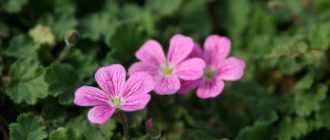
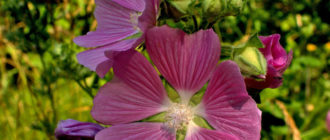
Geranium, also known as cranesbill, is a plant in the Geraniaceae family. It is a popular garden plant.
Characteristics of garden geraniums
Garden geranium is a beautiful, lush, compact shrub and herbaceous perennial. The plant's height varies, with both low-growing and tall varieties.
The leaves are dense, lacy, and carved. They come in a variety of sizes and shapes, with rounded or pointed edges.
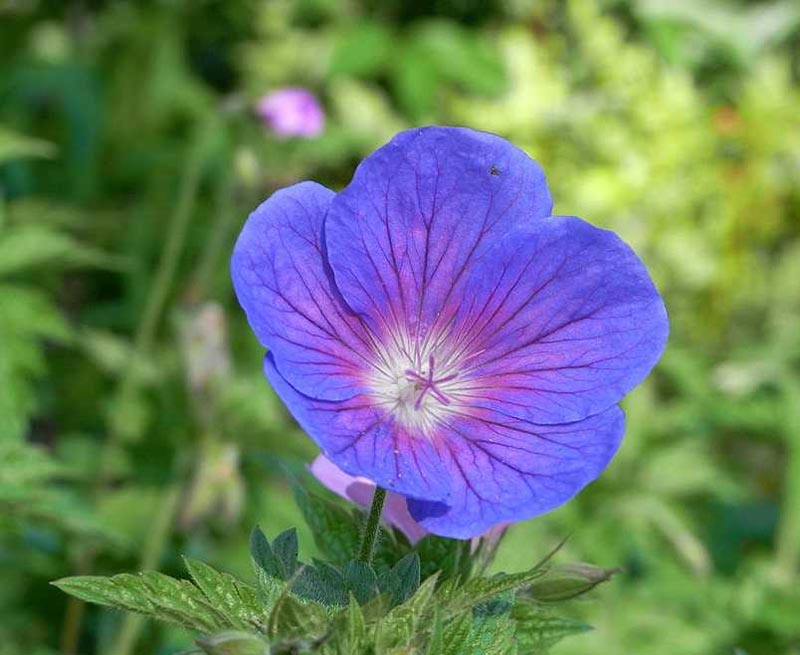
The plant's buds reach up to 5 cm in diameter and consist of approximately five petals. Geranium flowers come in a wide range of colors, including all shades of red, white, pink, and purple. Geraniums have a pleasant, sweet aroma.
The most important advantage of this species is its health: the flower is resistant to drought, easy to care for, and has excellent immunity.
The difference between garden geraniums and indoor geraniums
Indoor geraniums, or pelargoniums, were grouped together with geraniums in 1738, despite their genetic differences. They are very similar in appearance, but have many differences. For example, although they belong to the same family, they cannot interbreed.
The table discusses other distinguishing features.
| Sign | Garden | Indoor |
| Habitat | Temperate climate zone – the Mediterranean region, Belarus, Central Asia, the regions of the Caucasus Mountains, Siberia and the Far East. | Mainly South Africa. |
| Weather sensitivity | Feels great in open ground all year round, very frost-resistant. | It loves heat and overwinters exclusively indoors. It can be grown outdoors only during the summer. |
| Seeds | "Geranius" comes from the Greek word for "crane." It's no coincidence that the seeds resemble the head of this bird. | "Pelargonium" means "stork" in translation. By analogy. |
| Flowers | They consist of 5-8 petals of a regular shape, which, in turn, form inflorescences, which contain about 5 such flowers. | Petals of various irregular shapes form flowers of multiple inflorescences. |
| Stamens | Up to 10. | Up to 7. |
| Color | There are no shades of red in nature. | There are no blue ones. |
Types and varieties of geraniums
Recently, the plant's use in landscape design has become increasingly popular due to its interesting appearance and properties, such as frost resistance and unpretentiousness.
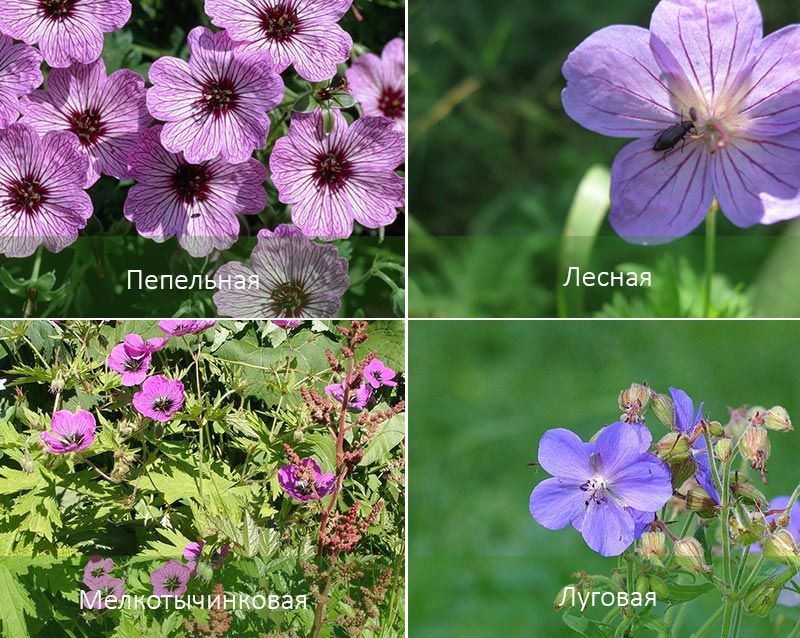
There are approximately 400 varieties of geranium. They are generally classified by bush height: low ones up to 50 cm, tall ones over 50 cm. Generally, four major species can be identified in Russia:
- large-rhizome crane grass;
- dark-brown crane;
- Southern European Crane;
- fur-flowered geranium.
| View | Description | Varieties and hybrids |
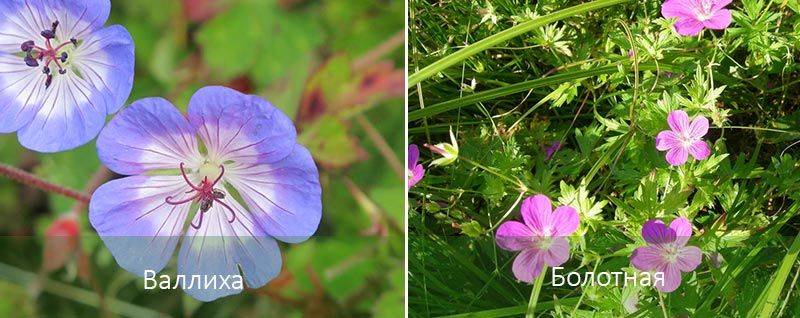
| Swamp | A perennial with short, branched roots. The shrub grows to a height of approximately 30-70 cm. The buds are 4 cm in circumference, 2-3 per inflorescence, and are predominantly lilac in color. Flowering occurs during the first two months of summer. Preferring moisture, it grows in areas with marshes, meadows, and forests. It is native to European Russia, Belarus, and Ukraine. The plant is valued for its healing properties: it helps with colic, ear infections, gout, genitourinary disorders, and rheumatism; it also normalizes heart rhythm. | - |
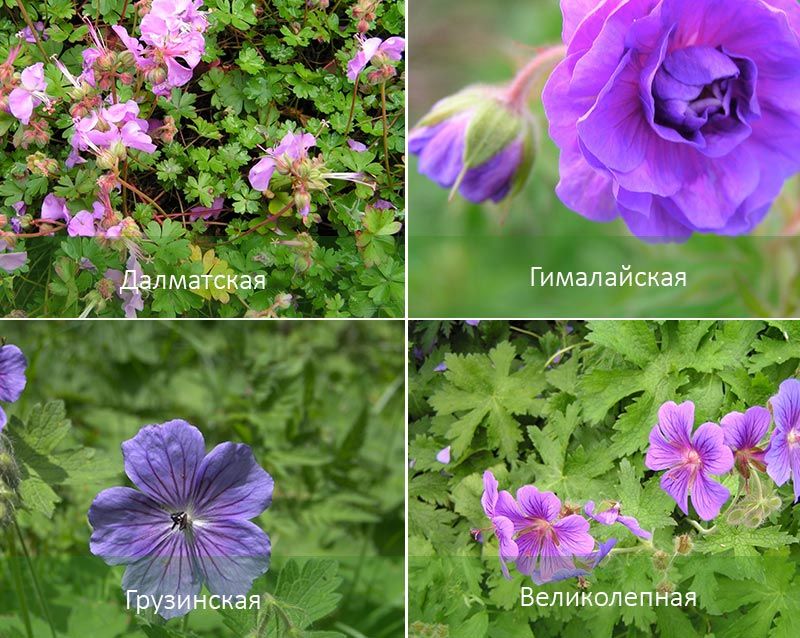
| Magnificent | A very beautiful, spreading shrub about 60 cm tall. Blue flowers form clusters of 2-3 flowers. Blooms can be seen throughout the summer months. The most striking feature of this species is the leaves. They have a fluffy, dissected shape and possess a curious feature: they turn from green to red in autumn. | Alan Mayes, Blue Blood, Mrs. Kendall Clark, Rosemoor. |
| Georgian | An unpretentious shrub growing up to 80 cm in height. It can be found in the wild in the meadows of the Caucasus. Its roots are remarkable – they contain natural black pigments. The voluminous buds are purple with dark flecks. Flowering period is from July to September. The foliage is fuzzy and has a very interesting, polygonal, pointed shape, with a greenish-gray color. | - |
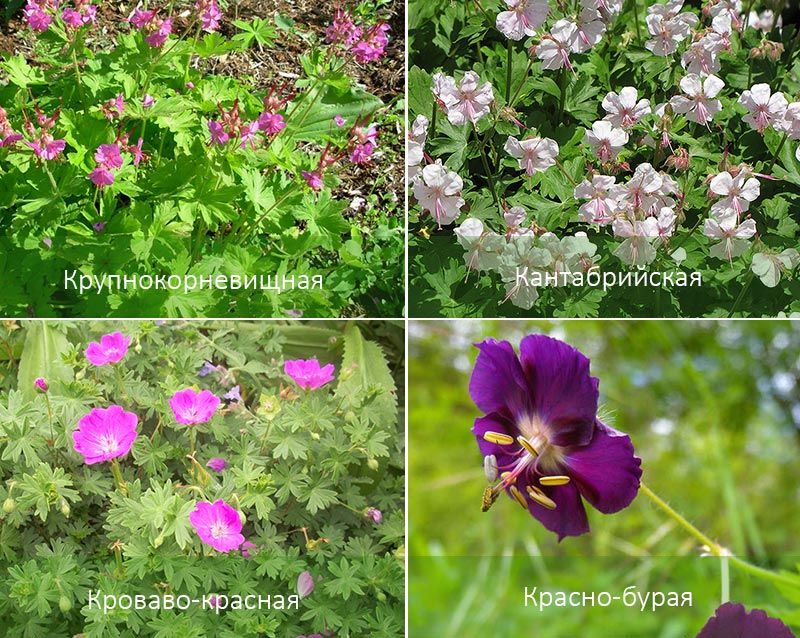
| Red-brown | A Carpathian shrub growing up to 80 cm tall with large basal leaves. These have an interesting shape and pattern: dark purple stripes appear on a grayish hue by late summer. The plant bears small purple flowers with wavy-edged petals that bloom in July-August. | Langthorn's Blue, Lily Lovell, Samobor, Album. |
| Blood red | A hemispherical shrub about 60 cm tall. Its distinctive features are large, single flowers, fuchsia or purple in color. It blooms all summer. The plant's leaves turn red in autumn. This type of geranium has healing properties and is used for: viruses, fungi, infections, microbes, and bleeding. Tinctures are often used. |
Alan Bloom, Apfelbute, Ankum's Pride, Canon Miles, Elke, Nana, Prostratum. |
| Forest | An 80 cm tall shrub with purple flowers. The blooming period is very brief, lasting only three weeks, beginning in May or June. In the wild, it grows in Western Siberia, Central Asia, and Europe. | Mayflower, Album, Birch Lilac. |
| Meadow | The plant thrives only in well-lit areas of Eurasia. It bears large flowers in a variety of colors: from red to blue, from light blue to purple. Monthly flowering begins in June.
Contains a green pigment. It is used medicinally as a sedative, antimicrobial, and anti-inflammatory agent. |
Algera Double, Cluden Sapphire, Ilja, Splish Splash. Jonson's Blue, Brookside, Kashmir Blue, Orion. |
| Small-stamen or Armenian | A perennial growing to 1.2 m tall with long leaves. Their color changes with the seasons: green in summer, crimson in spring, and red in autumn. The plant blooms from June, producing small fuchsia-colored flowers. | Bressingham Flair, Ann Folkard. |
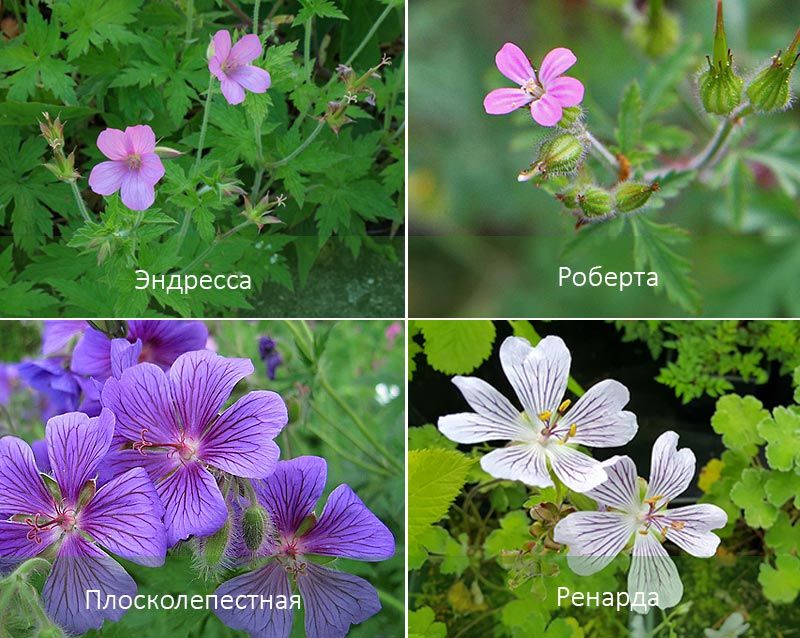
| Flat-petaled | A spherical perennial shrub, up to half a meter in height and up to 1 m in circumference. It has pubescent green leaves and purple flowers. | - |
| Endressa or Perenean | Due to its geographical location, it is a bush with long roots, spreading, and half a meter tall. It has large green leaves about 10 cm long and small pink flowers. It prefers well-drained soil and partial shade. | Beholder's Eye, Wargrave Pink, Betty Catchpole. |
| Himalayan | It has developed roots and grows to a height of no more than 60 cm. Its dissected leaves bear large buds up to 5 cm in circumference. Their colors range from blue to purple, with red veins. It blooms from late spring until autumn. It prefers loose, well-drained soil. It can be found in Afghanistan, Tibet, Tajikistan, and the Himalayan meadows. | Baby blue, Gravetye, Irish Blue, Plenum and hybrids Johnson's Blue and Rozanne. |
| Dalmatian | A low-growing shrub up to 15 cm tall and 50 cm wide with small, soft pink flowers. It blooms in summer. The leaves are dissected and turn red when temperatures drop significantly. It grows in Montenegro and Albania. | - |
| Ashy | A small shrub with bright pink flowers. Blooming lasts only 20-40 days, beginning in the first month of spring. The leaves are grayish-green, dissected, and about 5 cm long. They grow in Albanian and Balkan meadows. | Ballerina, Splendens, Subcaulescens. |
| Renard | A perennial plant with a thick rhizome, growing to about 30 cm. It has olive-colored, dimpled leaves and white flowers with purple margins. This geranium is native to the Caucasus. | - |
| Roberta | A half-meter tall plant. The foliage resembles ferns and may turn orange in autumn. The flowers are small and light pink. The stem is covered with small reddish hairs. This species is notable for its ability to thrive in high-altitude areas, preferring shade. It grows in forests across Eurasia and North America. | - |
| Wallich | This low-growing groundcover grows up to 30 meters tall and up to half a meter wide. It has long leaves and large purple flowers with a white center. It blooms from midsummer to mid-autumn. It is found in northeastern Afghanistan and Kashmir. | Buxton's Variety, Buxton's Blue, Syabru, Crystal Lake. |
| Large-rhizome or Balkan | A spherical, low-growing shrub with branched roots. This variety is tolerant of light. The leaves are round and divided. The rich green color turns red in autumn. The flowers come in vibrant colors: pink and purple. The plant has a pleasant scent. It grows in the Alps and Balkans. Its roots can be used as a natural flavoring in cooking. Geranium oil has wound-healing and soothing properties. | Bevan's Variety, Czakor, Lohfelden, Ingwersen's Variety, Inversen, Spessart, Variegata. |
| Cantabrian | A hybrid resulting from crossing Dalmatian and large-rhizome geraniums, this miniature perennial features glossy leaves and small flowers in white, pink, and purple. | Westray, St. Ole, Biokovo, Cambridge. |
Propagation of garden perennial geraniums
There are two ways to propagate the crane's nest:
- Seed propagation is a labor-intensive and difficult method. As a result, some geraniums fail to produce their own seeds, while others reproduce on their own and disperse them. To propagate this way, it's necessary to select the most attractive species, which will bloom only after a year.
- Vegetative propagation, or cuttings, is a method of dividing a portion of the root. This procedure is recommended in the spring. First, prepare the soil by adding compost and peat fertilizer. Next, plant the seedling in this soil. Regular watering is essential, and a month after planting, the seedling should be fertilized.
Planting and caring for garden geraniums
Planting is best done in the fall or spring. Prepare the soil by adding peat or compost. Water and mulch the soil. Divide the plant's roots before planting. It's recommended to space them approximately 30 cm apart.
Growing this undemanding geranium is easy. Feeding the soil with mineral fertilizer once a year is sufficient. Water regularly, maintaining moderate humidity. It thrives alongside other plants. The flower is resistant to diseases and pests, as its scent is repellent to them.
Wintering
Geranium is a frost-resistant plant.
It can be safely left in open ground throughout the winter. To do this, simply trim off any excess shoots and leaves.
However, indoor geraniums (pelargoniums) do not tolerate low temperatures, so it's best to keep them indoors for the winter. A glass balcony or loggia, where the temperature doesn't drop below 12 to 15°C, is ideal. Therefore, it's recommended to plant geraniums in pots, containers, or vases before the cold season. Do not dig them up or transplant them from the ground.
Pests and diseases
Geraniums' scent repel pests from themselves and neighboring plants. If pests do infest them, prune the plant at the base and burn the cut parts outside the flowerbed to prevent contamination. Diseases typically occur during heavy rains.
The most common pests of geraniums are:
- Aphids are eliminated by spraying the bush with a special solution.
- Goose – they pose a threat for a week, after which the poison dissipates. To control them, simply pick them off the plant by hand.
- Whitefly - use the drug "Iskra".
Geraniums have another problem: yellowing leaves. This occurs due to insufficient moisture. If the leaves are falling off, it means the plant isn't getting enough light.
Top.tomathouse.com recommends: the beneficial properties and contraindications of geranium
In folk medicine, geranium is used in the form of decoctions, tinctures and oils that strengthen human health.
Geranium oil, which has both medicinal and contraindication properties, can be extracted from the plant's roots. The oil is rich in glucose, fructose, tannins, and vitamins. It is used to treat viral infections, inflammation, fatigue, and nervous disorders.
Allergy sufferers should use with caution. It's important to remember that self-medication is not recommended; consuming garden geranium-based ingredients for health benefits should be done under the advice of a doctor. Elderly individuals should also avoid drinking these infusions.