This vibrant flower, reminiscent of a variegated daisy, has long been known as an indoor plant. Gerberas are quite difficult to grow in open spaces. However, with careful planting and proper care, they can be grown in gardens throughout central Russia, not just in the southern regions.
Description of gerbera
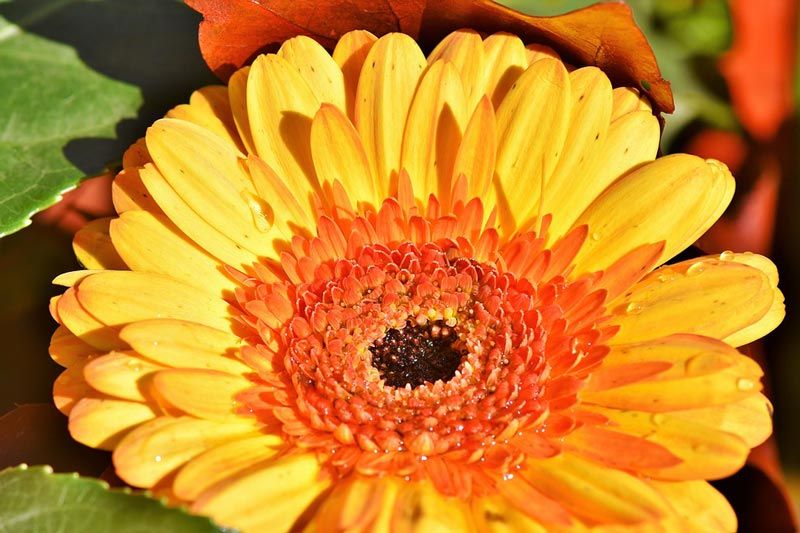
Gerbera belongs to the Asteraceae or Compositae family and is a perennial herbaceous plant.
The bush is small, with pinnate, dissected leaves with a leathery, iridescent surface, arranged in a rosette near the base. They reach 35 cm in length and are sometimes pubescent at the base.
The stem length ranges from 30 to 60 cm, and the inflorescence is large. When the flower opens, its diameter ranges from 12 to 17 cm. Depending on the variety, it is classified as single, semi-double, or double.
The flowering period begins quite early in spring and ends with the onset of the first cold weather.
The plant's homeland is believed to be Africa, Madagascar, and tropical Asia. Another name is Transvaal daisy.
Types and varieties of gerbera
Information on the species and varieties of Transvaal daisy varies—some sources say there are between 40 and 90. Every year, amateur breeders cultivate new varieties, hybridize, and crossbreed existing ones.
One of the classifications of plants is based on external characteristics:
- multi-flowered;
- large-flowered with narrow petals;
- large-flowered with wide petals;
- semi-double;
- terry.
All garden gerberas known today are based on two species: green-leaved and Jamesonian.
Some of the most popular varieties are:
| Variety | Description | Leaves |
Flowers / Flowering period |
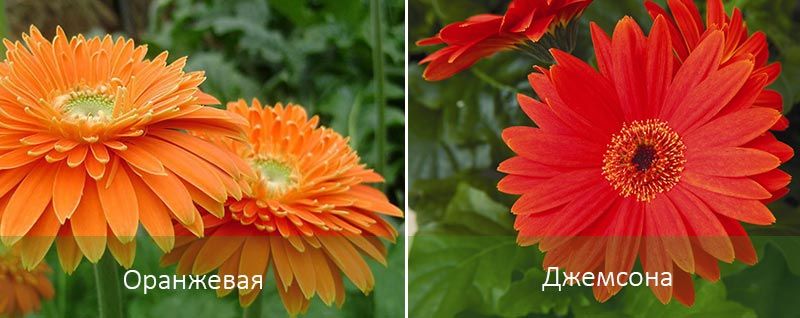
| Jameson | Perennial, strong. Well-known varieties include Parade, Harley, and Golden Serena. |
Feathery, pubescent. Length about 20 cm. |
Inflorescence diameter 10 cm. 3 weeks. |
|
Garden hybrid / Garvinea Sweet Dreams |
Height up to 45 cm, bush diameter up to 40 cm. | Rounded, hairy. About 15 cm. |
Inflorescences are 12-15 cm in diameter. Up to 20 flower stalks can be found on a single bush. Available in a variety of colors. Mid-spring – early autumn. |
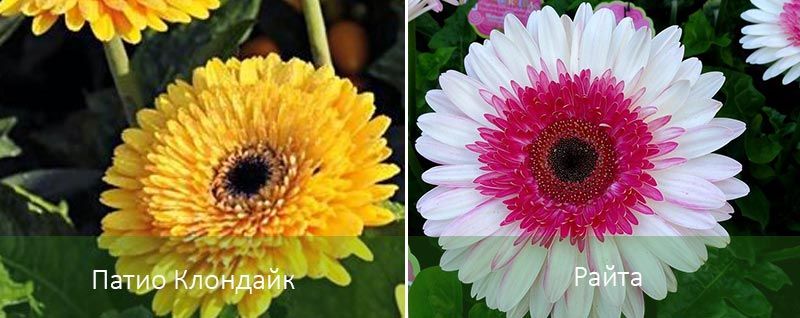
| Patio Klondike | Height and diameter up to 50 cm. | Elongated, serrated, 15 cm. |
Single, tongue-shaped petals, usually white or in all shades of red. July - October. |
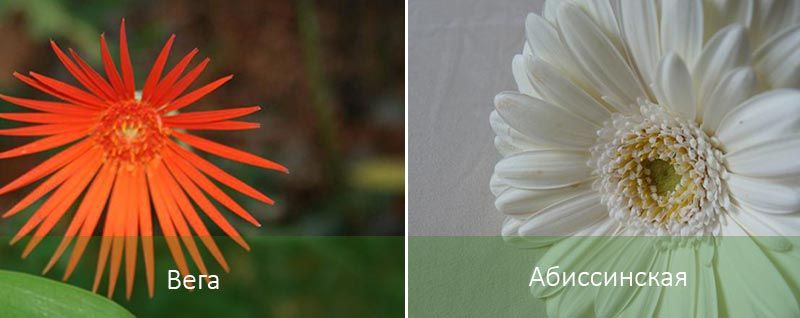
| Abyssinian | Bush height up to 45 cm. | Elliptical shape, bush height up to 45 cm, width up to 14 cm. Edges wavy or jagged, surface lightly fluffy. |
Single, tongue-shaped petals, usually white or in all shades of red. Spring - autumn. |
| Orange | A small bush with a powerful root system. | The leaf shape is elliptical, collected in a rosette at the base of the root. |
Orange, red, pink, purple, deep scarlet, yellow. The center of the inflorescence is black, dark purple. July - October |
| Wright | Used to create bouquets. | They can be lobed or feather-shaped. The edge can be wavy or smooth. |
Red, orange, purple, yellow, pink. The center is yellow or snow-white. Spring - late autumn. |
| Vega | Selection from America. | Up to 50 cm long, narrow, with light fluff. |
The diameter is about 13 cm, the height of the stem is up to 70 cm. The color of the petals is bright orange. July - October. |
The stem is not cut; it should be twisted or broken off, which encourages the growth of new flower stalks with large inflorescences. During the flowering period, the plant requires the most intensive care—watering generously, fertilizing regularly, removing dried petioles and leaves at the base, and irrigating the entire bush.
Growing young gerberas for further planting
Gerbera seedlings are prepared for the new season in the fall. If you plant the seeds in October or November, you can expect the plant to bloom in July or August.
Planting later (January-March) will prevent garden gerberas from blooming before the cold weather sets in. In this case, they should be repotted and brought indoors.
The seed method of preparing seedlings allows you to grow many plants at once and quite easily, without transmitting diseases and pests.
Step-by-step instructions:
- Special cassettes are filled with seedling mixture.
- In each cell, make a hole (no more than 3 mm) with a toothpick and place a seed.
- Spray with water from a spray bottle with a fine mist nozzle.
- To create a greenhouse effect, cover the cassettes with plastic film or glass on top.
- They maintain an optimal regime: a temperature of about +18 °C and fairly high humidity.
- After two weeks, the film is removed; the sprouts should already have sprouted.
- Subsequently, provide diffused lighting for at least 12 hours per day. If daylight is insufficient, use phytolamps.
- The crops are regularly ventilated and sprayed with water.
- When the sprouts reach 3-5 cm in height, they are transplanted into separate containers of a larger diameter using the transshipment method.
- Garden gerberas are planted in the ground provided that the night temperature reaches +12 °C.
- From the moment the seed is planted until the inflorescence opens, 10-11 months pass.
- If the characteristics of the variety are lost during flowering, this is the result of cross-pollination.
Planting and caring for gerberas in open ground
Garden gerbera is a heat-loving plant, so the planting area should be protected from the wind and well lit.
The bed is raised to prevent stagnant moisture and groundwater accumulation, which can lead to root rot. The soil is prepared to be loose and nutritious, with adequate drainage.
The area is pre-dug, and the soil temperature is checked before planting—it should be well warmed. To prevent fungal infection, the soil is pre-treated with a special solution.
The hole for the bush is made large enough to comfortably accommodate the seedling's root ball and soil. The root collar is left 2 cm above ground level. The distance between bushes when planting in the ground is approximately 20 cm.
Gerbera in cold weather
Garden gerberas can be grown as annuals. However, almost all varieties are perennials, so the bush is dug up along with its root ball for the winter. Then, place it in a pot of sufficient diameter and depth and transfer it to a basement or greenhouse with a temperature of 10 to 15°C. Water it very rarely in winter and do not fertilize it.
Sometimes the pot with the plant is placed in a dark and cool corner of the house.
If gerberas are planted in the garden in special large containers, then with the onset of the first frosts they are transferred indoors for the winter - for preservation and rest.
Gerbera propagation
Since the loss of varietal identity is possible when planting seeds, another method of propagation is sometimes used - vegetative propagation.
A three-year-old bush can be safely divided into several full-sized sections. The gerbera is dug up in early summer and the roots are trimmed to 15 cm. Two to three shoots are left on the divided sections. The divisions are treated with activated charcoal and, when replanting, are not placed too deeply into the soil to prevent rot.
After planting, young plants are shaded throughout the recovery period, which takes about 30 days.
Gerbera diseases and pests, care mistakes
Growing in the garden isn't without its share of diseases and pests. Keep an eye on your plant when it shows the following signs:
| Type of damage | Symptoms | Reasons | Methods of elimination |
| Root rot | The basal rosette begins to rot, the leaves become wilted and wither, and the entire bush may die. |
|
Spray with Fundazol and Maxim. If the plant dies, dig up and destroy it. |
| Gray mold | The stem, inflorescences, and basal rosette are covered with a gray coating. |
|
Fundazol, Rovral solution. |
| Powdery mildew | The whitish coating first forms on the stem, then spreads to the leaves and flower stalks. |
|
|
| Mosaic | Initially, yellow-green spots, resembling marbled streaks, appear on the leaves. These then become deformed and necrotic. | A parasite is a sucking insect. | The only preventative measures possible are pre-treatment of the soil with insecticides. Gerberas should not be planted in areas previously occupied by Cucurbitaceae plants. If a plant becomes diseased, it must be destroyed; there is no cure. |
| Aphid | Brown bumps appear on the underside of the leaves, stems, and inflorescences. | Insect parasite infestation. | Irrigation with insecticides – Decis, Karate, Actellic, Fitoverm. Dusting with ash and tobacco dust. |
| Whitefly | The leaves that the insect feeds on turn yellow and dry out, then become covered with a sticky substance and larvae. | The parasite is a small white butterfly. | Insecticide treatments such as Aktara, Confidor, and Iskra are recommended. Maintain optimal temperature and humidity. Peppermint and nasturtiums act as butterfly repellents and are planted near gerberas. |
Using gerberas in landscape design
A variety of garden gerbera flowers brightly color the garden and surrounding area.
It is planted along paths as a border, using single-color bushes or combining different tones.
Gerberas grown in garden pots or special containers are placed on balconies, verandas, and terraces, thus serving as a portable decorative element.
This plant looks wonderful both in single and mass plantings, as well as in combination with other flowers. Common choices include pansies, bellflowers, poppies, calendula, gentians, salvias, bidens, heuchera, grasses, and conifers. Cut flowers in a bouquet will provide energy for almost a month.