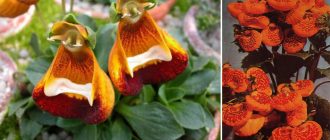
Hypocyrta is an exotic houseplant that has only recently become known. In America and Britain, it is called "goldfish." From the Greek, it translates as "thickened at the bottom."
It's grown as a hanging or shrub flower. According to popular superstition, nemanthus (also known as "nemanthus") has miraculous properties, bringing happiness and prosperity, and cleansing the home. When the plant looks healthy and well-cared for, its owners are in a better mood.
Description of hypocyrta
Hypocyrta is native to tropical areas of Brazil and Paraguay. It belongs to the hemiepiphytic plants of the Gesneriaceae family. In the wild, it grows on the branches of tropical forest trees. Its long aerial roots reach the ground for nourishment. Nemanthus grows up to 25 cm, with some varieties reaching 60 cm. The root system is thin, superficial, and branched. The stem is thick and prostrate.
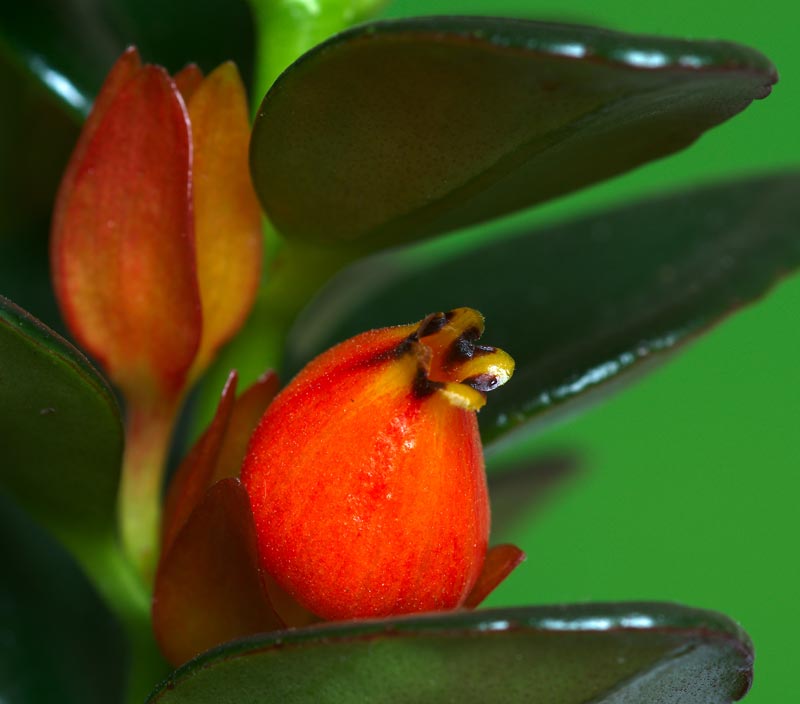
The leaves are dark green and glossy, oval, round, or diamond-shaped. Their undersides are streaked with lilac. The open, tubular buds resemble a jug with a narrow neck and upturned edges, or lips pursed for a kiss. Hypocyrta blooms for up to four months—from mid-spring to early fall. In warmth and adequate light, they can bloom into winter. The petals range in color from orange-red, yellow, or pink, depending on the variety.
Types of hypocyrta
There are over 30 species of this plant. Popular among gardeners are the Monetnaya and Nalaya.
| View | Description |
| Coin | A drooping, straight stem without lateral branches, with light green, pubescent leaves. The flowers are bright red, with yellow markings and a black throat. It sheds its leaves after flowering. |
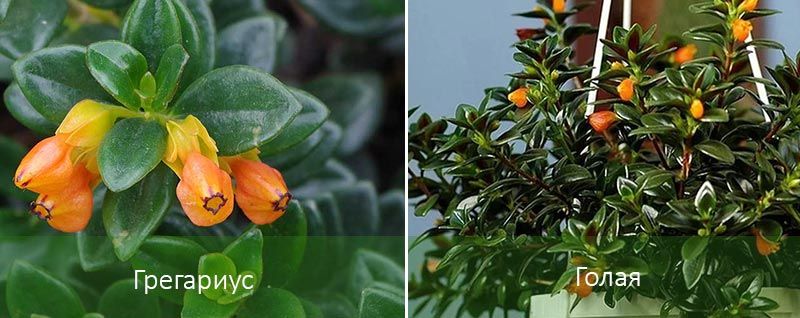
| Naked (glabra) | An epiphyte, it lives on other plants, using them for support. The shoots are bush-like. The leaves are small, elongated, and waxy. The color is bright orange. |
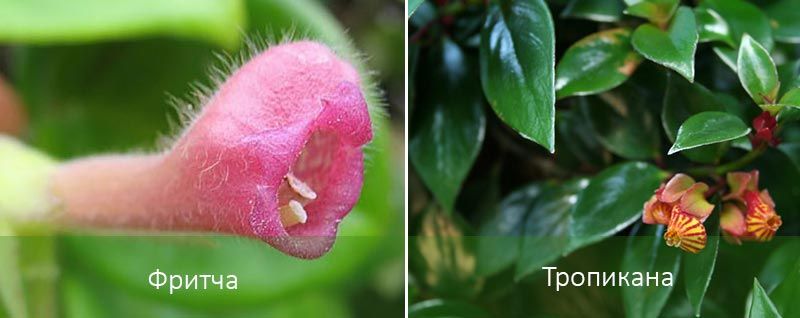
| Tropicana | An upright stem, bright leaves arranged in a diamond shape, terracotta petals, blooms all summer. |
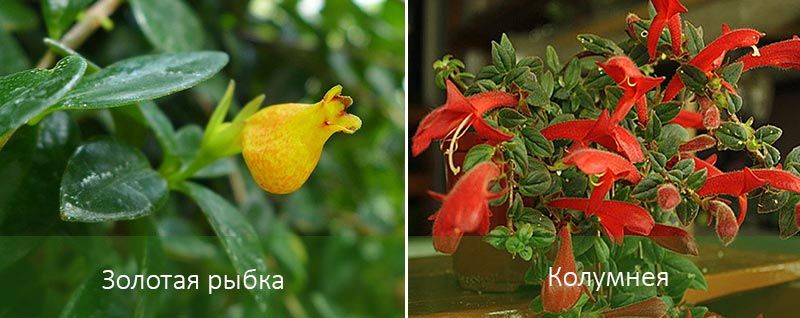
| Gregarius | Soft, creeping shoots. Oval, pointed, waxy leaves. Red or yellow flowers. |
| Columnea | Semi-erect stem, bright green, pointed leaves, scarlet petals. |
| Variegated | Two-colored leaves, with a white border along the edge or in the middle. |
| Fritch | Large leaves are green on top and red on the bottom, a thin, pubescent stem, and light pink flowers. |
| Vetsteina | Small, elliptical, dark, waxy leaves, orange-colored petals, distinguished by abundant flowering. |
| Prirechny | Large leaves, two-tone, lemon-colored flowers. |
| Santa Teresa (Albus) | White, hairy petals with a citrus scent. |
Caring for Hypocyrta at Home
The maintenance of nemanthus in a room has some peculiarities.
| Factor | Spring/Summer | Autumn/Winter |
| Location, lighting | Southwest or east-facing windows or a draft-free hanging planter. Bright, diffused light, protected from direct sunlight. | Quite bright, with additional lighting. |
| Temperature | +20…25 °C, without fluctuations. | +12…16 °C, depending on the variety. |
| Humidity | More than 50%, frequent air misting during the growth and flowering period. To achieve this, place the plant on a tray with moistened pebbles or moss. | Not required during dormancy. |
| Watering | Plentiful, soft, settled water at room temperature. | Moderate in autumn and rare in winter. |
| Top dressing | Mineral fertilizers for flowering plants from April to August every week. | Not needed. |
Transfer
Every 2-3 years in the spring, repot the plant into a smaller pot, 2-3 cm larger than the previous one. Choose a light, loose substrate: leaf mold, peat (3:1), and river sand with charcoal, or purchase a ready-made potting mix for Saintpaulias. Place a drainage layer of expanded clay or pebbles at the bottom of the pot to prevent root rot. Disinfect the container, soil, and drainage. Repot by transshipment, taking care not to disturb the root system.
Rest period
From October to the end of February, the plant enters a dormant period. Before this period, the flower is cut back by 1/3, which encourages active growth of young shoots in the spring.
Reproduction
The flower reproduces in several ways.
Cuttings – take a lateral shoot 8-10 cm long from a mature plant. Remove the lower leaves. Place the cuttings in water, or perhaps a mixture of sand and peat. Cover the top with plastic wrap. When a root appears, plant the cuttings in a prepared container.
To create a lush bush, place several cuttings in a pot. This method is used for propagation in the spring, during the first ten days of summer.
Seeds are distributed into moist soil made of peat and sand. Cover with plastic wrap or glass. Water through a tray. When seedlings appear, remove the plastic wrap. Plants are transplanted after two weeks. Flowering begins the following season.
Hypocyrta care errors, diseases and pests
If the care standards for hypocyrta are not followed, problems, diseases, and pests arise.
| Manifestations | Reasons | Elimination measures |
| The leaves curl and turn yellow. | The sun is too bright. | Move the flower or shade it. |
| Does not bloom. |
|
Select the appropriate container and follow all care instructions. |
| Leaves and buds fall off. |
|
|
| Brown spots on the plant. | Burns due to spraying. | Do not spray the leaves with water or leave them in bright sunlight. |
| Hypocyrta is fading. | The plant was overfed. | Do not exceed the dosage; feed once every ten days. |
| Indentations in the leaves. | The watering regime has been violated. | Do not allow the soil to dry out or become waterlogged. |
| The plant is withering, the leaves are turning yellow. | Root rot. | Remove the flower from the pot, remove the affected roots, dry and replant, water with Carbendazim (Carboxin) |
| Fluffy mold on a flower. | Gray rot. | Remove diseased parts, change the soil. Treat with Fundazol. |
| White coating on the plant. | Powdery mildew. | Trim off affected areas and treat with Fitosporin. Ventilate the room for prevention. |
| Light yellow spots, sometimes cobwebs are visible. | Spider mite. | Treat with Actellic, Fitoverm. |
| The shoots are curled up, insects are visible on the plant. | Aphid. | Spray with special aphid control products – Inta-vir, Decis. |
| Hypocyrta does not grow, flowers are deformed, leaves are covered in silvery streaks. | Thrips. | Treat with Akarin, Actellic. |
| White, cotton-like coating on shoots. | Mealybug. | Spray with Commander, Vermitek. |