Gloriosa is a flowering plant belonging to the Colchicum family. It is native to tropical regions of Africa and Asia.
Description of Gloriosa
The slender, twining stems form from oblong tubers. The foliage is satiny, with tendrils along the edges for grasping support. The color is bright green.
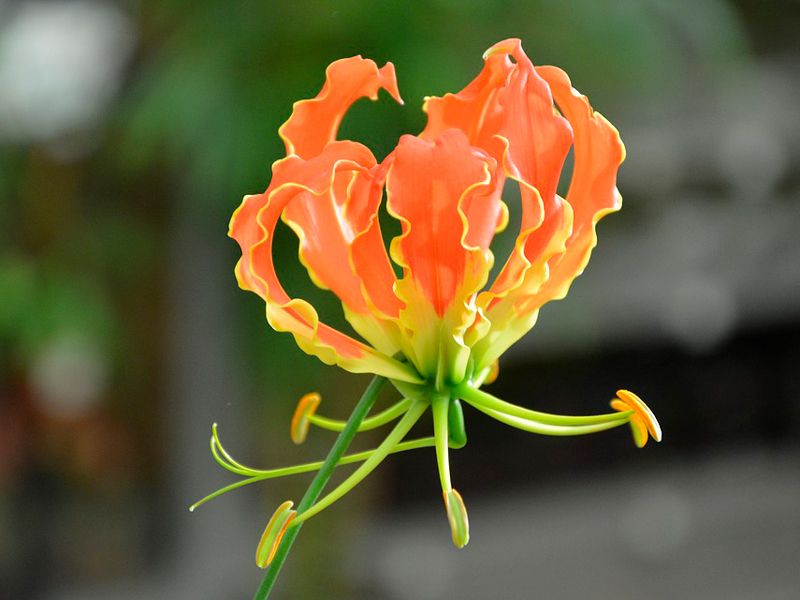
The flowers are solitary, up to 12 cm in diameter. They resemble lilies in appearance, with long, wavy petals that curve upward. The coloration is varied, combining two colors, often quite bright.
Types of Gloriosa
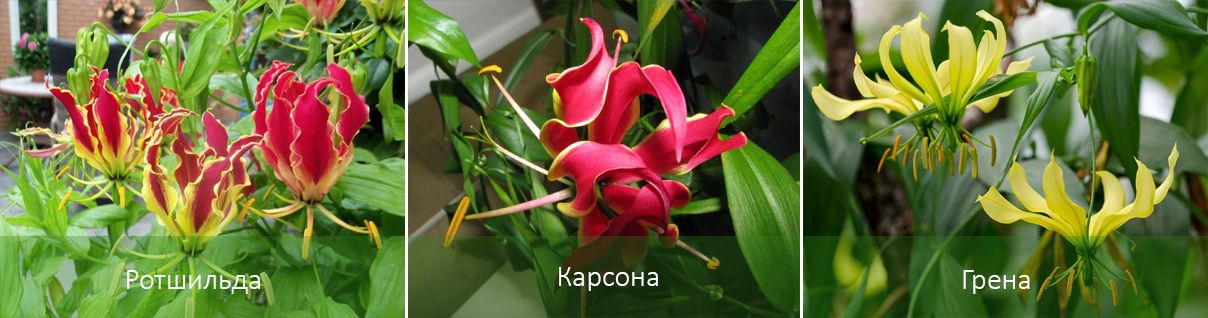
There are several varieties of Gloriosa that can be grown at home:
| View | Description | Flowers |
| Rothschild | Native to Africa, it has a fast-growing, climbing stem. It tolerates direct sunlight poorly. | Yellow-red with twisted petals. |
| Carson | A small plant with bright inflorescences. | The center of the petals is purple-brown, with yellow edges. |
| Simple | Elongated and branched shoots reach 3 m. The foliage is lanceolate, bright green. | It has several stamens and 6 wavy petals. |
| Grena | They look like Chinese lanterns. | The color is soft yellow. |
| Luxurious or magnificent | It is considered the most common ornamental variety. The shoots reach 2 m. The foliage is lanceolate and glossy. The inflorescences form from the axils. | Wavy red petals. |
| Yellow | An evergreen plant, up to 2 m tall. The stem is branched. The foliage is lanceolate and green. | Curved petals, yellow color. |
| Citrine | Large inflorescences, externally reminiscent of the Rothschild variety. | Lemon yellow with reddish spots at the base. |
Caring for Gloriosa at Home
When growing Gloriosa, special attention is paid to planting and care at home, focusing on the season:
| Factor | Spring/summer | Autumn/Winter |
| Location/lighting | An east or west-facing window. Place on a south-facing windowsill only for shade during periods of high sun. Moving to a glassed-in balcony or terrace is permitted. Bright, diffused light is recommended. | Does not require backlighting. |
| Temperature | +20…+25 °С. | +10…+12 °C. At temperatures above +15 °C, flower bud formation is disrupted. |
| Humidity | The optimal ratio is 70-80%. Frequent, generous misting is recommended. Place the pot in a tray filled with moistened pebbles and expanded clay. | Humidity level: 65%. The plant is moved away from heating devices. |
| Watering | After the soil has dried out by 1/3. Once every 21 days. | They stop. |
| Top dressing | Once every 7-10 days. | They are suspending. |
Landing, transplant
Gloriosa is repotted annually. The optimal time is early spring, immediately after wintering. Its small tubers allow for the use of low, wide ceramic containers.
The soil is made independently, choosing the appropriate option:
- humus, leaf and sod soil, peat, coarse river sand (4:2:4:1:1);
- compost, leaf soil, vermiculite, crushed moss (4:2:1:1).
Having prepared the soil, we move on to planting the gloriosa:
- A layer of expanded clay equal to 4-5 cm is placed on the bottom of the vessel, and then a substrate – 3-4 cm.
- The soil is slightly moistened with a spray bottle and left until it is absorbed.
- A support is installed in the container.
- The tuber is placed in the same location, with the growing point facing upward (if the flower has no buds, there's no point in planting it). Cover it with a 2-3 cm layer of soil and moisten it again.
- Provide heat from below, gradually increasing the temperature to 15–20°C. Bright light is essential. Until the first shoots appear, the plant should only be misted; the soil should not be watered.
Rest period
In early autumn, gloriosas stop blooming, but they retain their greenery for a few weeks. Then, the foliage turns yellow and the stem dries up. The above-ground portion of the flower dies, but the root system continues to feed. During this period, reduce the frequency of watering.
When the leaves are completely dry, stop watering. A dormant period begins. The part of the plant above ground is trimmed off, and there are several options for what to do with the tuber:
- Store without soil. Trim the top and then carefully remove the plant from the pot. Clean the tuber of old soil and place it in peat or moss, then in a cardboard box or paper bag. Store in a cool place, at a temperature of 10 to 15°C. In the spring, move the tuber to a pot.
- Store in a container. Remove all above-ground parts of the flower and transport the container to a warm, dry place.
The temperature is the same as when stored without soil. At the end of winter or in March, the gloriosa is transplanted into fresh soil.
When choosing a storage option for tubers, it's worth noting that when kept in a pot, the flower wakes up faster, while when overwintered without soil, development is slower.
Propagation of Gloriosa
It is carried out using seeds and daughter tubers.
When grown using the first method, the plant develops slowly. The first flowering occurs only after three years. Seeds up to two months old are suitable, as they quickly lose their germination capacity.
Having prepared the material for propagation, follow this plan:
- Artificial pollination is carried out by using a soft brush and transporting pollen from the stamen to the stigma of the plant.
- When the formed fruits crack, the seeds are removed and left in a biostimulator, Zircon or Epin, for several hours.
- The seeds are planted in small containers filled with a mixture of peat, turf soil, coarse sand, perlite, and vermiculite, all in equal quantities. They are spread over the surface of the soil and buried 2-3 mm deep. They are then sprayed with water from above.
- Cover the boxes with plastic wrap. The first shoots will appear in 20-25 days. During this time, open the greenhouse for a few minutes every day to prevent rot.
- After 2-3 permanent leaves appear, the flowers are planted in separate containers.
The mother tuber is divided in early or mid-spring, following these rules:
- Medium-sized pots are filled with soil mixture prepared for gloriosa.
- The substrate is moistened and small indentations are created.
- The tubers are placed in the holes made with the buds facing up, and then covered with soil on top, a layer of 2-3 cm.
- The containers are transferred to mini-greenhouses or placed in plastic. They are provided with bright, diffused lighting, under-heating (ideally located above a radiator), and a temperature of 23 to 25°C. Watering is only done after the first shoots appear.
- If necessary, the shoot is secured to a support. In the spring, the plant is transplanted into soil suitable for mature Gloriosas.
Problems with caring for Gloriosa, diseases and pests
Gloriosa can be attacked by diseases and pests, and improper care leads to certain problems:
| Manifestation | Cause | Elimination measures |
| Pale leaves, elongated shoots. | Poor lighting. | Place closer to the light source, and supplement with phytolamps in winter. |
| Slow growth, darkening of leaves. | Sharp temperature changes. | Protect from drafts. If the flower is on a windowsill, do not open the windows. |
| White coating on leaves. | Watering with hard water. | Before use, the water is settled and filtered. |
| Lack of flowering. | Insufficient lighting, damage to the tuber during planting, lack of wintering. | The conditions of detention are being adjusted. |
| The leaves turn yellow, the tips turn brown. | High or low humidity. | Normalize air humidity, avoiding sudden fluctuations. Maintain optimal levels throughout the flower's growth period. |
| Wilting of shoots, loss of elasticity. | High air humidity, root rot. | Adjust watering and eliminate rot by removing damaged roots. |
| Brown plaques on leaves and shoots. | Scale insect. | The pest is removed manually and sprayed with any insecticide. |
| Twisting and wilting of young shoots and foliage, many green insects are present. | Aphid. | The plant is sprayed with Fitoverm or Actellic. The leaves are also wiped with soapy water. |
| Wilting of foliage and formation of yellow spots, white webbing is present. | Spider mite. | Remove pest-infested foliage. Spray with Actellic. Increase the frequency of spraying, as the mite is sensitive to high humidity. |
| Withering of foliage, loss of elasticity of shoots, and then their death. | Root rot. | The tubers are removed from the soil, any damage is cleaned off, and they are treated with activated charcoal. They are replanted in fresh, pre-disinfected soil. |
Top.tomathouse.com warns: Gloriosa is a poisonous plant.
The plant is toxic, so its consumption is strictly prohibited. If ingested, it negatively affects the gastrointestinal tract, worsening general health, causing migraines, and possibly nausea and vomiting.
To prevent poisoning, keep the flower away from children and pets, as poisoning can even lead to death.
When in contact with Gloriosa, wash your hands thoroughly with soap and wear rubber gloves when working with it.
If you follow all the flower care guidelines, it will delight you with a healthy appearance and beautiful blooms. The main thing is to pay attention to the quality of watering and fertilizing.