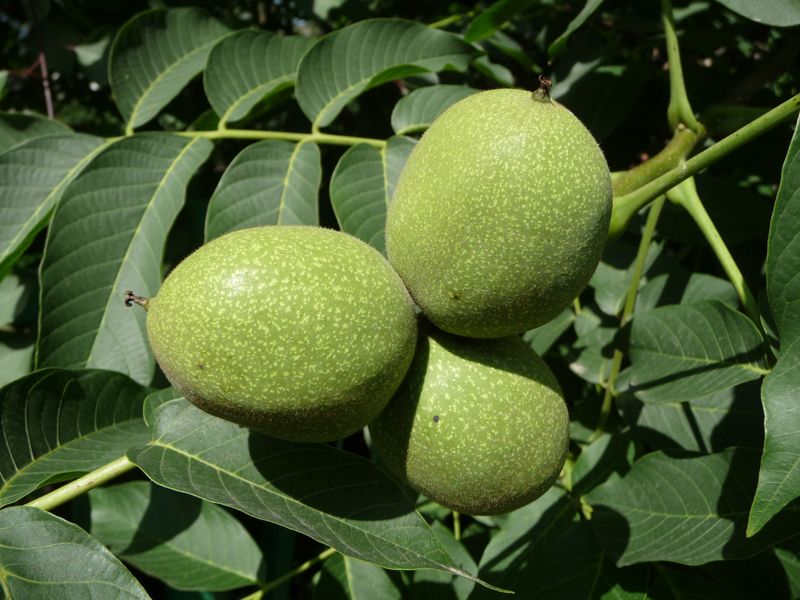
The walnut is a relatively easy-to-grow tree whose fruit strengthens the immune system, brain function, and the nervous system. The plant lives for about 300 years and was first imported from Greece, hence its name.
To obtain a fruitful plant, you need to know some rules for planting and caring for this delicacy.
Selecting a landing site and preparation
The walnut tree is a large one. Its overall diameter is 20 meters, its height is 25 meters, and its roots are 3.5 meters long. Therefore, before planting, it's important to plan the growing site. It should be located at some distance from the house, otherwise the roots will damage the foundation. Leave at least five meters between seedlings or seeds.
It's important to determine the planting method—seeds or seedlings. The former is the most common. It's best to find a variety that can withstand the local climate.
Seed preparation
You can plant in the fall or spring. When planting in the spring, stratify the seeds four months beforehand. This is necessary for germination. Place the seed in a container with damp sawdust or soil, edge-up, cover with another layer of soil, and place it in a room with a temperature of 0 to 5 degrees Celsius. Every three weeks, remove the nuts and air them out, and moisten the sawdust. This procedure should be repeated for four months. After this, place the seeds in the sun to dry for four days.
Another spring planting method: place the nuts in water, leave at 10°C (50°F) for 5 days, then remove any that have sunk to the bottom and discard any that float to the surface. Place any remaining nuts, especially those that have sprouted, in dry sand to dry for 4 days.
When planting in autumn, stratification and drying are not necessary.
The nuances of planting seeds and seedlings
Planting most often takes place in the spring, in April. The fruits are placed in the soil to a depth of 11 centimeters. It's important to place them correctly, seam-side up, otherwise the first fruits will appear 3-4 years later than usual. Before planting, enrich the soil by mixing it with compost.
It's best to plant sprouted seedlings in April, using two-year-old plants. The trees are very fragile, so digging and transporting them should be done carefully. The roots are trimmed to 40 centimeters, and the cut is coated with clay. The hole should be 1 meter deep and 0.5 meters in diameter. The root collar should be approximately 4 cm above the ground.

The first pruning of branches occurs at two years of age. The tree's crown can be shaped for up to four years, after which only weak branches need to be pruned.
How to grow a walnut tree in a pot?
To grow a tree in a pot, prepare fertilized soil or purchase it from a specialty store. In the former case, add a third of the drainage material to a 30-centimeter-wide pot, followed by the soil.
Place the treated fruit in a hole 8 centimeters deep, cover with soil, and then keep at 28 degrees Celsius for about 5 days. Then, place the pot indoors and keep it constantly moist. Every 4 years, repot the plant, trimming a third of the root system.
How to care for a nut tree?
Plant care primarily involves good watering. Each seedling is watered twice a month, three times during hot weather. Each plant requires about three buckets of water. Trees taller than four meters are watered less frequently and less abundantly. Watering should be stopped after the age of ten.
Walnut trees need to be fertilized twice a year – in April and October. In the spring, use nitrogen-containing fertilizers.
It's worth keeping in mind that such fertilizers can lead to the development of pathogenic bacteria if overused. Phosphorus and potassium are needed in the fall. It's better to buy granular fertilizers, as they quickly become more readily available, unlike powdered fertilizers. Once the tree begins bearing fruit, stop using nitrogen as a fertilizer for the first two years.
It's crucial to prune excess branches promptly. This is best done in early summer, leaving 5-7 centimeters, and the following year, trimming them back completely, coating them with tree resin. For four-year-old plants, only weak and old branches need to be removed.
Mulch should be applied around the trunk, along with any organic matter or compost. This is especially important during the seedling's early years to retain moisture in the summer, and in winter, mulching protects the soil from freezing. This should only be done during the first few years; after that, the tree will harden off on its own.
Walnuts have no natural enemies, and since their smell repels pests, they do not need to be treated.
Top.tomathouse.com: grafting and propagation at the dacha
Since cuttings don't root, the only way to obtain the desired variety is by grafting it onto another tree. Ideally, the plant should be about two years old. Grafting is done if you have a truly good variety, such as Manchurian, or if an existing variety hasn't performed as expected and you have a cutting from a more suitable walnut tree.
The commonly used bud grafting method involves removing the bark and bud in a semi-tube shape, making a similar cut on the rootstock (scion), and attaching it to the tree. The graft site should be secured with film or tape until it heals completely.
Cultivation in the garden usually occurs from seeds, which are planted untreated in the fall. After about two years, the tree produces its first fruits, and after another eight years, it produces a significant harvest.
For your convenience, below is a table on how to care for walnuts:
| Plant care | Years of a tree's life | |||||||||
| 1 | 2 | 3 | 4 | 5 | 6 | 7 | 8 | 9 | 10 | |
| Watering a tree | 2-3 times a month | Reduce watering to 2 times a month | Stop watering | |||||||
| Pruning branches | Form the crown and trim old branches | Only sanitary pruning of branches | ||||||||
| Fertilizers | Only phosphorus-potassium | Phosphorus-potassium and nitrogen fertilizers | ||||||||
The walnut tree is easy to plant, adapts to harsh conditions, requires little watering, and produces very healthy fruit. Growing the tree in the Moscow region is possible.
Helpful tip: to avoid wasting time while waiting for the first walnut fruits, plant bushes, such as raspberries. While the walnut grows and develops, the bushes will bear fruit for up to 10 years.
Some interesting facts about walnuts:
- Because of its similarity to the brain, it is considered a separate life form, with a "strong family" within its shell. Hence the belief that eating walnuts is killing life.
- In ancient Greece, it was especially valuable due to its many nutrients, but ordinary people were forbidden from eating it, as the authorities did not want the people to become smarter.
- In science, it is not a nut at all, but belongs to the “drupe” species.
- "Loves iron." It turns out that driving a nail into the trunk improves fruiting quality and promotes early fruiting.
- Just 400 grams per day can replace a full meal plan, containing all the necessary nutrients for proper body function.
- Statistics: 100 grams of nuts can replace 300 grams of whole grain bread or 700 grams of potatoes.