Huernia is a flowering succulent plant belonging to the Asclepiadaceae family. It is native to the arid regions of the Arabian Peninsula and Africa.
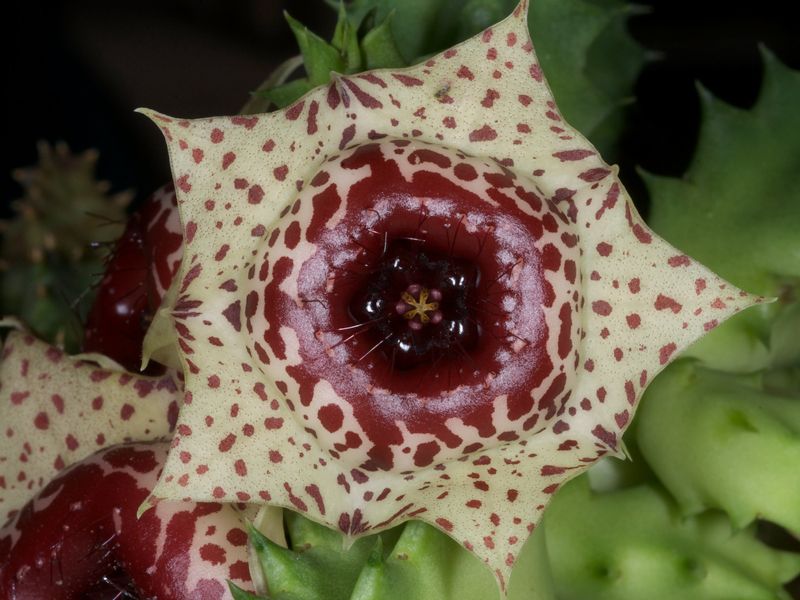
Description of Guernia
This plant was first described in 1810 by renowned botanist Robert Brown. The flower's distinctive appearance has earned it several names: devil's tongue, voodoo lily, and snake palm.
The trunk is 22 to 30 cm long, with branched shoots. The flowers are pentagonal, brightly colored, and the rosettes are bell- or funnel-shaped.
There is a specific smell, similar to the aroma of rotten meat.
Types of Huernia
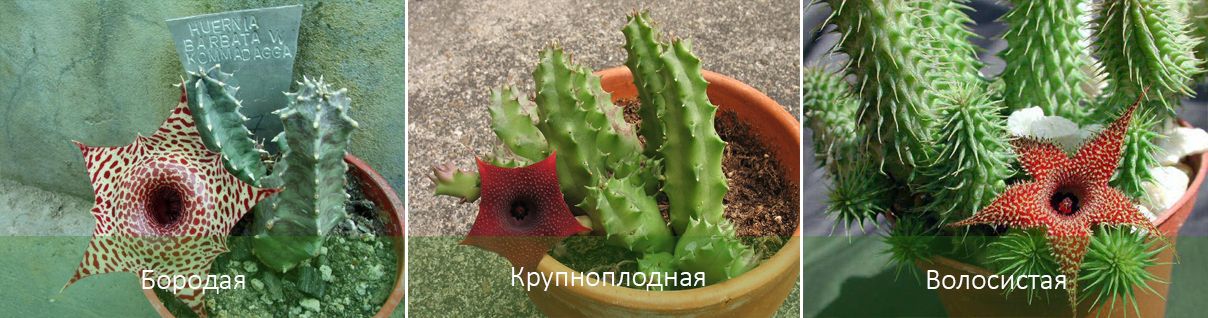
Several varieties of Huernia can be grown indoors:
| View | Description | Flowers |
| Bearded | Shortened ribbed trunks, up to 6 cm high. | Yellow-brown, sometimes striped. |
| Large-fruited | The stems reach 7-10 cm and are covered with sharp teeth. | Small, yellow with brown stripes. |
| Hairy | A short, thick trunk with several facets. Densely arranged growths with long, light-colored hairs. | Small, bell-shaped, and red with white spots. |
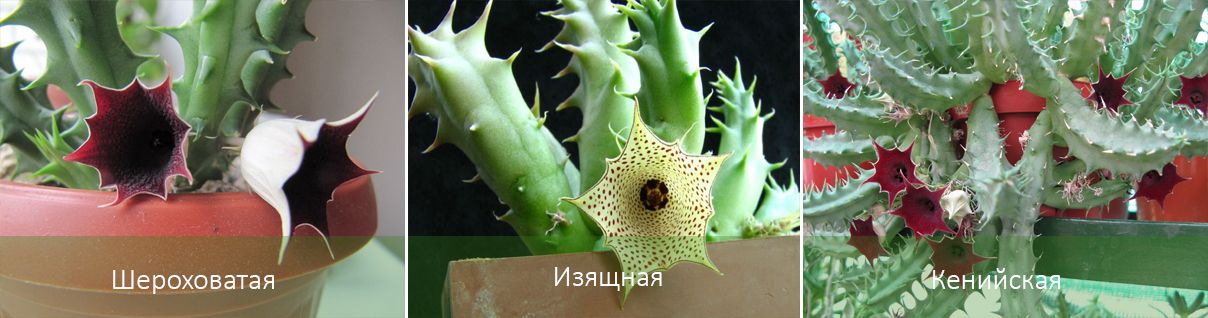
| Rough | The shoot grows up to 20 cm. | Medium-sized, they have five fused, reflexed petals and are shaped like bells. The outer side is light, while the inner side is dark burgundy. |
| Graceful | The trunks are light green, pentagonal. | Pale yellow, bloom simultaneously. |
| Kenyan | Long creeping stem with sharp teeth. | Velvet, purple color. |
| Striped (Zebrina) | The shoots are green, five-sided, and reach 8 cm in length. | Yellow with reddish-brown stripes. The pattern is similar in appearance to that of zebras. |
Caring for Huernia at Home
Home care for huernia depends on the season of the year:
| Factor | Spring/summer | Autumn/Winter |
| Location/lighting | East or west-facing windows, or if planted on a south-facing window, provide shade during midday hours. The light should be bright and diffused. | Requires additional lighting with phytolamps. |
| Temperature | +22…+27 °С. | +5…+10 °С. |
| Humidity | Tolerates humidity well at 40-50% | |
| Watering | Moderate, carried out only after the top layer of soil has dried out. | A little, once a month. |
| Top dressing | Once every 4 weeks. | It stops. |
Transplantation, soil
Repotting is done every spring if the plant has outgrown its pot. The substrate should be as nutritious as possible and consist of the following components in equal proportions:
- leaf and sod soil;
- humus;
- coarse river sand;
- lime and charcoal.
Reproduction
The plant is propagated by cuttings and seeds. The former method is most commonly used. To do this, a young shoot is cut from the Huernia and placed in moist peat. After rooting, the cutting is transplanted into soil suitable for mature succulents.
Mistakes in caring for huernia, diseases and pests
When growing a houseplant, problems may arise due to poor care or attacks by diseases and pests:
| Manifestation | Cause | Elimination measures |
| Dark spots. | Burn. | The plant is moved to partial shade. |
| Root system rot. | Overwatering. | Remove all affected areas and replant the plant in new soil. Adjust the watering schedule. |
| Lack of flowering. | High maintenance temperature during the winter period. | The plant is provided with a comfortable wintering. |
| Small white spot, wilting of foliage | Mealybug. | The flower is treated with solutions of Intavir and Aktara. |
If you provide your guernia with quality care, such problems will not arise.
Reviews of Huernia cultivation from gardeners
Huernia: exotic blooms without much fuss. Undemanding and beautiful. Photo.
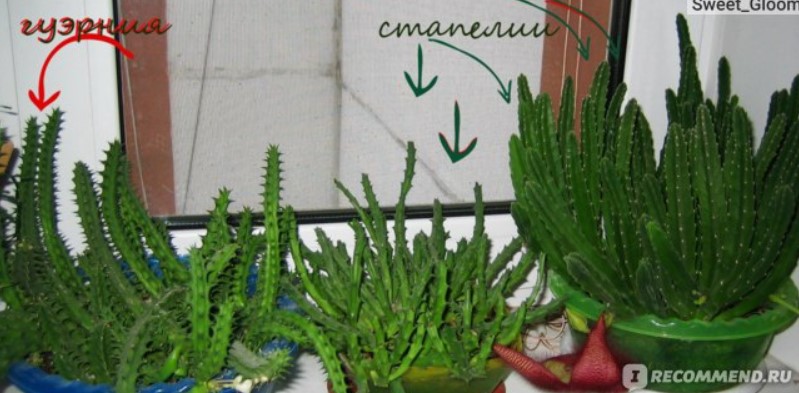
Continuing our conversation about houseplants with exotic blooms (which I began with a review of the stapelia), I can't help but mention another equally remarkable and unusual plant: the huernia. Incidentally, the huernia is a close relative of the stapelia. This is easy to see if you look at the stems of the plants; they are very similar. And unless you're a seasoned gardener, distinguishing one plant from the other, especially when they're not blooming, can be challenging.
On my windowsill, a huernia shares a space with two species of stapelia. While it's fairly easy to distinguish it from a common stapelia (in a green pot), it's definitely sister to a variegated stapelia (in a yellow pot). But there are still differences. The huernia has fleshier, thicker stems, and they have more pronounced spines. These spines may seem threatening, but they're nothing to worry about. They're completely harmless and have no prickles. Even if you run your hand over the plant, you won't prick or scratch yourself.
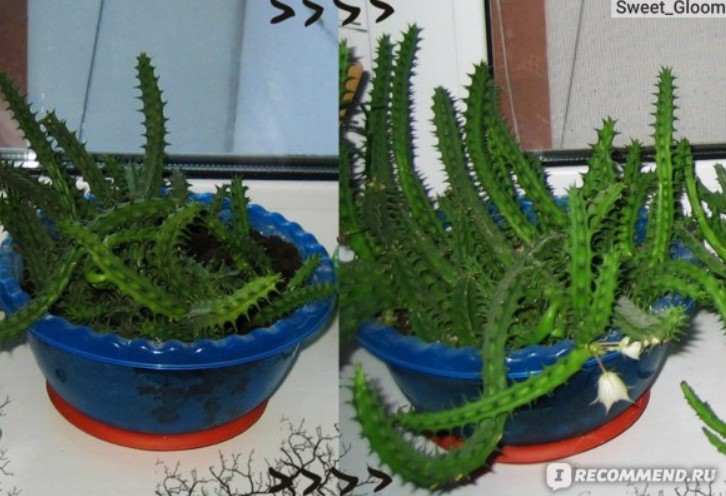
Huernia is a grateful and undemanding plant. The photo above shows the same bush over a six-month period. In the photo on the left, it has just been transplanted into a new pot. In the photo on the right, it has already taken root in its home and is blooming in full bloom.
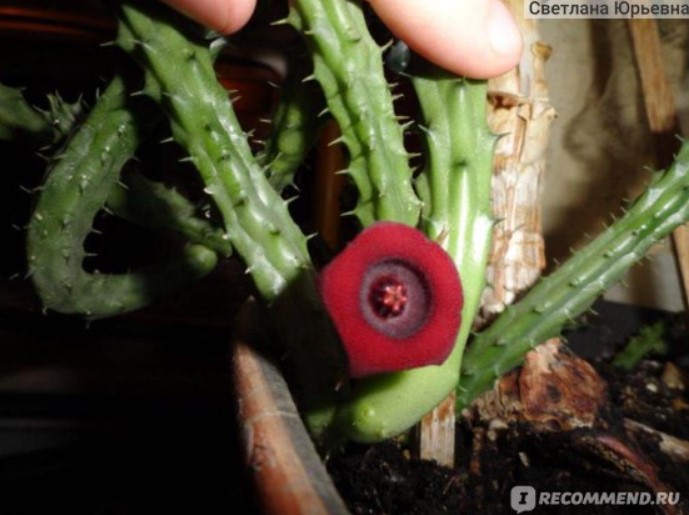
Yes, let's move on to the most interesting part - flowering.As you can see in the previous photo, Huernia flowers are nowhere near as gigantic as those of, say, stapelia. When fully opened, the bell-shaped flower is 1.5 (maximum 2) centimeters in diameter. The flower's scent isn't the most pleasant. It's reminiscent of a landfill or stale garbage. However, the aroma is not very strong, and you'll only detect it if you bring your nose close to the open flower.
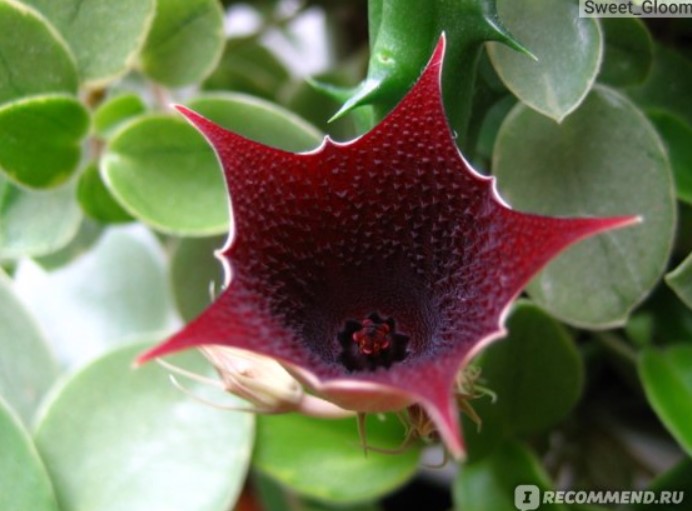
Despite its small size, the flower is stunning! Its exotic beauty rivals that of the magnificent stapelia! The only caveat is that the flower isn't as open as that of the stapelia. It's a dense, wax-hard bell, dark burgundy on the inside and a dull whitish on the outside. Huernia bells are very modest and always tend to retreat into a corner, the floor, or the interior of the bush. To fully appreciate their beauty, you have to be clever and take a peek. Shall we?
The textured, velvety flowers seem lifelike... Incidentally, they're quite long-lasting, with a single bloom adorning the bush for several days. New buds are quick to replace them. My Huernia blooms tirelessly almost year-round. There aren't always many flowers, but there are almost always one or two blooms or buds on the plant.
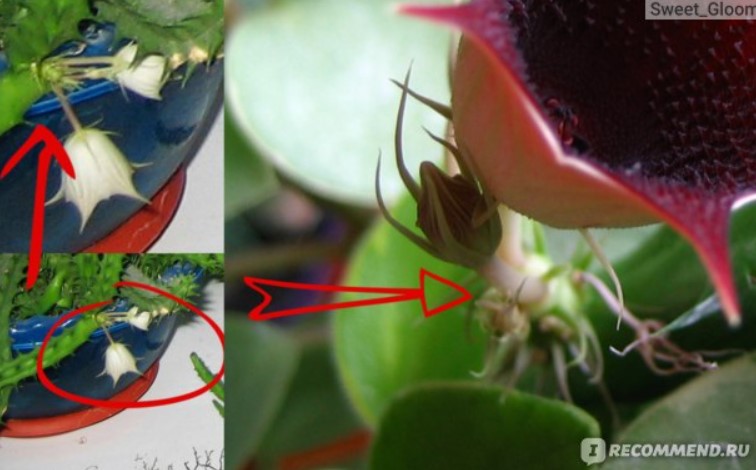
Huernia buds form repeatedly in the same spots, which eventually thicken slightly and form a kind of "flower bud" (pictured above). Even if new buds don't appear on a bud for a while, don't rush to remove it. Chances are, the bud will delight you again very soon.
Let me reiterate, this plant doesn't require any special or complex care. I've been growing it for many years in regular all-purpose soil with a layer of drainage (expanded clay or pieces of foam) in a plastic pot with drainage holes. I water it whenever the soil dries out (every 1-1.5 weeks in cold weather, a little more frequently in warm weather). I don't add any special fertilizers, but since I water it with water from the aquarium, the water already contains the fertilizer. Smile
I recommend Huernia to all flower lovers as an undemanding and responsive green friend.
Advantages
Long flowering
Beautiful bloom
Unpretentious
Sweet_Gloom
recommends
One of my favorites
I've had this plant for many years. It's one of my favorites. It's low-growing, with fleshy stems and interesting flowers. It belongs to the same family as the stapelia-lastovneve (Aspen genus). It's a very hardy and undemanding plant. It gets along well with other plants in similar growing conditions. I have it growing in the same pot with a scarlet aloe, or as a groundcover. It blooms regularly with dark-red, five-pointed flowers about 2 cm in size, firm to the touch. The flowers have a very faint, unpleasant scent, but it's only noticeable if you poke your nose into the flower. The main danger is overwatering, so water occasionally; misting isn't necessary. It grows well on an east-facing window. It propagates by cuttings. I recommend checking out this plant at flower shops.
Svetlana Yurievna
recommends