The Chinese carnation attracts attention with its lavish, elegant blooms. It came to Europe from China, as its name suggests. Wild species are found in the northern regions of Korea and Mongolia.
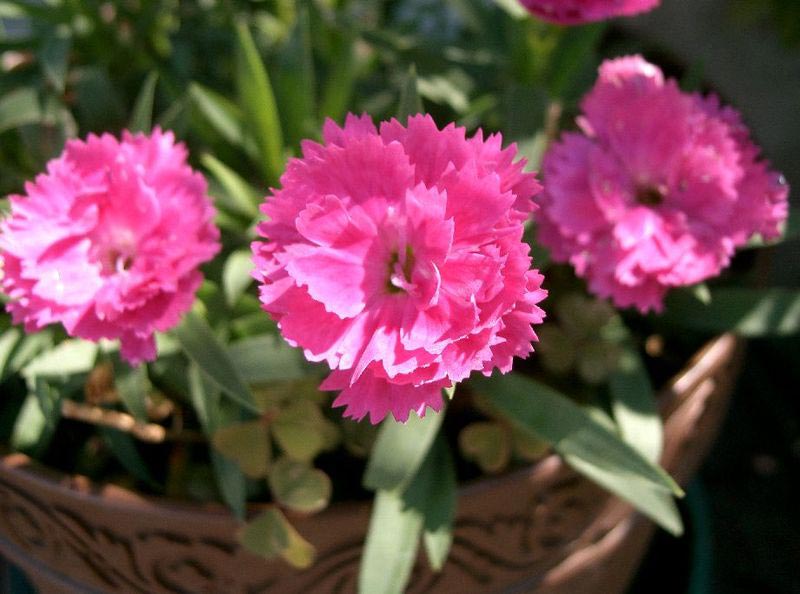
Description and characteristics of Chinese carnation
It is considered a perennial plant, but can be grown as an annual. Its characteristic features include jointed stems with narrow leaves at the nodes. Flowers in a variety of shades are borne singly or in umbels. The outer edge is beautifully serrated. Double-flowered varieties with a border are especially attractive.
Widely used in landscape design, it is planted in garden beds, rock gardens, or along paths. It does not tolerate cold, so it can freeze in winter. It is planted outdoors from seeds or seedlings. Flowering begins in July and continues throughout the summer until September, and for some varieties, until late autumn.
Popular varieties of Chinese carnation
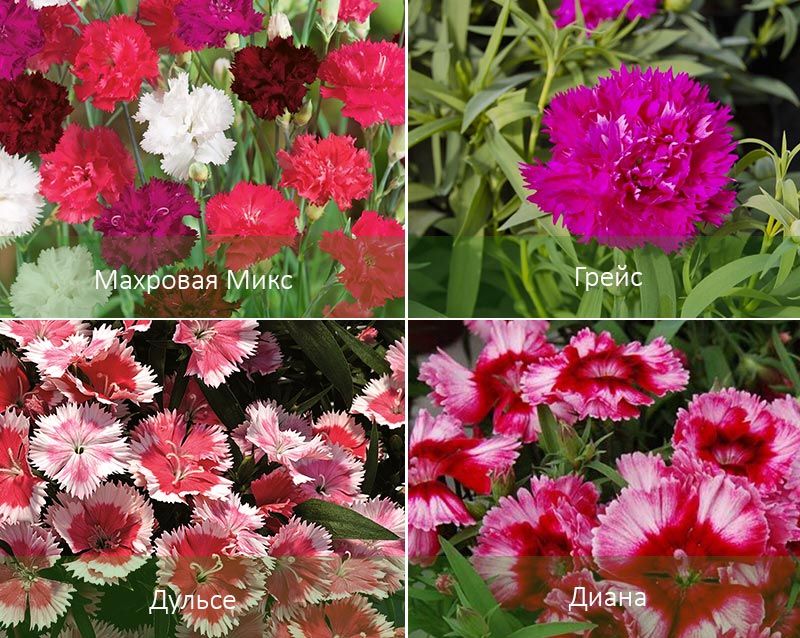
Chinese carnations have been cultivated for over 300 years, resulting in the development of a wide variety of hybrids and magnificent varieties with interesting shapes. Hobbyists prefer dwarf plants with lush blooms.
| Variety | Height (cm) | Flower | Flowering period |
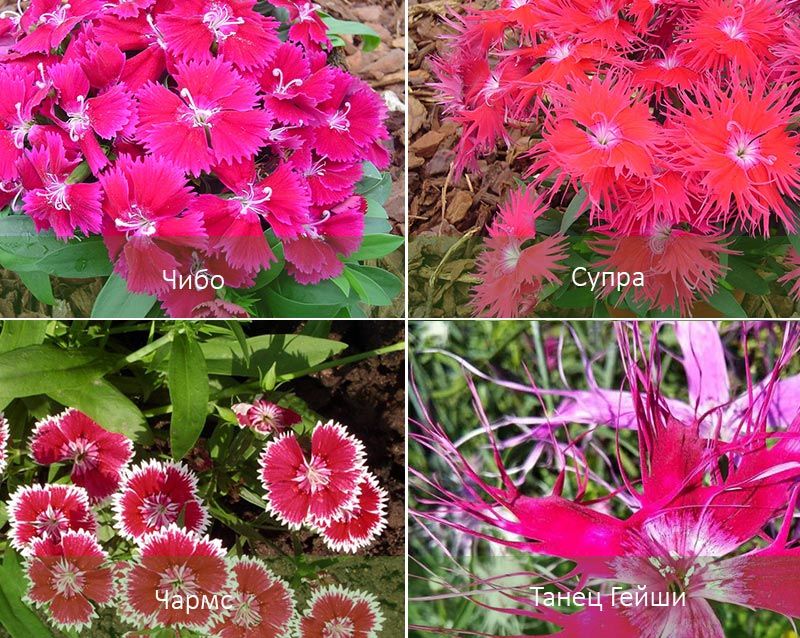
| Diana | 25 | Large, non-double, single, of varied coloring with heavily jagged edges. | July - September. |
| Geisha dance | 30 | Sturdy flower stalk, fragrant, blood-red, common. | |
| Supra | 25 | Bright, lacy, ordinary. | From July to October. |
| Grace | 30 | Fragrant, terry. | July - October. |
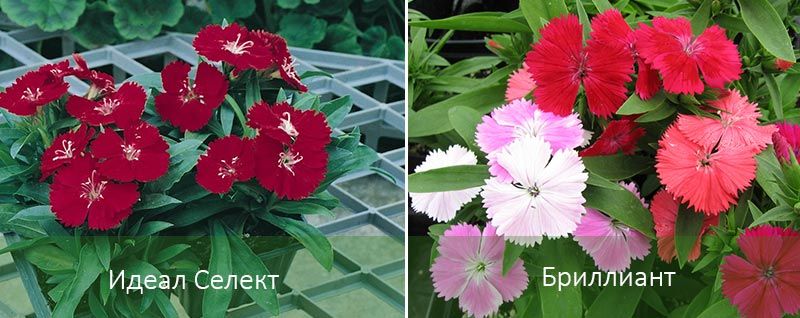
| Diamond | Purple-red, fluffy. | ||
| Tchibo | 25 | A mixture of Turkish and Chinese. | Mid-July – mid-November. |
| Dulce | Turkish velvet was mixed with Chinese. | July - October. | |
| Terry Mix | 20 | A combination of terry flowers in a variety of shades. Beautiful form, graceful serrated petals. | |
| Grace | 30 | A lilac or purple blend with a white speckled border. | Throughout the summer. |
| Charms | 20 | Semi-double, scarlet, spectacular. | From July to the end of September. |
| Carnation Chinese + Bearded Ideal Select | Interspecific hybrid, bouquet type, fragrant | Early spring - autumn. |
Planting Chinese carnation
When growing carnations in your garden, it's important to know one advantage. In the fall, they can self-seed from seeds that fall into the soil. After overwintering in the ground, the seedlings emerge in the spring and need only be transplanted.
If you plan to use carnations in your garden for the first time, you can plant the purchased seeds directly into the soil or germinate them in a greenhouse or indoors.
The second option produces a more robust plant, but it offers no particular benefit, as carnations grown from seedlings or from seeds begin flowering at roughly the same time. Planting occurs when no frost is expected. Annuals begin blooming after three months. Perennial varieties don't bloom until the following year. Beautiful flowering will only be seen if the carnations were grown in a warm location, properly cared for, and stimulated.
Sowing seeds in open soil
In the spring, after the snow has melted and the soil has warmed up well, begin planting seeds directly into the ground. This typically occurs in early May. In this case, the following technique should be followed:
- the seeds are dipped in succinic acid for 20 minutes to give them strength and provide them with the necessary substances;
- the soaked planting material is taken out and laid out on a cloth to remove excess water;
- prepare a place in the garden, loosen the soil, remove weeds and make small ditches;
- for uniform sowing, mix the seeds with loose sand and place them in prepared furrows;
- pour some soil on top, moisten it a little and cover it with covering material.
For germination, the following temperatures are required: soil temperature of 15°C and air temperature of 20°C. They should remain at this temperature 24 hours a day. After about three weeks, the first shoots will appear. Inspect the plantings, thin them out, and remove weak shoots.
Growing carnation seedlings at home
Seeds for greenhouse seedlings should be sown early, as early as April. They can be sown in fertile soil or a mixture of soil, sand, and perlite. This natural material is used for its excellent water and air permeability.
The order of work in this case is as follows:
- A drainage layer is placed on the bottom, then soil. The seeds are placed in the furrows, and soil is placed on top of them and moistened.
- Cover with glass or a special material and place in a fairly bright location. Maintain the room temperature at 20°C during the day and 17°C at night.
- It is essential to ventilate and water the plant in a timely manner.
- The cover is removed when the first thin shoots appear.
- The seedlings are transplanted into different containers after three good leaves have emerged.
- They are watering.
Care for the seedlings, maintaining the required temperature and avoiding overwatering. Before planting them in the garden, hardening them off is essential. This involves placing the containers with the plants outdoors. The period of hardening is initially short, then longer, and eventually constant, even if the temperature drops to 12°C.
To encourage lateral shoots and branching, pinch the seedlings after the third true leaf. When the soil dries out quickly, it's time to repot them into a larger pot. Plants are moved to the garden in the first half of June. The location should be open but not exposed to direct sunlight. Leave at least 25 cm between seedlings.
How to care for Chinese carnation
Planting and care are crucial aspects of this plant's development. Chinese carnations require attention not only during germination but throughout the entire growing season. Active growth and flowering require proper watering, loosening, and fertilizing.
To improve soil structure and retain moisture during the dry summer months, a layer of mulch is placed under plants and replaced periodically. This mulch will retain moisture in the soil and prevent weeds from growing.
Watering should be done carefully to avoid damaging the plants with jets of water. Watering should be done once a week; overhead watering has proven effective. Fertilizing should be done 5-7 days after planting. A complex fertilizer containing a high concentration of phosphorus is best. Apply the solution only when the soil is moist. This will enhance root development, stimulate bud formation, and increase resistance to fungal diseases.
A balanced fertilizer is used during flowering; it is desirable that it contains all the necessary substances, both basic nutrients (nitrogen, phosphorus, potassium) and microelements.
Pest and disease control
Every plant is susceptible to various pests and diseases. To prevent this, it's important to know their signs, take preventative measures, and treat them.
| Disease/pest | Manifestation | Elimination measures |
| Blackleg | It most often appears on seedlings. Dark spots appear on the stem near the soil surface, followed by rot at the neck, and the stem breaks. | Prevention: sterile soil, moderate watering, seed disinfection. In case of disease: remove the infected ones, powder the rest, ventilate and reduce the amount of water. |
| Fusarium | This condition occurs when plants are planted after or near gladioli or asters. Sunken black spots appear near the roots, followed by a brownish-pink fluff. The plants wilt, and other diseases develop. | Diseased plants are completely or partially removed and treated with a fungicide. |
| Spider mite | At first, white specks become visible on the undersides of the leaves of seedlings. The spots grow, dry out, and fall off. | Regular spraying is necessary, as mites are intolerant of moisture. Place crushed garlic in the area and treat it with an infusion or colloidal sulfur. |
| Click beetle, mole cricket, wireworm | They gnaw roots and shoots. They prefer acidic, dense soils. | The soil is limed (30 g per square meter) and wood ash is added. Weeds are destroyed. |
| Thrips, aphids | These are carriers of a viral infection. They feed on plant sap. Light streaks appear on the leaves, which later dry out. Flowers and buds are deformed. They prefer young shoots. | They need to be repelled by treating them with onion or garlic solutions. Insecticides are used for control, twice every 5-7 days. |
Propagation by cuttings
The perennial Chinese carnation is sometimes propagated by cuttings. Take a shoot that has no buds and three to four leaf nodes. Make a cut about 1 cm from the lower leaf node. Remove all the leaves, trim the upper leaves, and make several longitudinal cuts at the node. Heat the sand, let it cool, and place the prepared cutting in it. Water and cover.
Maintain constant moisture in the soil and under the cover. Roots form within two weeks. Tall carnations are not taken for cuttings. The nodes are cut, the trunk is bent to the ground, pinned, and covered with soil.
Top.tomathouse.com recommends: Chinese carnation and the secret to its popularity
This beautiful plant is easy to grow, requires little attention, and delights with its blooms almost all summer long, sometimes even longer. Its graceful form, varied colors, and spicy aroma make it a versatile plant.
The only plants that can compete with Chinese carnations in terms of use are marigolds and bulbous plants. They have one major drawback: their short flowering period.
Carnations are found in a wide variety of places: in gardens and parks, on balconies, or outdoors in special containers near the house. They adorn multi-colored or single-flowered flowerbeds and various types of front gardens. In ornamental gardening, they are planted in borders, placed on the slopes of rockeries, or in alpine gardens. They look beautiful in lawns alongside both low-growing and tall plants, in a variety of planting arrangements.