The Shabo carnation is a perennial plant. It belongs to the Caryophyllaceae family and is the result of crossbreeding. It is difficult to grow. However, if all necessary planting and care requirements are met, a rare and special flower will appear in the garden.
Content
- 1 Description and characteristics of the Shabo carnation
- 2 Shabo carnation varieties
- 3 Growing Shabot cloves from seeds
- 4 Sowing Shabo carnations
- 5 Caring for Shabo carnation seedlings
- 6 Picking and hardening Shabo carnation seedlings
- 7 Planting Shabot carnations in the ground
- 8 Caring for Shabo carnations
- 9 Pests and diseases
- 10 Shabo carnation at home
- 11 Vegetative propagation of Shabo carnation
- 12 Top.tomathouse.com recommends: new Shabo carnation hybrids
Description and characteristics of the Shabo carnation
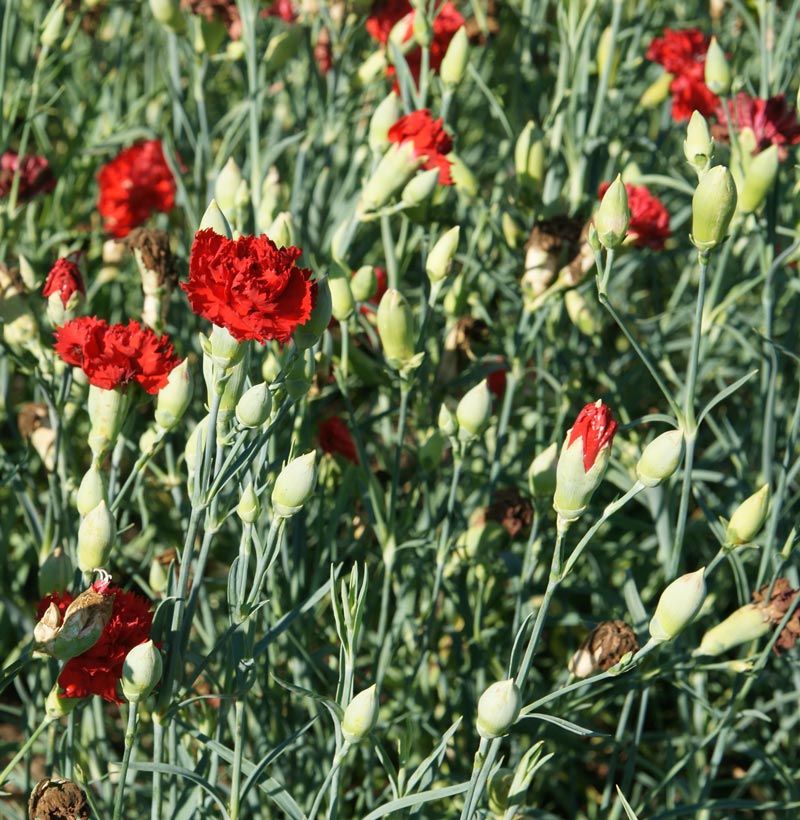
In European countries, the Garden Carnation is considered a modification of the Dutch carnation, but in Russia it is known as a distinct plant. It was first discovered in France and named after the pharmacist who brought it into existence. It is a small shrub, 40-60 cm tall, with gnarled, pale stems. These stems bear protective-colored leaves and large, delicately scented flowers. Fluffy varieties are distinguished by their fantastically shaped petals, ruffled and ribbed at the edges. They come in a wide variety of colors: red, yellow, pinkish, coral, white, and purple. The graceful and fragrant flowers are excellent for cutting and look beautiful in bouquets.
Its main quality is its ability to bloom repeatedly: all summer and fall until the first frost. Buds form year-round in southern regions. You can admire the flower for 5-10 days. If the weather is hot and dry, the petals immediately fade and lose their beauty. Pink and scarlet flowers are most susceptible to this. Seeds form 2-2.5 months after the start of blooming. The fruit resembles an elongated capsule with a thin angle at one end. It opens quickly. Each bush can produce 2.5 grams of seeds, which remain viable for planting for 3-4 years.
In Russia, it grows as an annual plant. It can overwinter in the soil, provided it is well covered.
Shabo carnation varieties
Some familiar and beautiful varieties.
| Variety | Flowers |
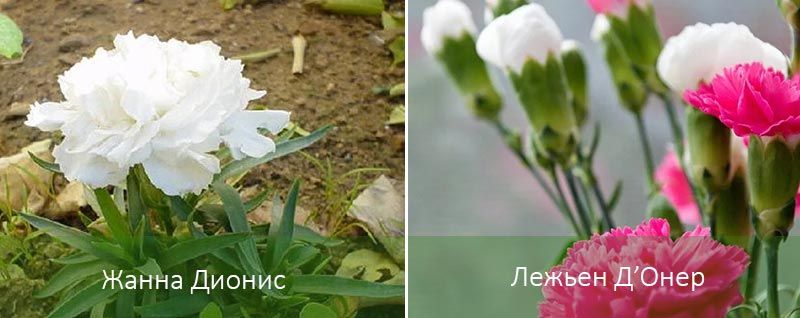
| Legien d'Aunaire | Dark cherry red. |
| Marie Chabot | Bright lemon. |
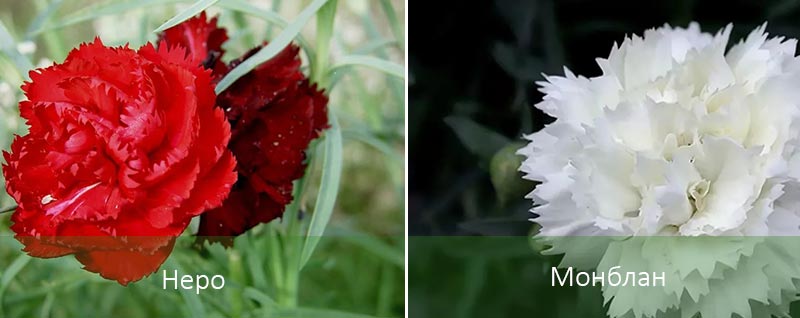
| Mont Blanc | Fragrant whites. |
| La France | Soft pink. |
| Giroflé | Interesting purple ones. |
| Ruby | Fiery. |
| Jeanne Dionysus | Large, snow-white. |
| Mikado | Lilac. |
| Champagne | Slightly golden. |
| Nero | Velvet red-black, do not fade in the sun. |
| Fire King | Bright orange. |
Today, a large number of new varieties have been developed. They haven't yet gained the same popularity as the old, classic ones.
Growing Shabot cloves from seeds
This familiar flower is propagated from purchased seeds. They are readily available and easy to acquire. Typically, 500 seedlings grow from one gram. The germination rate is 80-95% and lasts for 2-3 years, so seeds are purchased in advance. Collecting them yourself is quite difficult. For ripening, warm, cloudless weather without precipitation is required for an extended period. This period lasts 1.5-2 months. To collect all the seeds, the fruits are wrapped in a light-colored cloth and observed. When ripe, they fall off immediately.
In areas with cold autumns, flowers are transferred to a location where suitable conditions can be provided to obtain seeds.
Sowing Shabo carnations
The time to sow seeds for seedlings is determined by the beginning of flowering in summer. Therefore, Shabo is planted between January 10th and February 28th. Sowing for seedlings is not done earlier. Growing them requires specialized equipment, which is often unavailable. Before planting, preparation is necessary: fry the sand for covering; the seeds are not treated, but sometimes they are moistened with a diluted growth stimulant; the soil is not sifted. Fill the prepared container with soil, level it, and water it. Use a lightweight base made of two parts sod (garden) soil, manure, and peat, and one part sand. The container should be 5-6 cm high and have drainage holes. Use tools to make 0.3 cm deep depressions with a distance of 3 cm between them. Place each seed separately in a 1 cm section, cover with sand, and cover with glass or special film. Condensation may form. It is absolutely necessary to delete it.

Caring for Shabo carnation seedlings
Caring for seedlings is quite challenging: they need to be kept at a comfortable humidity level and pinched at the appropriate time. Furthermore, the following steps are essential:
- maintain a constant temperature of +12…+15 °C;
- create better lighting, and turn on additional lighting for a few hours;
- provide ventilation in warm weather;
- pinch off the tops when the fifth pair of leaves forms to increase branching;
- prevent overwatering, water only to maintain humidity;
- carry out foliar feeding with saltpeter.
Plants may show signs of disease (blackleg, weakening). It's best to remove such seedlings and treat the soil with a mixture of sand, ash, and crushed charcoal.
Picking and hardening Shabo carnation seedlings
Carnations need to be pricked out twice:
- For the first time, a pair of whole leaves has formed. Transplant into a container approximately 4 cm in diameter.
- The second time is at the very end of March, when four pairs of leaves have formed. Use pots with a diameter of about 10 cm.
The planting depth remains unchanged. If the plants have grown significantly, you can increase it by 2 cm. After the fifth leaf appears, pinch them back. If growth is slow or the color is pale, apply a light fertilizer. Hardening off begins after all transplanting. This can be done using various methods:
- Place overnight in a cool room, where the temperature should be 10°C lower.
- In warm weather, greenhouses can be used, but only if no frost is expected overnight.
- It can be moved to an open area during the day, but it must be sheltered from the wind. It should be returned at night.
Planting Shabot carnations in the ground
Planting in open ground is almost always done in early May. Hardened seedlings don't require special warmth, and short-term cold temperatures of -3°C (33°F) are fine. It's best to choose neutral or slightly alkaline soil. The site should receive plenty of sun. They won't thrive in sandstone or clay soil. Prepare the soil in advance in the fall: dig it up, add 45g of phosphate, and 20kg of compost or manure per square meter. In the spring, apply fertilizers containing nitrogen (15g) and potassium (25g) per square meter. Seedlings are thoroughly moistened, then carefully removed along with a clod of soil and placed in prepared holes. The root system is left at the same level. Plants are spaced at a rate of 16 per square meter.
After planting, be sure to water thoroughly.
Caring for Shabo carnations
Achieving a beautiful flower requires a lot of effort. Caring for it requires the following steps:
- regular watering to maintain a slight dampness;
- gentle weeding and loosening;
- adding fertilizers to the soil: first nitrogen (15 g per m2), a week after planting, when the ovary appears - ammonium nitrate and potassium sulfate (10-15 g per m2);
- no use of biological additives;
- securing tall plants to prevent them from breaking;
- constant monitoring of appearance;
- carry out preventive measures to protect against diseases and pests.
Planting in the same area for more than two years is not recommended. Avoid planting too close together. To ensure vigorous flowers, side-shoots should be removed, removing all ovaries and branches up to the sixth node, leaving only the central bud. Removing spent buds promptly will extend the flowering period. In cold autumns, growth activity decreases, and bud opening continues at a slow pace.
Pests and diseases
Proper and timely care of the Shabo will prevent the development of various diseases, or they will only occur occasionally. If the weather is rainy, fungus may appear. Affected plants are then removed, and the remaining ones are treated with copper-containing solutions.
They are damaged by sap-feeding insects, such as aphids, mites, and thrips. Characteristic signs include stunted growth, changes in appearance, and an unattractive appearance. These pests can also transmit viral diseases. To save plants with a small number of pests, spray them with an infusion made from onion skins or garlic cloves. You can also prepare a solution of soap containing no more than 72% fatty acids, or 8-10% birch tar. Insectoacaricides (Actellica, Aktar, Karbofos) are diluted and sprayed if the insect population increases.
Shabo carnation at home
Shabo is a garden plant that typically doesn't grow indoors. It can be transplanted into a container in the fall and moved indoors. Provided the same conditions are observed as for growing seedlings (good light, cool conditions), Shabo will continue to delight with its blooms for some time. Carnations preserved this way are used in the spring for preparing cuttings.
In indoor climates, it is better to give preference to varieties such as Chinese, hybrid or Turkish carnations.
Vegetative propagation of Shabo carnation
Propagating hybrids by seed is far from perfect. Plants produced this way may vary in color and lose their doubleness. Therefore, vegetative propagation is used as an alternative to reproducing rare varieties.
In the fall, the bush selected for propagation is potted and brought indoors. Choose a well-lit, moderately warm location (10 to 12°C). In the spring, cuttings are taken from the plant, 3-4 internodes long, and placed in water for rooting or in sand that has been pre-heated and moistened. After 1-1.5 months, roots will appear, and in early summer, the plant is planted in the garden.
If planted and cared for properly, buds will appear within a year. Some gardeners take and root cuttings in the fall and grow them indoors over the winter. This is a complex method that requires a lot of effort and expense, so it's rarely used.
Top.tomathouse.com recommends: new Shabo carnation hybrids
In addition to the old, well-known varieties, new ones are being developed. Some of the more familiar ones include: Picotee, Watercolor, Disco, Giant Terry, and Lyon. They are distinguished by a shorter time between the emergence of the first shoots and the onset of flowering. Seeds can be planted much later, without the need for additional lighting. These varieties are still poorly studied, so cultivation is recommended for professionals.
The Luminette Mix (tall) and Night Series (low) varieties bloom for almost seven months, with up to 35 flowers appearing on a single bush. These compact hybrids are perfect for adorning balconies and flower beds. Varieties suitable for indoor cultivation have also become available. When choosing a flower for planting for the first time, it's best to stick with the classics and select only the bud color, as they require roughly the same care. Experienced gardeners can experiment with new hybrids and varieties.