Dianthus ssp. is a perennial groundcover plant. Its name comes from two Latin words, "dios" and "anthos," meaning "divine flower." It belongs to the herbaceous genus Dianthus, family Caryophyllaceae. Growing from seed is one method of propagating plants indoors.
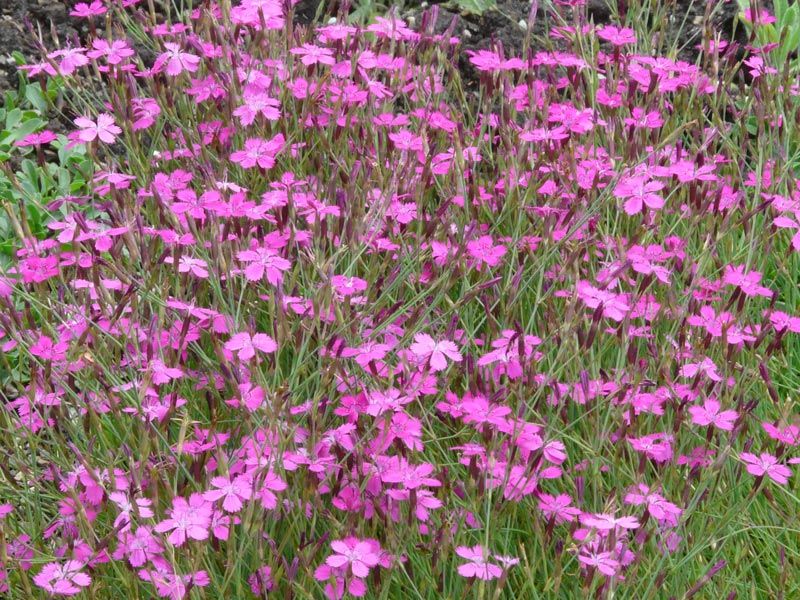
Description and characteristics of the carnation species Travyanka
The flowers are typical of carnations—widening smoothly from the base to the serrated edges. The capsule, where the seeds are formed, is located between the petals. This plant species easily takes root on slopes and elevated surfaces thanks to the unique structure of its root system. The grass grows in all directions, allowing it to maintain its footing in such soils. It is found in India and Europe, and can also be seen near rivers and in the steppes.
The advantage is that the plant is quite resistant to diseases, but sometimes young bushes suffer from insects and rodents.
Varieties of Travyanka carnation: characteristics of varieties
The table presents data describing the characteristics of each type of Dianthus herbaceus:
| View | Height, cm | Description | Flowers, flowering period |
| Wild-growing | |||
| European | 20-40. | The leaves are dark green. The plant lives for approximately 6-9 years. It tolerates temperatures down to -40°C. Propagation is by seed and layering. It is resistant to pests and diseases. | Five petals spread out from the base, with jagged edges. The flowers come in red, bright pink, and purple. The flowers, which contain numerous seeds in the center, are always gathered in clusters. |
| Siberian | |||
| Indian | |||
| Selective | |||
| Diamond | About 15. | It has a cushion-shaped form and is a fast-growing plant. The leaves are oblong, narrow, and dark green, with a white bloom. It prefers open, moderately moist, sunny locations. This variety of Dianthus scaly-leaved carnation is resistant to temperatures down to -35°C. |
Flowers are cherry red. Mid-June – early October. |
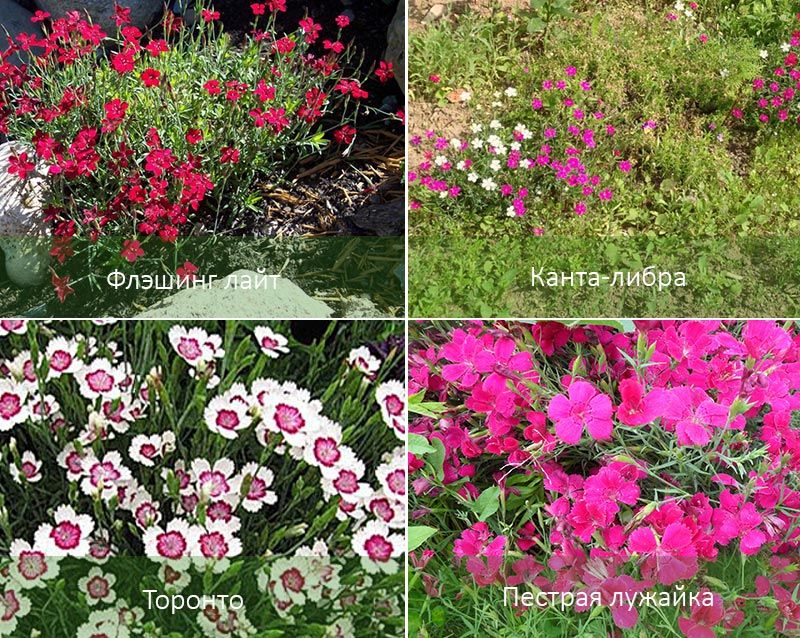
| Toronto | Compact bush up to 15. | Prefers non-acidic soils and does not tolerate excessively wet conditions. The ideal temperature for seed germination is 14–15°C. It is not tolerant of cold weather. Removing spent flowers promotes further growth. |
Five white feathery petals gradually expand from the middle to the outer part of the flower, with a raspberry-red border inside, which is typical for some varieties of Dianthus travinas. June – August. |
| Variegated lawn | About 17. | The ideal temperature for good growth is 15 to 19 °C. The soil should be non-acidic and well-drained, allowing water to drain through the holes in the pot rather than remaining in it for long periods. | The color is white, pink and red. June – August. |
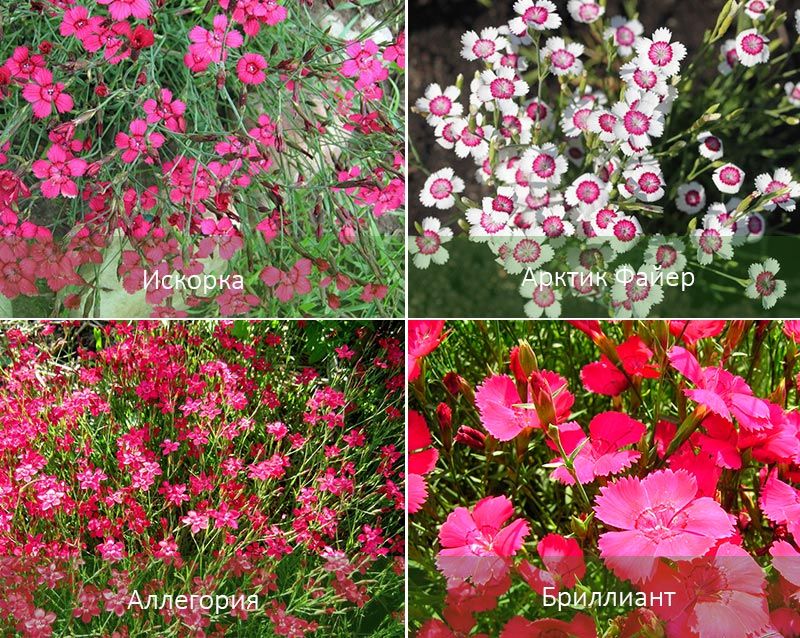
| Allegory | 20-25. | A perennial species of Dianthus ssp. It has knobby stems that often branch at the top. Almost the entire plant is covered with a bloom. It is grown by sowing in open ground; the first shoots appear after seven days. |
Carmine-red flowers, 1.0-1.5 cm in diameter. June – August, after which it is recommended to cut off the flower stalks. |
| Flashing Light | 40. | The stems, like the leaves, are covered with fine hairs along their entire length. It prefers loamy garden soil containing clay and sand. | The petals are sharply toothed and dark pink in color. June – September. |
| Canta Libra | Low - from 10 to 15. | Rapidly multiplying. Resistant to sub-zero temperatures. Grows well in sandy loam, moderately moist soils. |
Graceful and large flowers in dark red shades. Beginning of June – end of September. |
| Sparkle | Up to 25. | An undemanding plant, it thrives in open, sunny locations. The leaves are narrow and covered with a grayish coating. | Flowers are a soft pink. Requires little care. Mid-July – end of September. |
| Arctic Fire | 20-25. | It's one year old. It loves light, is drought-resistant, and tolerates severe frosts well. This variety of Dianthus herbaceus is often used in landscape design, planted under conifers. |
The flowers are large and have a pleasant aroma. The color is white and red. June and September. |
| Dolly doll | 18-20. | An annual variety. A cold-hardy plant, it prefers sunny locations and non-acidic soil. |
The diameter of the white-red flowers is 4–6 cm. July – beginning of October. |
Features of caring for the Grasshopper
Caring for the plant isn't burdensome or difficult. Considering the fact that the grass carnation is quite undemanding, it's important to avoid growing it in waterlogged soil (otherwise, the roots will rot, which in turn will promote fungal diseases). It's also very important to apply phosphorus, magnesium, nitrogen, and calcium fertilizers depending on the season.
Planting Dianthus Travyanka
Planting is one of the most important steps in growing this flower. Although most varieties of Dianthus are perennials for outdoor use and require little care (an example of such a variety is Allegory), they do need to be replanted every 3-4 years.
This is necessary in order to preserve the decorative properties of the flower, namely: the presentable appearance of the plant, since the bush grows chaotically and the decorative role disappears.
This plant prefers dry, non-acidic soil. Before planting, clear the soil of weeds, and soak the seedlings in a chemical solution to protect against pests and diseases. If the gardener decides to plant the carnation in waterlogged soil, it's a good idea to add limestone and sand.
Growing Grasshopper from Seeds and Seedlings
Both annual and biennial varieties are grown from seed. Since the plant is frost-hardy, the seeds can be sown before winter, resulting in the grass sprouting as early as mid-March. If sown during the warmer months, the best time is from April to the end of May. Carnations will thrive only in loose, slightly elevated soil—this is because this type of soil never retains water, which is beneficial for the plant's growth.
When planting Dianthus herbaceus, some disadvantages of growing from seeds should be taken into account:
- The seed size is too small to ensure uniform sowing.
- In spring, due to constant temperature changes, weeds grow very quickly, absorbing everything they need for growth from the soil.
Grasshopper seedlings are very fragile and delicate, so they should never be planted before frost—the bushes simply won't survive. Seedlings are usually planted in long furrows or holes.
It is recommended to plant seedlings in groups of 6-8 in open ground, spaced 15 to 30 cm apart.
Vegetative propagation of plants
Dividing the bush is one method of propagating Dianthus sphaerosa. The flower grows, exposing its center, after which it must be dug up and divided into smaller bushes. The next step, which will ensure the Dianthus sphaerosa thrives, is planting the seedlings in the soil, where they will eventually grow. They require little care, other than watering and loosening the soil around the bushes to enrich the soil with oxygen.
Disease and pest control
| Disease/pest | Manifestations | Elimination measures |
| Alternaria | Formation of brown spots and dark green plaque on leaves and stems. | The plant dies because this disease is not treatable. |
| Fusarium | Brown coloration on the stem. Yellow spots appear on the leaves, causing them to dry out. | It's recommended to add lime to the hole. Keep in mind that the plant will be saved, but flowers will no longer bloom. |
| Rust | Reddish-brown swellings on the leaves. | The affected parts must be cut off, and then the grass carnation must be treated with fungicides (chemicals for combating fungal diseases). |
| Thrips, mole crickets | Deformation of leaves, appearance of brown or brown spots. | Excessively damaged areas should be cut off. The top layer of soil should be replaced, as it may harbor thrips larvae. The next step in saving the plant is spraying it with chemicals. |
| May beetle, cutworm, rodents | Eaten marks on the leaves and stems of the plant. | If the grass carnation has suffered minor damage, treat it with fungicides. However, if the plant is damaged more than 50%, it cannot be saved. |
Top.tomathouse.com recommends: the medicinal properties of cloves
The most common use of clove is as a hemostatic agent (blood stopper). There are two main methods of using this plant medicinally: internally and externally.
It is an excellent folk remedy for:
- high temperature (as an antipyretic);
- burns;
- heart pain and migraines;
- internal bleeding;
- edema (as a diuretic).
https://www.youtube.com/watch?v=zQ3QyfK-PpM
Recommended for external use for:
- bruises;
- joint pain;
- scratches, wounds (as a healing agent);
- skin diseases, including those on the face (acne, dermatitis, etc.).