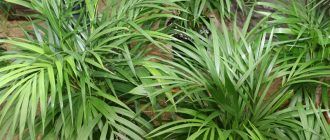
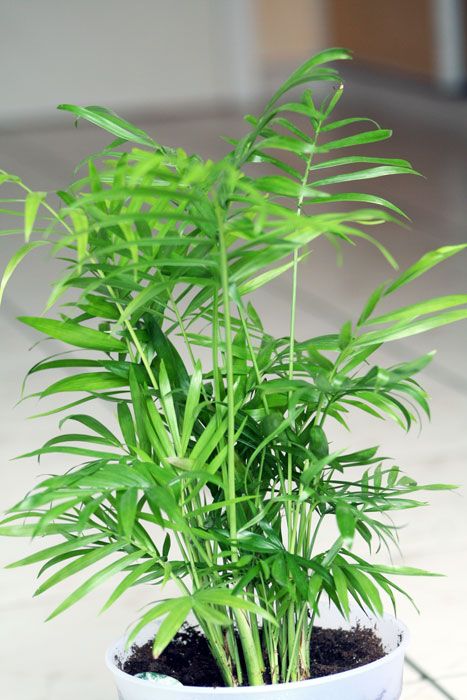
Chamaedorea is a dioecious plant of the palm family. It was first discovered on the forested mountain slopes of South America. In the wild, the palm grows to a height of 2-3 meters, with slender, bamboo-like stems, which is why it is sometimes called the bamboo palm.
In its native land, the unopened flowers of the Chamaedorea are used as food. Its name, translated as "gift close to the ground," refers to its small size and the availability of its fruits.
Content
Description of Chamaedorea
Indoors, bamboo palms grow very slowly and rarely reach a height of more than 1.5 meters. Each stem has only one terminal bud, which must not be allowed to die. The leaves are entire or dissected, ranging from light green to emerald; some species have blue-green foliage. Flowers are borne in panicles.

The plant is unpretentious, prefers partial shade to bright sun, is small in size, and its decorative foliage serves as an original decoration and helps purify the air.
Types of Chamaedorea for indoor growing
| View | Description |
| Chamaedorea Elegans (Neantha) | Suitable for beginning gardeners. The leaves are located on long petioles. |
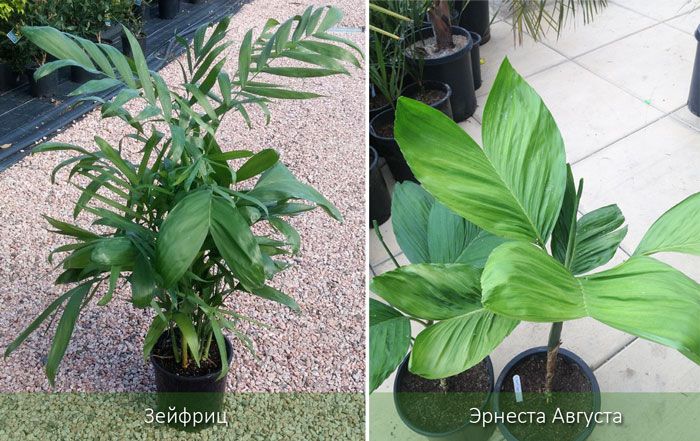
| Seifritz | It doesn't require much watering. The stems resemble bamboo. |
| Ernest Augustus | What distinguishes this palm tree is its solid leaves with serrated edges. |
| Metal | Beautiful metallic sheen of the leaves. |
| Monochrome | Green long dissected leaves. |
Home care
| Time of year | Location, temperature and lighting | Humidity and watering | Top dressing |
| Spring | Warm place, +16…+20°C, diffused lighting and partial shade, possible placement near a window. | Water and mist once a week. The water should be warm. | Granular fertilizers twice a month. |
| Summer | Can be placed on a balcony or in a garden in partial shade, +20…+25°C. | Abundant watering and spraying twice a day. | |
| Autumn | Warm place, no drafts, +16…+22°C, partial shade. | Spraying and watering once a week. | Reduce feeding. |
| Winter | A warm place, without drafts, +15…+18°C, but not below +12°C, diffused lighting. | Spraying and watering are moderate. | Avoid fertilizing (from October to February). |
Selecting a container, soil, and replanting
The main requirement for repotting a Chamaedorea is for the roots to completely fill the pot. If this doesn't happen, you can add a little more soil.
It's best to repot your Chamaedorea in the spring. The pot should be a few centimeters taller than the previous one. To prevent root rot, good drainage (pebbles, expanded clay, or tiles) is essential. A stable, ceramic pot is ideal.
The soil for the plant should be light. Its composition (2:1:2:2):
- Peat.
- Sand.
- Leaf soil.
- Humus.
- Vermiculite, coconut chips to lighten the soil.
Leaf soil and humus must be disinfected.
Reproduction of Chamaedorea
There are three ways to propagate a plant.
Seeds
This is one of the most time-consuming and labor-intensive methods. Several conditions are essential: the seeds must be freshly harvested, stratification is necessary (partial destruction of the outer seed coat, which can be done with a sharp object), and the Chamaedorea will thank you for good care at home.
Pre-soaked palm seeds should be placed in plastic 200-gram containers with nutrient soil, slightly deepening them (1-2 centimeters). There is no need to sprinkle them with soil; they should be covered with glass or film.
Make sure the soil doesn't dry out. Remove the glass or film daily to allow air to enter.
After 5-6 months, the chamedorea will produce its first shoots, which need to be replanted as they grow.
Dividing the bush
Well-grown, mature Chamaedorea plants are suitable for this method. Carefully remove the palm from its pot and untangle the roots. Cuttings with three or four well-developed roots are suitable for separation. Plant 5-6 of them in a single pot, cover with plastic wrap, and provide comfortable conditions. Remember to water and mist regularly.
Propagation by basal shoots
A well-developed, mature plant is suitable for this method. Carefully separate the shoot with formed roots from the mother plant, transfer it to a pot with good drainage and nutritious soil, cover with plastic wrap, and leave it in a warm, bright place, ensuring regular watering. This is best done in early spring.
Care errors and how to fix them
Chamaedorea is easy to care for and low maintenance, making it suitable for even the most novice gardener. By following the proper growing practices and taking timely preventative measures, many problems can be avoided.
| Visible damage | Reasons | Elimination |
| The tips of the leaves are drying out. | Insufficient watering or hard water. | Water only with soft water, increase its volume. |
| The appearance of light spots on the leaves. | Micronutrient deficiency. | Add magnesium and potassium to the water. |
| Small foliage. | Lack of light and fertilizers. | Move to a bright place, add fertilizer to the water. |
| The color of the leaves is light yellow. | Direct sunlight, iron deficiency. | Move the palm tree to a shaded area and water it with iron-containing fertilizers. |
Diseases and pests, their control
Diseases and pests weaken plants, interfere with normal growth, and reduce their decorative value. Therefore, preventative measures are essential, and if a disease develops, immediate action is taken to eliminate it.
| Disease/pest | Symptoms (on leaves) | Prevention and treatment |
| Spider mite. | Web. | Spray more frequently. In case of severe infestation, use acaricides and insectoacaricides. |
| Mealybug. | The discharge is sticky and pale green. | Wash off the pests with soap and water; in severe cases, treat the chamedorea with Vertimek. |
| Thrips. | Black drops. | Use insecticides Aktara and Confidor. |
| Root rot. | They are falling off. | Repot the plant. Water with solutions of Khometsin and Kuprozan for 10 days. |
| Stem rot. | White coating. | Destroy the plant and pot if the infestation is severe. |
Top.tomathouse.com recommends: Chamaedorea – a boost of energy and optimism
The bamboo palm is a beautiful, elegant plant. With careful and attentive care, it can harmonize the environment, delight with its graceful foliage, and cleanse the air in the home.
According to folk beliefs, the Chamaedorea palm eliminates negative energy in the home. Unfriendly people don't linger in its vicinity, and there's less noise and bustle. The palm promotes concentration, lifts mood, and elevates vitality.
A room where a Chamaedorea grows makes breathing easy and work productive. If you have these bamboo palms in your home or office, all your projects will be completed on time.