The palm tree is native to Madagascar and Colombia. Some species grow in Spain and southern France. Its uses range from food to construction. It is also a beautiful ornamental plant.
The palm family comprises over 100 genera, including the coconut palm, saw palmetto, date palm, and Bismarckia palm. Their large, glossy, fan-shaped leaves create a very exotic and expensive look indoors. The palm is a symbol of wealth and joy, demonstrating its owner's good taste.
Content
- 1 Palms and false palms
- 2 Choosing a palm tree for home cultivation
- 3 What types of indoor palm trees are there?
- 4 Types of indoor palm trees
- 5 Maintaining and caring for indoor palms at home
- 6 Transplanting palm trees
- 7 Caring for Palm Leaves
- 8 Propagation of indoor palm trees
- 9 Diseases and pests of palm trees
- 10 Beneficial properties of palm trees
Palms and false palms
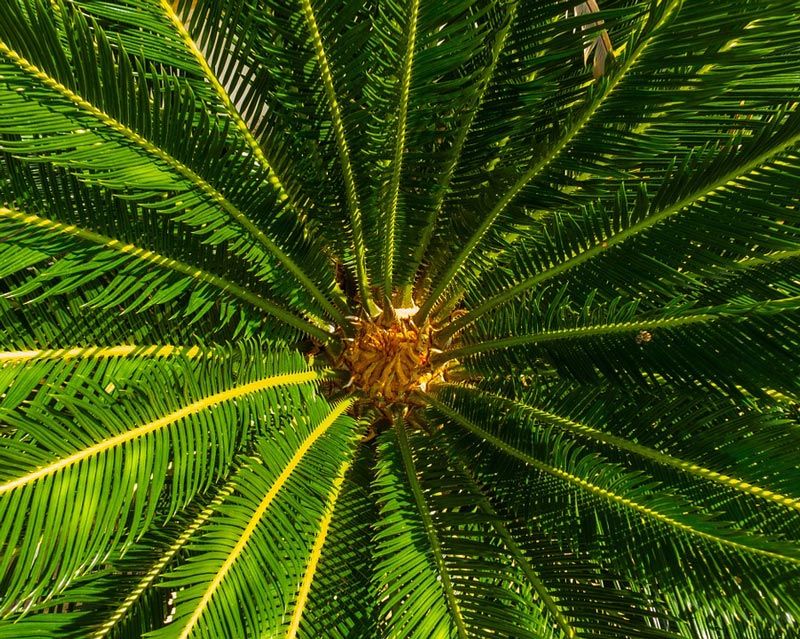
Not every plant that resembles a palm tree is a palm species. Not all indoor plants with spreading, fan-shaped foliage and a central trunk are members of the Arecaceae family. Such pseudopalms include yucca, dracaena, nolina, and cycas. True tropical beauties lack a trunk and a crown, consisting of leaves of various types and shapes.
Choosing a palm tree for home cultivation
Don't buy a palm tree from a catalog, as this won't allow you to fully assess its condition. To ensure your plant brings you joy for as long as possible, or at least prevents it from spreading any plant diseases to other palm trees, it's best to buy it from a specialist store or nursery.
When choosing, pay attention to the flower's condition. The following signs should alert you:
- completely or partially dry leaves;
- the presence of an unpleasant musty smell;
- a plant that is too elongated (usually this happens due to a lack of sunlight);
- stickiness of leaves or growths on them is a sign of disease;
- abnormal leaf size or damage to the leaf surface, which occurs due to a deficiency of micronutrients.
When purchasing a flower, it's best to choose a cutting or a small, sturdy specimen—a young plant adapts better to environmental changes. An adult plant, exposed to unfamiliar conditions, may become ill or even die.
What types of indoor palm trees are there?
There are many types of palms suitable for indoor cultivation. They differ in the structure of their branches and the presence or absence of a trunk. Fan-shaped and pinnate branches are categorized by their shape. The leaves of fan-shaped palms are attached at a single point on the petiole, forming a sort of umbrella. Palms with fine, delicate foliage are called pinnate. These foliage is located along the stem on both sides.
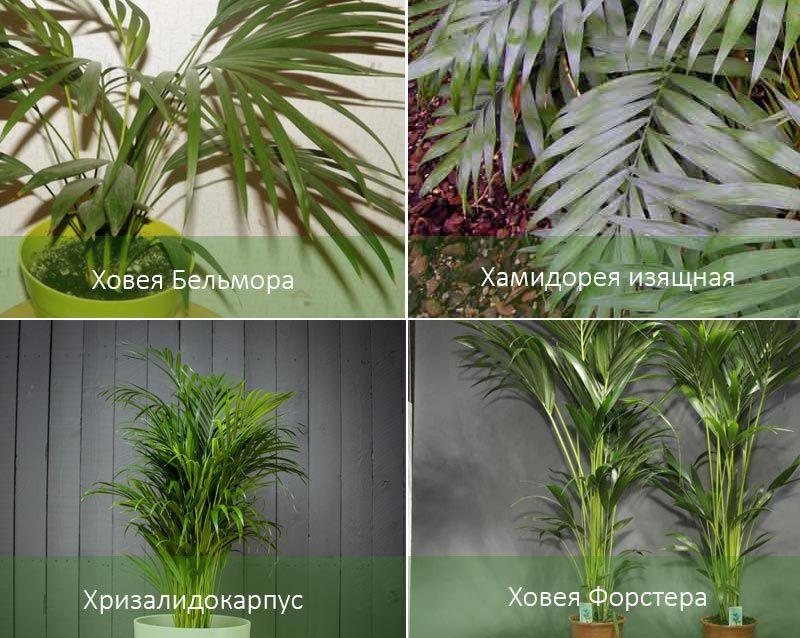
Typically, indoor palms have the appearance of a bush, which over time can develop into a single trunk, but this happens extremely rarely.
Types of indoor palm trees
| Types | Description | Care Features |
| Howea Forster | Dark green, leathery leaves adorn the trunk. In the early stages of growth, the branches appear to "shoot" out of the ground, but over time, they grow larger and bend under their weight, creating a framing effect. | It can adapt even to low-light conditions, although it prefers bright, diffused light. The flower loves heat and prefers abundant watering and fresh air. |
| Howea belmoreiana | It grows slowly. With proper care at home, it can reach a height of about 3 m. The trunk is slightly thicker at the base, and the leaves differ from those of the Howea forsteriana—they are narrower, smaller, and curved. The petiole is short, reaching up to 45 cm.
The branches are arranged vertically and are rarely spreading. |
It loves warmth, light, and water. Moisture is essential for normal growth.
Timely, uniform watering and spraying are the secret to the health and beauty of the plant. |
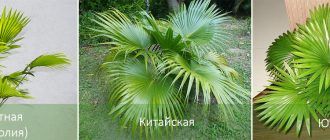
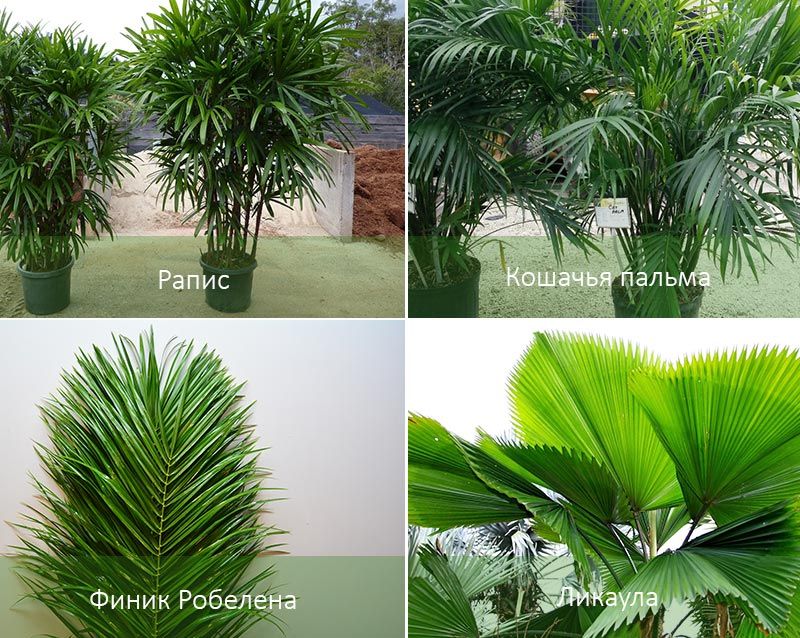
| Likaula (parasol palm) | It grows up to 2 m. The trunk is slender. Beautiful, impressive, large leaves resemble a fan. The surface of the foliage is corrugated and folded. | It's somewhat fussy about water: it enjoys watering and misting, but overdoing it can cause root rot. To prevent root damage, add alcohol to the misting water. |
| Chamaedorea graceful (bamboo palm) | The trunk consists of dead leaves. This palm is called graceful for a reason: in just a few years, it grows to just 1.2 meters.
The leaves are pinnate, oblong-elongated in shape. |
This heat-loving plant is fussy—it dislikes direct sunlight, but it does require warm conditions. The optimal air temperature is at least 18°C (64°F). It requires ample watering. |
| Cat palm | It can be recognized by its cascade of spreading, delicate foliage. | It is easy to care for and loves spraying and warm temperatures. |
| Caryota | Belongs to the pinnate family. It is distinguished by its striking asymmetrical, carved leaves, lush foliage, and compact size: indoors, it reaches no more than 2 meters in height. Some species, such as Caryota spp., have a single trunk. Others, such as Caryota spp., are bush-shaped. | Hardy, heat-loving, but defenseless against direct sunlight.
It is important to follow the watering and spraying regime for greenery. The root system should not be overheated; it is better to place the pot with the plant on the floor. |
| Date Robelena | An indoor tree 2.5-3 m tall with a thin, knobbly trunk, framed at the top by a tuft of lush leaves. These are pinnate, curved on a short petiole, and can reach 1 m in length. The color ranges from dark green to greenish-silver. | Prefers moderate temperatures, sunlight and regular watering.
To prevent dryness of the greenery, the plant should be sprayed daily. |
| Rapis | Rhapis dwarf grows up to 1.5 m. This variety is more popular among gardeners.
Rapis alta is commonly used to decorate the interiors of shopping and office centers. A cluster of tubular, bamboo-like stems. The leaves are shiny, stiff, and fan-shaped. The leaf blade is dissected into 7-8 lobes. |
The optimal temperature is +20…+22°C. It prefers filtered light or partial shade. Water regularly to avoid stagnant water and dry soil. Misting is recommended during the summer. |
| Chrysalidocarpus | A single-stemmed or bushy plant with tall shoots. Belongs to the pinnate palm family. The foliage is lush and light. | It tolerates heat well, but direct sunlight can damage the delicate foliage. It dislikes drafts. For uniform growth, the crown should be rotated 180° every 1-2 months.
Prefers high humidity and abundant watering. |
Maintaining and caring for indoor palms at home
Despite the variety of palm tree species, when caring for any of them, you should follow the following general principles:
- No drafts.
- Average temperature - the palm tree does not like heat and cold.
- High-quality drainage. To prevent water stagnation in the soil, you can use coarse crushed stone or expanded clay.
- Water thoroughly with room-temperature water. Water generously in summer and sparingly in winter. The soil should be moist but not soggy. After watering, it's best to loosen the soil.
- Protection from direct sunlight.
- High humidity. Use a humidifier in the room and don't forget to mist and wipe down the air regularly.
Transplanting palm trees
Repotting is necessary every 2 or 3 years (depending on the species). If the plant is large and repotting is not possible, change the top layer of soil annually, but be careful not to damage the roots.
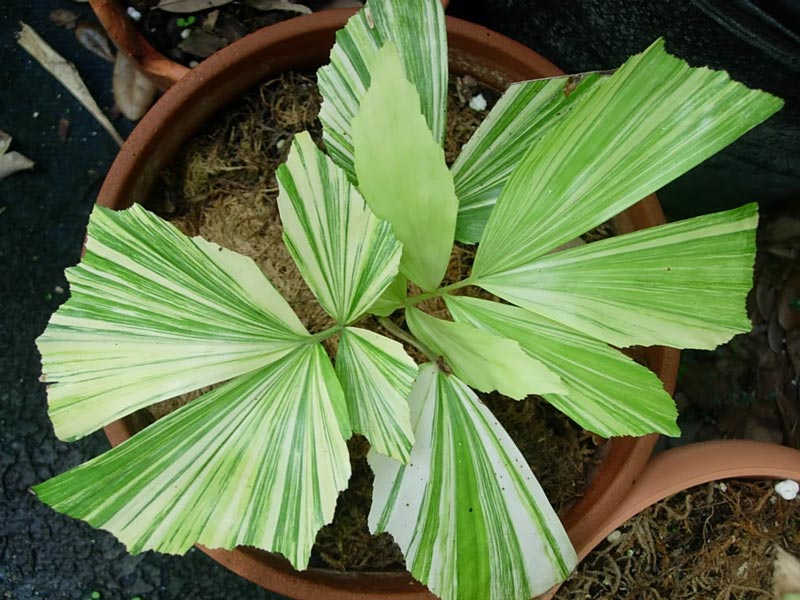
A layer of expanded clay at least 2 cm thick should be placed on the bottom of the tub. It is best to choose tall flower pots that match the size of the indoor tree.
Light soil is best for young plants. For mature plants, dense soil with a slight clay content is best. Immediately after transplanting, the palm should be kept in the shade for better adaptation.
To ensure your palm continues to delight those around you for as long as possible, it should be fed with organic fertilizers or mineral supplements during the spring and summer.
Caring for Palm Leaves
When caring for leaves, you need to adhere to the following rules:
- Careless wiping, removal of wax coating, and pubescence is unacceptable - the crown of the palm will acquire an unpleasant brown tint and an unsightly appearance.
- The plant enjoys showers and generous misting, but only with warm water. Water treatments are an effective preventative against spider mites. Before washing the palm, cover the soil with plastic wrap to prevent overwatering.
- Don't interfere with the natural dying of foliage. If a leaf begins to turn yellow, wait until it dies completely before trimming it.
Propagation of indoor palm trees
Palms such as Chamaedorea and Caryota produce basal shoots and have a bushy growth habit. This allows for vegetative propagation using root suckers.
Other plant species, such as licuala and howea, can only be propagated by seeds; this method is considered the most labor-intensive.
Diseases and pests of palm trees
| Disease / pest | Manifestation | Treatment |
| Rotting roots | Active yellowing and then darkening of leaves. | Possibly only at an early stage. Remove the diseased plant from the pot, remove any rotted roots, and soak it in a fungicide for 20 minutes. Then replant it in a new pot with steamed soil. Afterward, water with a fungicide for the first few days. |
| Stem rot | Dark spots on the leaf blade with a whitish coating. | Remove infected leaves and treat with a fungicide. Replant in steamed soil.
In addition, you can use folk remedies - an infusion of horsetail or an aqueous solution of laundry soap. |
| Fungal infection | Round spots of various shades (brown, yellow, gray, light green). | Remove affected leaves, treat the flower with an alkaline solution, and spray with a fungicide.
Since infection can be caused by overwatering, hypothermia, or too-dense soil, eliminate any of these by organizing proper plant care. |
| Spider mite | The insect is very small and difficult to spot. It comes in a variety of colors (green, red).
A thin web is visible on the underside of the leaf. Light yellowish spots cover its entire surface. The plant dries out quickly. |
Treat with anti-tick preparations (Actellic, Neoron, etc.). Folk remedies include onion or garlic infusions, or a solution of water and laundry soap. Spray once a week until the mites are completely eliminated, using products such as Sanmite or Actofit. |
| Mealybug | It has a white oval body and lives on petioles, in the veins, and in the ovaries of young leaves.
The palm tree's growth becomes slow, the leaves turn pale, and the flower weakens. |
If the infestation is in its early stages, the leaves can be removed. In cases of extensive infestations, it's best to spray the palm with anti-mite treatments until complete recovery. |
| Blister-legged thrips | A black parasite with an elongated body and a pair of wings. It can also live without plants: on windowsills and flower pots.
Under the influence of the pest, the leaves turn pale and eventually wither completely. |
Correct any errors in care (normalize watering, temperature regime, loosen or change the soil).
Spray with Agravertin insecticide once a week. It is toxic, so it's important to take precautions and wear personal protective equipment, such as gloves and a respirator. |
Beneficial properties of palm trees
People around the world believe in the healing and magical properties of the palm tree. For example, wearing a sprig of the plant as a talisman or decoration protects the wearer from adversity and misfortune, empowers one to find happiness, cultivates inner harmony, and restores strength.
A house where a palm tree grows has good energy.
But even if all this seems superstitious, medicine and cosmetology also utilize the beneficial properties of the flower. Palm oil has proven itself as a ailment fighter—it contains vitamins A and E, essential for our bodies. Skin care products protect skin from the harmful effects of UV rays, combat wrinkles and age spots, and leave it looking fresh and radiant.