Chamaerops belongs to the genus Arecaceae. The plant is native to France and Italy. This variety is also found on the Black Sea coast in Russia.
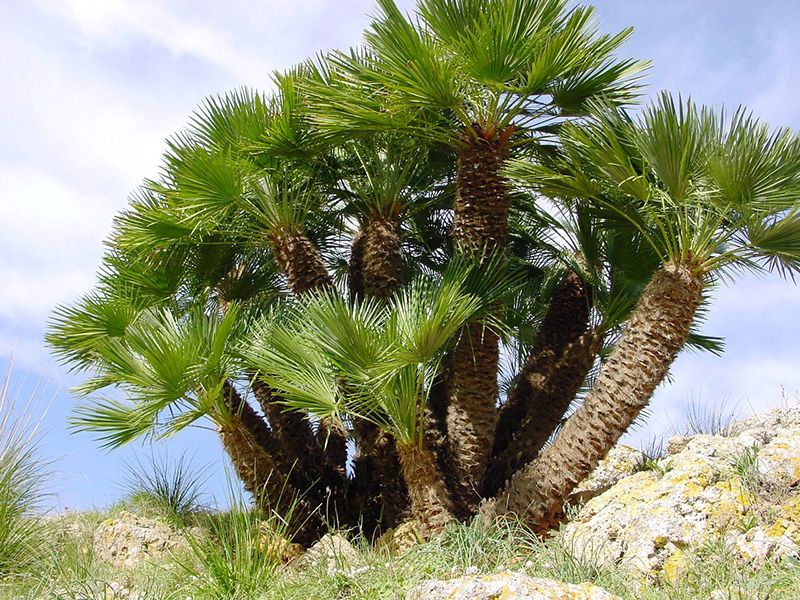
Description of Chamaerops
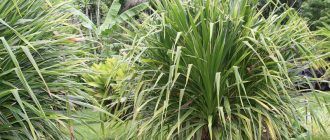
The palm tree has one species, Chamaerops scaly-leaved. It is a shrub reaching 4-5 m in height and 35 cm in width. The tree has a long rhizome and several trunks growing from a single base, arranged close together and covered in fibers.
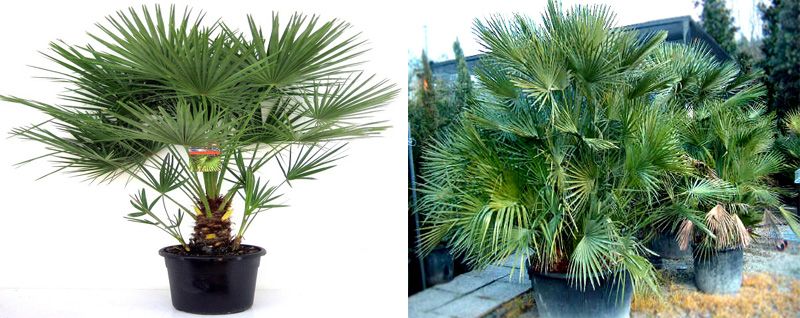
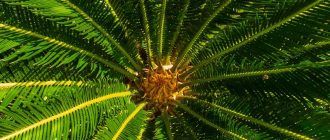
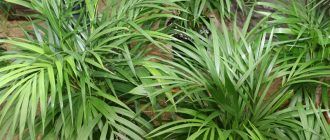
The palm has a lush crown. A single basal stem bears 10-20 1.5-meter-long leaf blades with parallel veining and covered in spines.
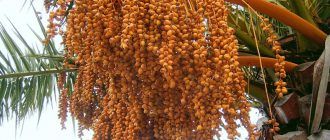
A single stem bears 1-5 inflorescences. The yellow buds are dioecious (less commonly monoecious). Female flowers are smaller, while male flowers are larger. Flowering lasts from the first month of spring until the end of June. After this, the yellowish or dark red fruit develops, fully ripening in October.
Caring for a Chamaerops at home
Caring for a palm tree at home is typical for a shrub with a subtropical climate:
| Parameter | Spring/summer | Autumn/Winter |
| Location | For three to four days after purchase, the plant should be kept in a bright, high-humidity room to acclimatize. After this, it can be acclimated to its permanent location by leaving it there for a few hours. | |
| Lighting | The palm is shade-tolerant but thrives in bright light. It thrives in fresh air, so it should be placed on a balcony or terrace. It is UV-resistant and requires protection from drafts. | The lighting is bright. Artificial lighting is required. The room is cool. |
| Temperature | +23…+25 ºС | +6…+10 ºС. |
| Watering | Abundant, produced when the top layer of soil dries out. | Moderate, the lower the temperature and light level, the less often you need to water. |
| Humidity | High (from 65%). Daily spraying with warm, settled water. | Every month the foliage is wiped with a damp cloth. |
| Top dressing | When grown outdoors, feed with mineral fertilizers (containing nitrogen, potassium, etc.) once every seven days according to the instructions on the package. When grown indoors, feed once every two weeks. | Not fertilized. |
Transplantation, soil
The planting substrate is light, nutritious, and balanced. For young trees, use a mixture of humus, turf, compost, and sand in equal parts. For mature trees, reduce the amount of compost and add loamy soil. Ready-made palm mixes are available at the store.
Repotting doesn't need to be done annually. It's done when the root system becomes cramped in the old pot.
The Chamaerops rhizome is very fragile and easily damaged. This can cause the shrub to become diseased, lose its decorative appeal, and even die. If repotting is necessary, it should be done by transshipment, preferably in the spring, but can also be done in the summer after flowering.
Reproduction
The palm produces side shoots that are unsuitable for propagation. Seeds are used for propagation. They are planted in soil to a depth of 1-2 cm, covered with moss, and kept at a temperature of 25 to 30 °C. Seedlings appear after 8-12 weeks.
Diseases and pests
The tree may be affected by the following diseases:
| Name | Description of the lesion |
| Root mealybug | The plant stops growing. The leaves turn yellow and wither. |
| Spider mite | The leaves curl into tubes and wilt. White patches and a fine web appear on the greenery. |
| Whitefly | Insects can be seen on greenery with the naked eye. |
| Scale insect | The pests live on the underside of the leaf. When infected, the surface of the leaf becomes covered with yellow spots. |
To combat diseases, remove affected leaves and roots with a knife. Pest control products (Karbofos, Aktara, and other insecticides) are available at the store.
Problems with growing Chamaerops
When errors occur in cultivation, problems arise that can be resolved by adjusting the content.
| Problem | Cause |
| The leaves wither, their tips turn brown and dry out. | Insufficient humidity. |
| Brown spots on greenery. |
|
| Brown leaves. | Over-watering of the soil, water stagnation. |
| The greenery turns yellow. | Irregular watering. |