Hatiora, a member of the cactus family, is native to eastern Brazil. It is a small shrub, no more than 40 centimeters tall, but can grow up to 1 meter in the wild in its native habitat. Its distinctive structure is characterized by branches originating from the very top of the shoots and arranged in a whorl—a group at the same height.
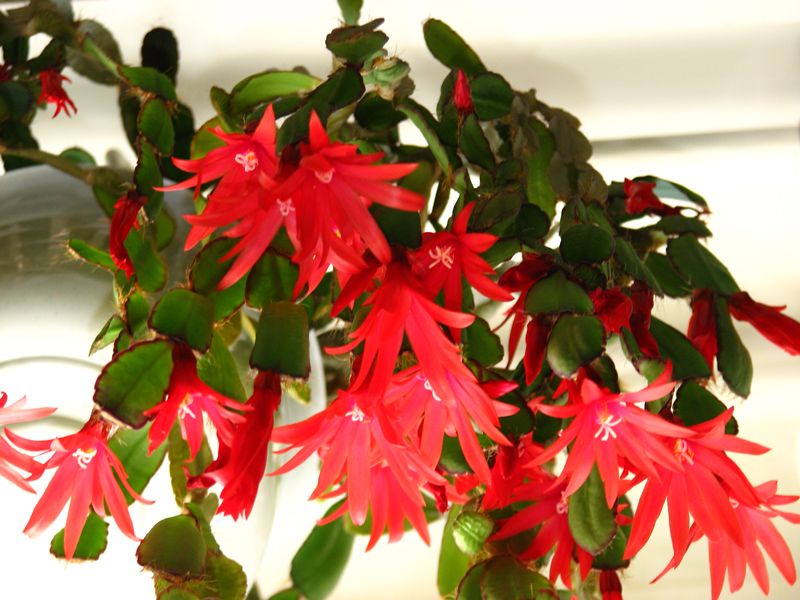
Hatiora gets its name from an anagram of the surname of the English mathematician Thomas Harriot, who mapped the flora of South America. Several varieties of this plant are known for indoor gardening today.
Content
Description
Hatiora possesses an unusually exotic appearance for our latitudes: it can be mistaken for a shrub, a herbaceous plant, and a beautiful flower with vibrant blooms all at once. It consists entirely of leafless branches, either slightly drooping or standing erect. The bare stem eventually transforms into a woody trunk.
The lack of foliage is more than compensated for by the funnel-shaped flowers that appear along the entire length of the stem shoots and their extraordinary beauty of color: pink-purple, yellow, red.
In its natural habitat, Hatiora can grow on tree bark (epiphytic forms) or in rock crevices (lithophytic forms). Indoors, this succulent makes a decorative potted plant with small spines on the lateral areoles.
Types of Hatiora
There are several varieties and hybrids of Hatiora suitable for growing indoors.
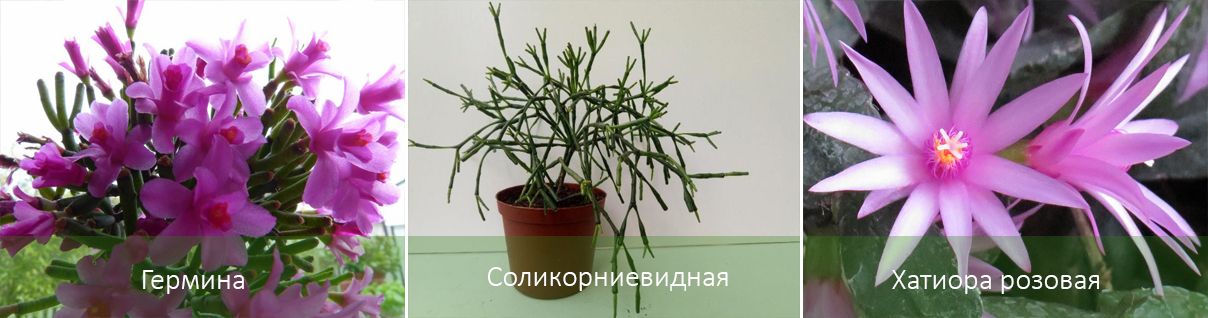
| View | Description |
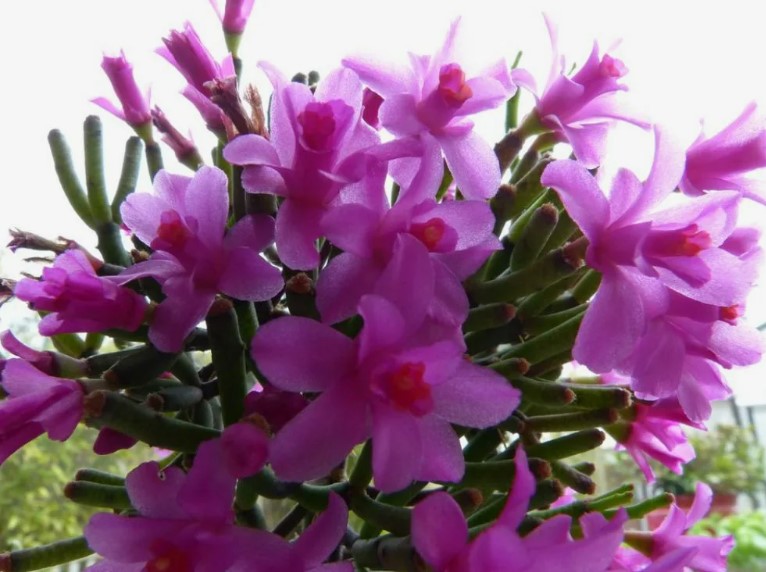
| Hatiora Hermina (Hariota herminiae lat.)
|
A stem or epiphytic plant with straight or slightly curved shoots no more than 30 cm tall. Its internal stroma is dense and elastic, the cylindrical shoots are approximately 50 mm long, and the lateral buds of the areole are covered with spines and scattered along its entire length. The medium-sized flowers, up to 3 cm in diameter, are a vibrant lilac-pink color. |
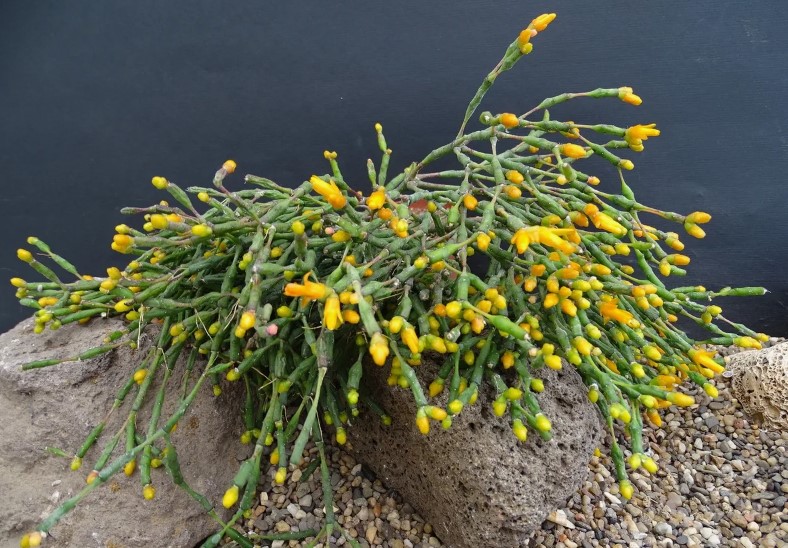
| Hatiora salicornioides or saltwort (Hariota salicornioides Haw.)
|
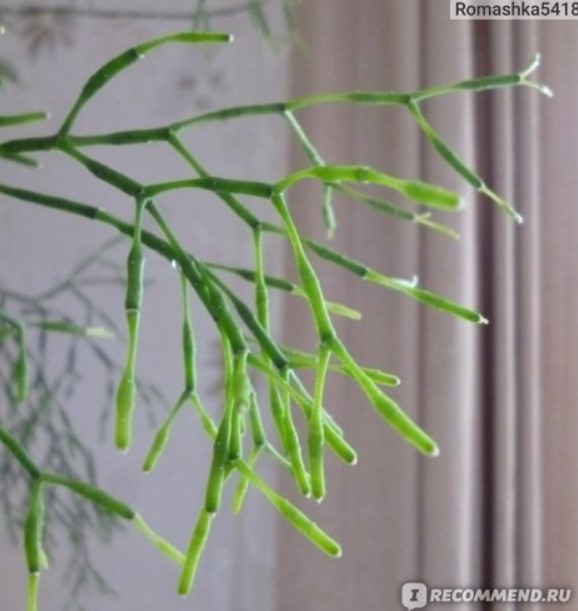
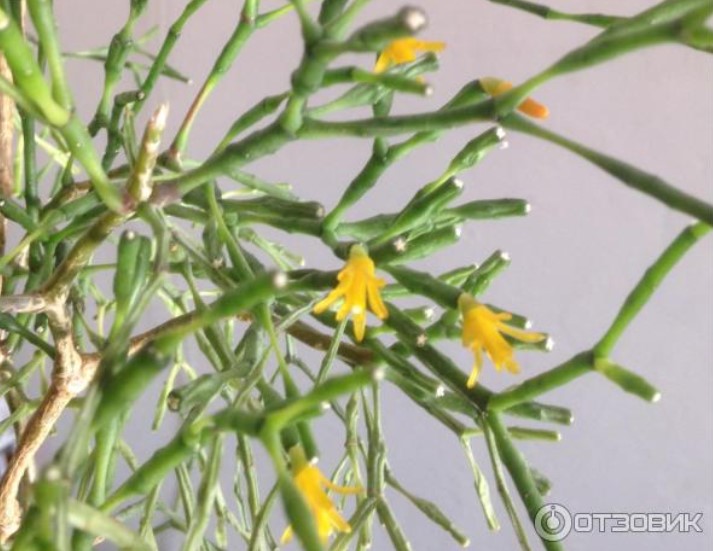
A classic plant species. It has many common names, including "dancing bones," "drunkard," and "little wine glass," all based on its structural features. The shoots consist of small (2-3 cm long) club-shaped or saltwort-shaped segments 0.5 cm thick. The plant's shape is slightly jagged. In the first phase of development, the stem shoots are erect, but as they mature, they droop. The rootstock gradually becomes woody. Salsola-like Hatiora blooms with small (0.3-1 cm) yellow and orange flowers. The flowering period lasts two months. |
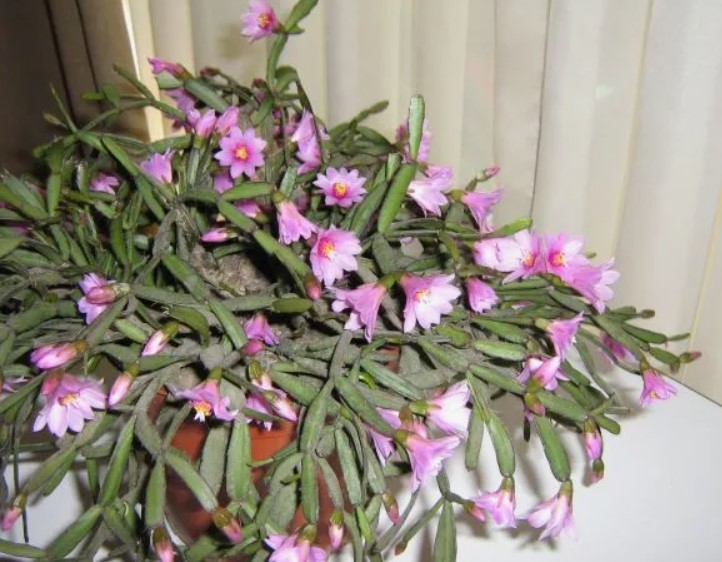
| Hatiora rosea (Hariota rosea Lat.)
|
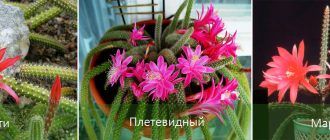
A compact bush of small, flattened, faceted segments measuring 2.5 x 1 cm, edged with reddish festoons. Its branches are a rich, dark green and drooping. The flowers are bright pink, large, over 3.5 cm, and bloom at the apex and at the joints—one of the distinctive features of the Rhipsalidopsis Hatiora. |
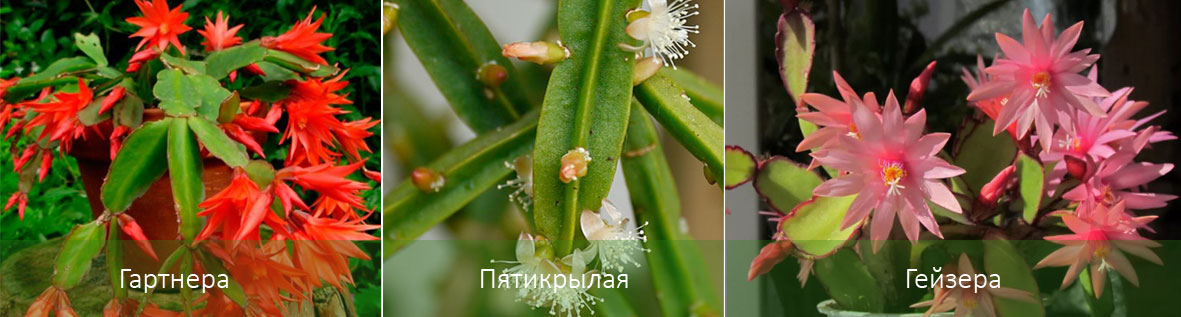
Hatiora gaertneri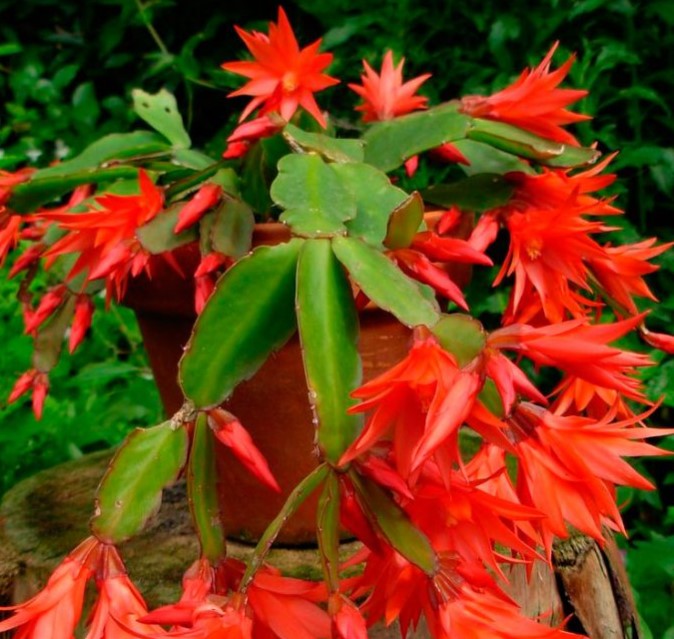 |
The bush consists of 7cm long segments, the flowers are scarlet, about 5cm long, funnel-shaped. |
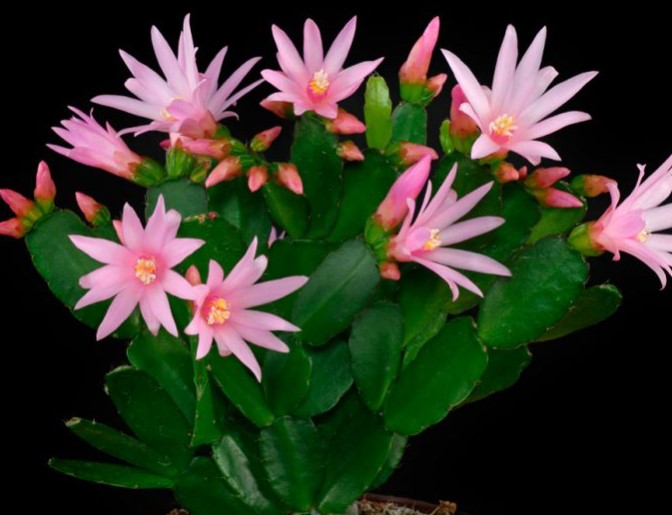
| Hatiora graeseri
|
A hybrid created from two species of Hatiora rosea and Hatiora gartneri. Flower color varies. |
Hatiora pentaptera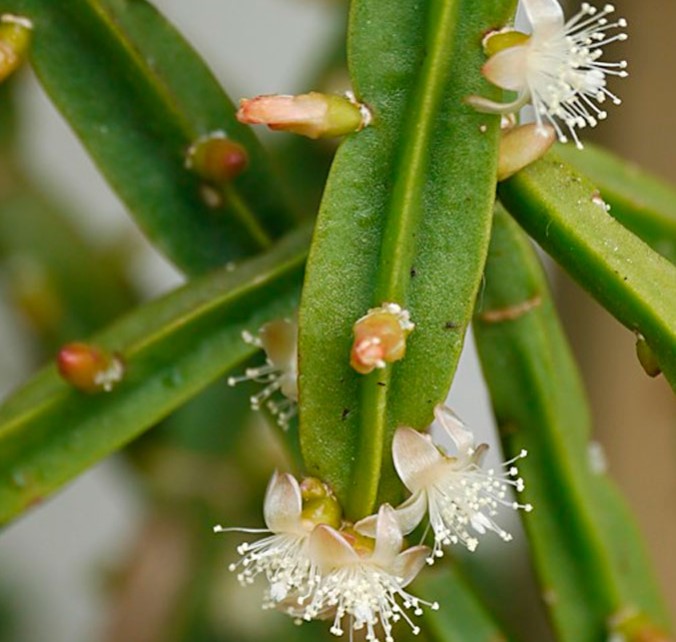 |
A bush with pentagonal shoots and small white flowers. |
Features and care instructions
Caring for and maintaining a Hatiora at home is not difficult. The main requirement for its growth is sufficient space in the pot or container. Therefore, as the plant matures, it will require more space.
The growing segments of the cactus are delicate and fragile, requiring additional support over time.
Location and lighting
For optimal growth, the plant requires warm, well-lit windows facing east or west. Hatiora does not tolerate direct sunlight, as this negatively impacts its growth and flower color. On hot south-facing windows, the plant should be shaded during the midday heat.
Temperature
The optimal growing temperature for Hatiora is considered to be between 17 and 23°C, regardless of the time of year. During the summer, the plant can be moved to an open terrace or balcony, provided it is protected from direct sunlight.
Air humidity, watering
During the hot summer months, the Hatiora requires regular, thorough watering. However, before watering, make sure the soil in the pot is dry to prevent root rot from overwatering. Watering is best done in the morning or evening.
Watering solution – the water should be settled and at room temperature. Periodic misting with a spray bottle is acceptable.
During the autumn-winter period, the Hatiora flora enters a dormant phase – moderate watering is required at this time.
Soil, fertilizer
Like any houseplant, Hatiora requires additional feeding and growth stimulation. The frequency and composition of fertilizer mixtures depend on the plant's developmental stage:
- During the growth and budding phases, the flower requires nitrogen-based fertilizers. These are applied once every ten days.
- During the flowering period, fertilizing with potassium-containing fertilizers is necessary.
Additionally, cactus plants respond favorably to organic fertilizers such as peat, compost, bone meal, and humus. These are available in specialized stores labeled "for indoor plants."
Hatiora's root system, like that of all cacti, is poorly developed and requires well-drained, pH-neutral, light soil. The soil mixture should include leaf mold or loam, coarse sand, humus, and crushed charcoal (ideally birch).
Transfer
The ideal time for repotting is when flowering has completely faded; the choice depends on the plant's growth rate. Young hatioras are repotted annually in early autumn, after clearing the roots of old soil.
Old flowers are repotted every five years, choosing a spacious but not too deep pot. Properly performed repotting is easily tolerated by Hatiora.
Bloom
Hatiora blooms from late spring until late summer. Growing indoors, it often requires some crown shaping for added decorative appeal.
Reproduction
Hatiora is propagated by stem cuttings and sowing seeds.
- Cuttings are the ideal method. Select a small stem segment, cut it with a sharp knife, and sprinkle the cut area with activated charcoal. After leaving the cutting for three days for certification, it is then shallowly planted in light, moist soil.
- Propagation by seeds is a labor-intensive process requiring compliance with all constant conditions and certain knowledge.
Diseases and pests
If the plant is not properly cared for, it may be attacked by parasitic pests such as:
- spider mite;
- mealybug;
- root mealybug;
- slugs;
- scale insect;
- root nematode.
They are controlled using insecticidal preparations and spraying the plant with garlic infusion (20 g per 1 liter of water).
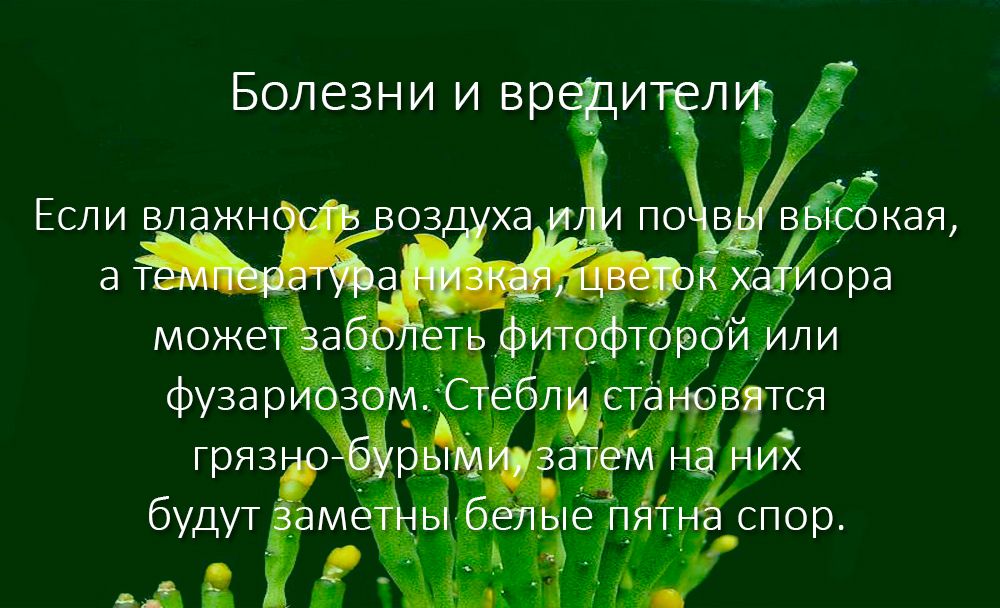
Excessive moisture and non-compliance with temperature conditions lead to fungal diseases:
- Viral spotting.
- Dry or wet rot.
- Late blight.
They are controlled by treating them with fungicides or by destroying parts of the diseased plant.
Top.tomathouse.com warns: Hatiora care difficulties
Hatiora is not a capricious plant, but sometimes certain difficulties arise when growing it:
- poor growth and/or lack of buds are associated with low room temperatures or a lack of nutrients;
- weakening of leaf turgor and root rot are signs of stagnant moisture or drying out of the soil;
- the appearance of light spots means that the plant has been exposed to excessive sunlight;
- falling of flowers and buds - drafts or sudden movement of the plant.
Hatiora – “men’s tears”
Besides its extraordinary beauty, Hatiora has become surrounded by a host of omens and superstitions associated with the personal lives of its owner. It is believed that keeping this plant in the home means a woman will sooner or later be doomed to loneliness, as the flower dislikes the presence of men.
In addition to its mystical properties, people believed that Hatiora was extremely poisonous, although there is no scientific evidence to support this.
Not blooming for a long time, but suddenly covered with buds, it symbolizes renewal and the beginning of change.
Reviews of Hatiora
Review: Houseplant Hatiora - I love Hatiora, I don't know why, it's quite capricious
Advantages: unusual, easy to propagate
Disadvantages: capricious
Sometimes I write unpaid reviews because, firstly, I really want to talk about something, and secondly, nobody has cancelled graphomania.This is a Hatiora—one of my most troublesome but beloved houseplants. Many years ago, I stole a sprig from my daughter's garden when they were painting the windows. That was the first time I saw such a strange plant and fell in love. I thought it must be one of those easy-to-root plants. And it turned out to be—I stuck it in the ground and it sprouted.
I'm fascinated by its unusual structure—it has no leaves, and it looks like it's made up entirely of twigs. But it's actually a cactus. It loves water, but it doesn't like the sun; its twigs dry out right away. So finding a good spot for it is difficult, and you need to water it more often, otherwise it won't forgive you.
I grew a tall tree, and I wanted to shape it into a beautiful crown, but it didn't work out. It's called the "dancing skeleton" for a reason—I had to add a support, otherwise it almost fell over when it was reaching for the light.
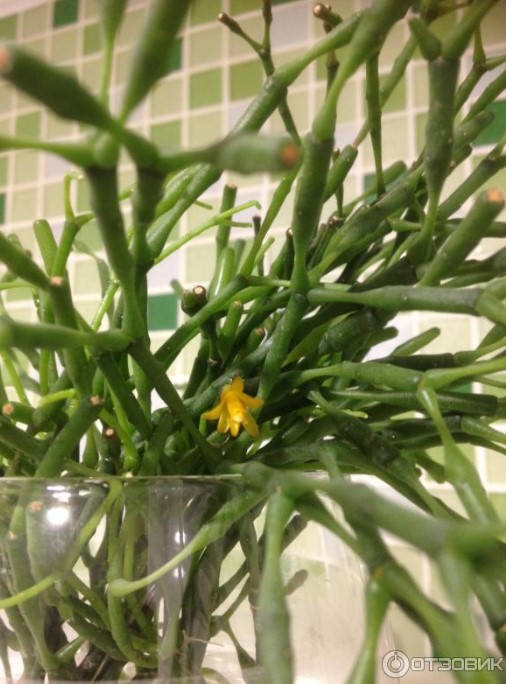
It blooms optimistically in winter and early spring with cheerful yellow stars.
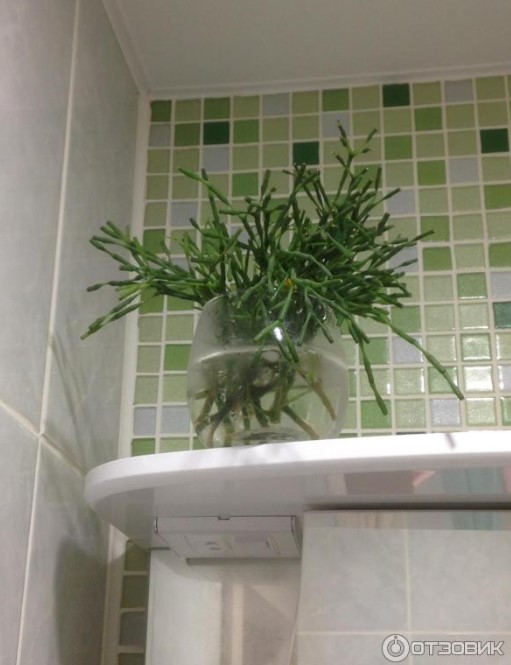
I was cutting it once, and I felt bad about throwing away the trimmings, so I collected them and put them in a glass of water. Now Hatiora even decorates the bathroom.
And it's so lush and green, even trying to bloom. Although there's no daylight there at all, the ceiling is stuffy, and the electricity only comes on when people need it. Sometimes you can't guess what these cacti need.
The use time is many years
Year of manufacture/purchase 2014
Overall impression I love hatiora, I don’t know why, it’s quite capricious
My rating
4
I recommend it to friends YES
A strange cactus for exotic lovers
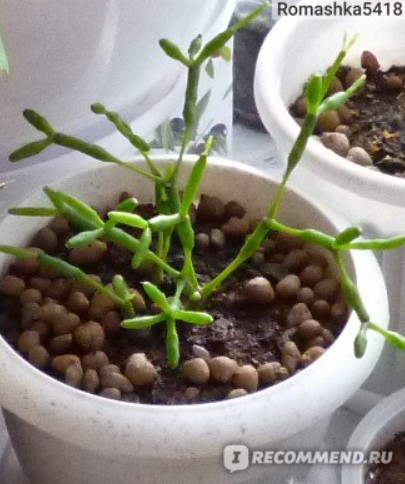
I've been growing houseplants for over 20 years. I prefer succulents. I especially like cacti. The regular, pot-bellied ones with large flowers. A friend, learning about my hobby, gave me a cutting of a plant I'd never seen before.
That same cutting
It had no leaves, only green twigs. They root easily and quickly in any soil. However, a broken twig has a pungent and unpleasant smell.According to botanists, the hatiora is also a cactus. But it's a forest cactus, not a desert cactus, growing in tree canopies, like the well-known Christmas cactus. It blooms in spring with small yellow flowers. It's undemanding when it comes to growing conditions.
Hatiora is easy to care for. During the warmer months, I move the plant from my room to the balcony, keeping it in partial shade, although it tolerates direct sunlight well. I water it 2-3 times a week and mist it occasionally. I feed it once a month with Agricola, a general-purpose indoor plant fertilizer. I repot it every 2-3 years.
The plant loves heat, so when the temperature on the balcony drops below 15 degrees, I take it indoors.
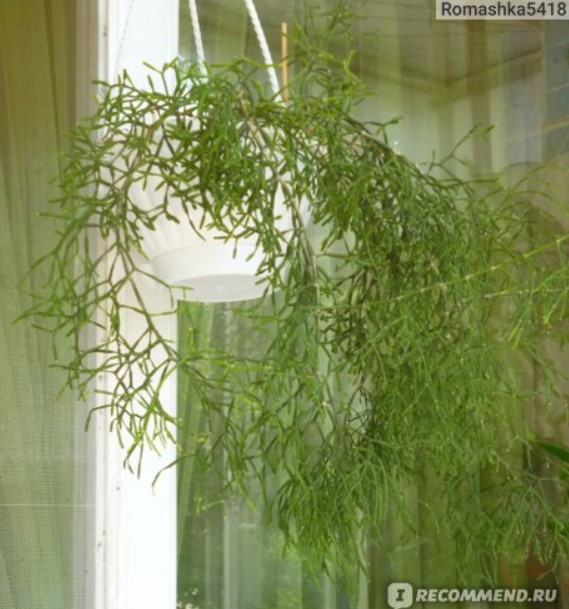
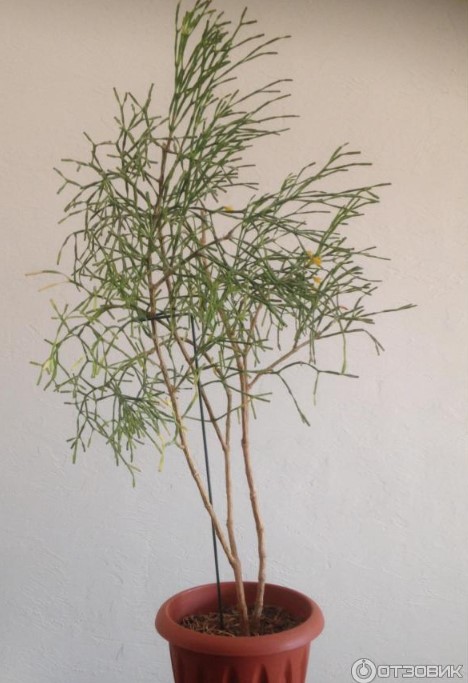
Hatiora grows slowly. It takes 5-6 years for it to form a spreading bush. Unfortunately, the mature plant looks rather unattractive, especially without flowers. And it blooms rarely.
Mature bush
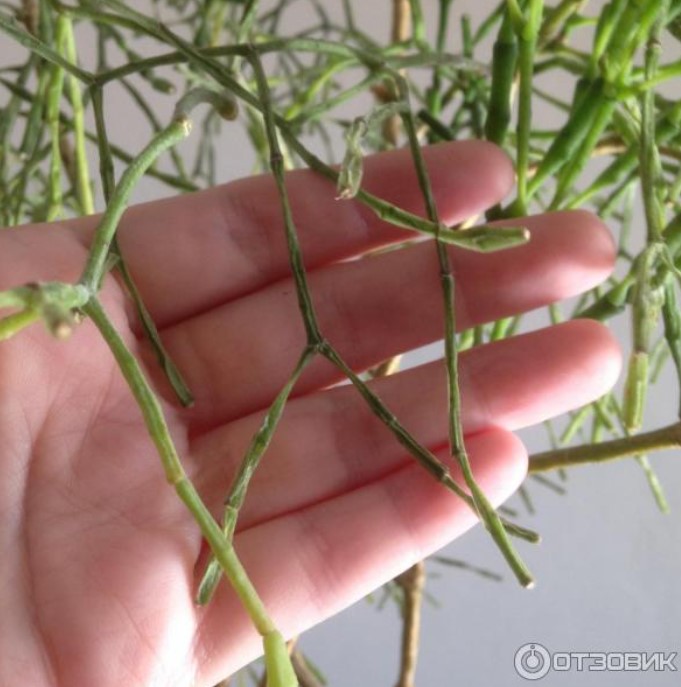
Young plants look more attractive and look good in compositions with other succulents.
Young shoots
Among the easy-to-grow houseplants, you can find much more spectacular and interesting plants. But I'm sorry to throw away the Hatiora. It's been growing for about eight years now.Useful information on growing indoor plants, including cacti, can be found in the magazine "I Love Flowers"
Advantages
Unpretentious
Shade-tolerant
Flaws
Nondescript appearance
Romashka5418
does not recommend