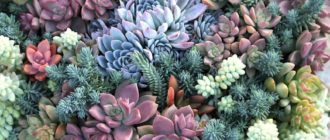
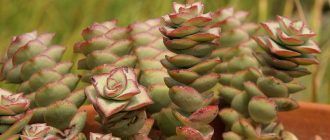
Haworthia is a genus of dwarf succulent plants in the Xanthorrhoeaceae family, subfamily Asphodelaceae. The flower is named after E. Haworth, who discovered it in Africa, its place of origin. Many varieties are also grown indoors.
Description of Haworthia
A miniature plant, reaching 15 cm in height. It grows slowly, but is long-lived: its average lifespan is 20-30 years. Under good conditions, it produces numerous offspring.
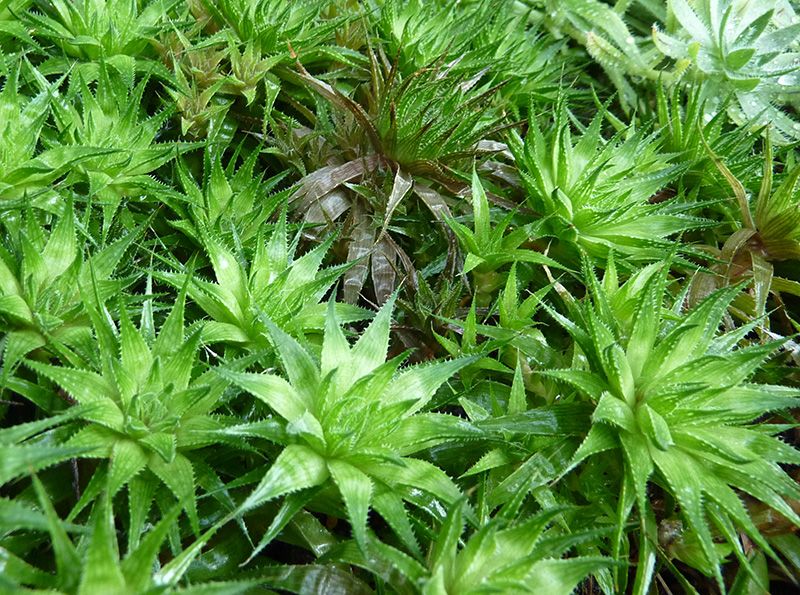
Haworthia has a virtually invisible stem. The leaves are dense and fleshy, arranged in rosettes. They come in a variety of shapes: lanceolate, triangular, oval, and needle-shaped. They also come in a variety of shades: snow-white, blue, brick-red, brown, light green, and dark green. They can have flat or voluminous spots, stripes, and streaks.
Small whitish flowers grow on elongated peduncles. They are gathered into spike-shaped inflorescences. Flowering is rare indoors. And if it does occur, the plant often becomes exhausted and dies. Therefore, as soon as a flower stalk appears, it should be cut off immediately.
Types of Haworthia for indoor cultivation
Many varieties are easy to care for at home. Popular species for indoor cultivation include:
| Name | Leaves | Flowers |
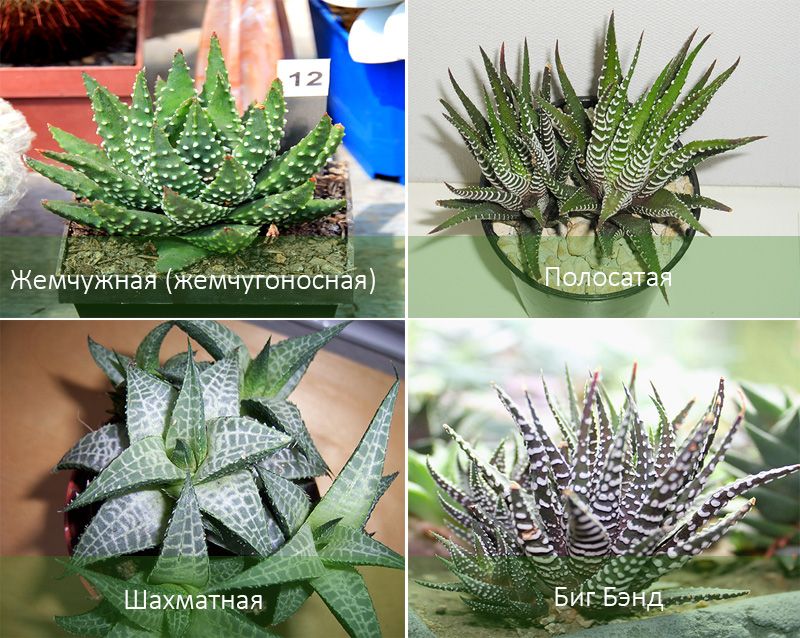
| Pearl (pearl-bearing) | Thick, lanceolate, growing up to 7 cm. Dark green with snow-white growths resembling pearls. | Small, greenish on a 30 cm peduncle. |
| Striped (the most popular variety) | Dark green, hard, up to 10 cm. The outer side is smooth, with growths on the inner area that form stripes. | Small, inconspicuous, on brown peduncles. |
| Chess | Triangular, stemless, up to 3.5 cm, thickened, growing in a spiral. The outer side is flat, the underside is convex. They have a pointed end and serrated sides. Green, with a checkerboard pattern. | Whitish-green, paniculate. |
| Big Band | Linear-pointed, tapered and fleshy, 5-10 cm. Dark green, solid on one side, with inclusions forming stripes on the other. | White, located on a brown peduncle. |
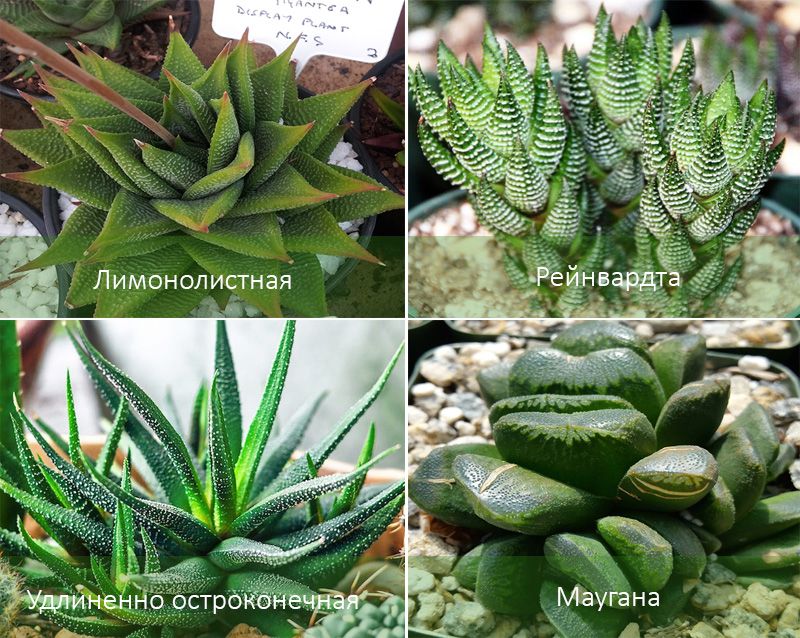
| Lemon-leaved | Hard and compacted, shaped like a wide triangle, dark green or yellow, covered with wavy "warts" on both sides. | Snow-white, small in size. |
| Reinwardt | Small and thick, with teeth, growing vertically. Lanceolate, up to 3.5 cm. There are whitish growths on the inner surface, but few on the outer surface. | Greenish-yellow on an elongated peduncle. |
| Elongated-pointed | Thick and wide, they are arranged in star-shaped rosettes. There are transparent "windows" on the outer side of the plate. | Whitish, unremarkable. |
| Maugana | Cylindrical, growing upwards. All are the same length. | White and green, collected in inflorescences in the form of a brush. |
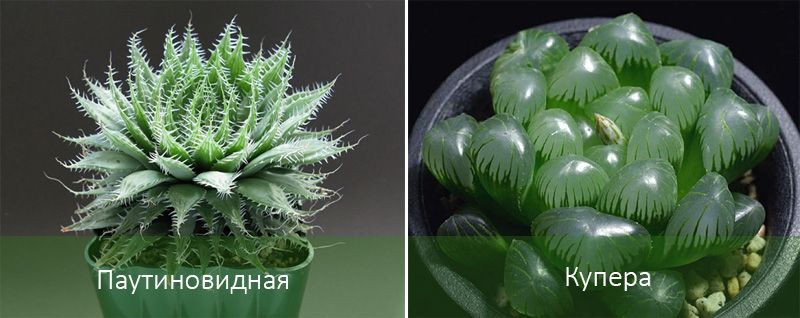
| Arachnoid | Along the contour are branches resembling a web. Sometimes this interweaving is dense, spherical, completely covering the greenery. | Miniature, white. |
| Cooper | Rough, oval, arranged in three rows. | Small in size, light green. |
Caring for Haworthia at Home
In the wild, this variegated desert plant survives droughts without difficulty. It's accustomed to the extreme conditions of South Africa: high temperatures and scorching sun. This should be taken into account when growing it indoors.
Necessary conditions
Requirements for growing at home:
| Factor | What is needed |
| Location | Near a south-facing window. The room needs to be ventilated, but not drafty. In summer, it's best to move the pot to a balcony or terrace. Outdoors, protect it from rain and strong gusts of wind. |
| Lighting | Bright light is essential, especially in winter. Supplemental lighting with fluorescent lamps is recommended. Direct ultraviolet rays adversely affect the foliage's beauty, so shade is essential in summer. |
| Temperature | The optimum temperature is +23…+27 ºС. It can tolerate higher temperatures, but its development stops at them. |
| Air humidity | It doesn't play a significant role. Normal air in the apartment is fine. |
Landing, transplant
Newly purchased plants should not be left in their transport container. The soil in it is not suitable for Haworthia growth. A neutral or slightly acidic succulent substrate is suitable for planting. You can prepare it yourself from sand, peat, leaf mold (2:1:1), or from equal parts clay, sand, and crushed shell rock.
Young plants are repotted once a year. Mature plants are repotted every two or three years if the root system becomes cramped in the old container. When the rhizome begins to rot, repotting is necessary immediately.
The pot should be slightly larger than the previous one. If it's too loose, the root system will develop rapidly, and leaf growth will stop. Furthermore, the soil will begin to acidify. When repotting, you can use the same container, but with new soil. The pot must have drainage holes.
Step by step:
- A drainage layer of expanded clay and broken shards is laid out.
- The roots are inspected; any rotten or dry shoots are removed. The cut area is treated with a fungicide and left for 24 hours.
- Place the bush in the pot, slowly adding the soil. Don't compact the soil, as the root system is very fragile. To distribute the soil evenly, pat the sides of the pot or tap the bottom against the surface. Some small voids in the pot are acceptable.
- The soil around the haworthia is collected in the form of a cone.
- If the rhizome is healthy, water it moderately. If the root system is damaged, avoid watering for a week after repotting.
Step-by-step planting in a terrarium (glass container):
- The vessel is washed and wiped with a napkin soaked in alcohol.
- It is essential to lay out a drainage layer, as the container has no holes.
- Fill the soil with soil and add activated carbon to prevent mold from appearing.
- The roots are cleared of old soil and planted in depressions in the soil.
- Add decorative elements (stones, shells, colored sand, etc.).
- Water the composition with a small amount of water. Wait at least a month before watering again.
- Place the terrarium in a well-lit area with good ventilation.
Methods of reproduction
Haworthia is bred:
- kids;
- cuttings;
- seeds.
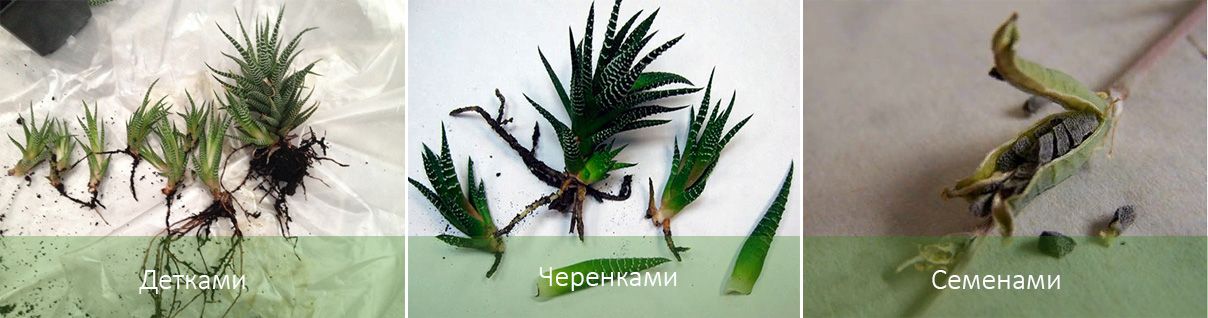
At home, the first method is usually chosen. Haworthia regularly produces daughter rosettes, which root near the mother plant. Separate the daughter rosettes (with a well-developed root system) and plant them separately in the spring.
Propagation by cuttings occurs as follows:
- Carefully cut off the formed leaf at the base.
- The damage is treated with a fungicide or charcoal.
- Leave the cutting to dry for 2 days.
- Plant the cutting in a small container with a sandy mixture. Do not water the soil until the plant takes root.
- Rooting will occur within a month, after which the shoot is transplanted into a permanent pot.
Haworthia is rarely propagated by seed because this method is more complex and less effective. Furthermore, the seedlings do not inherit the varietal characteristics of the mother plant. Propagation by seed proceeds as follows:
- Prepare a shallow container with loose soil or wet sand.
- Distribute the seeds over the surface and press them into the soil.
- Cover the container with polyethylene or a glass jar.
- Place the seedlings in a well-lit room with a temperature of 20 to 25°C. Open the pots regularly for ventilation and remove any condensation from the walls.
- After the first shoots appear, the cover is removed.
- The shoots are transplanted into a permanent pot after 3-4 months or the following spring.
Problems with Haworthia maintenance and ways to solve them
Without proper care, unpleasant symptoms can occur. These can be eliminated by adjusting the following:
| Problem with leaves etc. | Cause | Methods of elimination |
| Flabby to the touch. The plant is stretched out. | Lack of light. | The pot is moved to a well-lit place and fed with any purchased mixture for cacti and succulents. |
| They curl into a spiral and dry out from the ends. | It's cold, perhaps the plant is in a draft. | The pot is moved to another place and protected from drafts. |
| They turn yellow or red. | Excess fertilizer, especially phosphorus-containing mixtures. | The fertilizing regime is being revised. |
| They wrinkle, become covered with brown spots, and darken. | Burn. | Affected leaves are removed. The plant is shaded. |
| Soft, watery, shapeless. | Excessive amount of moisture. | Watering is stopped for 2 weeks. |
| Dark and rotten. |
|
They are moved to a warm place and the amount of watering is reduced. |
| They stretch out, bend, and the pattern blurs. | It's hot in the room. | The pot is moved to a cool room. The room is ventilated more frequently. |
Controlling diseases and pests that attack Haworthia
Haworthia is susceptible to diseases and pests. Here are some preventative and control measures:
| Disease/pest | Signs | Treatment | Preventive measures |
| Gray mold | There are grayish-ash spots on the greenery. The leaves are drooping. |
|
|
| Mealybug | White sticky marks on leaves. The insect can be seen with the naked eye. It's harder to spot on roots. | 2-3 treatments with commercially available Aktara and Confidor products, spaced 5-7 days apart. If root damage occurs, water with the same products. | Spraying with a solution containing an extract of anise, wormwood, cumin, and coriander every week. |
| Thrips | They settle on bushes and in the soil. They can be seen with the naked eye: they resemble dark flies. Traces of their activity: a brown coating with silvery highlights. |
|
|
| Slugs | They attack plants kept outdoors and eat the foliage. |
|
Inspection for insects. |
Benefits of Haworthia
Haworthia is believed to bring positive energy into the home. A potted plant is recommended for the kitchen or work desk. The flower energizes, improves mental abilities, and aids in work. Having it in the room reduces fatigue.
The leaves have antiseptic and bactericidal properties. They are beneficial when applied topically to a cut. This reduces the risk of inflammation and infection, and the injury heals faster.