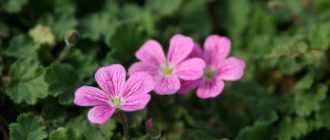
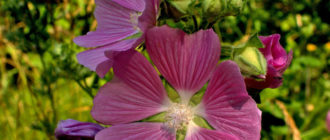
Corydalis is a perennial plant belonging to the poppy family. It is primarily found in northern latitudes. Its theoretical name (from the Greek cons, meaning helmet) derives from the flower's shape. However, the official name, Corydalis, is derived from the name of the crested top, as its shape resembles a bird's crest.
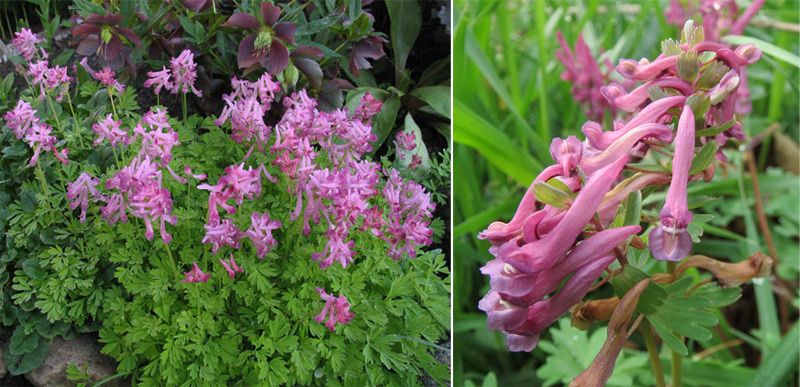
The species has over 200 varieties. A huge diversity is found in China, the Himalayas, Tibet, Siberia, and Upper Asia. Gardeners prefer it for its frost resistance, ornamental beauty, ease of care, and array of beneficial properties.
Content
Main features of the Corydalis
Chinese crested lilies are annuals and perennials. They have active and extensive root systems. The height of their shoots ranges from 0.20 to 0.45 m.
At the base of the stem are up to four fern-like leaves, green with a silvery coating. They can be triangular or round, each with its own petiole.
The formation of cylindrical inflorescences at the tops of the stems occurs in the second half of spring. They bear 5–35 elongated flowers in various shades: red, purple, snow-white, lilac, and gold. The corolla is 1 to 3 cm long, with pointed sepals—small and large apical leaves. Nectar is stored in a long spur, which is collected by long-nosed insects.
The fruit is an elongated capsule containing small, shiny black seeds. They have a growth that ants find attractive, allowing them to transport the seeds over long distances.
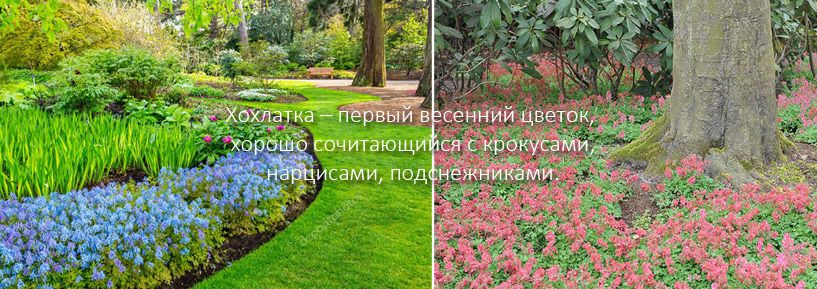
In decorative design, flowers are grown with crocuses, hyacinths, snowdrops and early tulips.
Types and varieties of Corydalis
There are a large number of varieties that cover different parts of the world.
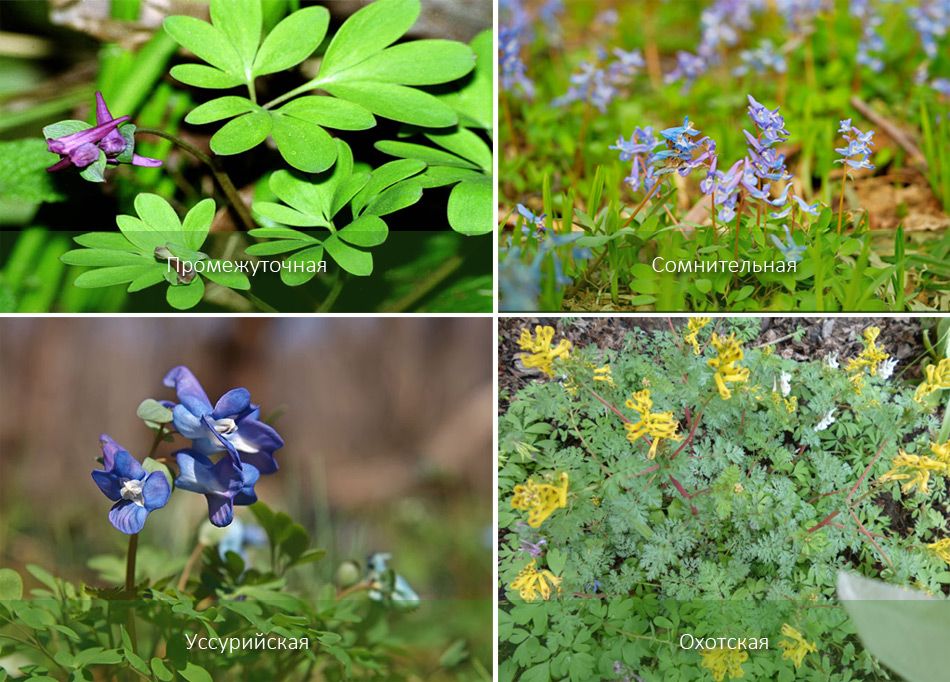
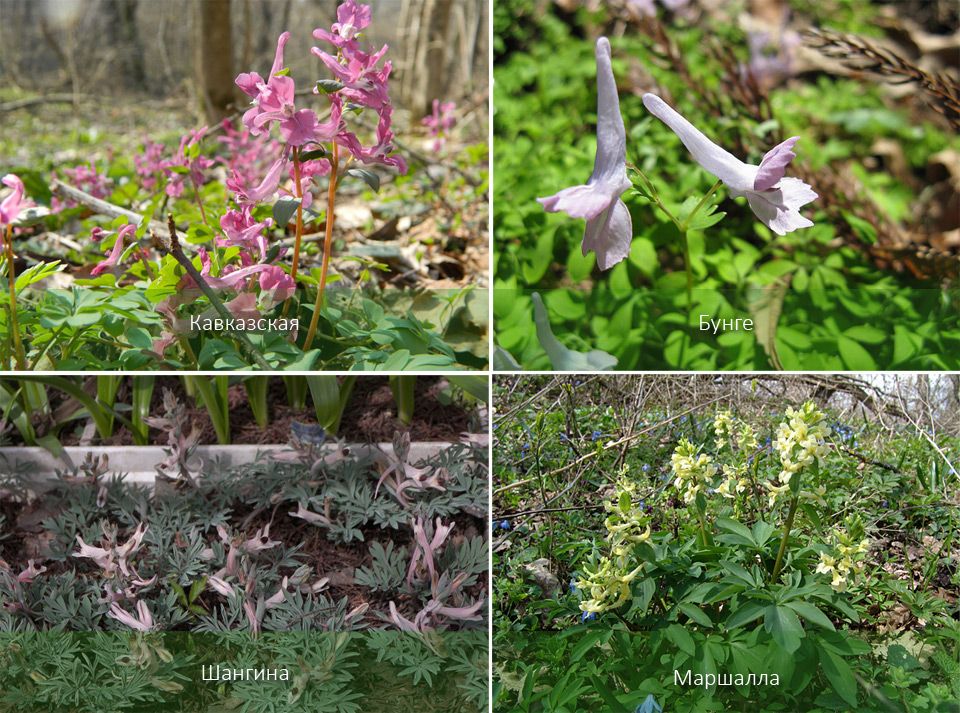
| View | Description | Leaves | Flowers |
| Yellow (lutea) | Winter hardiness. Propagation by sowing. Watering is necessary. Unpretentiousness. |
Green ones.
Triple complex. Pointed. Oval. |
Bright yellow.
Racemose. |
| Hallera (solida)
(dense) |
Southern origin.
Trunk 7-21 cm. The size of the root crop is 9-14 mm. Abundant flowering – May. |
Twice and thrice difficult.
Delicate blue color. |
Dense inflorescences.
Snow-white. Purple. Scarlet. Pink. Purple. |
| Marshall (marschalliana) | East Europe. Perennial. Sprouts 10-25 cm. |
Ternate.
Emerald. |
Pale yellow.
Height – 20 mm. |
| Okhotsk (ochotensis) |
China, Japan and Korea. Height 50-60 m. Weakness of the root. Propagation by self-seeding. Abundant flowering – May, September. Flowering places are forests, rivers, mountains. |
Heart-shaped.
Doubly or triply pinnately dissected. Spherical |
Yellow.
Size – 1.5 cm. |
| Intermediate (intermedia) | Flowering – April – May. Erect shoots. Height – 10-75 cm. |
Tubular.
Pale grey colour. |
Purple rim.
Elongated box. Dark seed. |
| Caucasian (caucasian) |
Early spring.
Height up to 15 cm. The size of the tubers is 2 mm. Blooming May – June. |
Oval. Bright green. |
Lilac-pink.
Size 2-3 cm. |
| Doubtful (ambigua) | Perennial.
The height of the stems is 10-25 cm. |
Pointed.
Ash-gray layer. |
Soft blue. |
| Shangina (schanginii) | Deserts of Kazakhstan. The height of the stems is 30 cm. Tuber diameter is 3 cm. |
Blue tint. | Length – up to 5 cm.
Soft purple color. |
| Kashmiri (cashemeriana) | Himalayas.
The flowering period is late spring. Propagation by daughter tubers or seeds
|
Secondary appearance. | The height of the stalk is 15 cm.
Inflorescence – up to 5 cm. |
| Bunge (bungeana) | Two-year-old spherical.
Height – 50 cm. Thin rod up to 10 cm. Colour – beginning of summer. |
Gray color.
Twice pinnately dissected. Crushed into narrow halves. |
Separated 1.5 cm.
Pinkish-purple color. Seed pods are flat, oval, 2.5 cm. |
| Ussuri (ussuriensis) | Korea.
Elongated stem about 25 cm. The tuber diameter is not less than 2 cm. Blooms in late spring. Valley cedar-broadleaf forests. |
Diamond or oval shape. | Blue.
Pinkish purple. |
Features of growing Corydalis
The flower begins to germinate in early spring, before the snow melts. Flowering occurs when the soil warms to +3… +5°C. The flowering period lasts about 30 days. The seeds ripen in early summer, after which the part of the seedlings above ground gradually dies.
There are species that bloom in summer—the dubious, the cashmere, and the Ussuri. The yellow one delights throughout the warm season.
Planting, replanting and propagation methods of Corydalis
For breeding use:
- seeds;
- tubers;
- division method.
Seed
The seed method is used after harvesting. Seedlings can be observed within 6-7 days. Care must be taken to prevent the soil from drying out.
Tuber
After fruiting has finished, the flowers turn yellow and dry up, and the roots remain deeply embedded in the soil. This period is ideal for replanting. Repotting is done during the dormant stage, but also during the period of active flowering. This should be done carefully, as the slightest damage to the tuber can lead to disease and death of the plant.
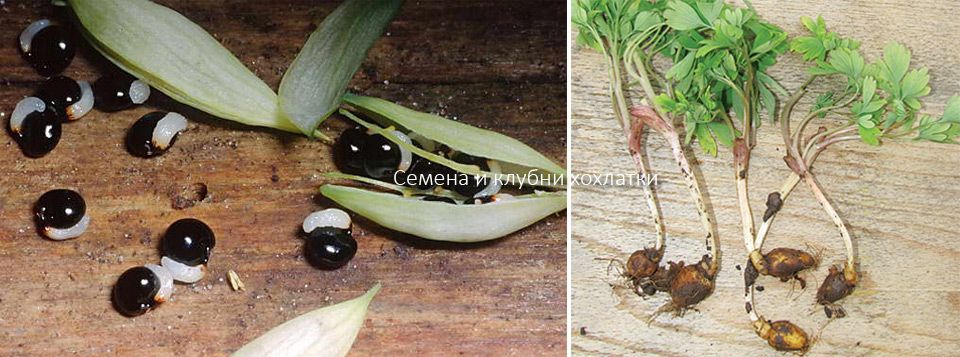
Moreover, damage to the above-ground part will not affect the plant's health. The following varieties are propagated by dividing tubers: Kashmiri and Bushi. They are planted in the ground from June to the end of September. Large ones are buried 8-14 cm deep, and small ones 5-8 cm.
Dividing the bush
In the spring, division is used. It's important to remember that each half must have a bud and rhizome. The separated bushes are moved to a new clearing along with the soil. The dug-up seedlings should have a large lump of soil. Maintain a distance of 10-15 cm between them.
Caring for a Corydalis in the Garden
When growing Chinese Crested Lily, follow certain guidelines. Regular watering, weeding, fertilizing, soil loosening, and pest control are essential.
- Corydalis chinensis prefers fertile, loose (therefore, if necessary, it is mixed with crushed stone), light, sandy loam or loamy soil.
- By nature, it's easy to grow and thrives in sunny or shaded areas. Experienced gardeners choose a planting site with filtered light and no stagnant water.
- It's recommended to ensure proper drainage, as the plant will rot. Natural precipitation and meltwater are sufficient.
- The stems are cut after they are completely dry.
- Does not require winter cover.
Forcing
It's worth noting that only one variety is used for forcing—Corydalis densita. Take large tubers and place them in a pot. Store in a dark place at a temperature of +5…+10°C. Check the container regularly, prevent drying out, and maintain the temperature. Water the plants until the foliage turns yellow. Then place them in a black bag and refrigerate until March.
Diseases and pests
The Crested Tail, although resilient, can be attacked by parasites and infections.
- Virus outbreaks are identified by the presence of spots and growths on the leaves, which may curl the edges. If you notice these symptoms, remove the corydalis immediately to prevent infecting the flowerbed.
- Fungal infection appears as reddish and dark spots. Leaves are cut off and burned, followed by preventative treatment of the plants. Spraying the flowerbed with a fungicide solution is effective.
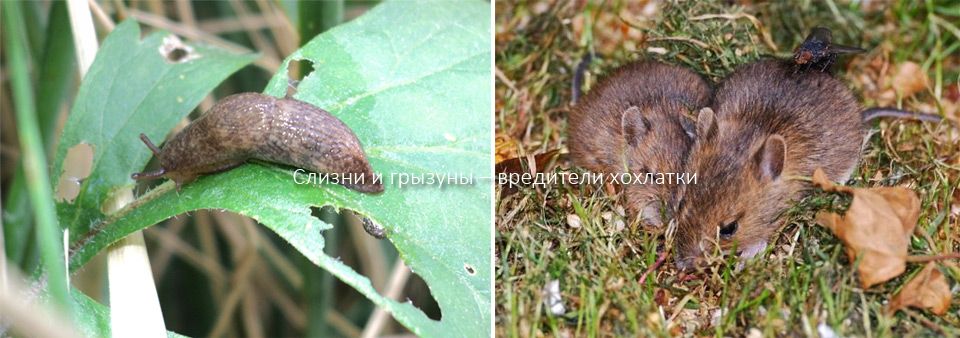
- Rodents are also dangerous. To kill them, prepare poisonous bait and fill their burrows with it. Treat the tubers with ash and dry them.
- Eggshells or lime will help get rid of slugs.
Useful properties of Corydalis
Home remedies enthusiasts rely on folk remedies, and Corydalis is one of them. Little known is that the flower tubers possess powerful medicinal properties. Decoctions, tinctures, and ointments have anti-inflammatory, sedative, antiseptic, and hypnotic effects. They are used for gastrointestinal tract, reproductive and nervous system disorders, arthritis and arthrosis, liver pathologies, and insomnia. The decoction is also useful for treating dermatological and dental conditions, wounds, and burns.
After fruiting, the tubers are cut, dried, and stored in a glass container. The remaining parts of the flower contain harmful substances!
- For rheumatism and diarthrosis, this recipe is effective: pour 100 ml of boiling water over 5 g of tubers and let steep for 40 minutes. Drink three times daily. The course of treatment is 7 days.
- If sleep is disturbed, take 1 teaspoon of powder before bed.
The plant is not recommended for patients with obesity, diabetes and intestinal disorders.
Thus, the tufted flower is becoming a popular ornamental plant and is valued for its frost resistance, early flowering, pleasant scent, ease of care and beautiful flowering every spring.
Three varieties are found in our region: yellow, dense, and Marshallian. It's perfect for designing natural gardens, parks, and wooded areas. It's often used in various landscape projects or for edging garden paths. This beauty is both pleasing to the eye and beneficial to health with its healing properties.