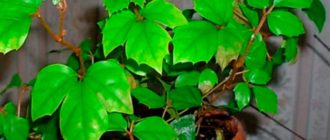
Hoya is an evergreen vine, often called wax ivy. It belongs to the Apocynaceae family.
The plant's main species grow in southeast Asia, China, and India. Several Hoya varieties can be found on the islands between the Pacific and Indian Oceans.
Content
Description
Hoya is an epiphyte flower, so it needs large shrubs or trees for support while growing.
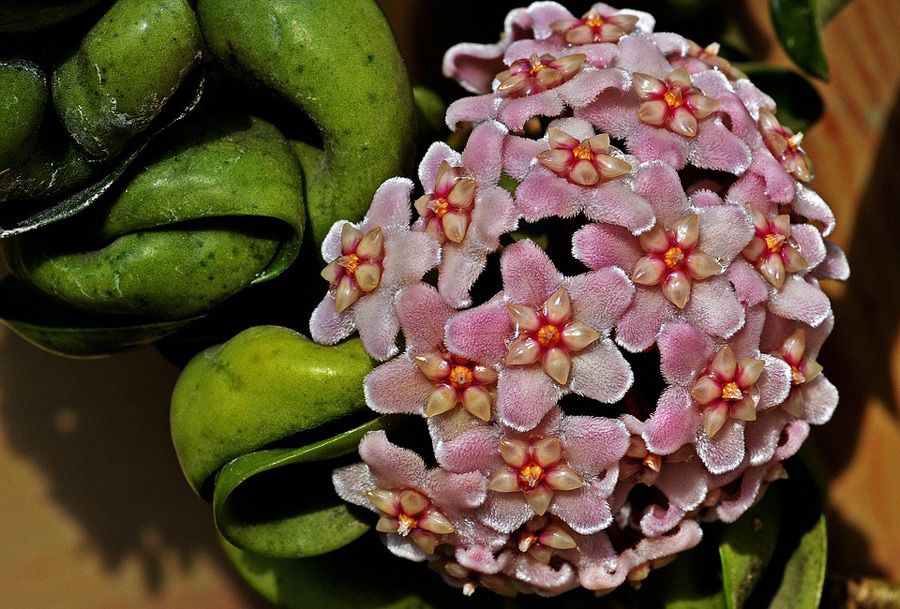
Wax ivy has white or bright pink star-shaped flowers, their diameter is about 15 mm, and the number in the inflorescence is 15-20 pieces.
The dark green leaves are curled into ringlets and firmly positioned on a drooping stem. They reach 5 centimeters in length and 7-10 centimeters in width. The foliage is succulent, dense, and fleshy, a characteristic that has led wax ivy to be classified as a succulent.
Types
There are about 300 varieties of hoya, but only a few of them can be grown indoors.
| View | Description |
| Caudata | Native to Thailand and Malaysia, the flower was first discovered in 1883. It has dense, ovate leaves with a heart-shaped base. The leaves are spotted in varying colors, from pinkish to dark green. The lower part is reddish, while the upper part has silvery speckles. The flowers are small, scentless, and white and red. |
| Silver Splash | The leaf petioles are dense, containing dense fluff that is thinned out as the flower grows. The buds are white and red. The leaves have a reddish tint. |
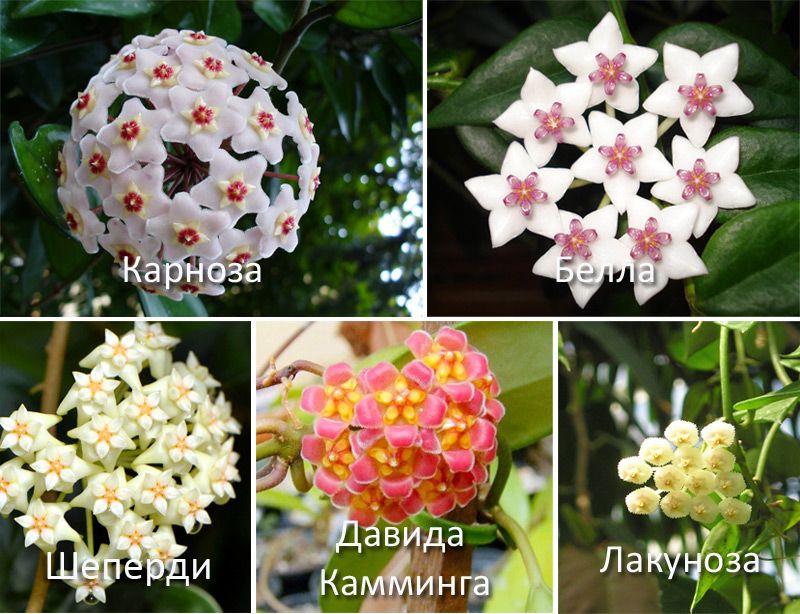
| David Cumming | A rare species of wax ivy. Distinguished from others by its salmon-pink flowers with a bright yellow center. In the evening, it emits a pleasant caramel aroma. The foliage is lanceolate, with barely visible veins. |
| Callistophylla | The leaves are broad and have dark green veins. The flowers are milky yellow, with 18 to 20 flowers per umbel. It emits an unpleasant odor during flowering. |
| Imperialis | The largest variety of wax ivy. Native to the Malay Peninsula. The flowers are dark red with a white center. It emits a pleasant fragrance at dusk. |
| Locky | A native plant to Vietnam, with proper care it can delight with pearlescent flowers year-round. Its scent is reminiscent of chocolate and intensifies in the evening. |
| Lacunosa (concave) | The leaves are dark green, diamond-shaped, with curved edges that form a depression, giving the variety its name. The flowers are clustered in clusters of 15-20, velvety white with a yellow crown in the center. |
| Shepherds | The flowers are pale pink with drooping corollas. The foliage is long and narrow, boat-shaped, with a bright green vein in the center. |
| Carnosa (fleshy) | A vine growing up to 6 meters in length. The leaves are small, oval, but quite dense, with a waxy coating. They are dark green with silvery streaks. The flowers are fragrant, white and pink. |
| Beautiful (Bella) | Bella's shoots constantly droop downwards, and the shrub itself is heavily branched, making it a trailing plant. The leaves are small, ovate-lanceolate, and green. The buds are white, and there are 7-9 umbels. |
Growing Hoya indoors
Caring for this flower at home is straightforward, as the vine doesn't even require annual repotting. Typically, changing the pot every two to three years is sufficient.
Choosing a pot, soil, replanting
Hoya is suitable for growing using the hanging method, so when choosing a container for wax ivy, it is worth giving preference to a cache-pot.
There are two types of soil for plants:
- peat, river sand, humus and turf soil are mixed, everything is taken in equal proportions;
- Combine loamy-turf soil, greenhouse soil and humus in the following ratio: two parts loam and one part of each of the other components.
The plant should be replanted according to the following plan:
- A 40-50 mm thick layer of expanded clay and pebbles is poured onto the bottom of the pot. The mixture is covered with fresh substrate and filled to about ¼ of the pot's capacity.
- If necessary, install supports. However, it's recommended to avoid using bamboo poles, as they often break due to the plant's weight.
- The hoya is watered and then removed from the pot after 30-40 minutes. This should be done as carefully as possible to avoid damaging the root ball.
- The ivy is moved to a new pot, and substrate is added around the edges.
For the first few weeks after replanting, the plant should be watered moderately and protected from direct sunlight.
Watering
Despite the fact that hoya is considered a large tropical plant, it absolutely cannot tolerate excess moisture:
- Most types of wax ivy require moderate watering.
- If the hoya variety has dense leaves, then between waterings, the top layer of soil should dry out by 20-30 mm.
- Hoya varieties with tough but thin leaves need to have the root ball constantly kept moist.
Top dressing
When actively growing and flowering, the plant requires fertilizing twice a month. However, don't overdo it; ivy tolerates a deficiency of nutrients better than an excess.
It is recommended to give preference to mineral fertilizers; they should be diluted slightly more than indicated in the instructions; this will protect the ivy from possible burns.
Pruning, support
Most Hoya varieties grow vertically quite quickly. The stems are initially flexible, but as they grow, they become brittle and easily damaged. Therefore, after planting in the ground, the plant needs support. This can be achieved with wicker arches or bamboo trellises. External support is also possible: mesh, a wooden trellis on a wall, or string stretched nearby.
The most important thing to remember is that it is strictly forbidden to cut off the "stumps" that form in place of fallen flowers. It is on these stumps that buds will form during the next flowering period.
Bushy wax ivy is pinched annually, removing two or three apical buds on each shoot. The first time, this procedure is performed after the fourth leaf has formed.
Different periods: flowering – dormancy
Wax ivy begins to bloom in summer.
To stimulate the flowering process, in May and September, you need to dip the flower in water preheated to thirty degrees for several hours.
After this, the substrate is thoroughly dried. If "bathing" the entire plant, the procedure should be reduced to half an hour.
During the cold season, the plant needs to be given the opportunity to "rest." A slowdown in the vine's growth indicates dormancy. This typically occurs when daylight hours decrease.
In winter, in the storage area of the plant, it is necessary to reduce the temperature, reduce the amount of watering and temporarily stop using fertilizers.
A lack of moisture during the cold season promotes more abundant flowering of hoya.
Reproduction
The plant can be propagated in the following ways:
- cuttings;
- seeds;
- layering.
The most popular propagation method is using cuttings. To successfully propagate a flower, follow these step-by-step instructions:
- In the spring, cuttings (ten centimeters long) are taken from the tips of shoots formed last year. Each cutting should contain 3-4 internodes.
- The stem cut is treated with Zircon, Epin or any other phytohormone.
- The plant pot is filled with a mixture of sand and peat, and then moistened.
- The cuttings are placed deep into the soil and then carefully compacted to avoid any voids.
- The seedlings are covered with a bag, jar or film.
- The plant is placed in a warm and bright place, the temperature should be +18-+24 degrees.
- The planting material is regularly moistened and ventilated.
- After the first leaves appear, the cuttings are transplanted into small pots or planters.
To propagate by layering, follow these steps:
- On several shoots in the area between the growth points, a small annular cut is made with a blade.
- The cut is wrapped in sphagnum moss, pre-moistened with a biological stimulant solution. The top of the cut is covered with foil or film.
- After the roots have formed, the top of this shoot is cut off, and the flower is moved to a new pot.
To germinate seeds, the following manipulations are performed:
- The strongest seeds are selected and dried for 2-3 months.
- The seeds are planted in a mixture of universal soil and finely chopped sphagnum moss (the components are taken in a 1:1 ratio).
- Similar conditions are created as for growing cuttings.
- Seedlings should appear in about a week. From this point on, keep the soil moist; it should remain slightly damp.
- After the seedlings have formed three or four leaves, they are transplanted.
Errors and their correction
When caring for wax ivy, certain mistakes can be made that require immediate correction.
| Typical mistakes | Cause | Features of correction |
| Formation of yellow spots on leaves. | Exposure to direct sunlight, burns. | In spring and summer the plant needs to be placed in partial shade. |
| Fall of leaves. | Excessive soil moisture can be combined with low air temperatures. | Maintain a watering schedule and allow the soil time to dry out. The lower the room temperature, the less moisture the plant will require. |
| Pale leaves, slow growth of stems. | Lack of useful components. | It is necessary to increase the amount of fertilizer or transplant the plant into more nutritious soil. |
| Wrinkling and death of foliage. | Regular watering with cold water. | The plant needs to be watered with water at a temperature slightly above room temperature. |
| The edges and tips of the leaves dry out. | High temperatures and dry air. | Humidify the air and mist the plant with water (except during the flowering period). During the cold season, keep the plant away from heating appliances. |
Diseases, pests and control measures
There are a number of diseases and pests that most commonly affect wax ivy.
| Disease and pest | Manifestations | Control measures |
| Powdery mildew. | White coating on foliage. Wilting and yellowing of leaves. | — All shoots and leaves affected by the disease are cut off; — The top layer of soil is replaced; — At the initial stages of the disease, the plant is placed in a solution of soda ash; — In severe cases of the disease, fungicides are used – Skor, Topaz. |
| Root rot. | The bases of the shoots darken. A rotten smell develops, and a thin layer of mold forms on the soil. | — All infected shoots are cut off, and the cut sites are sprinkled with activated carbon; — The roots of the plant are placed in a solution of any fungicide for two to three hours. |
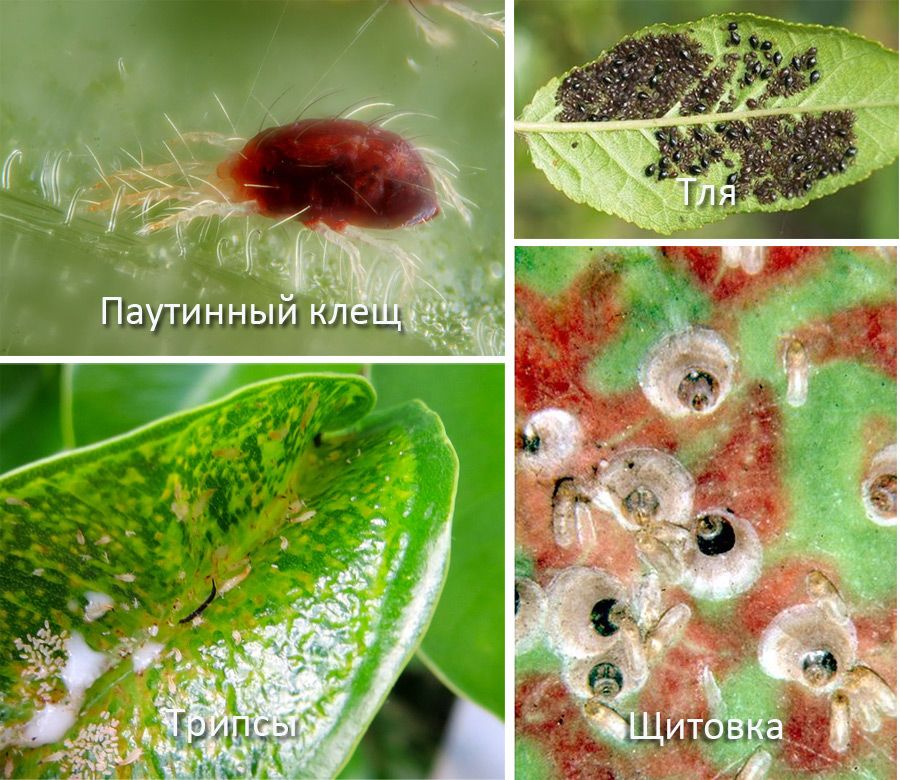
| Scale insect. | Hard, brown bumps form on the leaves, and the surrounding tissue turns reddish-yellow. | — The shells of pests are smeared with kerosene; — The leaves are wiped with a solution based on soap and alcohol; — The flower is washed with warm water and treated with Metaphos. |
| Aphid. | Small yellow-green insects cover the tops of plants. | - Severely damaged shoots are cut off; — The flower is sprayed with an onion or garlic solution several times a day. |
Occasionally the plant may be affected by spider mites.
Signs
There is a superstition that wax ivy can bring bad luck to the home, so not all gardeners dare to grow this plant, despite all its beauty.
Another popular belief exists in Russia. It's believed that the hoya can drive a man out of a house, and that the plant can also discourage suitors from young unmarried women.
Rich people are also not advised to grow the plant, as it foretells losses.