Ipomoea quamoclit belongs to the genus Ipomoea of the Convolvulaceae family. It is considered the best vine for landscaping gardens, vertical structures, and balconies.
Growing is easy, even in apartments, making it suitable for beginners. Ipomoea quamoclit requires little care and grows quickly. Annual varieties also boast rapid growth rates, reaching up to 3 meters in a year.
Content
Types and varieties of Ipomoea quamoclit
There are four species of Ipomoea quamoclit, which are further divided into cultivars. All are used to decorate facades and buildings.
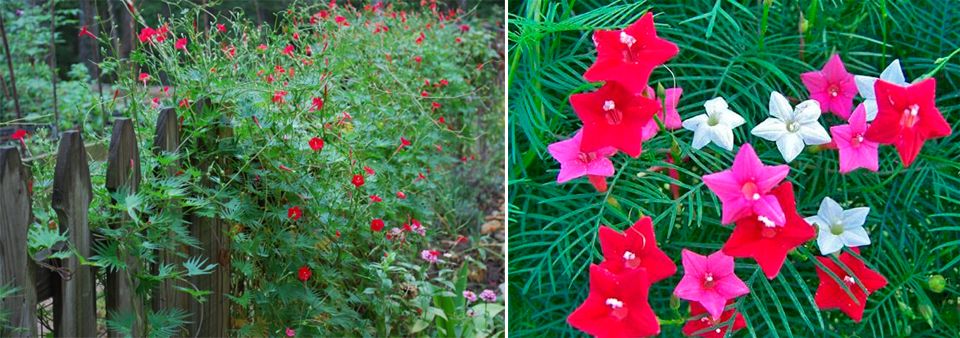
Red
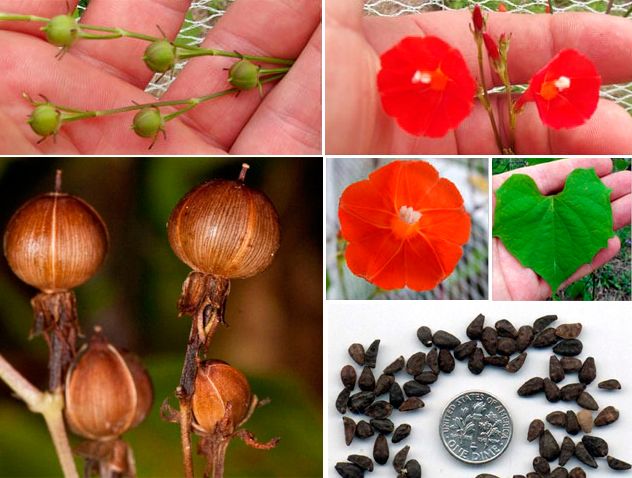
These three-meter-tall vines have dense stems that develop quickly, forming a support structure. The leaves are heart-shaped, approximately 9 cm long. During abundant flowering, buds appear, which open to form stars. This is why this variety of morning glory is popularly known as "quamoclit"—meaning "star-beauty." Five beautiful, fiery-hued petals extend from the corolla. In the wild, there are varieties with a single bud, as well as those with inflorescences containing up to eight. Flowering lasts for about a month.
Bladed
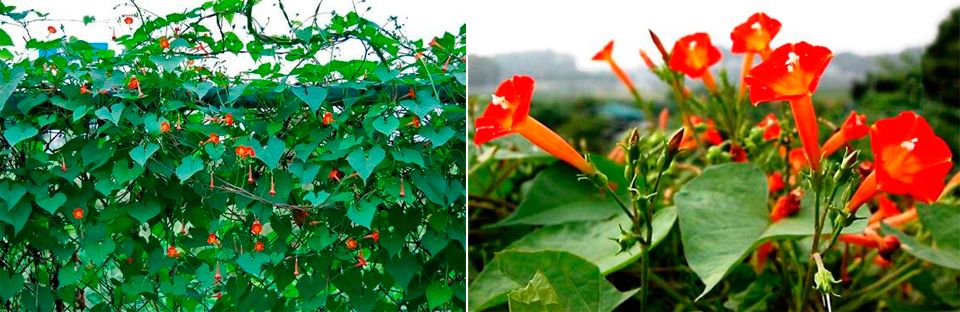
Found in the wild exclusively in the Mexican tropics, it gained popularity due to its rapid, tall growth. It can reach a height of three meters in a year. The leaves are divided into three parts.
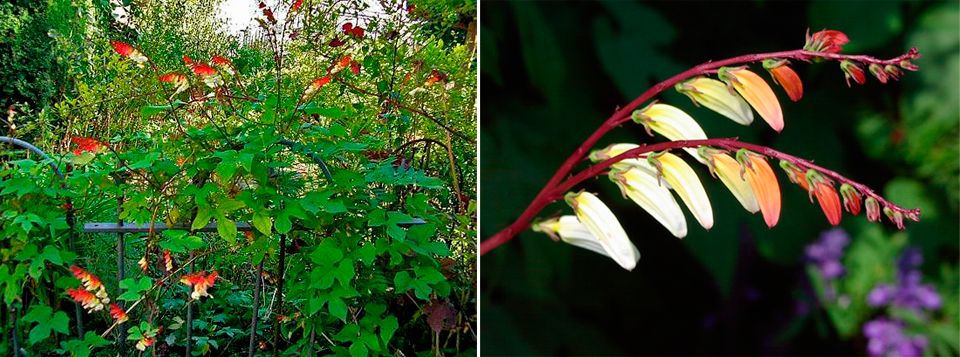
The buds are lobed. The inflorescence can contain flowers of completely different colors. This variety is popularly known as "Fire Flower" for the vibrant, saturated color of its petals. It makes a beautiful addition to a garden.
Cirrus
In the wild, it is found in the tropical forests of South America. It grows up to 5 meters. However, in the CIS countries, due to the climate, this species is grown as an annual, reaching only 3 meters during the flowering season. It gets its name from the unusual shape of its leaves, which are divided into narrow stripes.
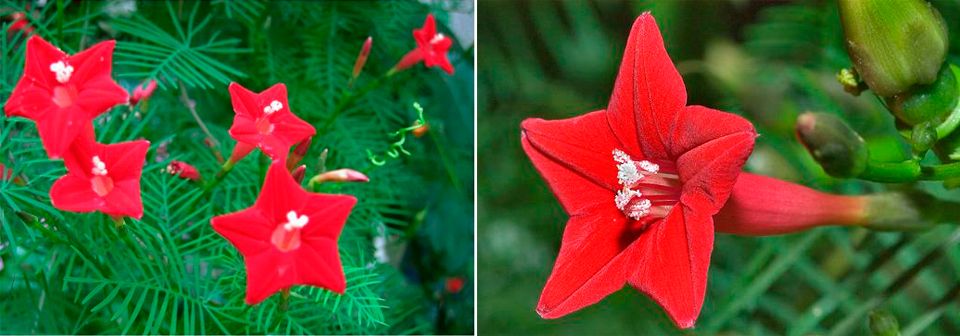
Because of its resemblance to cypress, it is commonly known as the cypress vine or cardinal vine. It begins blooming in August and finishes blooming in October. During this time, flowers measuring 4 by 2 cm appear.
The disadvantage is that it does not tolerate transplantation, so it is better not to propagate this flower using seedlings.
Slaughter
A hybrid of pinnate and red. It has absorbed half the qualities of each donor. For example, it has widely dissected leaves. A single petiole bears up to 7 pairs of filiform lobes.
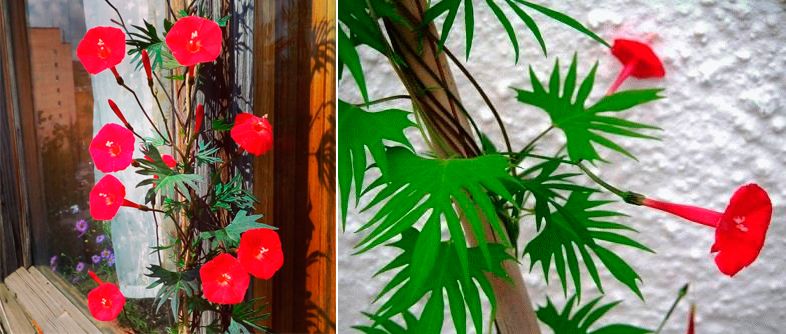
It blooms from midsummer to early fall. The flowers have a yellow-white throat, and the flowers themselves are red or pink. However, although the roots of this hybrid were tall, it is medium-sized, reaching only 1.5 m in height.
Features of planting Ipomoea quamoclit
Native to tropical forests, Ipomoea quamoclit requires specific growing conditions. It can be planted directly into the ground in late spring (mid-April to early May). After sowing, seedlings are visible within 25 days, but the time depends on soil and air temperature. As soon as small sprouts appear, they are thinned out to a plant every 20 cm. As growth increases, they are replanted, leaving 40 cm between vines.
Growing Ipomoea quamoclit from seeds at home
Seed propagation is the most effective for Ipomoea quamoclita. Sow seeds in seedling containers, preferably peat pots (no more than two seeds per container), in March. Immediately before sowing, soak the seeds in warm water for 24 hours. If they haven't swelled after 24 hours, pierce the seed coat and then soak them again. Use neutral or slightly alkaline soil. The soil should be loose.
Next, plant the seeds in the soil to a depth of no more than 1 cm, then water the soil. Cover the seedling containers with plastic wrap to create a greenhouse effect, which will help the seeds germinate quickly. Place them in a well-lit area with a temperature of at least 20°C. Once two leaves appear, transplant the seedlings into individual containers (this will take about two weeks).
It is important to maintain air humidity at around 60-70%. Fertilize only with complex fertilizers.
Planting seedlings in open ground
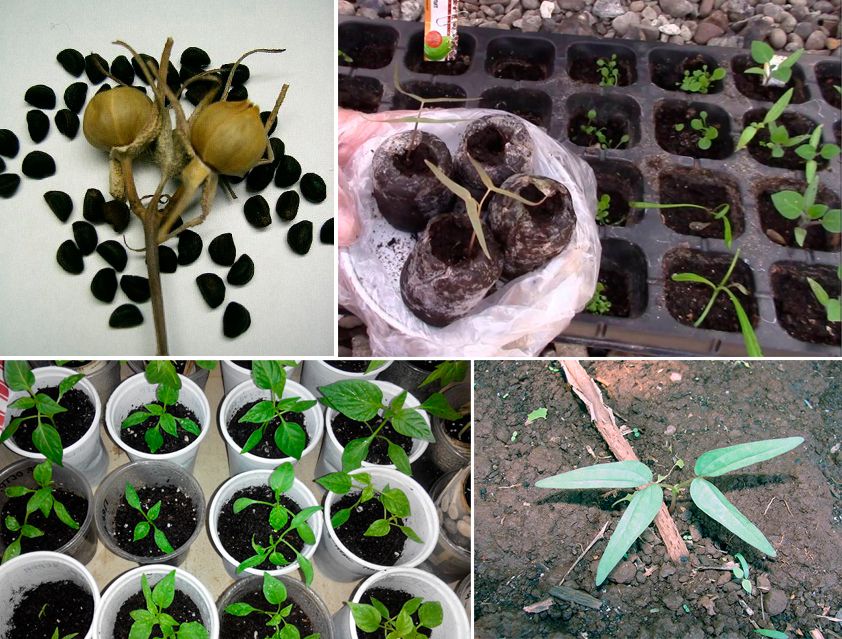
Ipomoea quamoclita seedlings are planted around the end of May, when further frosts are no longer expected. Dig furrows no more than 3 cm deep, and space the seedlings 10 cm apart. Planting quamoclita deeper is not recommended.
Sowing seeds in open ground
This method is recommended for southern regions. However, it is not prohibited in other regions either; the only caveat is that sowing should be done at the end of April. This method promotes late flowering.
In open ground, seeds are planted to a depth of up to 3 cm, unlike when sowing for seedlings. They are then watered with warm water and covered with plastic. The plastic is removed as soon as the first shoots appear.
Due to its growth habit, the plant branches extensively. This should be taken into account when choosing a site. If you want many flowers close together, plant the seeds 20 cm apart.
Caring for Ipomoea Quamoclit
The purpose of the surface roots is to collect moisture from the soil, while the lower roots absorb nutrients. Therefore, watering is recommended every three days, unless there's rain. Each plant should receive at least 1 liter of water. If this isn't possible, mulching is necessary. Straw, seed husks, coconut fiber, sawdust, wood shavings, and paper are all good options.
Morning glory needs to be fertilized frequently. Neglecting this will weaken the plant, cause it to bloom poorly, and produce smaller buds.
Fast-growing vines require staking; this will help keep the plant in good shape and protect the vines from the wind.
Aphids are a problem, but they're easy to control. When they appear, spray the affected areas with cold water once a week. Best results can be achieved by adding a foliar fertilizer.
Top.tomathouse.com recommends: Ipomoea quamoclit placement in the landscape
Before sowing a plant, you need to decide on a location. Each variety has its own characteristics. For example, a feathery vine can grow into a beautiful green pyramid. To achieve this, it requires supports at least 2 meters high, arranged in a circle, and the plants are planted near them. This flower can also be used to conceal visible imperfections in walls. For this purpose, it is planted directly against the wall of the house.
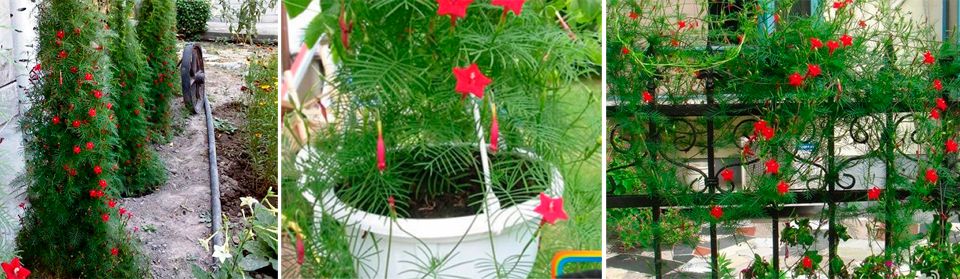
Quamoclits are often used to create shade on a veranda. This provides both pleasant shading and a beautiful view. Furthermore, the vines can be used as a barrier, a fence separating two areas—living and relaxing.
Plots with chain-link fencing are a constant source of intrusion. To avoid this, plant morning glory next to them. As it grows, it will twine around the fence, creating a veritable green wall.