Ipomoea purpurea is a tropical plant that is found in the wild on the continents of South and North America, where it grows as a perennial climbing plant.
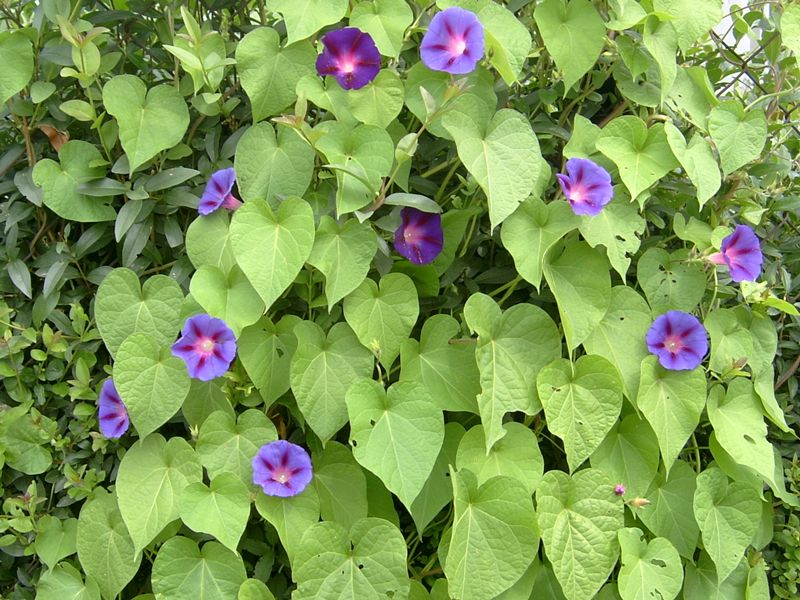
In the Russian latitudes, it is cultivated as an annual plant. Purple morning glory produces numerous buds. Although they bloom for only one day, many more appear after each one. Purple morning glory is popular in landscape design and is grown on balconies and loggias.
Content
Description of the purple morning glory
This flower belongs to the morning glory family, and many poisonous species are found in nature. Breeders have developed harmless cultivars, which offer a striking variety of bud colors. The plant is characterized by rapid growth, quickly filling a space. With proper cultivation, shoots can reach 7 meters in length. On average, the vine grows to 3-4 meters in length. The flower grows until frost, delighting with its continuous blooms.
The branched shoots are pubescent, the leaves reach 18 cm, have a heart-shaped form, and are held on oblong petioles more than 10 cm long.
The bud consists of five fused, thin petals. Flowering begins in June, and each bud lasts only a day. They open in cooler parts of the day and close in bright light. A pollinated bud produces a three-star capsule containing naked, dark seeds up to 7 cm long.
Varieties of purple morning glory
There are over 20 varieties of various colors. It's worth considering the most popular ones.
| Variety | Description of buds | Colors |
| Tall varieties with branches up to 5 m | ||
| Star Waltz, mix | Bell-shaped with a contrasting throat up to 5 cm. | White, pink, blue, light blue, light blue, purple. |
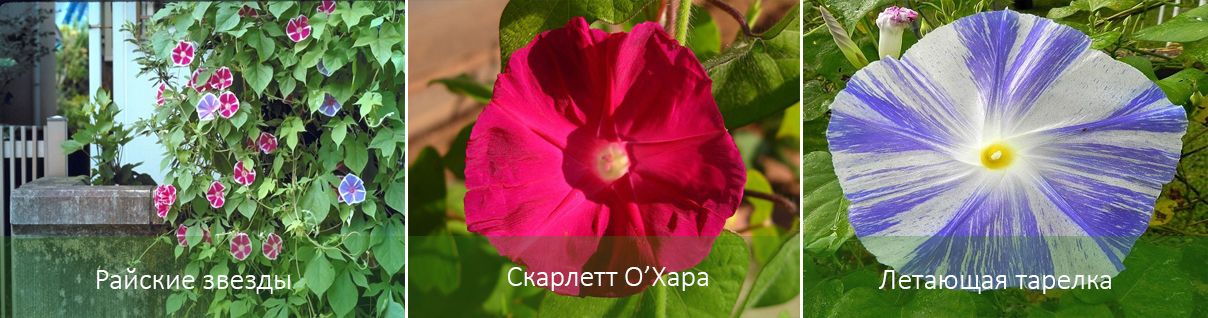
| Stars of Paradise, mix | With rounded, pointed petals, 5–7 cm. | Beige, pink, soft blue, bright blue, purple. |
| Scarlett O'Hara | Bell-shaped with a white throat, 5 cm. | Crimson red. |
| Flying saucer | Monochrome. | Pale blue. |
| Milky Way | Plain with symmetrical coloring, 5–7 cm. | White with bright pink streaks. |
| Medium-sized varieties with branches of 2.5–3 m. | ||
| Ultraviolet | Plain with contrasting throat. | Deep purple. |
| Kiozaki | With corrugated petals, plain and with edging, 5 cm. | White, violet, purple with white border. |
| Starfish | Solid color with a colored stroke in the center of the petal. | White with pink spots. |
| Blue sky | Monochrome with a white throat. | soft blue |

Growing and care rules
This tropical plant prefers sunny, wind-free sites. It grows upwards and requires support. It can be planted from seedlings or directly into the ground. Basic care guidelines include avoiding overfeeding, overcrowding, and overwatering. Regular loosening, weeding, and pruning are required. Loose soil is essential.
Growing from seeds
Before planting, soak the seeds in warm water (25–30°C) and leave for 30 minutes to swell. This will ensure abundant germination.
Sowing seeds
For planting, use deep plastic boxes or pots. White plastic is best, as it absorbs less heat from the sun and prevents the soil from drying out. Drainage is important: place at least 5 cm of drainage material in the bottom of the planting containers. Top with potting mix. Space the holes at least 15 cm apart to prevent the morning glory from crowding each other.
Caring for seedlings
The recommended growth temperature is +20°C. Fertilize every two weeks, and loosen the soil. When the seedlings reach 15 cm, they need to be trained. If planting morning glory outdoors is not possible, support the pots with stakes.
Planting seedlings in open ground
Morning glory is transplanted using the transshipment method. The planting hole is made 5 cm wider and deeper than the container. The distance between the bushes is at least 20 cm. The bushes are immediately tied up.
Planting seeds in open ground
Morning glory is a heat-loving plant. Seeds are sown when the soil warms to 10°C (50°F) and there are no low nighttime temperatures. Planting follows the same pattern as for pots. Place 203 seeds in each hole, and after sprouts emerge, select the strongest clump.
Caring for purple morning glory in open ground
This tropical plant requires regular watering and fertilizing. Outdoors, it's important to monitor the plant, as it's susceptible to fungal diseases. A wilted flower usually falls off on its own, but sometimes it needs to be cut off.
Many varieties are propagated from self-collected seeds, with the exception of hybrids. When frost sets in, the plant dies and is composted if the trunk is free of fungal infections. If the bush becomes very dense, remove excess shoots, leaving two or three stems. The soil should be loosened and mulched periodically. Once the shoot forms a shoot, pinch it back to encourage branching.
Temperature conditions
For normal growth, the temperature should be at least +5°C; at lower temperatures, the plant becomes diseased and may die. Planting is done when the soil warms to +12°C.
Soil and fertilizers
Purple morning glory prefers loose, humus-rich soil. The soil pH should be between 6 and 7.
Growing seeds in a general-purpose soil is recommended. For replanting, mix equal parts of turf soil, compost, and river sand.
Fertilize every two weeks, applying fertilizer during watering. Succulent fertilizers and potassium-phosphorus mineral mixtures are suitable for purple morning glory. If budding is insufficient, treat with biological preparations such as "Ovary," "Rost," and Plantafol. It's important to follow the instructions when applying. Excessive fertilizer can lead to fungal diseases, which can lead to plant death. Excessive nitrogen can reduce the number of flowers, and the bush will develop foliage.
Humidity and watering
Stagnant water is unacceptable. In areas with a high water table, morning glory will not grow without drainage. The roots will rot. In dry areas, watering should be increased during the period of mass gain—early summer. After rain, moisten the soil only when it begins to dry out. Spraying should be done only in the evening, when there is no sunlight.
Diseases and pests
Morning glory is susceptible to fungal infections and plant viruses. The plant should be regularly inspected and treated at the first sign of disease.
| Diseases and pests | Manifestations | Elimination measures |
| Fungal stem rot | Uneven dark brown spots with a clear border. | The plant is removed to avoid damage to neighboring vines. |
| Soft rot | The stem becomes soft. | Sprinkling the soil with wood ash, spraying with fungicides. |
| Root rot | The plant is withering and may die. | Transplantation with removal of the damaged part of the root system. |
| Black rot | Dark spots on the stem sag and exude pinkish juice. | Spray with fungicides at weekly intervals. Affected plant parts are removed. |
| White rust | White spots with moldy coating. | The affected branches are cut out, and the remaining parts of the morning glory are treated with fungicides. |
| Anthracnose, consequences of waterlogging | Dark brown leaf spotting with yellow margins. | The soil is sprinkled with dry phytosporin and loosened. Damaged foliage is removed, and watering is reduced. |
| Spider mite | Webs appear on the underside of the leaf. | Biological insecticides are used: onion or garlic infusion, liquid soap is added to improve the adhesion of the solution. |
| Aphids | They settle on the lower part of the leaf, and light spots appear on the upper plate. | Aphids are carried by ants; they must be controlled using chemical insecticides for garden crops. |
Growing purple morning glory on a balcony
Hobby gardeners without land cultivate the plant on balconies and loggias. Glazing does not interfere with its growth.
Care for seedlings and mature vines is the same as for garden plantings. Pinch shoots promptly and train them toward supports. Fertilize the soil regularly, as it quickly becomes depleted. Add mineral fertilizers at least every two weeks. Water frequently, especially if the balcony is south-facing. Avoid allowing the soil to dry out. Flower buds will remain open longer on south-east and north-facing surfaces.
Top.tomathouse.com informs: problems with growing morning glory on the balcony
Unpleasant surprises await novice gardeners. To avoid them, consider a few morning glory care nuances:
- The plant requires ultraviolet light. In cool, rainy weather, bud rot is possible. Minimize watering, mulch the soil, and provide additional lighting.
- In persistent summer heat, morning glory may lose its leaves and turn yellow. It's best to shade the pots, increase watering, and mist in the evenings.
- It is important to avoid proximity to other crops, morning glory needs nutrients.
Another peculiarity: on a balcony or loggia, the bud must be pollinated with a brush to produce seeds. With self-pollination, only a third of the flowers produce seeds.
Purple morning glory in the landscape
This annual vine can quickly cover a gazebo or fence. During the period of green growth, it requires supports, trellises, twine, wire, and mesh.
Purple morning glory makes a wonderful drape over walls, hiding any imperfections. Plant it near wicker fences in sunny areas. It can cover a gazebo or mesh arch within a month. In cloudy weather, the buds remain open for a long time.
Purple morning glory thrives in large pots, forming a lush bush around a support. A potted purple morning glory can be moved around to suit your landscape. It will enhance any garden. Its lush foliage and abundant blooms will be a true gem in landscape design.
It's used to shade south-facing windows. Another convenient location is a tree trunk; the vine quickly climbs the trunk, twining around the branches, creating fertile shade. An old snag can be used as a support. Morning glory will look good in any corner of the garden.