It's essential to shape the apple tree's crown from the first year after planting. Otherwise, the tree will grow too tall, and the lower branches will become brittle and thin, as they won't receive sufficient nutrients. Proper pruning increases the tree's yield and prevents disease. A well-maintained and beautifully decorated tree will always be a delight to behold in your garden.
When shaping, use pruning shears carefully to avoid stripping the young bark from the trunk; it's very delicate and easily damaged. Otherwise, the apple tree is a very pliable tree; it tolerates pruning well and can be shaped into various forms.
Why is the crown formed and when is it done?
The formation of the "cap" is a very important process that affects the yield of the fruit tree; the branches become stronger, withstand adverse climatic conditions, and do not break off in wind, snow, or rain.
Pruning is necessary to create the correct top shape. This involves leaving strong skeletal branches and pinching out young fruit-bearing branches. It's crucial to do everything correctly, otherwise you could ruin the apple tree.
Many beginning gardeners skip pruning, considering it unnecessary, but this is not true, because:
- A dense, overgrown crown causes branches to break, wounds to appear that don't heal, and the apple tree begins to suffer. Recovery will require considerable effort and time, and some of the harvest will be lost. Gradually, the tree's condition will deteriorate, and it will eventually die.
- Dense and dense foliage causes diseases, which ultimately makes the apples tasteless and unattractive.
- An uncared-for tree produces small, sour fruit. This is because the sugar produced during photosynthesis is used to grow leaves and branches, not apples. The more shoots an apple tree has, the more nutrients are needed to maintain them, and these are insufficient. Eventually, the shoots freeze, weakening the plant as a whole.
- The correct shape will help support the weight of the apples and prevent them from bending under their own weight, as the tree is very brittle after planting and can break under the weight of the fruit and harsh climatic conditions. Pruning can maintain a balance between the strength of the branches and the weight of the fruit.
- Because of the dense foliage, sunlight doesn't reach all the branches, causing the fruit to ripen more slowly and become of poor quality. With good lighting, the fruiting period is reduced by two years, but the apples will remain juicy and tasty, and the plant itself will grow quickly.
- The right shape helps you pick fruit effortlessly at a comfortable height.
If the tree is not looked after for four years, it will become wild, and the fruits will be tasteless, sour and small.
Timing of apple tree pruning
Pruning should be done a year after planting, since by this time the roots of the fruit tree are not yet strong enough and do not provide the entire crown with adequate nutrition.
The shoots should be cut back by one-third. Remove the larger upper branches first, and keep the lower branches to a minimum.
Pruning should be done annually, shortening new shoots by a quarter of their original length. The best time is spring, specifically March and April. It's important not to prune key branches, otherwise the tree won't support its weight. In the fall, you can also begin shaping the crown, helping the tree shed unnecessary weight for the winter.
In spring, pruning should be done before the leaves emerge. If you miss this time, life-giving sap will leak from the cuts, which will take a long time to heal. As a result, the tree will become diseased and possibly die. By choosing the right time to shape the crown, the cuts will dry and heal faster, and all the necessary nutrients will be delivered promptly to all parts of the apple tree.
The best time to rejuvenate an apple tree is in summer, when it begins to dry out. This will require a fairly severe pruning of the branches, by about a quarter of their length. The advantage of pruning is that many new shoots will emerge from the cut areas next year, and this period is also convenient for shaping the branches into the desired direction.
In the fall, gardeners perform extensive pruning to prepare the tree for winter. Branches are cut back to two-thirds their length. The strongest and thickest shoot, considered the "lead shoot," is selected. After this, come the so-called second-order shoots, which begin to develop in the first year of growth, and the third-order shoots, which will begin to bear fruit the following year.
During the first three years, when shaping, it is necessary to carefully monitor the “cap” of the fruit tree; after that, only rejuvenating procedures can be carried out.
Preparing for formation
It's important to choose good pruning tools: pruning shears for thin branches and a saw for thicker ones. Sharpen them before cutting, otherwise you can damage the tree. The health of the apple tree depends on the accuracy, precision, and ease of the cut.
For large cuts over 2 cm, you'll need a special garden varnish. The cuts should be treated with a thin layer, but be careful not to overdo it, otherwise the varnish will run into the bark openings, blocking oxygen supply.
All cuts should be made from the bottom up. They should be made above a developed bud and at a slight angle to prevent water from collecting at the top of the cut.
Before forming the crown of a young tree, it is necessary to determine the approximate ratio of the crown to the roots:
- If a seedling is dug up in the garden, only a portion of its roots, up to 45 cm, is taken. This length will not supply nutrients to the entire crown, so the shoot should be shortened to 35 cm.
- If the seedling has widely spaced branches, it is advisable to cut off all shoots to 45-50 cm from the ground.
Scheme of crown formation of a young apple tree
The crown pruning scheme is based on the correct balance between old branches and new ones that appeared last year. Excess branches are cut off and shaped correctly.
| Method/Analysis | Description | Advantages | Flaws |
| Tiered-discharged | Measure exactly 55 cm from the ground and leave three strong shoots – this is the first tier. The second tier is 60 cm from the ground, but before this, you need to select five of the strongest branches, which are positioned at a fairly wide angle to the trunk. If there are several apple trees in the garden, they should be planted 4 meters apart. | Good tree frame and illumination of all branches due to the large distance between tiers. | It can be difficult for beginning gardeners to determine the correct distance between tiers that will maintain a balance between the upper and lower shoots. |
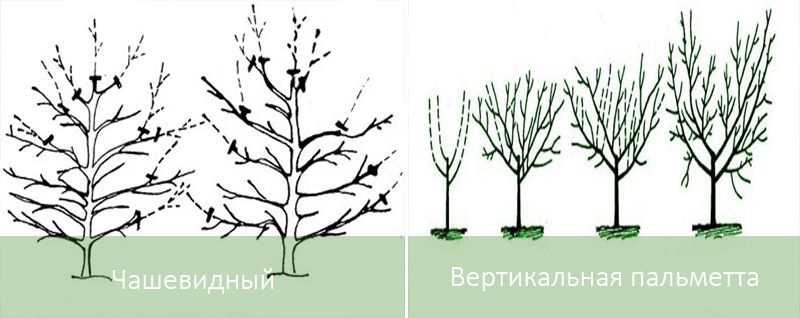
| Cup-shaped | Only three shoots are left on the lower tier and spread out at approximately 120 degrees. Each shoot is cut symmetrically at a distance of 50 cm from the central leader. The leader branch is completely cut off. Shoots growing inside the "cap" are removed over time. | Suitable for low-growing columnar apple trees. | You'll need to constantly monitor the growth of shoots near the center of the crown and remove them promptly. Frequent pruning can lead to disease. |
| Vertical palmette or trellis | First, select the skeletal branches. Then, prune all the lateral and adjacent branches. As the tree grows, remove any branches that don't grow along the selected row. | Crown formation is quite simple. | Frequent pruning can significantly reduce yields. |
| Fusiform | In early autumn, new shoots are bent horizontally using struts. In spring, the main branch is cut back 30-50 cm from the top. This pruning is necessary every year for seven years. It is important to keep the apple tree no taller than 3 m, and horizontal branches no taller than 1.5 m. | The crown will become rounded and fruiting will increase. | Annual work. |
| Creeping | The strongest branches are bent into a horizontal position using guy wires. | During the cold season, you can cover it with a special material or a snow bank; the branches will withstand the weight. | A labor-intensive process. |
| Bushy | Five to six of the strongest branches are left, and the rest are removed. The following year, the shoots are pruned to form a "Christmas tree" structure, cutting all annual shoots to half their length, and the central branch is also shortened. | Due to the low height, it is easy to harvest from the tree. | This method is not suitable for a tree with weakly branched branches. |
| Whorled-tiered | The original apple tree crown shape, refined to optimize light penetration to the leaves. Formation occurs in tiers. Each tier contains four strong branches, with a distance of 1.5 meters between tiers. | High yield. | The tree grows slowly, becomes frost-sensitive and weak. |
| Flat crown | They select two oppositely growing strong and sturdy branches and bend them into a horizontal position, that is, they simply split the “cap” in two. | The crown is evenly and well lit, very high yield. | Constant pruning of young shoots and maintaining the plant height at no more than 2.5 meters. |
The crown at different stages of a tree's life
A fruit tree is formed throughout its life, but there are some differences in the actions in different years.
| Age of the apple tree | Formation |
| Seedling | A one-year-old tree consists of a single, slender trunk. To accelerate the growth of new shoots, the top is pruned to 90 cm above the ground. If the tree has adjacent side branches up to 70 cm long, they are removed. Shoots growing higher are pruned to 3-5 buds. Shoots growing at a very sharp angle are removed or bent horizontally. |
| Actions with the crown in the second year after planting | Two-year-old trees always have adjacent shoots. Leave five strong branches with a wide angle from the trunk. The lower branches should be longer than the upper ones. This will create a rounded crown. |
| Pruning an apple tree aged three to five years | The previously used plan should be continued. It's best not to overdo the pruning during this period, otherwise fruiting will be delayed for a long time. |
| Features of crown care for an adult tree | With age, yields decrease significantly, but it's possible to reshape an old apple tree. It's best to remove all upper branches and shorten the trunk by one-third. Prune all central shoots by three-quarters of their length. This is done in late summer or spring. |
Top.tomathouse.com explains: mistakes in crown formation
A good and proper crown takes several years to develop, and during this time, mistakes can be made. The most common is leaving a stump where the cut was made, which then causes numerous shoots to appear, and the crown begins to thicken considerably.
Also, don't leave a short stump, as it will peel off the bark and expose the trunk as it slides off. This can lead to the development of necrotic disease on the apple tree.
A common mistake is to over-prun the crown, usually due to branches growing too tall above the trunk. This can be corrected by pinching these branches in the summer and then cutting them back completely in the spring, ensuring a strong and reliable shape.
If branches are poorly pruned, the crown diameter increases significantly. A healthy crown has only 5-6 skeletal branches, without shoots, growing toward the trunk.
Gardeners often choose poor quality pruning tools; saws and pruning shears should be inspected and sharpened and cleaned if necessary.
Proper pruning of an apple tree takes a lot of time only in the first 3-4 years, then it is necessary to control the growth of shoots, which is not particularly difficult.
As a rule, even a novice gardener can manage to prune an apple tree, but the crown shape doesn't always turn out as intended. To begin, follow the simplest scheme—tiered pruning. To maintain a good fruit tree yield, it's necessary to constantly monitor the crown's condition.
Be sure to coat the cuts with garden pitch or paint to prevent moss from getting into the cut areas and to prevent small bugs and other pests from occupying the wounds.
Artificial crowns
In some orchards, you can see decoratively shaped apple tree crowns, a technique reminiscent of bonsai. They come in a variety of designs. These artificial forms stimulate the productivity of southern varieties. Apple trees shaped this way bear fruit early. The apples, although small, are very tasty, thanks to their generous exposure to sunlight.
These trees will look beautiful as separate garden features. The flattened shape of apple trees makes a stunning green wall that can be used to define a separate area. Only dwarf trees with ring-shaped fruiting are suitable for this type of crown formation. Pruning should be done seasonally, and a good framework will also be necessary, as the trees will not withstand the elements.
Branches should be removed piecemeal, and any that have protruded from the crown should be pinched, bent back, or tied up. The crown of a "weeping" apple tree looks very beautiful; the "cap" is formed using a "reverse grafting" technique. Three or four scions are carefully grafted, bud-side down, into the center of the rootstock.
In the third year, the plant will begin bearing delicious apples, ensuring a high yield and a beautiful, unique crown. This method can be applied to dwarf apple trees, resulting in a neat appearance with a unique crown that is sure to attract attention.
These trees can be used to decorate a garden plot for beauty purposes, and as a pleasant bonus, they will produce abundant, juicy fruit.
Artificial crown formation is a complex undertaking. Apple trees with such a "hat" will resemble a true work of art. The garden will delight with its beautiful and unusual appearance, yielding delicious, juicy fruit, and beautifying it with its greenery.